
If you target highly regulated European markets, a higher-tier framework is often necessary to support bankability and partner trust. In some emerging markets, lower-friction jurisdictions can be a practical entry point, as long as they align with your risk appetite and payments strategy.
Crypto Gaming Licenses: Best Jurisdictions, Key Requirements, and Compliance Basics
If you have spent more than five minutes in the iGaming world, you have heard the pitch: Get a crypto-friendly license in two weeks and start taking bets immediately. It sounds like the dream for a lean startup. But here is the hard truth I have watched play out in boardrooms from Dubai to Budapest: a founder secures a cheap offshore license, spends a fortune on a slick UI, and then hits a brick wall.
Why? Because no Tier-1 Payment Service Provider (PSP), the companies that actually move your money from A to B, will touch them.
Sure, they have a crypto gaming license, but they are functionally cut off from the global financial system. Their choice of jurisdiction signals such a high level of risk to the banking world that they are effectively locked out.
You shouldn’t care about what looks good on a pitch deck to impress investors on LinkedIn. You should care about bankability. Let’s talk about escaping the “prestige trap” in the crypto gaming world.
Why a Crypto Gaming License is Only Half the Battle
In today’s landscape, there is a stark disconnect between being crypto-friendly and being bankable. While a crypto-friendly gambling license means the regulator permits Bitcoin, being bankable means that major payment service providers like Nuvei or Paysafe will actually trust the business.
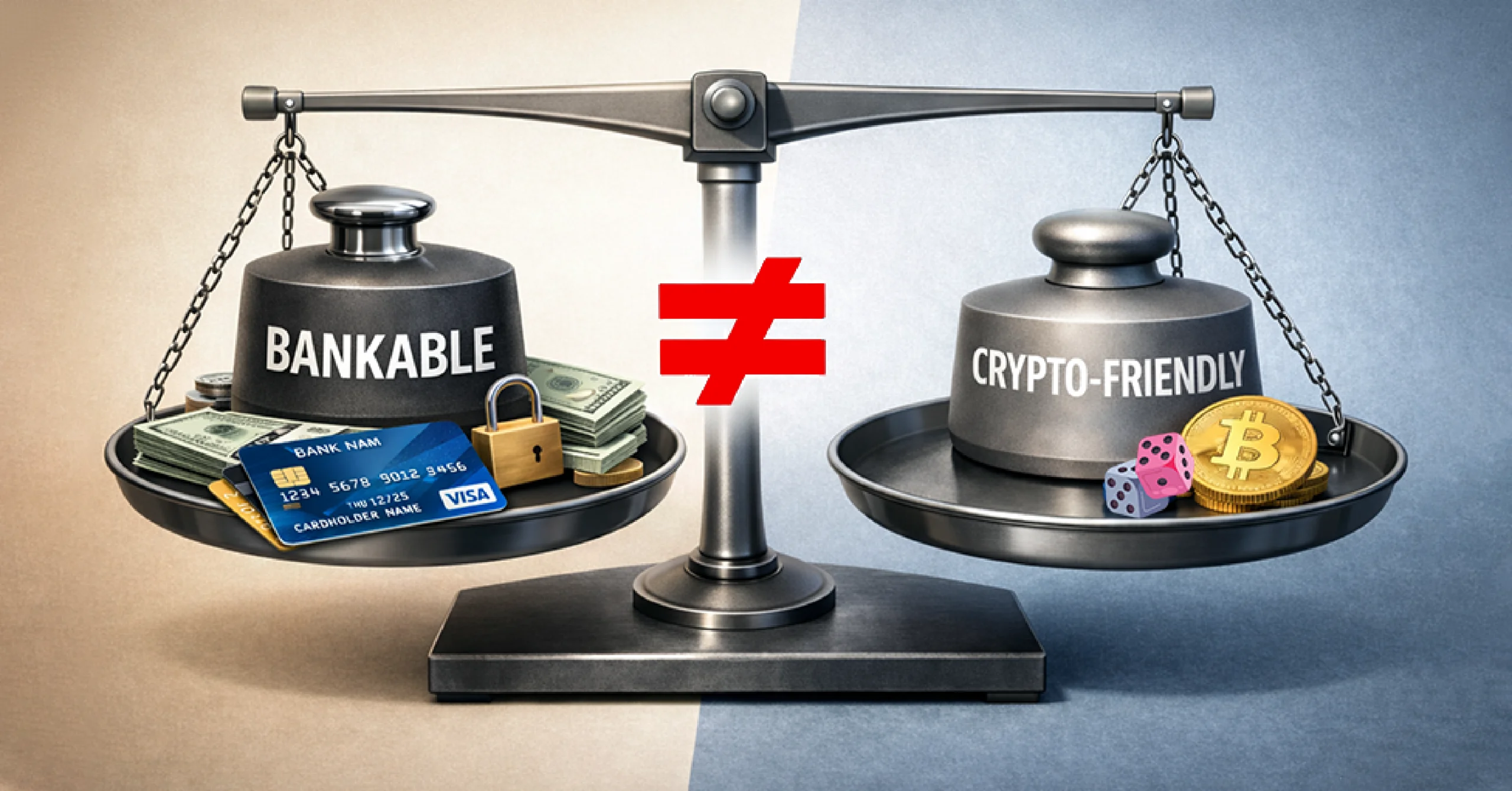
I have seen far too many operators secure a cheap crypto gaming license only to find themselves suffocated by payment friction, because the choice of jurisdiction signals toxic levels of risk to the financial world.
The hard truth is that electronic money institutions, those that are allowed to issue digital money, and traditional banks have their own compliance heads to satisfy. They care more about whether the crypto casino jurisdiction forces monitoring for illegal funds more than about marketing claims.
We saw this with Tobique: top-tier processors would not even take a meeting until the regulator proved the ability to enforce geofencing, the technology used to block players from restricted zones like the United States or Russia. If the operator cannot prove the blocking of prohibited traffic, the partner becomes a liability.
After all, reputation dictates profit margins. A reputable crypto-friendly gambling license can materially reduce processing costs, in some cases, compared to high-risk offshore setups, while offshore hubs often leave the operator paying massive risk premiums. However, high-tier status comes with a warning: regulators can turn knee-jerk overnight.
In the Isle of Man, a major fraud scandal involving a Chinese scam operation caused the authority to swing from being relaxed to overly strict. Success in this industry is not about finding the one that lets the business operate profitably.
Identifying that path requires a filter from the marketing noise that doesn’t lead to conversions.
Key Factors to Consider When Choosing a Crypto Casino Jurisdiction
A license is only a ticket to the game and definitely not a guarantee of a bank account.
The next step is having a filter to figure out which crypto casino jurisdiction actually makes sense for your specific roadmap.
I have watched operators burn through six-figure budgets chasing the wrong paperwork because they lacked a realistic filter. Before you wire a single Euro for a crypto gaming license, you must run your plan through these five criteria. This is the exact logic we use to keep our clients from paying five times more than necessary.
Budget versus Long-Term Execution
A Tier-1 Malta or Isle of Man gaming license is a powerful long-term asset, but it requires a serious commitment to your operations. In many cases, maintaining the specialized compliance team, the staff responsible for following anti-money laundering rules, and the constant reporting these regulators demand can exceed hundreds of thousands euros in annual overhead alone.
For many founders, the most effective strategy is often to launch in a more agile crypto casino jurisdiction during the early stages. This approach allows you to keep your business lean and invest your capital directly into player acquisition. You can then graduate to those premium environments only when your revenue comfortably supports the added complexity.
Target Market Realities
Your choice of a crypto-friendly gambling license must reflect the reality of your background and your players. For example, the Isle of Man recently issued a National Risk Appetite Statement, a formal document where a regulator defines which business origins and regions they are willing to accept, signaling a very limited appetite for business coming out of Asia.
This means founders from these regions often find themselves unwelcome, regardless of where their players live. If you target emerging markets, forcing a High-Friction license onto your brand, which requires heavy documentation and long wait time, can destroy the percentage of visitors who successfully sign up and deposit.
You need a jurisdiction that understands your specific traffic sources, which is why we are currently seeing a massive wave of brands moving over to an Anjouan or Tobique gaming license from places like Curacao.
The Reality of Speed to Market
In the iGaming world, every month of waiting is a month of lost revenue and burned capital. We see a massive delta in timelines across the globe. You can secure a fast route to market in places like Anjouan in roughly four to six weeks.
Conversely, securing a prestigious crypto-friendly gambling license in a place like Kahnawake or the Isle of Man can take anywhere from four to eight months just to reach a hearing.
For a startup, that is an eternity. You must ask yourself if your business can survive a year of collecting dust while a regulator scrutinizes every line of your documentation.
Banking and Payment Integration
The jurisdiction you choose determines who will move your money. If you want to accept traditional government-issued currencies via credit cards or settle funds into a corporate bank account, you must choose a base that major processors trust.
A reputable license can actually drive your transaction fees down below 0.5 percent because the banks trust the regulatory oversight. If you choose an offshore hub with a poor reputation, you will find yourself paying massive risk premiums on every single deposit.
You have to decide if you want the “pirate island” setup that is fast to launch but expensive to run, or the Tier-1 integrity that takes longer to build but protects your bottom line for the long haul.
Compliance Appetite and Audits
Be honest about your readiness. Top regulators will want to see substance, not just statements. They perform dip sampling. This is a process where the regulator randomly selects ten or twenty of your player files to ensure you are actually verifying their identities and checking where their money originated. They will also expect to see proof of chain analytics. These tools keep an eye on the blockchain, the open digital record where every crypto transaction is logged and visible. If your back-office is not built to provide this level of transparency, or if you cannot provide evidence of automated behavioral monitoring, your license can be suspended before you ever hit your stride.
Selecting a crypto gaming license is a product of your actual bandwidth, not just your starting capital. Once you understand the level of workload your team can actually handle, you can move past the theory and look at the raw data in the global scorecard.
The Jurisdiction Scorecard: Comparing Crypto Openness, Friction, and Bankability
There is no one-size-fits-all in this industry. Your choice of a crypto casino jurisdiction depends entirely on your roadmap.
This matrix breaks down the practical trade-offs regarding costs, speed, and reputation so you can see exactly where your business fits on the global map.
Crypto Licensing Comparison Matrix
|
Jurisdiction |
Crypto Openness |
Compliance Friction |
Bankability / PSP Readiness |
Best-Fit Operator Profile |
|---|---|---|---|---|
|
Anjouan |
Very High |
Light |
High |
Bootstrapped Startups |
|
Tobique |
High |
Medium |
Moderate |
High-Growth Scale-ups |
|
Malta (MGA) |
Moderate |
Heavy |
Very High |
Enterprise / Public Firms |
|
Isle of Man |
High |
Very Heavy |
High |
B2B Resellers / High-Net-Worth |
Anjouan: The Startup Workhorse
For founders who need a fast route to market, the Anjouan crypto gaming license is often the smartest entry point. It treats crypto exactly like fiat, as just another currency, with minimal friction. It’s the creative zone for startups, because it is cost-saving and allows you to “test, fix, and scale” your product without an army of lawyers in the first six to twelve months.
Tobique: The Rising Middle Ground
The Tobique gaming license has rapidly become the “goldilocks” choice for those who need to maintain a high level of integrity. Launched in 2023, it sits robustly between Anjouan and Curacao. It is already accepted by major PSPs like Nuvei and Paysafe because they have demonstrated strict KYC (Know Your Customer) and AML (Anti-Money Laundering) regulations.
Malta (MGA): The Golden Handcuffs
While Malta MGA crypto payments are a reality, the MGA is significantly stricter than offshore hubs. You cannot play with just a wallet address. Registration is mandatory.
Typically, standard KYC triggers at €2,000, and Source of Wealth (SoW) checks trigger between €10,000 and €25,000. It is the gold standard for bankability, but it requires constant reporting, including weekly player balance reports.
UK (UKGC): The Toughest Environment
The UKGC AML/KYC standards are the strictest in the world. For most crypto operators, it is simply too troublesome. As the veterans say, you can’t breathe due to the level of player protection and reporting required. It is rarely the first choice for a crypto-native startup.
Isle of Man: The Tier-One Survivor
The Isle of Man gaming license is technically very friendly to Convertible Virtual Currencies (CVCs), which is the term for virtual currencies that can be converted back into traditional money. However, the jurisdiction is currently “toxic” in Asian markets following the King Gaming scandal, where a major company was found to be a front for a scam operation. It remains a top choice for “unlicensed B2B” reselling, allowing you to have a Tier-1 British base for banking while your operations stay offshore.
Kahnawake: Stable but Capped
The Kahnawake license is a stable, tribal jurisdiction that shares dividends among its people. They aren’t looking to explode in growth because they have limited manpower, but they are incredibly rigorous with their 8-month onboarding and 3-month RTP (Return to Player) testing. It is a “low-drama” jurisdiction for those who do not mind a slower pace.
Curaçao: The Baseline
Curaçao remains the baseline for comparison, but many operators are now shifting to Tobique or Anjouan as the Curaçao Gaming Authority (CGA) introduces more onerous requirements.
Selecting a crypto-friendly gambling license is the big first step, but do not mistake the paperwork for the finish line. Even the most prestigious jurisdiction is worthless if you cannot connect it to a reliable payment ecosystem that allows you to move money.
In the next section, we will look at the payments reality check and explain why your ability to process transactions depends entirely on the integrity of your compliance posture.
The Payments Reality Check: Why a Crypto-Friendly Gambling License is Earned, Not Bought
A crypto gaming license is only half the battle. Your business lives or dies by your crypto casino compliance stack. In our experience, payment service provider (PSP) acceptance follows your compliance posture.
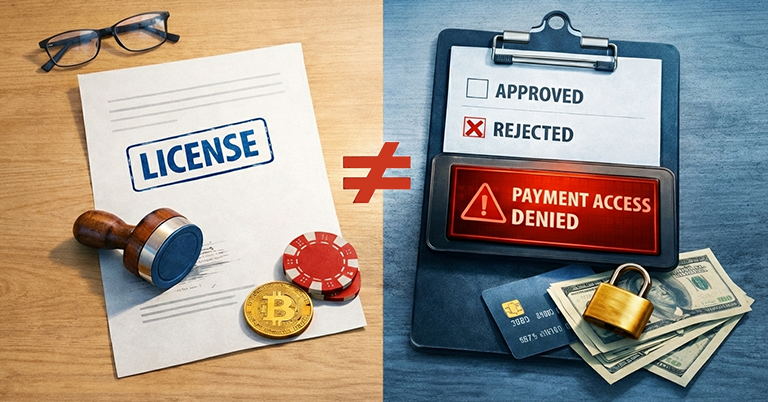
Case Study: PSP Fraud Alert — How “Bankable” Is Earned
- Context: Our client, a Canada-focused casino and sportsbook working with three PSPs, received a fraud warning from one provider.
- The Problem: Failed card authorizations spiked six times, attempts clustered in the same BIN range, and multiple player accounts shared the same device fingerprint. Internal monitoring showed it was not one bad actor: 23 new accounts appeared in four hours with random-looking emails, small deposits of 50 to 100 dollars, minimal play, and fast withdrawal attempts—a repeatable script consistent with an organized stolen-card group.
- The Action: The client activated a Fraud SOP, a standard operating procedure immediately. They confirmed the cluster, froze linked accounts, paused withdrawals, and temporarily blocked the risky BIN range, all within two hours. The client then sent the PSP a clear preliminary fraud report with transaction IDs and the clustering logic.
- The Outcome: The PSP confirmed a wider card-compromise issue. Because of this proactive response, the chargeback ratio stayed below 0.65 percent, and the PSP noted the proactive fraud management of the operator.
This is why payments do not just work after launch. The operational stack is what keeps them alive.
Managing the Operational Overhead of a Crypto Casino Jurisdiction
Securing your payment channels is a milestone, but it shifts the focus to long-term sustainability. Maintaining a crypto gaming license requires a relentless commitment to the reporting and audits that keep a business in good standing.
Going live with a crypto-friendly gambling license is the beginning, not the finish line. The real cost of a crypto casino jurisdiction is the ongoing operational overhead.
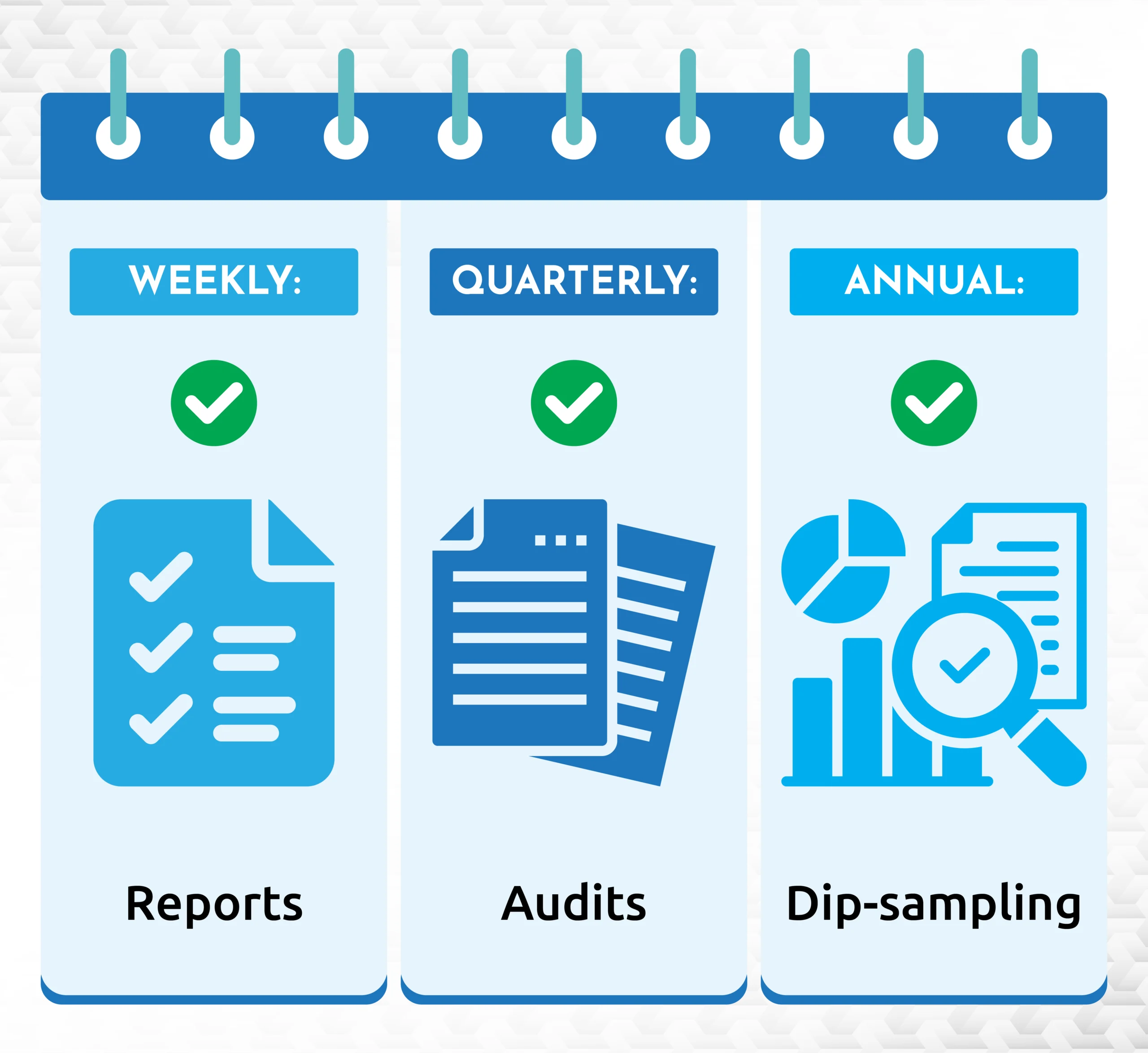
- Reporting Cadence: Under the MGA, you must file weekly player balance and complaint reports. Tobique requires fully encrypted quarterly uploads of player data, balances, and self-exclusions.
- AML Thresholds: Many frameworks use rolling thresholds that trigger Customer Due Diligence (CDD), the basic identity checks, once deposits or withdrawals reach certain levels over a period, often thirty days.
- Annual Audits: At your license renewal, regulators will “dip sample” your files. They will ask to see 10 or 20 files to ensure you are actually collecting the KYC data you claim to be.
- Substance and Staff: Some Tier-1 licenses, particularly the Isle of Man under the Designated Business Act (the law governing designated businesses), require you to have local directors, a registered office, and actual employees on the island.
- The Tools: You can’t handle this manually once you start scaling. You will need automated systems like Zion for Politically Exposed Persons (PEP) screening or ComplyRadar for behavioral monitoring to catch suspicious spikes in transaction velocity.
Managing the operational overhead of a crypto casino jurisdiction is an ongoing investment. Because the workload varies so much between hubs, you must select a home that matches the current scale and the future roadmap of the company.
Choosing the Right Crypto-Friendly Gambling License for Your Roadmap
With the regulatory and payment landscape mapped out, the final task is to determine which hub fits your specific goals. Every crypto-friendly gambling license offers a different balance of speed, cost, and reputation.
The Bootstrapped Startup
If you need a crypto gaming license fast (4 weeks) and cheap, go with Anjouan. It lets you test your product without burning an investment on a compliance department you do not need yet.
The High-Growth Operator
If you need Tier-1 banking acceptance (like Nuvei or Paysafe) but can’t wait 18 months, Tobique is the smarter crypto casino jurisdiction.
The Enterprise Powerhouse
If you are going public or need to satisfy institutional investors, the crypto-friendly gambling license from Malta or the Isle of Man is your only real move, provided you have the millions to maintain it.
Selecting the right home for an iGaming brand is a decision that dictates the ability to scale. To help you clear any remaining hurdles, we have answered the most common questions regarding crypto gaming license compliance in the final section.
F.A.Q. (Frequently Asked Questions)
Anjouan and Tobique are often viewed as more crypto-open, because they treat crypto like another currency with relatively low friction. Malta supports crypto too, but within a stricter compliance framework.