
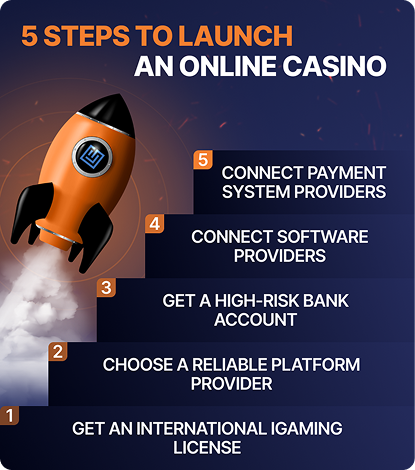

How to Start a Crypto Casino in 2026: Complete Launch Guide
Crypto casinos have moved from fringe payment experiments into serious iGaming businesses.
This year, founders searching for how to start a crypto casino in 2026 need more than a coin list: they need licensing, payments, providers, compliance, and trust working before the first player deposits. The goal is to launch a crypto casino that can pass checks and still feel quick for players.
This crypto casino guide explains the core launch choices: market angle, license route, platform, payment setup, compliance, budget, and acquisition. Some founders want to start Bitcoin casino brands for VIP players. Others build a crypto gambling website around stablecoins, crash games, sportsbook traffic, or a local market gap.
Either way, every crypto casino business faces the same test: can players deposit, play, withdraw, and trust the site enough to return?
The Crypto Casino Market in 2026: Why Now Makes Sense
At LicenseGentlemen, we have helped launch crypto online casinos, and we know both sides of the model. The upside is real, but a crypto casino is not all shiny dashboards and easy cash flow. Getting it right takes time, coordination between several stakeholders, practical licensing knowledge, and a fair amount of luck with timing, payments, providers, and traffic.
The crypto casino market in 2026 still makes sense because player demand and operator economics are moving in the same direction. Online gambling is expanding, and Grand View Research forecasts that the global online gaming market will exceed $150 billion by 2030.
Market size alone does not tell an operator what to build. The useful crypto iGaming statistics are the ones that answer the questions a founder has before launch:
- Which networks will our players use to deposit in our online casino?
- How fast should we clear withdrawals before players start doubting the cashier?
- Which PSPs will accept our license, our countries, and our risk profile?
- How much of our deposit volume will come through stablecoins?
- How will we drive traffic, and where can we realistically get it?
If 70% to 80% of deposits are expected to come from Tether’s USDT, weak stablecoin support is not a technical detail. It can lower cashier conversion, slow withdrawals, and create avoidable support tickets.
Crypto, Blockchain, and Hybrid Casinos: What You're Actually Building
The crypto casino vs blockchain casino distinction is operational. A blockchain casino records more activity on chain, such as bets, game results, wallet activity, or randomness. That is blockchain casino explained in plain terms.
What is a crypto casino, then? Usually, it is an online casino where players deposit and withdraw with cryptocurrency while games, balances, bonuses, risk controls, and reporting run through a standard iGaming platform.
A hybrid casino fiat and crypto setup keeps traditional casino infrastructure while adding crypto payment rails. Of the main types of crypto casinos, this is often the easiest model to license, operate, and explain to partners.
Pros and Cons of Running a Crypto Casino
For founders asking why to start a crypto casino, the answer is commercial: fewer card dependencies, a 100% processing success rate, lower commissions, faster withdrawals, and better access to crypto-native players.
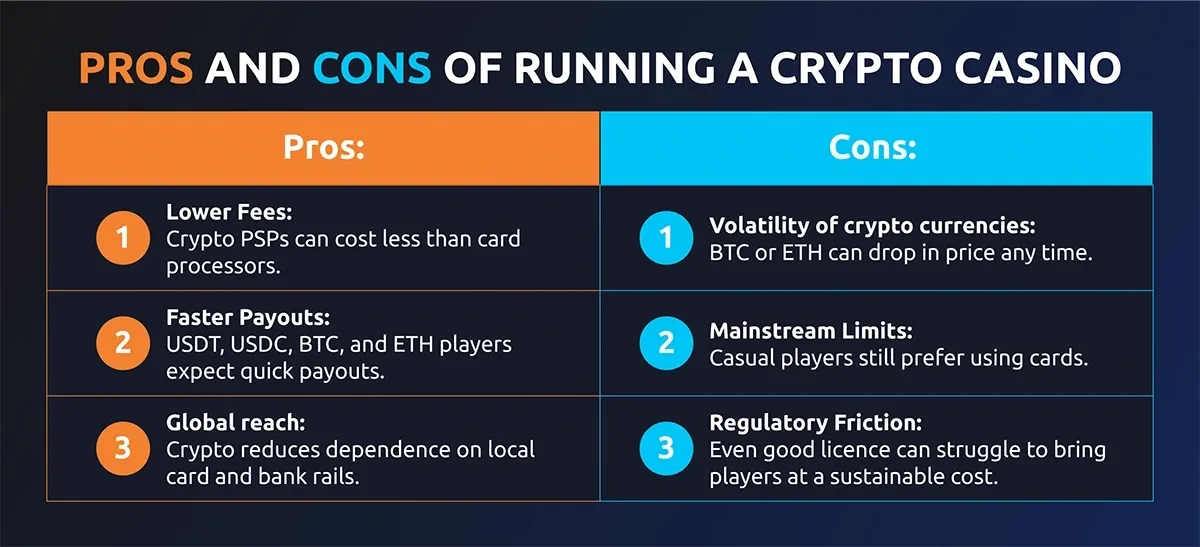
Those benefits only matter if the operation can handle the risks. Crypto casino operations become fragile when treasury rules, wallet screening, bonus controls, support, or traffic planning are weak.
Pros: Lower Fees, Faster Payouts, Global Reach
Crypto casinos can outperform card-based casinos when payments are fast, clear, and built into the product.
- Lower payment friction: crypto PSPs can cost less than card processors.
- Faster withdrawals: USDT, USDC, BTC, and ETH players expect quick payouts.
- Wider reach: crypto reduces dependence on local card and bank rails.
- Stronger niche appeal: crypto users, esports bettors, crash players, and Telegram audiences respond to brands that understand how they deposit, play, and withdraw.
- Fewer chargebacks: blockchain transactions are final.
Cons: Volatility, Mainstream Limits, Regulatory Friction
Crypto casinos face four constraints in 2026: price movement, user education, stricter AML expectations, and traffic availability. They are manageable only if they are built into the model from the start.
Volatility is usually the first issue. If a casino accepts BTC or ETH and holds those balances while paying providers, staff, affiliates, or taxes in fiat or stablecoins, a price drop can turn a profitable month into a treasury problem. Stablecoins reduce that exposure, but they do not remove custody, network, monitoring, or bank conversion risk.
Many casual players still prefer cards and wallets, while regulators increasingly treat crypto deposits as payment activity with higher risk. Traffic is another constraint. A crypto casino can have a good license, fast payments, and strong games, but still fail if affiliates, SEO, streamers, VIP communities, or regional channels cannot bring players at a sustainable cost.
Step 1: Market Research and Niche Selection
Before choosing a market, understand who you’re building for. To choose a crypto casino niche, define the crypto gambling target audience first: crash game players, LATAM sports bettors, VIP crypto users, stablecoin players, or another group with clear behavior.
A useful crypto casino competitors analysis goes past the homepage. Study Stake, BC.Game, Roobet, Cloudbet, and other brands for currencies, withdrawals, games, bonuses, affiliates, restricted countries, and communities.
Most crypto casinos fail because they look identical. If you’re launching a new brand, give players a reason to choose you. That could mean stronger VIP rewards, better sportsbook coverage, a focus on crash games, provably fair games, eSports betting, or customer support tailored to a specific region.
Step 2: Choosing the Right License for a Crypto Casino in 2026
The best license for a crypto casino in 2026 depends on players, payments, supplier approval, and compliance capacity. A serious crypto gambling license comparison starts with the business model, then tests each jurisdiction against PSP acceptance, game provider approval, restricted countries, reporting duties, and crypto payment rules.
Before applying for a crypto gambling license or a Bitcoin casino license, define ownership, restricted countries, accepted coins, networks, KYC triggers, providers, and withdrawal monitoring. FATF crypto compliance belongs in that plan because banks, PSPs, regulators, and platforms will ask about the source of funds, wallet screening, and Travel Rule readiness.
The license decision is where the plan stops being theoretical. A route can look cheap on paper and still block a PSP, provider, market, or crypto monitoring setup later. Before company formation or platform contracts lock you into a path, LicenseGentlemen can review the license, PSP route, provider list, and target markets together. The consultation is free, and the call is easy to arrange.
Anjouan: Best for Crypto-First Operators
Anjouan is often practical for crypto operators that need a faster, cheaper offshore route. For many startups, an Anjouan crypto license can support casino, sportsbook, poker, or several products under one framework.
The attraction is speed and cost. A prepared application moves faster when ownership documents, source of funds records, AML/KYC policies, platform details, provider information, and restricted country rules are clean. Operators still need PSP, provider, affiliate, and market checks.
In our experience, Anjouan is the choice for roughly 95% of crypto online casinos for a reason. It often gives founders the fastest workable route to market while still giving PSPs and game suppliers a licensing framework to review.
LicenseGentlemen has issued more than 500 gaming licenses, so a short call can help you understand whether Anjouan fits your model or whether another route would protect the business better.
CGA Curaçao Under LOK: Hybrid Fiat-Crypto Setups
Curaçao under LOK suits operators that want a more formal offshore structure, especially for fiat cards, digital wallets, bank settlement, and crypto. For teams comparing the Curacao crypto license 2026 requirements, the old master license model has moved to direct licensing under the Curaçao Gaming Authority.
For hybrid casinos, that means clearer supervision, more local presence, and visible compliance. It may cost more than Anjouan, but partners may understand it better for fiat and crypto rails.
Tobique and Other Alternatives
Tobique and other alternatives can suit specific operator profiles, narrower market strategies, or backup routes where Anjouan or Curaçao does not fit.
Check restricted countries, B2C vs B2B coverage, banking acceptance, provider comfort, reporting, renewal cost, and support for your crypto payment flow.
What to Avoid: Licenses That Block Crypto
Avoid licensing routes that do not support your payment model. Some respected jurisdictions suit traditional iGaming but make raw crypto deposits difficult without explicit approval and mature controls.
The UK Gambling Commission treats cryptoassets as higher risk, and the Malta Gaming Authority has required approval and strict controls for virtual assets. They can work, but rarely suit fast startup launches.
Crypto casinos often compete on economics. Lower transaction costs, faster settlement times, and broader payment flexibility can let operators invest more in bonuses, acquisition campaigns, and market expansion.
The problem starts when a licensing framework removes those advantages through restrictive treatment of digital assets. If compliance costs, onboarding requirements, and operational limits begin to resemble a fiat-only model, the competitive edge of a crypto casino can shrink quickly.
Founders should check whether the chosen jurisdiction supports the economics of a crypto casino before they build around it. A crypto operation under a license that limits cryptocurrency in practice may struggle against competitors using more practical regulatory environments.
Step 3: Selecting a Platform That Supports Crypto Natively
A crypto casino platform should make crypto payments part of the product from day one. In a standard guide on how to start an online casino, the platform conversation can begin with games and design. In crypto, it has to begin with the cashier.
Before spending money on traffic, make sure your platform can process deposits, approve withdrawals, track affiliates, apply bonuses, and trigger KYC checks automatically. Fixing these systems after launch is far more expensive.
When comparing a white-label crypto casino, turnkey crypto casino, or custom build, inspect the back office before the lobby. Most platforms look similar during a demo. The differences appear after launch. Recovery of wrong network deposits, fraud controls, withdrawal workflows, and wallet attribution often determine whether operations can scale efficiently.
White Label vs Turnkey vs Custom
White label is fastest, turnkey offers more control, and custom gives the most autonomy with the highest build risk. Choose by budget, timeline, team strength, and product difference.
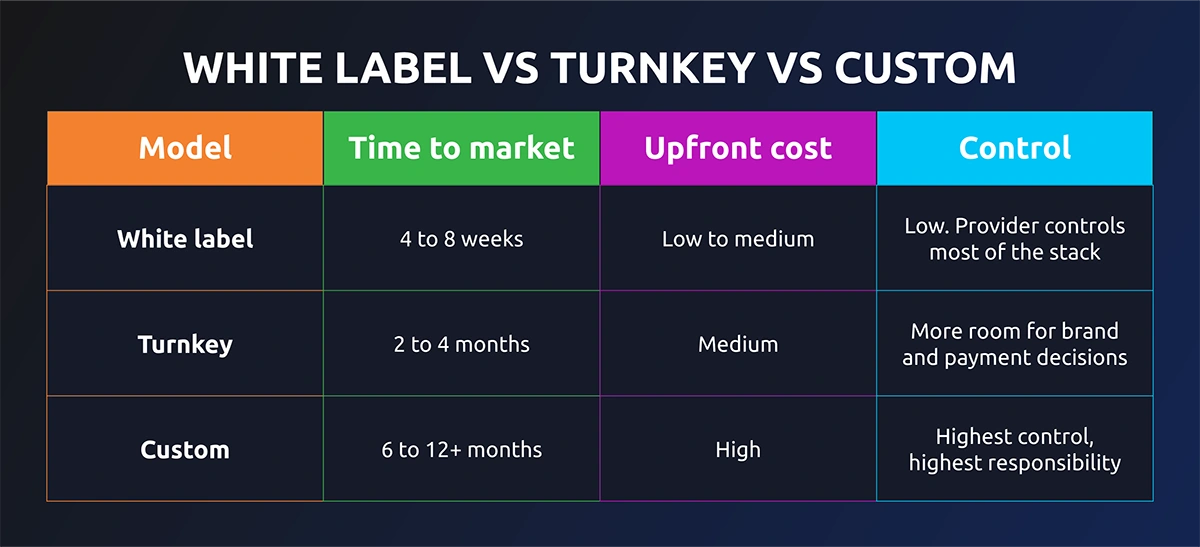
For most new operators, turnkey is the middle ground: more control without building everything from scratch.
Crypto-Native Platform Features
A strong platform should support multi-currency balances, fast deposit detection, wallet attribution, withdrawal approvals, and gas fee rules.
At minimum, look for USDT, USDC, BTC, ETH, fast deposit detection, pending confirmations, clean balances, and automated plus manual withdrawal rules.
Provably Fair Game Integration
Provably fair games use cryptographic methods, often SHA-256 hashing, so players can verify that outcomes were not changed after the bet. Typically, the casino commits to a server seed hash, the player uses a client seed, and the result can be checked after the server seed is revealed.
Do not treat this as a shortcut around certification. A regulator may still ask for RNG certification for the game, even if players can verify the result through a seed system. If you want to build your own Stake Originals-style games, plan it as a budget and timeline decision. Many operators launch first with proven games in their target markets, then add custom titles when traffic and retention justify the work.
Step 4: Cryptocurrency and Network Selection
The answer to which cryptocurrencies for casino launches should come from player behavior. Most operators should start with a USDT USDC casino setup, add Bitcoin and Ethereum casino support for VIPs, and choose networks around the audience.
In many crypto casinos, deposits usually concentrate around USDT first. A practical launch mix is often USDT at around 80%, followed by Bitcoin, USDC, TRX, ETH, and SOL. Together, those assets can account for roughly 98% of deposits, so adding obscure coins before the main flows work rarely improves the business.
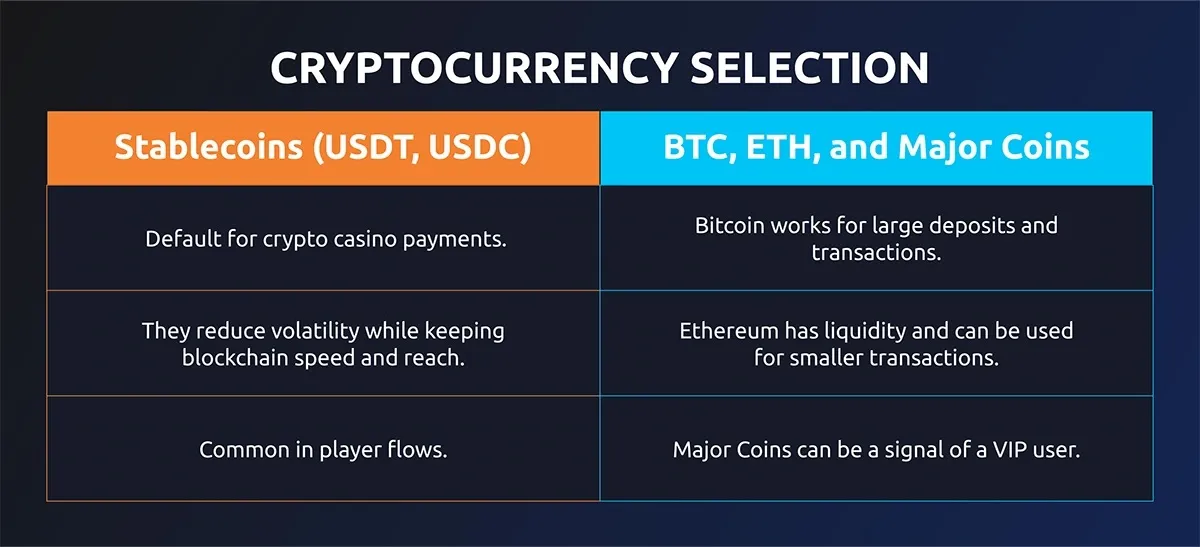
Stablecoin gambling is easier because balances stay readable. Crypto network fees in casino payments still matter, but do not rely on old assumptions about which chain is cheapest. Compare current fees, confirmation times, wallet habits, and PSP support before deciding which networks to show first.
Stablecoins (USDT, USDC): The 2026 Default
Stablecoins are the default for crypto casino payments in 2026 because they reduce volatility while keeping blockchain speed and reach.
USDT is common in player flows, while USDC may suit stricter payment teams. Decide whether balances show fiat value, crypto value, or both.
BTC, ETH, and Major Coins
BTC and ETH still signal credibility and serve VIP crypto users, but they should not be the main transaction layer for every player.
Bitcoin works for VIP deposits, but not always for small transactions. Ethereum has liquidity and can be cheaper than older assumptions suggest, so compare live fees and player wallet habits rather than treating any other network as automatically cheaper.
After BTC and ETH, add coins only when they serve a clear player or payment use case. LTC is still useful for some players who want a familiar coin with lower fees and faster movement than Bitcoin.
BNB, TRX, SOL, and AVAX can make sense too, because their use is already widespread among crypto gambling users. DOGE, SHIB, PEPE, GRAM, HYPE, and JUP can help with specific communities or campaigns, but they are not must-have launch assets.
If a coin adds extra liquidity work, support tickets, or PSP friction without bringing the right players, leave it for later.
Network Choice: TRON, Solana, Polygon, BSC
Network choice determines how fast and clear the casino feels. The best network is the one your players already use, your PSP supports reliably, and your support team can explain without confusion.
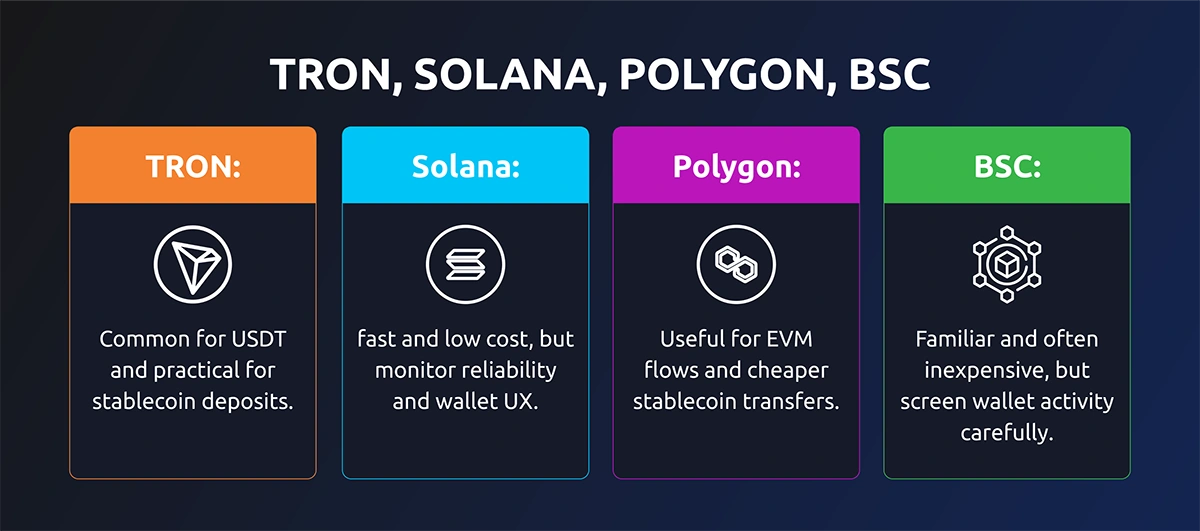
Make network selection obvious and easy to understand. Many online casinos have a navigation flow that is too complicated. This is especially important with stablecoins. USDC may be available on BEP20, ERC20, and Solana, while USDT is often supported across TRC20, BEP20, ERC20, Polygon, Solana, and Avalanche C-Chain.
Make the difference between the asset and the network clear: ERC20 means the token is moving on Ethereum, BEP20 means it is moving on BNB Smart Chain, and TRC20 means it is moving on TRON. Players often say “USDT” or “USDC,” but the cashier has to show which network they are using before they copy an address or confirm a withdrawal.
Remember! even your parents should be able to deposit – this is how easily understandable everything should be. Create video manuals if necessary; this will help your players figure out how to use a cashier at your online casino.
Wallet Integration: Custodial vs Non-Custodial
Custodial wallet systems are easier for mainstream UX. Web3 wallets appeal to advanced users but add friction. Most operators should start custodial unless the brand is built around Web3.
Custodial systems let the casino or PSP manage addresses, balances, and withdrawals. They are easier to support but create custody responsibility.
Step 5: Payment Processing and Crypto PSPs
A crypto payment processor for a casino should be judged by the whole cashier flow: deposits, confirmations, wallet screening, settlement currency, withdrawal review, and support when players send funds on the wrong network. The wrong PSP can make a good product feel slow or risky.
Build a crypto PSP comparison before signing. Check CoinsPaid casino support, BVNK iGaming, CoinPayments, CryptoProcessing, NOWPayments, and CoinGate for gaming acceptance, coins, network coverage, spreads, minimums, API quality, crypto casino fees, reserve rules, and crypto deposit withdrawal casino flows. Also, ask how fiat settlement, blocked wallets, suspicious transfers, and manual payout pauses are handled.
All PSPs process payments, but they do not create the same player experience. Commissions, security rules, processing speed, support response, and settlement options can differ heavily. If your competitor confirms a deposit in 20 seconds and your player waits two minutes before the balance appears, you are creating doubt at the worst possible moment.
Before choosing a PSP, ask LicenseGentlemen to review whether the provider fits your license, target countries, expected coins, and withdrawal policy. The consultation is free, and it can prevent a payment setup that looks acceptable in a demo but fails under real traffic.
Step 6: Game Selection and Aggregators
Don’t choose games because an aggregator offers 15,000 titles. Choose them because players in your target market actually play them. A strong launch usually mixes slots for crypto casino acquisition, live dealer crypto content, crash games, instant wins, and sportsbook content, where allowed.
A game aggregator for crypto can open thousands of titles through one integration. Study popular crypto casino games in your niche: crash and dice, live dealer, slots, and sportsbook traffic.
Step 7: KYC, AML, and Responsible Gaming for Crypto
Crypto casino KYC is now part of the operating model. Modern crypto AML compliance means identity checks, wallet screening, thresholds, responsible gaming crypto controls, and player risk review before withdrawals become a problem.
A practical setup includes crypto casino source of funds checks, blockchain analytics, thresholds, suspicious activity escalation, exclusion tools, deposit limits, and responsible gambling messaging. Chainalysis, Elliptic, TRM Labs, and Sumsub can support checks.
The FATF Travel Rule casino impact belongs in payment planning from the start. Operators may need originator and beneficiary information for some virtual asset transfers, plus rules for when extra review is needed.
Step 8: Designing the Casino and User Experience
Good crypto casino design removes doubt during registration, deposit, bonus claim, game launch, and withdrawal. Strong crypto casino. Most support tickets start before the player ever contacts support. They happen because someone copied a USDT TRC-20 address into an ERC-20 wallet.
Casino website design, crypto casino branding, and mobile crypto casino flows should feel like one product. Keep registration short, wallet instructions clear, cashier warnings visible, and deposit status, bonus terms, wagering progress, and withdrawal timing easy to find.
Step 9: Hiring Your Launch Team
A crypto casino team needs product, compliance, payments, marketing, affiliates, CRM, and support from the start. Hiring an iGaming team prevents licensing, platform, payments, and acquisition from bottlenecking with the founder.
Start with a crypto casino project manager who understands iGaming operations. Add compliance, payments, an affiliate manager for crypto casino growth, a CRM expert with crypto experience, support, technical ownership, and a casino SEO expert.
Step 10: Marketing a Crypto Casino in 2026
Crypto casino marketing in 2026 is built around trust, community, affiliates, and retention. Paid ads are restricted, so growth usually comes from crypto casino SEO, crypto casino affiliates, Telegram casino marketing, Discord casino promotion, streamers, VIP programs, and controlled bonuses.
Affiliates can drive early acquisition, but they need clean commissions, tracking, fast payments, and retention. Telegram can support bonus drops. Discord works for VIP or esports groups when rules are clear.
Crypto Casino Cost Breakdown in 2026
Crypto casino cost in 2026 depends on license, platform, payments, compliance, games, marketing, and cash reserve. For founders asking “how much does it cost to start an online casino?”, crypto adds pressure around payments, compliance, and liquidity. For anyone asking how much to start a crypto casino, 80,000 EUR to 150,000 EUR is a realistic lean starting model, while stronger turnkey or hybrid setups can pass 300,000 EUR to 500,000 EUR before serious growth spend.
A useful crypto casino budget separates setup from survival. Crypto casino startup cost covers launch, but the total cost of crypto gambling also includes withdrawals, affiliate prepayments, PSP balances, staff, support, compliance, and early acquisition.
License Costs
License costs include regulator fees, company formation, legal support, compliance policies, due diligence, and renewals.
For startup offshore routes such as Anjouan, published market estimates often put regulator fees in the low five figures before advisory, company, payment, and compliance costs. Curaçao is heavier and can reach roughly 120,000 EUR once application, nominee director, local substance, key people, and professional costs are included.
Do not budget only for the government fee. You also need advisor time, fit and proper documents, AML manuals, responsible gaming policies, domain approvals, and ongoing support.
Anjouan is chosen by roughly 95% of crypto online casinos for a reason. It often gives founders a faster route to market while keeping the license practical for crypto payments, PSP onboarding, and game provider review.
LicenseGentlemen has issued more than 500 gaming licenses, and a free consultation can help you check whether Anjouan fits before you spend money on the application.
Platform Costs
Platform costs depend on the build route: white label, turnkey, or custom. White label reduces upfront spend, while turnkey and custom usually need higher setup fees, monthly minimums, and sometimes GGR revenue share.
A lean setup might start around 20,000 EUR to 50,000 EUR for platform onboarding, while stronger turnkey builds can move into six figures once design, integrations, games, analytics, and support tooling are included.
PSP and Compliance Costs
PSP and compliance costs include integration, transaction fees, spreads, blockchain analytics, KYC, AML monitoring, failed transfers, and review time. These costs grow with volume and risk.
Budget for payment setup, wallet screening, verification, monitoring, Travel Rule processes where applicable, and manual review capacity. If the PSP offers fiat settlement, check spreads, payout schedules, reserves, and withdrawal pause rules.
Marketing Budget
Marketing is usually the biggest variable after platform and licensing. Budget for SEO, affiliate testing, community management, bonuses, CRM, and retention.
For a lean launch, 20,000 EUR to 50,000 EUR may only cover testing. A stronger first year plan can require 100,000 EUR to 250,000 EUR or more, especially with English SEO or upfront affiliate deals.
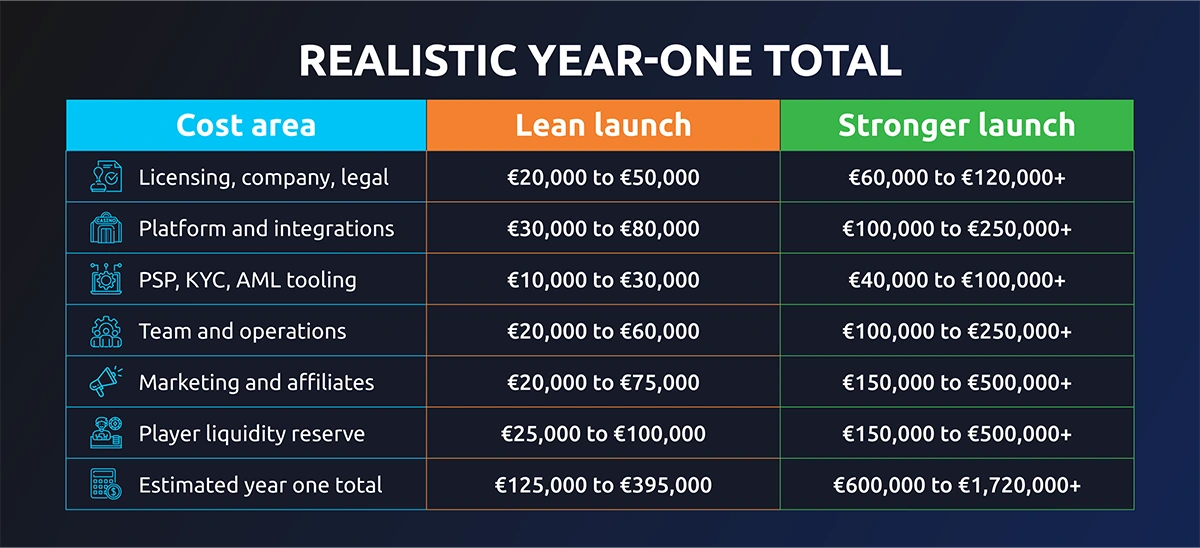
Realistic Year-One Total
A credible first year total should include launch costs, operating reserve, and enough liquidity to survive slow early traction. Many casinos fail because cash runs out before acquisition, retention, and withdrawals stabilize.
Real Crypto Casino Examples to Study
Successful crypto casinos usually win through clear positioning, fast payments, active communities, and retention. The best crypto casino examples show operating patterns to adapt without copying the surface of bigger brands.
Stake.com case study: Stake pairs a simple cashier with sponsorships, VIP programs, and an entertainment-led community. The lesson is not to copy its budget. It is to make positioning, payments, retention, and brand visibility work as one system.
BC Game casino shows another pattern: broad coin support, crypto games, and token-led loyalty give players a reason to stay inside the ecosystem. For new operators, the lesson is to align supported coins, rewards, and game mix instead of adding assets randomly.
Cloudbet and Roobet show narrower wedges. Cloudbet leans into sportsbook credibility; Roobet built recognition through influencers and a distinct brand world. Study top crypto gambling sites this way: find the operating pattern, then choose one that your budget can support.
Common Mistakes That Sink New Crypto Casinos
The most common crypto casino mistakes happen before launch: weak licensing, poor payment planning, underfunded liquidity, bad bonus rules, and shallow compliance. These crypto casino launch errors often explain why crypto casinos fail early.
The biggest crypto gambling pitfalls are practical: unclear restricted countries, withdrawal promises the risk team cannot support, weak bonus rules, low stablecoin treasury, and affiliate traffic bought only for volume.
Treat licensing as part of risk control, not admin. Before setting up invoices, a quick LicenseGentlemen review can check whether the company structure, PSP route, platform, providers, and marketing plan can actually work together.
FAQ
A lean crypto casino launch can start around 80,000 EUR to 150,000 EUR. A safer first-year budget is often 125,000 EUR to 400,000 EUR once licensing, platform, PSP, compliance, team, marketing, and liquidity are included. Stronger hybrid or turnkey launches can exceed 600,000 EUR.