

Nevis Online Gaming License 2026: Complete Operator’s Guide
If you’ve looked into the Anjouan licensing process before, parts of the St. Kitts and Nevis online gaming licence will feel familiar. The jurisdiction is relatively new within the 2026 regulatory reality of online gambling, but it has already attracted attention from operators looking for an alternative to some of the more established licensing hubs.
One reason is timing. Many founders want to get to market without spending months navigating lengthy approval procedures and multiple layers of administration. Nevis positions itself as a more streamlined option, with applications typically taking 8 to 12 weeks, depending on the structure of the business and the quality of the documents submitted.
That said, Nevis online gaming license is still building its track record. The ecosystem around the licence is developing, and many operators are currently evaluating where it fits alongside longer-established jurisdictions.
In this guide, we break down how the Nevis gaming license 2026 works, what the application process looks like in practice, and where we think it sits compared with other licensing options available today.
We’ve guided founders through more than 500 licensing projects. Schedule a free call and get practical advice on your next steps.
Why Nevis Became a Tier-One iGaming Jurisdiction in 2026
Nevis tier-one gaming jurisdiction sits in an interesting position in the offshore gaming space. It’s not as established as long-standing European jurisdictions, but it also isn’t operating in the loosely structured environment that many operators associate with “light-touch” licences.
In practical terms Nevis Online Gaming Ordinance 2026 is trying to offer something in between: a framework that is more structured than the most minimal offshore setups, while still being more accessible in terms of cost and onboarding than heavier regulatory regimes.
Why choose Nevis iGaming license? For founders, the appeal is usually not about labels or rankings, but about whether the licence is usable in real operations – banking, payment processing, and getting a product live without unnecessary delays.
Nevis is still early in that lifecycle. The jurisdiction is building its track record, and most operators are currently in evaluation mode rather than large-scale adoption.
We’re seeing interest from operators like Futorox Ltd with their yobet.game casino, Polar Jam LLC with their rollanzia.com that already have a Nevis license, and others, particularly where teams are actively working through payment processing requirements and corporate structuring decisions.
A few elements tend to come up repeatedly in discussions:
Regulatory structure
The framework was designed with reference to established offshore models, including the Isle of Man. That doesn’t make it equivalent, but it does signal the direction the regulator is trying to move in.
Administration model
Licensing is handled through an independent management structure rather than a purely traditional government department setup. In practice, this is intended to keep the process more direct and operational.
Timelines
Applications are generally expected to take around 4-8 weeks once documentation is in order, although timelines can shift depending on complexity and responsiveness during review.
Scope of the licence
A single licence can typically cover both B2C operations (casino, sportsbook) and certain B2B activities, which can reduce the need for multiple separate approvals as a business expands.
The Nevis Online Gaming Authority (NOGA) Explained
The Nevis Online Gaming Authority (NOGA) is the dedicated body responsible for overseeing licensed gaming activity in the jurisdiction. In practice, it functions as the operational regulator for gaming matters, working alongside the broader Financial Services Regulatory Commission (FSRC), which already supervises financial services in Nevis.
The idea behind this structure is fairly straightforward: gaming regulation sits within an existing financial oversight environment rather than being built entirely in isolation. For operators, that usually translates into a clearer administrative pathway and more direct engagement with the regulator during setup and ongoing compliance.
The NOGA regulator is responsible for day-to-day licensing administration, supervision, and enforcement. The NOGA license issuance process is managed by an independent management company. The Nevis FSRC gaming provides the wider regulatory backbone and institutional continuity. Together, they form the framework that Nevis is currently using to position its gaming regime in the market.
In reality, the system is still young. Most operators are still in assessment or onboarding stages, so the long-term operational consistency of the framework is something the market is still testing.
Nevis License Types: B2C, B2B, and White Label
The Nevis framework uses a relatively consolidated licensing structure, designed to reduce the need for multiple separate approvals when operators expand or adjust their business model.
This is particularly relevant in 2026 when many operators are no longer running a single business model but instead combining casino, sportsbook, and infrastructure services under one group structure.
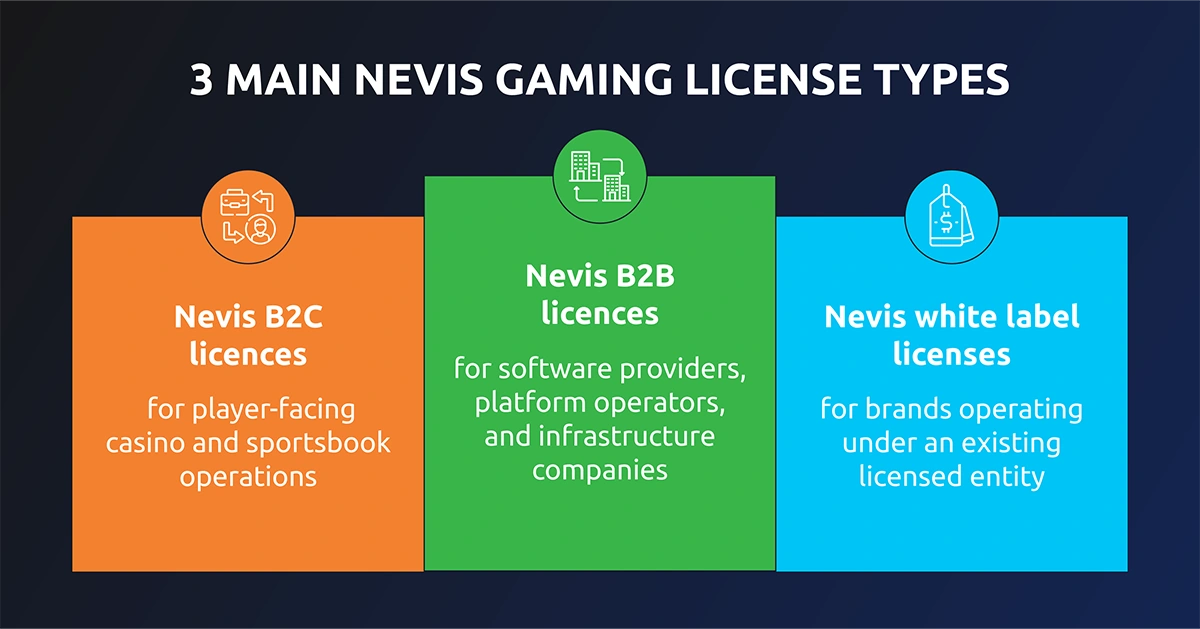
The three main Nevis gaming license types are:
- Nevis B2C licences for player-facing casino and sportsbook operations
- Nevis B2B licences for software providers, platform operators, and infrastructure companies
- Nevis white label licenses for brands operating under an existing licensed entity
Each category comes with its own compliance expectations and operational scope, but they sit within a single overarching regulatory framework rather than fully separate regimes.
B2C License
The Nevis B2C licence is used for operators running player-facing platforms such as online casinos, sportsbooks, and related gaming products.
From an operator’s perspective, the main practical benefit is consolidation. Instead of managing fragmented approvals across multiple jurisdictions or entities, businesses can typically operate under one licensed structure, subject to NOGA’s domain and compliance requirements.
We are seeing uptake from operators like Tiketa Bet, Polar Jam, Futorox Ltd, and Vesaro Tech. In these cases, the Nevis framework is used as part of broader licensing and payment strategies, particularly in cases where teams try to streamline operational overhead during launch and early scaling phases.
That said, most operators are still building around the licence rather than relying on it as a fully mature regulatory endpoint.
B2B License
The Nevis B2B licence is intended for companies that supply infrastructure to gaming operators rather than interact directly with players.
This typically includes game studios, platform providers, odds engines, and other backend service providers.
The focus of this category is less about player fund handling and more about technical reliability, system integrity, and cybersecurity standards. In practice, it is designed to allow suppliers to work with multiple operators within the Nevis ecosystem or externally, depending on their commercial model.
White Label Authorization
White-label arrangements allow new brands to operate under the infrastructure of an existing licensed entity.
This is usually used by startups or early-stage teams that want to enter the market without building full regulatory and banking infrastructure from scratch. The trade-off is reduced independence in exchange for faster deployment and access to an established compliance and payments setup.
In practice, this model requires alignment between the underlying B2C/B2B licence holder and NOGA’s authorisation requirements for white-label activity.
The ecosystem is still developing, so market practice is not fully standardized yet. In earlier stages of offshore gaming markets, this type of structure often starts with flexible interpretation and becomes more formalised over time as volume and regulatory scrutiny increase.
Nevis Gaming License Requirements in 2026
Nevis licensing in 2026 reflects a more formal compliance posture than older offshore gaming setups. The direction is fairly consistent across new jurisdictions: more transparency at the corporate level, clearer ownership structures, and stronger AML expectations from the outset.
Nevis license documents
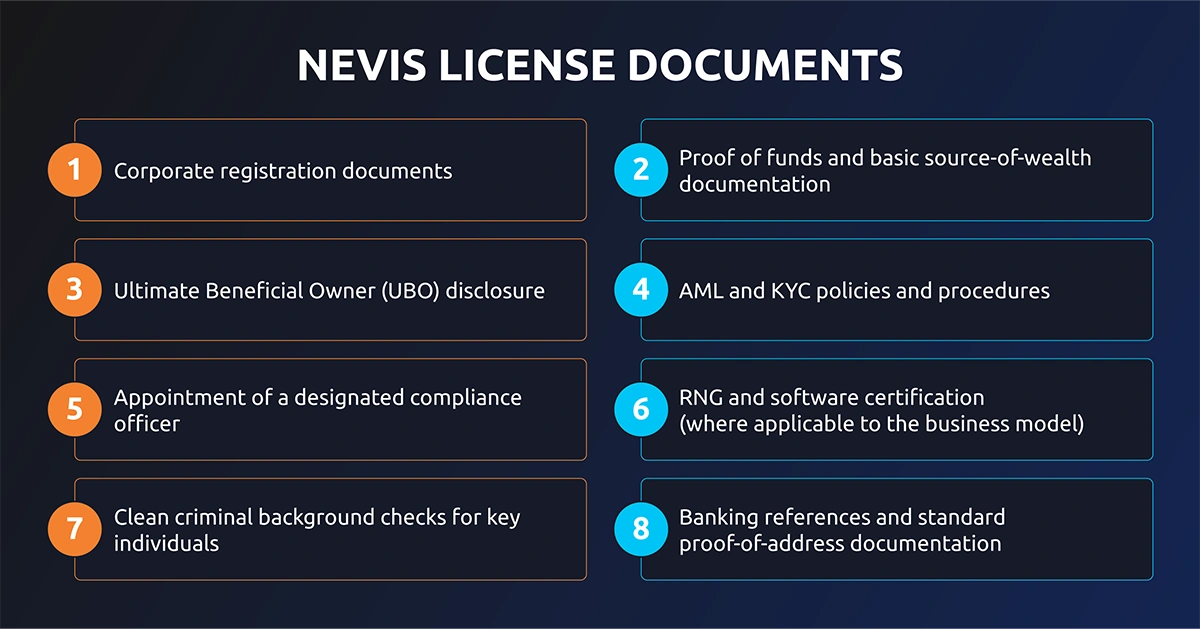
In practical terms, applicants should expect to prepare the following core documentation and controls:
- Corporate registration documents
- Proof of funds and basic source-of-wealth documentation
- Ultimate Beneficial Owner (UBO) disclosure
- AML and KYC policies and procedures
- Appointment of a designated compliance officer
- RNG and software certification (where applicable to the business model)
- Clean criminal background checks for key individuals
- Banking references and standard proof-of-address documentation
These NOGA license requirements 2026 are not particularly unusual in today’s market, but they do represent a step up from older offshore regimes that historically operated with lighter disclosure expectations and less structured oversight.
From an operator’s perspective, the key shift is less about paperwork volume and more about accountability. Regulators and counterparties increasingly expect companies to be able to clearly explain three things: where funds come from, who ultimately controls the business, and how player risk is managed in practice.
That typically translates into working AML frameworks, transaction monitoring systems, and documented internal controls rather than informal or ad-hoc processes.
The broader driver behind this trend is external pressure rather than jurisdiction-specific policy alone. Banks, payment providers, and compliance partners are tightening expectations across the iGaming sector, particularly where crypto exposure is involved and where cross-border payment flows are high.
Nevis is aligning itself with that direction of travel. It is not as heavy-handed as some of the more established European regimes, but it is also not operating in the low-friction environment associated with early-stage offshore licensing models.
For more experienced operations teams, these requirements are often not viewed as a burden in and of themselves. In many cases, they are seen as part of building a structure that can withstand the payment workflows, bank audits, and long-term operational analysis.
Corporate Structure and Company Setup
The corporate entity is generally required to be incorporated in Nevis as part of the licensing process. Most of the documentation flow is handled digitally, with local administrative support assisting where physical documents, notarisation, or apostille processing is needed. In practice, this setup is designed to reduce logistical friction rather than eliminate formal verification.
To begin a formal review with the Nevis Online Gaming Authority (NOGA), applicants typically need to establish a Nevis-registered company with a minimum share capital requirement of around €50,000.
Unlike some higher-cost European jurisdictions, Nevis does not generally require a physical office lease or full-time local operational staff as a baseline condition for licensing. That said, this should not be interpreted as “lighter regulation” in a broad sense — it simply reflects a different approach to structuring operational presence.
Before an application moves into substantive review, NOGA will still expect a structure that is clear and transparent.
Common expectations include:
- Corporate governance setup
A locally appointed director or authorised representative is typically required to act on behalf of the entity for regulatory purposes.
- UBO transparency
Ownership must be fully disclosed, and beneficial ownership structures are reviewed to ensure they are traceable and coherent. Complex or layered structures are usually expected to be clearly mapped rather than assumed to be acceptable by default.
- Auditability of structure
The regulatory authority will assess the extent to which the ownership chain is simple or complex and whether the structure of control can be traced reasonably and unambiguously.
- Operational clarity
Where multiple founders or holding entities are involved, applicants are expected to clearly document decision-making authority, ownership percentages, and the flow of control across the group structure.
Proof of Funds and Source of Wealth
The proof of funds and source of wealth process is one of the more substantive parts of the onboarding review. It is not treated as a formality, but as a verification step intended to align the applicant with modern banking and payment expectations.
The focus is on establishing a clear and traceable origin of capital used to fund the operation.
Typical supporting evidence may include:
- Sale of business documentation (e.g. share purchase agreements)
- Real estate sale records, including notarised transfer documentation where applicable
- Corporate dividend flows supported by audited financials and bank statements
- Crypto-related proceeds supported by transaction histories and independent verification where available
The emphasis is on continuity of funds, the ability to show a consistent and explainable path from origin to operational capital.
Personnel and Compliance Officer
A designated compliance officer is required under the Nevis gaming license requirements. The role can be fulfilled internally or externally, depending on the size and structure of the operation.
NOGA expects this individual to be responsible for AML implementation, internal reporting, and oversight of KYC procedures.
In practice, this means maintaining ongoing monitoring of transactional activity, reviewing flagged behaviour, and ensuring escalation procedures are followed when required.
For example, if unusual transaction patterns appear across player accounts — particularly in high-frequency or crypto-heavy environments — the compliance officer is expected to investigate, document findings, and escalate where appropriate under the operator’s AML framework.
The role is less about formality and more about ensuring there is a clear point of accountability inside the organisation for regulatory and financial risk controls.
Technical and RNG Certification
Accredited RNG certification is a core requirement under the 2026 Nevis regulatory framework. All gaming systems and game content are expected to undergo independent testing to confirm statistical randomness, payout consistency, and overall system integrity.
This is typically carried out by internationally recognised testing laboratories such as iTech Labs, GLI, or BMM Testlabs, depending on the scope of the platform and the jurisdictions involved.
In practice, these audits focus on three main areas:
- Payout logic – verifying that return-to-player (RTP) values match declared mathematical models
- RNG behaviour – confirming that outcomes are statistically unpredictable and not systemically biased
- System integrity – reviewing server infrastructure and platform architecture for vulnerabilities or manipulation risks
The framework is designed to accommodate both traditional online casinos and blockchain-based gaming platforms. That includes standard fiat payment systems as well as Web3-native game logic, provided the same baseline integrity standards are met.
Where operators use proprietary games (for example, in-house “original” titles), the review becomes more detailed. In those cases, testing laboratories typically require access to mathematical models and, in some cases, source code to validate that randomness and payout structures behave as declared.
Book a free consultation, and we’ll help you figure out which path fits your situation.
Documentation Checklist
To reduce delays during review, applicants are generally expected to prepare a complete and certified documentation package in English. This usually includes:
- UBO and director KYC (passport, proof of address, clean criminal record where applicable)
- Banking references and supporting CVs for key individuals
- Operational documentation, including a business plan (often 2-3 years), financial projections, and AML/KYC policies aligned with FATF standards
The emphasis here is consistency rather than volume — regulators and counterparties are primarily looking for coherent documentation that matches the structure of the business being presented.
Application Process and Timeline
If you’re wondering how long a Nevis license takes, the application process is generally completed whitin a 4-8 week workflow once incorporation and documentation are in place. The Nevis license timeline can vary depending on the complexity of the ownership structure.
NOGA application steps: a typical sequence for the Nevis license application looks like this:
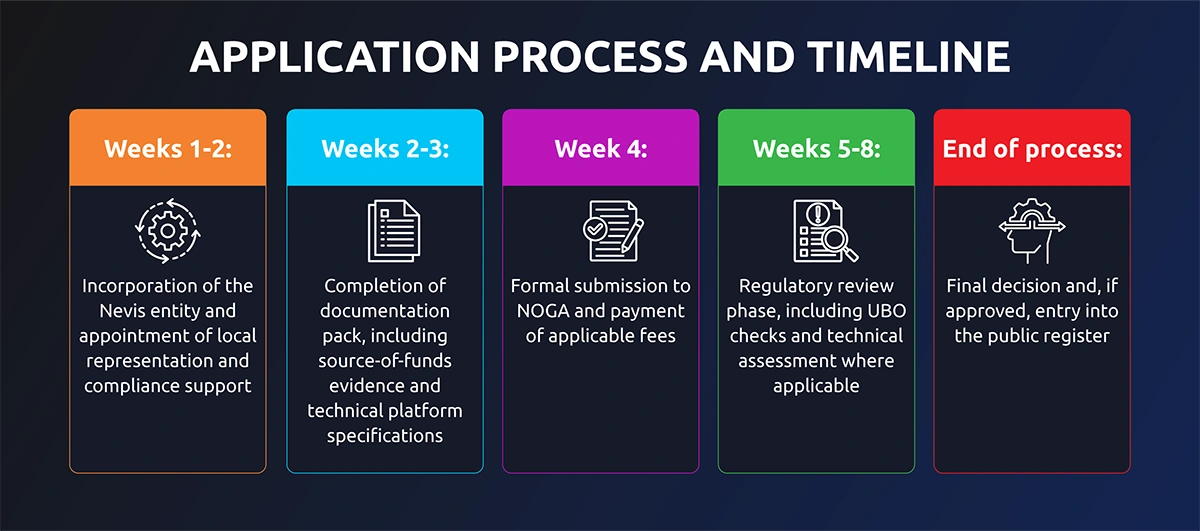
Compared to longer-established jurisdictions such as Malta, where licensing can extend significantly depending on scope and backlog, Nevis is generally positioned as a faster onboarding environment. That said, speed is usually contingent on preparation quality – incomplete or inconsistent submissions remain the most common cause of delay.
Nevis Gaming License Cost Breakdown
Nevis positions itself in the mid-range of offshore gaming jurisdictions from a cost perspective. The structure is relatively straightforward: instead of turnover-based taxation models, operators typically deal with fixed annual fees and defined service costs.
For founders, this creates more predictability in planning, particularly during the early stages of scaling, where revenue volatility can make percentage-based regimes harder to forecast.
That said, cost expectations should still be understood as a framework rather than a fixed package, since final figures depend on structure, providers, and operational scope.
Government and Annual Fees
Nevis gaming license cost generally relay on a fixed annual licensing fee model rather than gross gaming revenue (GGR)-based taxation, which is more common in higher-tier European regimes.
Indicative baseline Nevis license fees 2026 are typically structured as follows:
- Annual licence fee: approximately €28,000 for the core gaming licence (covering both B2C and B2B operations under the same regulatory umbrella, depending on structure)
- Renewal fee: generally aligned with the annual licence cost, subject to regulatory confirmation at renewal stage
- Additional domains / URLs: often priced separately, with typical add-on costs around €1,000 per licensed domain and lower fees for sub-domains depending on volume and structure
- NOGA application fee: is included in the initial first-year setup cost of approximately €34,000, which covers the fixed €28,000 annual license fee and the regulatory submission process handled by the independent management company
These figures are best understood as operational planning ranges rather than fixed universal tariffs, as final billing can vary depending on the licensing setup and service provider arrangements.
Total First-Year Setup Cost
For most operators, the first year includes a combination of incorporation, compliance preparation, licensing, and technical certification costs.
A realistic budget typically ranges from €33,000 to €50,000+, depending on the complexity.
This generally includes:
- Company formation: incorporation of the Nevis entity and initial corporate structuring (approx. €2,200 as a reference point)
- Compliance setup: drafting AML/KYC policies, responsible gaming documentation, and supporting manuals (often around €3,000, depending on provider scope)
- Local representation and administrative services: required for regulatory communication and ongoing liaison functions
- Technical and RNG certification: costs vary significantly based on platform complexity, number of games, and whether proprietary systems are involved
Overall, the Nevis license price is designed to be more predictable than revenue-based systems, but it still requires proper budget planning in the areas of legal, regulatory compliance, and technical matters. In practice, most variances stem not from the license fee itself, but from the complexity of the operational and technical configuration.
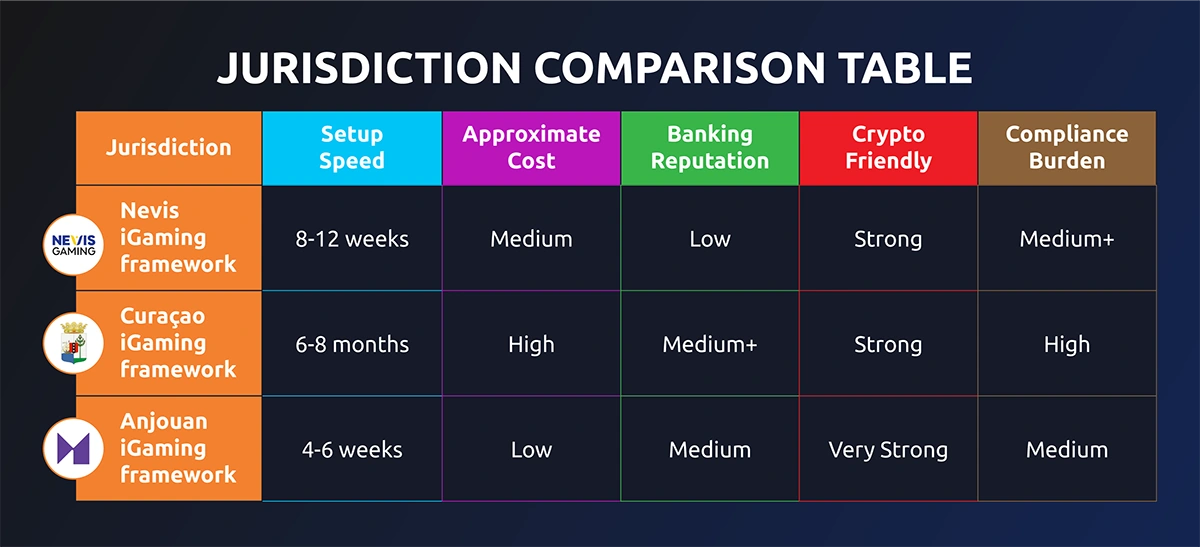
Nevis vs Curaçao, Anjouan, and Malta
Nevis is often positioned somewhere between fast-moving offshore jurisdictions and the more established European licensing regimes. In practice, that “middle position” is less about formal categorisation and more about how operators experience the framework in terms of onboarding time, cost structure, and ongoing regulatory engagement. For example when evaluating the Nevis vs Curaçao cost, operators find that Nevis offers a more affordable entry point with total first-year expenses of approximately €34,000, whereas Curaçao’s annual costs typically range from €65,000 to €95,000.
Compared to very light-touch jurisdictions, Nevis generally requires more structured documentation and clearer corporate governance. At the same time, it is typically more accessible than full-scale European regimes, which tend to involve longer approval cycles and higher ongoing compliance overhead.
That’s why most operators evaluate Nevis not in isolation, but as part of a broader licensing stack decision.
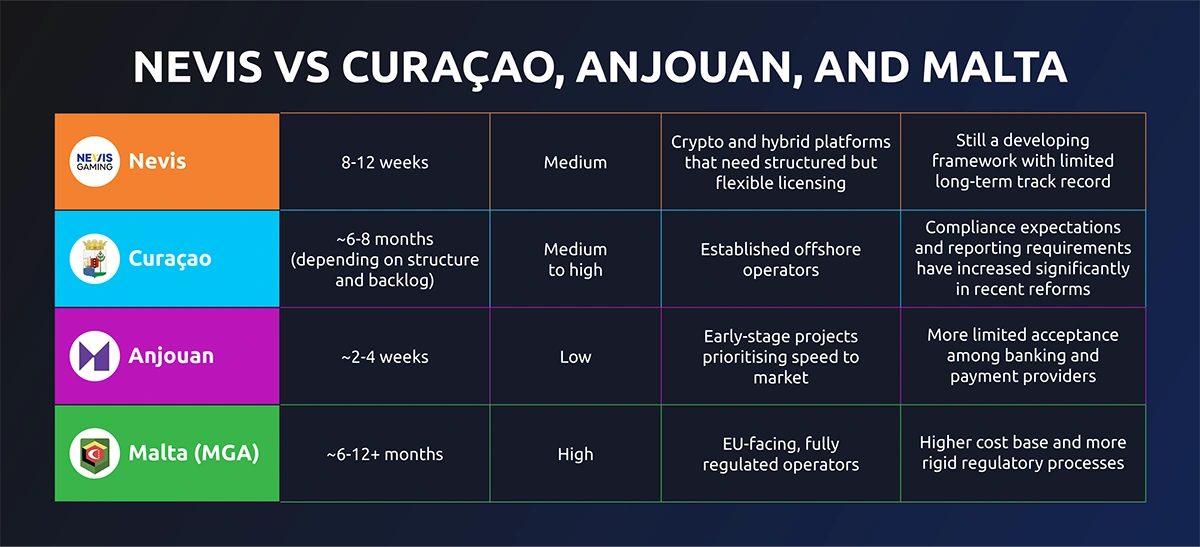
From an operator’s perspective, the differences usually come down to trade-offs rather than “better or worse” jurisdictions. Faster onboarding tends to correlate with lighter institutional acceptance, while stronger regulatory recognition typically comes with longer timelines and higher compliance costs.
Nevis is currently being evaluated within that spectrum. It is not yet in the same category as long-established EU regimes, but it is also no longer treated like a purely lightweight offshore option in most discussions.
Banking, Payments, and Crypto Under Nevis
One of the reasons operators look at Nevis is the possibility of combining traditional payment infrastructure with crypto operations under a single regulatory framework. In practice, a Nevis crypto gambling license can support both fiat and digital asset models, provided operators implement proper AML and KYC controls.
That does not automatically guarantee access to banking services. Nevis casino banking and payment relationships still depend on the operator’s business model, ownership structure, target markets, and compliance standards. However, operators with well-documented corporate structures and robust compliance procedures are generally in a better position when approaching banks and payment providers.
The same applies when applying for a Nevis merchant account. Banks and Nevis payment processors will typically want to understand how the business generates revenue, how player transactions are monitored, and whether the company has sufficient liquidity to support ongoing operations.
By aligning with the Financial Action Task Force (FATF) standards, Nevis-licensed structures are increasingly capable of satisfying the stringent due diligence required by tier-one payment processors and merchant account providers.
A key element of these banking relationships is transparency regarding the operator’s financial health. Financial institutions and payment service providers (PSPs) assess your platform’s risk and liquidity using two main metrics: gross gaming revenue (GGR) and net gaming revenue (NGR).
Licence Gentleman expert explains the complexities of the operational math behind GGR and NGR:
In the professional iGaming sector, these formulas are the “litmus test” for your business model. Payment Providers use them to determine whether your casino has sufficient liquidity to cover player payouts and operational obligations.
- Gross Gaming Revenue (GGR)
Formula: GGR = Total Wagers — Total Payouts
GGR is the raw turnover metric. It represents the total amount of money players bet minus the total amount they won. While GGR shows the volume of your business, it does not represent profit. In many jurisdictions, this is the figure used to calculate gaming taxes; however, Nevis maintains a competitive advantage by offering a 0% tax on GGR, allowing you to retain more of your turnover.
- Net Gaming Revenue (NGR)
Formula: NGR = GGR — Bonuses — Payment Processing Fees — Gaming Taxes/Admin Surcharges
NGR is the metric that proves the casino’s true profitability. It is the actual revenue left after all operational deductions – including the “cost” of player acquisition (bonuses) and the “cost” of moving money (processing fees). Because Nevis has no GGR tax, your NGR remains significantly higher than it would be in a jurisdiction like Malta or Estonia.
Compliance and Tax Framework
One of the reasons operators consider Nevis is the combination of a relatively simple tax structure and a compliance framework that follows internationally recognised AML principles.
In practice, these two areas are closely connected. A favourable tax environment means little if a company cannot establish reliable banking and payment relationships. For most operators, compliance is not simply a regulatory exercise — it is part of building a business that payment processors and financial partners are comfortable working with.
Tax Benefits
The Nevis gaming tax framework is primarily designed for international business activity. Companies that generate revenue from player pools located outside Saint Kitts and Nevis can generally benefit from a Nevis 0% corporate tax model on qualifying foreign-sourced income.
Operators also typically do not face:
- Gaming-specific taxes on qualifying foreign-sourced revenue
- VAT on offshore gaming activity
- Sales taxes on international gaming operations
For growth-stage operators, this creates a relatively straightforward fiscal environment during the early stages of scaling. However, tax outcomes always depend on how the company is structured and where economic substance is established, so individual circumstances should always be assessed separately.
AML, KYC, and FATF Alignment
The Nevis framework follows internationally recognised anti-money laundering principles and incorporates Nevis FATF compliance expectations into its licensing model.
In practical terms, operators are generally expected to maintain:
- Customer onboarding and identity verification procedures
- Ongoing transaction monitoring systems
- Source-of-funds and source-of-wealth checks where appropriate
- Internal suspicious activity reporting procedures
For crypto-focused businesses, Nevis AML KYC obligations can become particularly important because banking partners and payment providers usually apply additional scrutiny to cross-border and digital asset transactions.
The reality in 2026 is straightforward: strong compliance processes are often a prerequisite for maintaining access to merchant accounts, payment processors, and banking services.
KYC Trigger Points and CDD Thresholds
Licensed operators are expected to implement automated monitoring systems capable of identifying when enhanced verification is required.
The most common CDD requirements in Nevis include:
CDD thresholds
Enhanced due diligence is generally triggered once cumulative player activity reaches material levels, often around the USD 10,000 mark. Systems should monitor aggregated transactions over time rather than individual deposits in isolation.
First withdrawal verification
Most operators perform identity checks when a player requests their first withdrawal, regardless of the transaction amount. This serves as an important control point before funds leave the platform.
Ongoing monitoring
Unusual transaction patterns or potentially suspicious behaviour should be reviewed, documented, and escalated under the operator’s AML procedures.
Crypto transaction monitoring
For crypto operators, automated risk monitoring is particularly important. During audits or reviews, operators are generally expected to demonstrate that they can explain transaction flows and evidence the origin and movement of funds.
Overall, Nevis does not operate as a low-compliance jurisdiction. Instead, it is positioning itself within a framework where regulatory expectations and access to financial infrastructure increasingly go hand in hand.
Ongoing License Maintenance
Getting licensed in Nevis is only one part of the operational cycle. The more important test, from a regulatory perspective, is whether the business can maintain consistent compliance over time as it scales, changes infrastructure, and expands into new markets.
In practice, this is where many operators underestimate the workload. It’s not about a single approval event, but about ongoing reporting, system integrity, and governance discipline.
Failure to keep these elements aligned can result in enforcement action, including fines or suspension, which in turn typically affects payment processing and banking relationships.
Annual Reporting and Renewals
To keep the authorization active, operators must engage in the Nevis annual reporting process, submitting updated operational disclosures and documentation to the NOGA. A central part of this cycle is the Nevis license renewal, which requires the payment of the flat €28,000 annual fee – a fixed cost that provides significantly more financial predictability than the GGR-based tax models found in other jurisdictions.
The process typically involves a Nevis compliance audit where the regulator reviews updated corporate documentation, including any structural changes to ownership, and confirms that AML/KYC policies remain functional and aligned with current FATF standards.
Because the framework allows for an outsourced compliance officer, this reporting period is the critical time to verify that local representative controls and technical auditing trails (such as RNG logs) still match the original approval profile. Proactive adherence to these requirements is essential for maintaining a Nevis gaming license, as it proves to international banks and payment processors that the business has preserved its “bankable” compliance posture, thereby protecting your merchant accounts and operational stability.
Compliance Audits
NOGA may conduct periodic compliance reviews to assess whether systems and controls are functioning as intended.
These reviews typically focus on three areas:
- Transaction monitoring and AML logs
- KYC verification records and onboarding history
- System audit trails and platform integrity controls
In some cases, operators may also be asked to provide updated technical documentation, including RNG certification or security audit reports, particularly where significant platform changes have occurred.
From an operator’s standpoint, the key expectation is not just having policies in place, but being able to demonstrate that they are actively implemented and properly documented.
Change Notifications and Structural Updates
Operators are generally required to notify the regulator of material changes to the business.
This includes, for example:
- Appointment or replacement of directors
- Changes in Ultimate Beneficial Ownership (UBO)
- Significant restructuring of shareholder or holding structures
- Material changes to core platform infrastructure or payment providers
These notifications are important because they affect how the regulator assesses control, risk, and accountability within the licensed entity.
In practice, most issues arise not from the changes themselves, but from delays or inconsistencies in reporting them.
Restricted Jurisdictions
A Nevis licence does not give operators automatic access to every market worldwide. Where a Nevis casino can operate ultimately depends on local gambling laws, sanctions regimes, payment provider requirements, and the operator’s own compliance procedures.
As part of their ongoing obligations, licensed operators are expected to implement geo-blocking and internal controls that prevent access from certain territories.
The main Nevis prohibited markets include:
- The United States
- Jurisdictions subject to international sanctions
- Countries identified by the FATF as high-risk or non-cooperative
- Saint Kitts and Nevis itself, as domestic players cannot be accepted under the licence
From a practical standpoint, understanding the Nevis license restricted countries is just as important as understanding where a Nevis casino can operate. Payment providers and banking partners often review market exposure closely, and operating in prohibited territories can create compliance and payment processing issues long before any regulatory action is taken.
Is the Nevis License Right for You?
Nevis is generally an attractive option for operators who are no longer in the “early experimentation” phase but are not yet ready to bear the costs and regulatory burdens associated with obtaining a full European Tier-1 license.
In practical terms, it sits between entry-level offshore jurisdictions and established EU regimes. That positioning is defined less by marketing and more by operational realities such as licensing speed, compliance expectations, and how banks and payment providers view the structure.
When weighing the Nevis license pros and cons, the main advantage is balance. Operators gain a more structured framework than Anjouan while avoiding much of the cost and complexity associated with major European jurisdictions.
Ultimately, who needs a Nevis license depends on the stage of the business. For some teams, a standalone Nevis licence is the right fit. Others prefer a Nevis vs Anjouan strategy, using Nevis as the core operating structure while leveraging Anjouan for faster market testing or additional brands. More mature groups may even consider a Nevis Anjouan license stacking approach to separate different products and market exposures across multiple entities.
Not sure whether Nevis, Anjouan, Curaçao, or Tobique fits your business model? Speak with our licensing team and receive a jurisdiction comparison tailored to your project.
| Operator Type | Is Nevis Suitable? | Why |
| Crypto Casino Startup | Yes | Fast setup and crypto-friendly structure |
| Large EU Gambling Brand | Sometimes | May still require MGA or Tier-1 EU licensing |
| Sportsbook Operator | Yes | Flexible B2C structure |
| B2B Gaming Supplier | Yes | Dedicated B2B framework |
| White-Label Startup | Yes | Faster launch pathway |
| High-Risk Grey Market Operator | No | Stronger compliance expectations in 2026 |
Pros and Cons in 2026
Nevis in 2026 is best understood as a developing regulatory framework with a relatively balanced cost and compliance profile. It is not ultra-light, but it is also not operating at the level of long-established European regimes.
Typical planning assumptions include first-year costs in the region of €33,000-€50,000 and a licensing timeline of around 4-8 weeks, depending on structure and documentation quality.
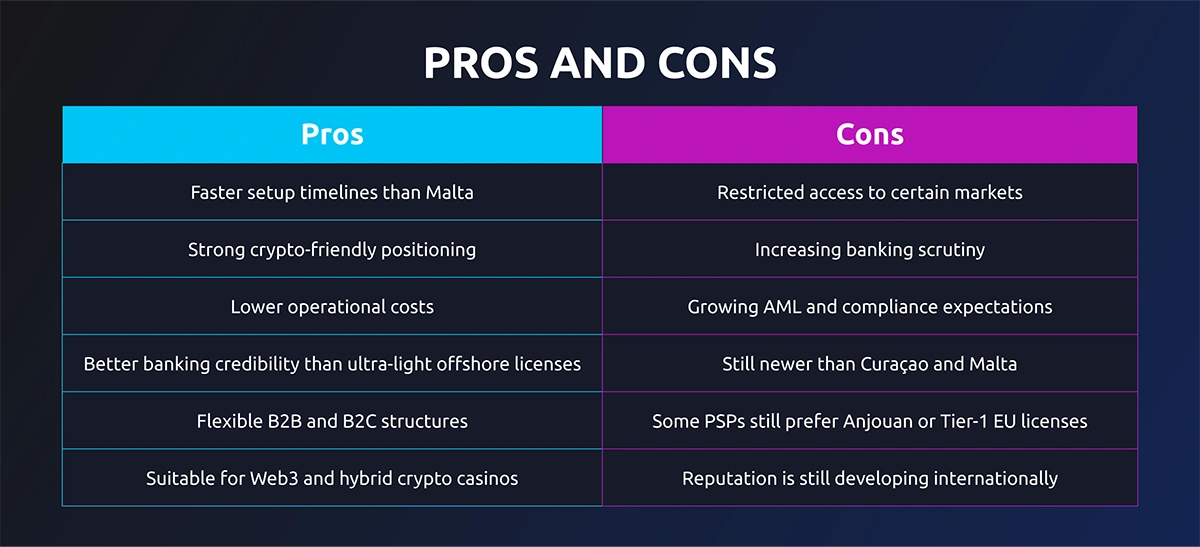
Nevis has positioned itself as a middle-ground licensing framework. It offers far more operational flexibility than major European jurisdictions while still providing stronger credibility than many low-cost offshore alternatives.
The strategy of combining licenses from Nevis and Anjouan allows the operator to use Nevis for core financial operations and banking infrastructure, while Anjouan is used for faster implementation cycles, market testing, and the launch of higher-risk or experimental brands.
In practice, this approach is used by some operators managing multiple brands to strike a balance between stability and speed. It is not a formal standard, but it is becoming increasingly common among more mature groups managing multiple products across different markets.
Through this dual-structure approach, some companies combine Anjouan with Nevis or, in some cases, include additional jurisdictions such as Tobique, depending on their payment processing reach and geographic exposure. This trend is typically observed among operators that already generate stable revenue and are capable of serving multiple corporate entities and ensuring regulatory compliance.
In this framework, Nevis acts as the primary anchor entity. It is generally used for banking relationships and engagement with more conservative PSPs. Anjouan, which can often be set up in around three weeks at an approximate cost of €17,000, is used for faster-moving brands where time-to-market is the main priority rather than long-term regulatory positioning.
The Tobique gaming licence has also started to appear in some multi-jurisdiction setups as an additional layer for geographic or payment diversification. While Anjouan is typically chosen for speed, Tobique is sometimes considered where operators are looking for a more Canada-linked regulatory reference point and broader PSP flexibility depending on target markets.
From an operational perspective, the goal of combining jurisdictions is risk distribution. If a payment provider changes its acceptance criteria for one licence type, or if a jurisdiction updates its restricted markets list, operators with multiple active entities can continue operating without rebuilding their entire structure.
This approach is generally reserved for more established operators. For early-stage teams, maintaining multiple licences often introduces more complexity than operational benefit.
Q&A
The annual licence fee is typically around €28,000. Including incorporation and initial compliance setup, most operators budget approximately €33,000-€50,000 for the first year. Nevis does not apply a gross gaming revenue (GGR) tax on foreign-sourced income.