
Choosing a Gaming License by Business Model: How to Avoid Paying 5× More Than Necessary
Picking the right jurisdiction for your online gambling business can feel like standing at a fork in the road, except every path is lined with €100,000 price tags, legal jargon, and promises that all sound the same.
Here’s the hard truth I’ve seen first-hand: it’s all too easy to spend €100,000+ on a Malta gaming authority license, or fork out €150,000 on an Isle of Man gambling license, only to realize your business model could have worked just as well with a €30,000 Anjouan setup. I’ve watched operators burn through budgets chasing a “premium” igaming license, when all they really needed was a license that simply allows them to offer gambling activities and get live fast.
Most of these costly mistakes are completely avoidable with the right plan. If you’re reading this because you want to launch or upgrade your online gaming business, don’t fall into the ‘prestige trap.’ Forget what the big gambling companies are doing. The right license isn’t about impressing people on LinkedIn – it’s about choosing what truly fits your business plan and target markets.
So let’s skip the industry noise, break down the real license costs, and get you matched with the type of license that lets your gambling platform operate profitably, without paying five times more than you need to.
Choosing a Gaming License by Business Model: What You Really Need to Know About the Regulations in 2025
Just as the gambling sector has seen considerable changes in recent years, the approach to licensing has also shifted. Curacao was once the licensing center of choice. Many operators found the option accessible and reasonably priced. However, today’s landscape is entirely different.
The licensing environment in Curacao has become divided since the Curacao Gaming Control Board (GCB) entered the picture. Its requirements are more stringent, and regulations have become more onerous. The most painful impact? Operators must comply with stricter scrutiny.
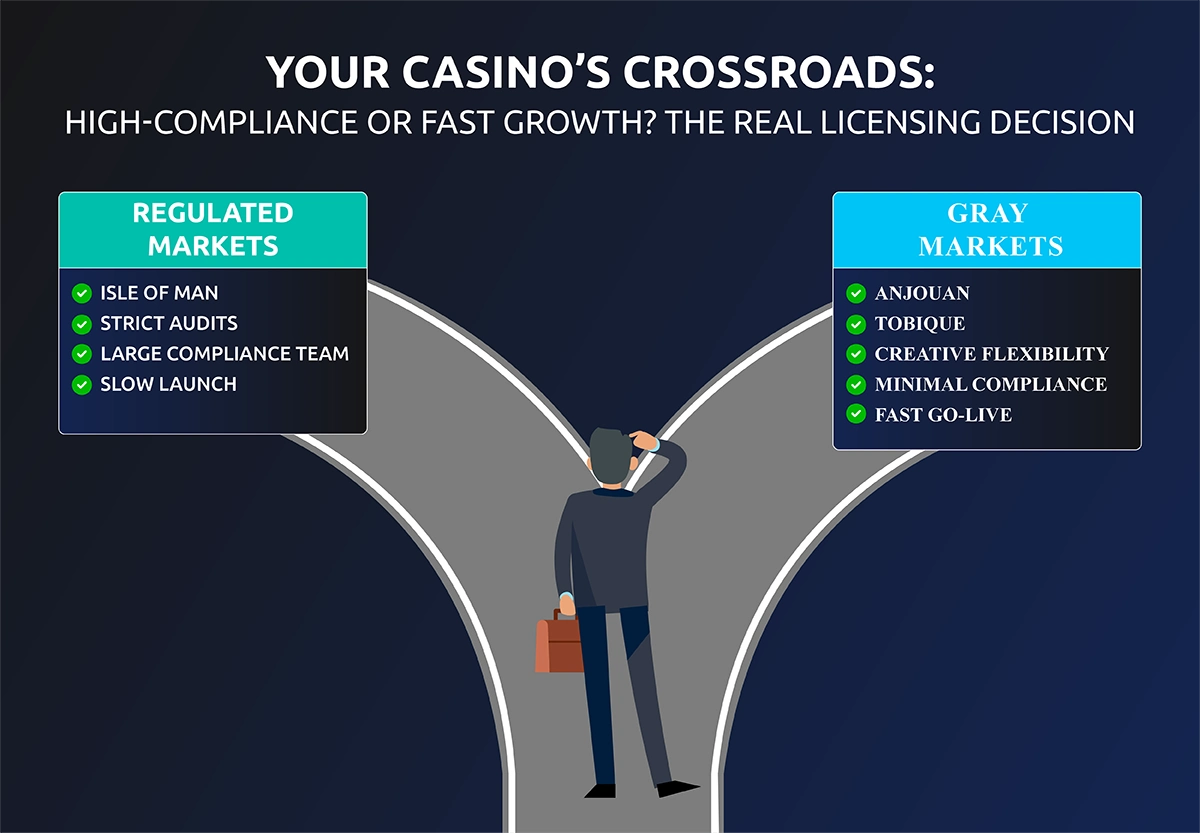
Meanwhile, Malta is gradually increasing its conformance standards. Higher fees and more consistent audits are the order of the day. Gaming companies interested in the European gaming market are particularly affected. What’s crucial to understand is that the ideal license depends entirely on your business model. First of all, we have to understand that there is a regulated and a gray market, right? Compared to regulated markets, where any tests would be challenging, where there are so many audits (monthly audits actually), where there are so many regulations, and at the end of the day, you’ll need like a team, like a compliance team to actually maintain a license of five people.
If you make the wrong move, your license can be canceled, and your 18 months of work that it took you to get the license would just…vanish. Along with hundreds of thousands of euros invested in your business.
On the other side, there’s that called gray market. For startups, it really makes sense because this is the “creative” zone compared to the regulated market, where any tests would be challenging. Because they are innovative, because they have to move fast, because it’s cost-saving, because there are fewer requirements for team members. After all, there are so many things you can work with.
You can look at Stake.com, Rollbit, Shuffle.com, all these multi-million-dollar companies, billion-dollar companies, even multi-billion-dollar companies, they all started, and they still have the international licenses.
Breaking Down Gaming Business Models and Licensing Requirements for Your Online Gambling Business
Breaking Down Gaming Business Models and Licensing Requirements for Your Online Gambling Business
Every gaming company must follow its own set of licensing rules and regulations; there’s no one-size-fits-all. Everything depends on the games on offer and how they interact with players and partners. The rules can become rather diverse and even somewhat complicated. This phenomenon is because the business side of gaming is constantly changing and keeping everyone on their toes.
1. B2C Full Platform Operators
You run the whole online casino show here. Directly serving players with your own platform, taking deposits, paying out winnings, offering all the games, everything.
What you need in a license:
- Payment processor compatibility
- Game provider accessibility
- Legal player protection framework
Legal player protection framework. So let me just tell you a real-world example. This happened only a few months ago. So one of our clients initially wanted a Malta license for their Asian-focused casino. Can you imagine they were about to spend €100,000+ in first-year costs when their target markets didn’t care about European licenses at all? We redirected them to an Anjouan gaming license, saving them over €55,000 in year one alone, money they invested in market-specific traffic sources that drove actual player acquisition.
2. White Label Solutions
White label is the “plug and play” option; you use someone else’s license and infrastructure, slap your brand, marketing, and player relationships on it, and off you go.
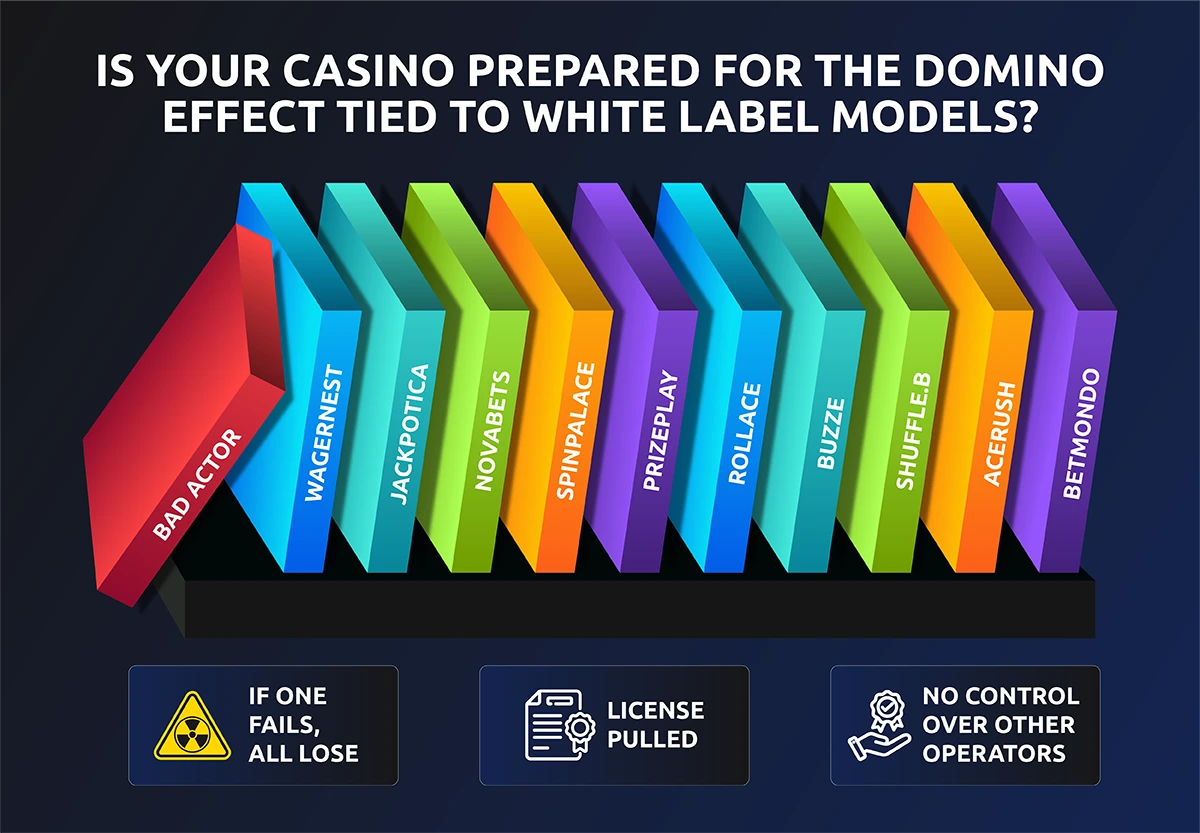
So you are opening someone else’s platform, but with your own brand marketing and player attention, white label, right? Amazing! The only catch? Another 100 casinos may use their license as well.
If just one operator on your platform messes up, the gambling commission can pull the main license. Everyone loses. That’s it. Game over for everyone!
What you need in a license:
- Legal framework to operate the client-facing business
- Ability to manage your own affiliate programs
- Freedom to develop your brand identity
What you DON’T need:You’re not the one dealing with technical compliance. That’s the platform provider’s headache. Things like software certification, game integration, and compliance with the gambling commission? Out of reach for you, and frankly, not your problem with a white label license. But this also means you’re not in control of your online casino license.
If you choose a regulated business model, be ready for extra license fees. The platform charges a premium to cover all those regulatory hoops. You’re not just getting a package, you’re getting locked into their platform, their rules, their version of what your site looks like.
Sure, white label is possible with a Curacao gaming license, Anjouan, Kahnawake, or Tobique. International gambling jurisdictions are more flexible, and many gaming operators choose these to obtain a license fast. Just keep in mind: while offshore licenses make things simple from a regulatory perspective, you’ll still pay a premium, and at the end of the day, you’re investing in a business that isn’t truly yours.
But step into a regulated market, like Romania or the UK, and things get brutal. Local regulators set stricter requirements for every type of license, especially white label. Here’s a real example: not long ago, a platform could add your domain under its B2C license and let you start offering gambling services in the UK. But soon, platforms realized the compliance and cash flow risks were out of control. They needed huge teams to manage operations and pass constant audits. Nearly all of them surrendered their B2C licenses because managing so many white label casinos was impossible.
In regulated markets, the cost for a white label is on a totally different level. Forget about paying 5-8% GGR (gross gaming revenue) for a turnkey Curacao solution. With a local license in the UK, that fee jumps to 15%, 16%, even 17%. The gap in license cost? Enormous.
See the pattern?
If you’re running a white label, paying for a premium online gambling license is just burning money on compliance that the platform is already covering. Double-paying for things you can’t control makes no sense.
Work with platforms licensed in practical jurisdictions: Curacao, Anjouan, Tobique. Always check what type of gaming license your provider holds before you sign any agreement or wire funds. With recent changes, even B2B platforms need their own license, so don’t get caught operating without a license and not even realizing it.
Why pay sky-high license fees just to fit inside someone else’s box? Choose the right jurisdiction, keep your costs down, and focus on building your brand, not theirs.
3. Game Providers (B2B)
If you’re creating and supplying games to gambling operators, you’re in the B2B license zone. You don’t deal with players directly, but that doesn’t mean you get to skip the paperwork.
What you need in a license:
- Technical certification for your RNG and game mathematics
- Indirect IP protection
- Testing and certification frameworks
- Ability to integrate with major platforms and directly with online casino platforms
First off, regulators will demand a technical certification for your RNG (random number generator) and your game math. If your numbers are off, or your RNG is dodgy, you won’t get far in the online gambling industry.
And don’t think you can “borrow” someone else’s work. If you show up with a copycat slot, say, a clone of Pragmatic Play or NetEnt, regulators will spot it instantly.
Your games will need to be tested by authorized labs, with certification documents to prove it. No certificate, no license. And don’t forget: integration with major platforms and casino operators is a must. If your technology can’t talk to theirs, your games will never make it to the gambling market.
4. Platform Providers (B2B)
If you’re the one building the tech backbone, the servers, software, payment pipes, game integrations, for online casinos, you’re a platform provider. You don’t deal with players, but your job is mission-critical for gambling operators.
What you need in a license:
- Technical security certifications
- Data protection frameworks
- Capability to support multiple operators
- Integration paths with payment and game providers
Basically, regulators want proof that your platform is secure, scalable, and able to connect with both payment providers and game studios, no exceptions. Without these fundamentals, you won’t even get through the door.
5. Affiliate Programs
Affiliates are the people bringing the players, not running the gambling games. You send traffic to casino operators, but you never touch the bets, the money, or the gambling activities themselves.
What you need:
- Often just a business license, or in some markets, a specific affiliate license
- Proper compliance with advertising regulations
- Commercial agreements with operators
Here’s where most people get confused. Since Affiliates aren’t casino owners and you as affiliate are not offering gaming software, and you’re not processing payments. You’re a marketer, right? Why in the world would you need to pay for an online gambling license?
Most of the time, you don’t. On the international side, working with offshore operators, even with big brands, affiliates do not need to obtain a gaming license.
But watch out for local rules. In some regulated markets, like Romania, affiliates are treated just like operators. If you want to promote a regulated online casino there, you’ll need an appropriate affiliate license, and yes, the cost can be hefty. That’s when you realize “just being a marketer” isn’t enough.
The Decision: How to Actually Compare Licensing Options
Let’s get practical. Below, I’ll break down the core factors I consider after helping over 500 operators find their ideal licensing fit. I’ll walk you through how to weigh these for your specific business model.
|
Parameter |
Weight |
Anjouan |
Curacao (GCB) |
Malta |
Isle of Man |
|
Initial Cost |
15% |
€30,000+ |
€100,000+ |
€100,000+ |
€120,000+ |
|
Annual Cost |
20% |
€25,000+ |
€60,000+ |
€70,000+ |
€100,000 |
|
Setup Time |
10% |
4-6 weeks |
5-8 months |
6-18 months |
6-18 months |
|
Payment Options |
15% |
Most Markets |
Most Markets |
Most markets |
Most markets |
|
Game Providers |
15% |
close to 100% |
close to 100% |
100% |
100% |
|
Compliance Burden |
10% |
Light |
Medium |
Heavy |
Very Heavy |
|
Market Restrictions |
15% |
Few |
Some |
Many |
Many |
Jurisdiction-Model Alignment: Matching Your Online Gaming License to Your Business
Let’s get practical for a second. Not every gaming license is built for every type of operator. It’s all about matching your business model to the right jurisdiction, otherwise you’re just burning cash on the wrong paperwork.
Tier 1: Premium Jurisdictions (Isle of Man, Malta)
Here’s who these licenses really make sense for:
- Enterprise-level operators with €10M+ starting capital
- Companies targeting super-regulated markets (think Germany, UK, Netherlands)
- Publicly traded firms that need to keep shareholders (and banks) happy
- Anyone planning to go public or sell in the future
- Operators who need banking relationships with major European institutions
Let me tell you a quick story. We had a client with a massive, multi-vertical gaming platform, sportsbook, casino, poker, the works, focused on regulated EU markets. For them, a Malta gaming license wasn’t just the official choice, it was the only appropriate license that fit their setup. Why?
Because Malta lets you set up a holding company for tax optimization. If you’re serious about the EU and you want to pay 5% corporate tax (compared to Italy or Spain), Malta is the proven route. That’s why for 20 years, it’s been the most successful brand in the business.
But the thing is, if you’re not chasing those super-regulated markets, or you don’t need old-school European banking, then the extra €100K+ you’ll spend is just vanity pricing. The gaming license cost is no joke, so before you get a gaming license in Malta or the Isle of Man, ask yourself, does my business model actually require it, or am I just paying for a shiny logo?
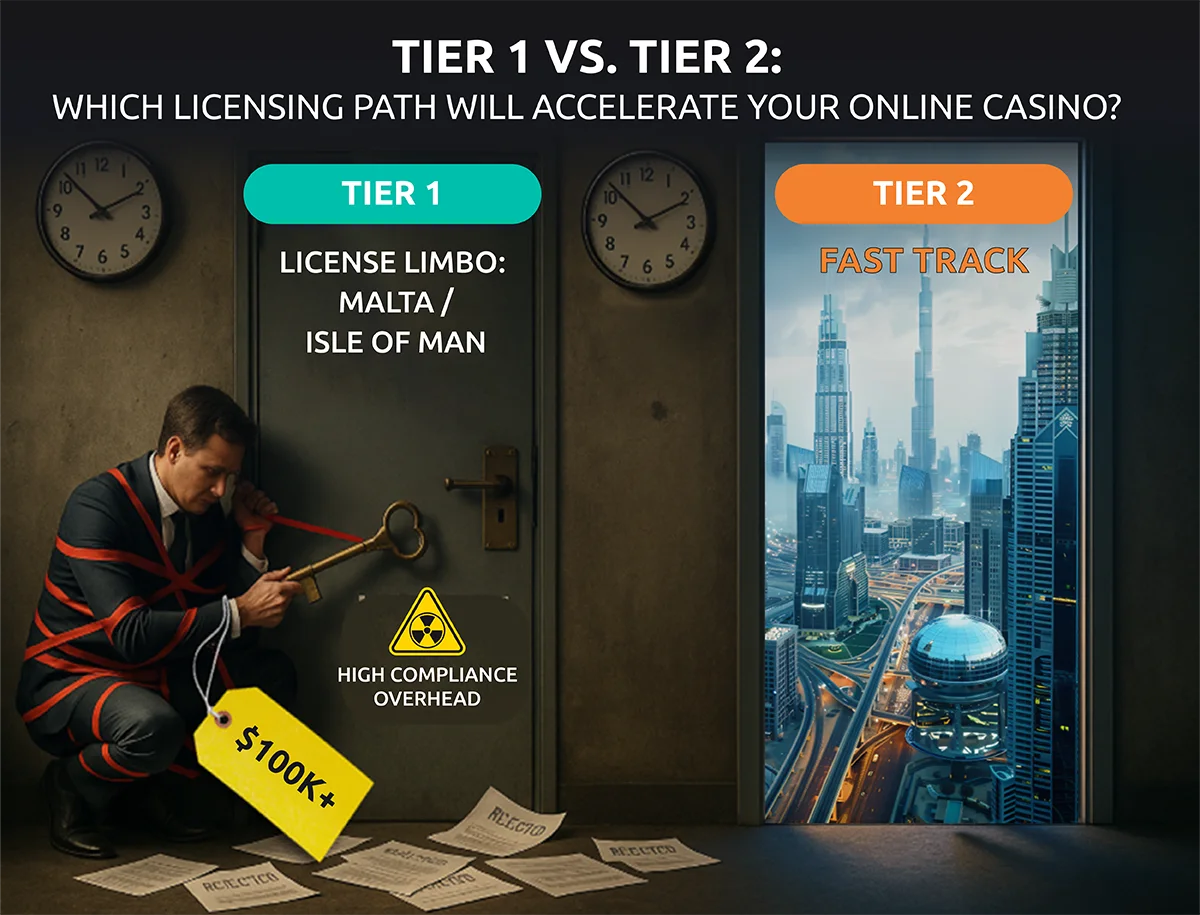
Tier 2: Cost-Effective Solutions (Anjouan, GCB Curacao, Tobique)
Here’s where things get interesting. Not every casino needs a premium badge and sky-high gaming license costs. For most startups, chasing an official Isle of Man license is like trying to run a marathon in flip-flops, you’ll burn cash, time, and patience.
Best suited for:
- Startups with capital between €100K and €5M
- Operators looking at fast-growing gambling markets in the world (LATAM, Africa, Asia)
- Businesses mixing regulated and gray markets
- Anyone who wants a quick launch and real ROI
- Companies that can’t afford to hire a small army just for compliance
And you know what’s wild? Some of the biggest names out there, Stake.com, Rollbit, BC.
Game, are running massive, multi-billion dollar operations with Tier 2 licenses. They never needed to start with a premium “official” license to build something huge.
Let me give you another real example:I was at the IGB Expo last year, talking outside with an operator who runs a casino gaming business. This guy’s operation is pulling in €40 million GGR a month. We’re talking big numbers. He told me they’ve been stuck in “license limbo” with the MGA for two years. Two years guys! They’re still waiting, still fighting for the paperwork… just for sport at this point.
But here’s the thing, they already had everything they needed to operate, and to be honest, the business never missed a beat. Cash flow? Solid. Team? Even more solid. All while waiting for an MGA license that just wasn’t happening.
So what did they do? They got an Anjouan gaming license. After two years wasted on Malta, it took just a couple months to get up and running with Anjouan. Suddenly, all the delays, audits, and headaches were gone. The license allows them to legally serve players in tons of markets and keep growing. They’re still chasing the MGA for fun, but in reality, they don’t need it, their Tier 2 license is more than enough.
Implementation Timeline: How Fast Can You Get a Gambling License and Start Your Casino Gaming Business?
Time to market is everything, especially if you’re a startup burning cash by the day. You can find all types of online gaming licenses, but what really matters is this: How long will it take before you’re live and actually making money?
Let’s compare the actual timelines you’re looking at:
|
Implementation Phase |
Anjouan |
Curacao (CGCB) |
Malta |
Isle of Man |
|
Application Processing |
4-6 weeks |
5-8 months |
6-18 months |
6-18 months |
|
Documentation Requirements |
Moderate |
High |
Very High |
Extreme |
|
Corporate Structure Setup |
Simple – Moderate |
Simple – Moderate |
Very Complex |
Very Complex |
|
Technical Compliance Audit |
Basic |
Moderate |
Extensive |
Extensive |
|
Go-Live Timeline |
2.5 months |
8-9 months |
7-18 months |
7-18 months |
Some licenses are fast. Others will make you wait 6, 10, even 18 months just for regulators to give the green light. And let’s be honest, every extra month is not just lost time, it’s lost opportunity, lost market share, and a bigger hole in your wallet.
Let me share a real story. Just this week, I was talking to a client from Budapest. Not exactly Silicon Valley, and his budget? Shoestring. But when he launched his online casino, things exploded…fast. He said, “Max, we saw 100 players right away. I go to sleep, it’s up to 200. I wake up and we have 800 players. We literally had to hit pause and rethink everything because it was happening too quick.”
That’s what happens when you get the timeline for obtaining a license right, you launch, you react, you adjust, you grow. You don’t sit around waiting for the license to be issued while your business dreams collect dust. With the right gaming license, you can actually test, fix, and scale on the fly. That’s how real growth happens.
Launching a gambling business without the right license, or waiting forever for the wrong one, can kill your momentum before you start. Find the appropriate license that lets you move fast, adapt, and build something real.
Compliance Resource Requirements: Why Gaming License is Essential for Sustainable Online Gaming
Here’s where most people trip up: getting a license is only the start. The real expense comes from ongoing compliance, and the differences are dramatic:
|
Compliance Requirement |
Anjouan |
Curacao (CGCB) |
Malta |
Isle of Man |
|
Dedicated Compliance Staff |
0-1 person |
2-3 people |
3-5 people |
3-5 people |
|
Annual Staff Cost |
€0-20K |
€50K-100K |
€100-180K |
€100-180K |
|
Reporting Frequency |
Annual |
Quarterly |
Monthly |
Monthly |
|
AML/KYC Complexity |
Basic |
Moderate |
Complex |
Very Complex |
|
Annual Audit Costs |
€0-5K |
€10-25K |
€30-50K |
€50K+ |
Take a look at the numbers in the table below and ask yourself, are you really ready for this?
If you’re looking at Malta, for example, you’ll need a compliance team, sometimes 3, 4, or even 5 full-time staff. Each one could cost €60K a year (or more). And we haven’t even touched the IT stuff yet.
Premium gaming license requirements often mean dedicated servers, top-shelf security protocols, and constant technical audits. For any normal startup, that’s an extra €50–100K a year, just for the privilege of keeping your license in good standing.
Can you honestly justify those numbers, based on your business model and the markets you want to reach? Because if you can’t, you’re going to feel the pain. There are ways to get a gambling license that don’t require you to build an entire compliance department from scratch. But with the top-tier licenses, you’re not just paying once. You’re paying, and paying, and paying, every year, just to keep your doors open.
Making the Decision: How Licenses Are Issued and Matched to Your Online Gambling Business
Let’s put everything together in a practical framework I use when someone asks me how to choose the right online gaming license. Don’t overthink it, just answer these:
- What’s my total budget for licensing in year one? – Under €50K: Focus on an Anjouan or Curacao license – €50K–150K: Consider Curacao or Malta – €150K+: Malta or Isle of Man is viable if needed
- Which markets am I targeting? – Asia/LATAM/Africa: Tier 2 licenses are essential for fast entry – Mixed markets: Still Tier 2 is usually the best fit – Regulated EU/UK: You’ll need a Tier 1 license, an official license is required to operate legally
- What’s my timeline to launch? – ASAP (1–3 months): Only Anjouan or Tobique can deliver that speed – 5–8 months: Curacao or Kahnawake may work – 6–18 months: All options are technically possible, but opportunity cost is real while you wait for licenses to be issued
- What’s my compliance capacity? – Minimal (0–1 person): Stick with Tier 2 to avoid heavy ongoing gaming license requirements – Full compliance department: Any tier is workable
- What’s my banking/payment strategy? – Crypto-focused: Almost any license allows this, just check for restrictions in places like the MGA – Mix of crypto and fiat: Tier 2 licenses usually cover it – Traditional banking: You’ll want to plan carefully, but both Tier 1 and Tier 2 licenses allow operators to legally offer gambling services to players
Conclusion: The Only Online Gaming License That Matters Is the One That Fits
After helping more than 500 operators obtain a gambling license that actually fits, I can say one thing for sure: the best license isn’t the fanciest, or the one that makes your lawyer smile. It’s the one that matches your business, your markets, and your resources…no more, no less.Ask yourself, do you really want to pay €300,000 extra over three years for an “official” Malta license if an Anjouan license lets you do everything your business needs? In the online gaming industry, for some operators, that premium makes sense. But for most? Not even close.
Here’s what we see when clients stop chasing prestige and choose the right license for their gaming platform and business plan:
- They go live 3–5× faster
- They cut compliance costs by 60–80%
- They get the same games and payment providers
- The player experience is identical
- Profitability goes through the roof
The gaming industry is built on confusion, so many people are convinced they need to overpay, over-comply, or chase a big-name license “just in case.” Now you know better. You have the framework to make a decision that’s actually based on your business, not just on what everyone else is doing.
If you want help finding the right fit for your operation, I’m happy to chat. Whether you’re new to obtaining an online gambling license or just want to avoid the classic mistakes, reach out. And if you want our License-Business Model Matching Tool (normally €1,500), it’s free when you book a consultation.
Always remember: The right gaming license allows your business to grow, without drowning you in unnecessary costs, staff, or headaches. Pick the license that lets you build, not just one that looks good in a frame.
If you’ve read this far, you’re already ahead of 90% of new operators, don’t waste it by overpaying for the wrong license.