
Tobique Gaming License 2026: Complete B2C and B2B Operator’s Guide
The Tobique gaming license 2026 is one of the fastest-growing licensing options for online casino founders, sportsbook operators, crypto casino teams, game studios, and B2B iGaming providers that want a practical route to market without the weight of older European regimes, with more than 168 licensed entities currently operating under the framework.
Tobique has become especially relevant following recent global licensing changes, as operators now seek a setup that is fast, clear, commercially manageable, and still serious enough to support real banking, payments, compliance, and platform partnerships.
For B2C and B2B projects, the Tobique License B2C B2B framework gives founders a way to launch under a modern offshore iGaming structure with 0% GGR tax, clear annual costs, and a regulatory process that rewards preparation.
A strong application can move quickly, while a weak one will still get delayed, so the real advantage belongs to operators who treat licensing as part of their business build, not simply as a badge to place in the footer.
We’ve guided iGaming founders from application to launch, securing over 500 licenses and building setups that meet regulatory and operational requirements. At License Gentlemen, we focus on clear, practical support so founders understand each step. If you’re wondering “is LicenseGentlemen legit,” we are available to address any inquiries directly and provide clear, authoritative guidance.
In this guide, we break down everything you need to know about the Tobique gaming license in 2026, including costs and timelines, requirements, compliance, market access, payment setup, and launch strategy.
What the Tobique Gaming License Is and Who Issues It
The Tobique gaming license is an online gambling authorization issued under the Tobique First Nation gaming framework and supervised by the Tobique Gaming Commission. The legal basis lies in the Tobique Gaming Act 2023, which established a modern licensing route for remote gaming businesses seeking to operate internationally under a recognized regulatory framework.
Tobique is connected to the Tobique First Nation, an Indigenous government in Canada with its own regulatory authority for gaming activities. The Tobique Gaming Commission, often shortened to TGC, reviews applications, checks ownership and compliance materials, evaluates business models, and decides whether an operator or supplier is suitable for licensing.
A useful way to look at Tobique is through the eyes of your future partners. A PSP will ask whether your license matches your target markets. A bank will ask whether the company and UBO file make sense. A platform provider will ask whether the license category supports the activity you want to run.
Tobique addresses many of these concerns before an application reaches banks, PSPs, game providers, and other commercial partners. Its balanced regulatory approach gives partners greater confidence that the operator has already undergone ownership, business-model, and compliance due diligence by the regulator.
License Types: B2C and B2B Software
Choosing the correct Tobique license type matters because the regulator considers who controls the player relationship, who supplies the technology, and who bears the operational risk. The main paths are B2C remote gaming and B2B software.
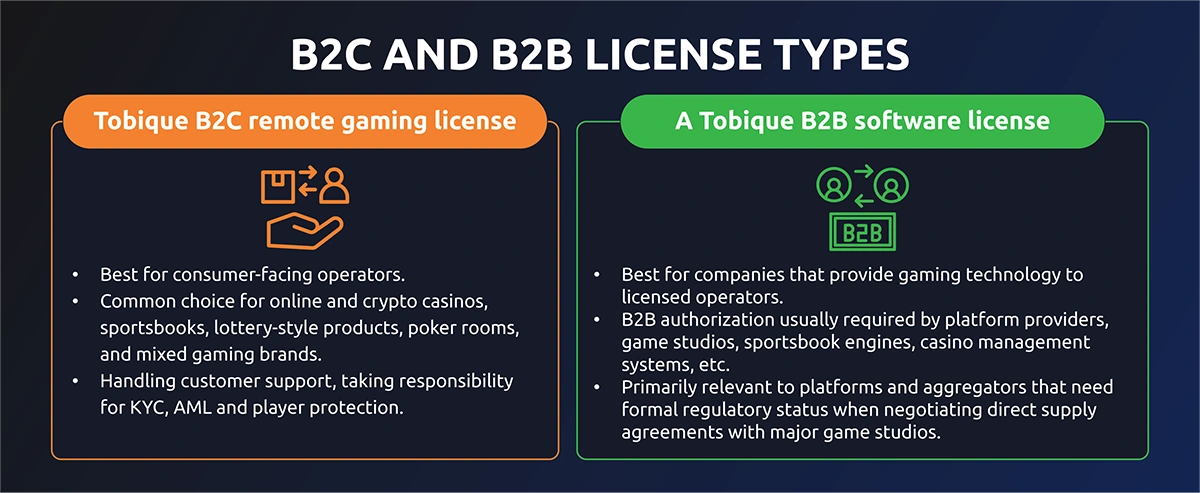
A Tobique B2C remote gaming license is for consumer-facing operators. Online casinos, sportsbooks, betting sites, crypto casinos, lottery-style products, poker rooms, and mixed gaming brands usually operate on a B2C model, accepting players, managing wallets, managing bonuses, handling customer support, and taking responsibility for KYC, AML, responsible gaming, and player protection.
A Tobique B2B software license is for companies that provide gaming technology to licensed operators. Platform providers, game studios, sportsbook engines, casino management systems, odds tools, and aggregation layers may require B2B authorization when their products are part of the licensed gaming operation.
However, supplying software to a Tobique-licensed B2C operator does not automatically mean the supplier needs its own B2B license. The B2B authorization is primarily relevant to platforms and aggregators that need formal regulatory status when negotiating direct supply agreements with major game studios.
Operators should also be cautious of claims about being an “approved vendor” of Tobique. The Commission does not issue public approved-vendor certificates, badges, or statuses. Instead, applicants disclose their platform, payment gateways, CRM systems, and other backend counterparties during the application.
The Commission then conducts fit-and-proper, background, and adverse-media checks internally with more than 1,000 technology and service counterparties having been cleared through this backend process.
Having successfully helped more than 500 online casinos secure gaming licenses, LicenseGentlemen can assess your business model, recommend the right Tobique license category, and identify potential issues before submission. Book a free consultation call to discuss your project and licensing options.
Key Advantages of the Tobique License in 2026
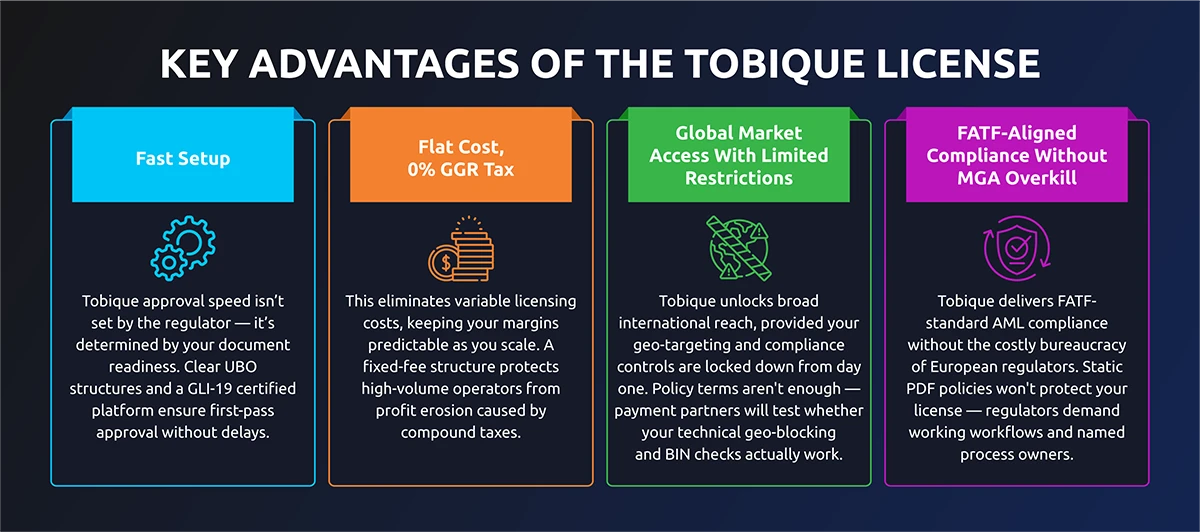
Tobique has become attractive because it offers serious operators a faster route to market without forcing them to bear the cost base of a mature European license. The strongest advantages are speed, predictable costs, 0% GGR tax, broad market access, and compliance rules that are serious without becoming overly burdensome.
For many founders, Tobique sits between low-cost offshore licenses and more demanding regimes like Curaçao. A strong Tobique project can move from initial review to licensing faster than most traditional options, but speed depends on the quality of the applicant. The regulator wants to understand who owns the business, where the money comes from, what the platform does, which markets the operator wants to serve, and how player risk will be controlled.
The hidden advantage is planning flexibility. Tobique can work for a startup entering open international markets, a crypto casino seeking a cleaner regulatory position, a game studio seeking B2B credibility, or an operator moving away from informal offshore setups. The license performs best when the founder already knows how traffic, payments, platform, and compliance will connect.
Fast Setup — If You’re Actually Prepared
Tobique can move quickly, but the fastest applications are usually the ones that look boring from a compliance perspective. Clean ownership, a signed platform agreement, clear source of funds, ready policies, and organized technical documents make the review easier to approve.
Delays usually stem from missing documents, unclear UBO structures, unsigned platform contracts, insufficient explanations of the source of funds, or incomplete compliance staffing. Founders often focus only on the licensing timeline, but the better question is whether the project is application-ready.
A clean file can move through preliminary review, full submission, due diligence, and issuance with fewer questions. A messy file can cost weeks because a single missing agreement or an unexplained shareholder payment forces the review team to pause.
Before you ask how fast Tobique is, ask whether your file can survive the first review without follow-up questions. The strongest applications have one clear ownership chart, one clear money trail, one clear platform flow, and one clear market plan.
One detail many first-time applicants overlook is the platform itself. Tobique asks applicants to identify their platform provider and expects the platform to be GLI-19 certified, so confirming this early can prevent a hidden technical issue from delaying an otherwise strong application.
Flat Cost, 0% GGR Tax
Tobique’s flat-fee model with 0% tax on Gross Gaming Revenue helps operators protect margins as their businesses grow. For startups, the absence of a GGR percentage makes forecasting easier because licensing costs do not increase with every rise in revenue.
Revenue-based taxes can become painful as a casino or sportsbook scales. A fixed-licensing model gives founders more control over cash flow, especially when payment fees, affiliate commissions, platform fees, bonuses, chargebacks, and compliance costs are already eroding net margin. Tobique does not remove normal business costs, but the 0% GGR structure keeps the licensing layer predictable.
The practical benefit appears in the financial model. A founder can estimate monthly burn, platform fees, PSP fees, affiliate spend, compliance support, game fees, and renewal exposure without adding a variable gaming tax to every revenue scenario. For high-volume brands with thin margins, that difference can decide whether the model survives after bonuses and payment costs.
Global Market Access With Limited Restrictions
Tobique gives operators broad international reach across open and emerging markets, provided restricted territories are blocked and local laws are respected. No offshore license gives permission to target every country, so the market plan should be built before the website goes live.
Market access should be planned by country, language, payment method, advertising channel, and risk level. A Tobique-licensed casino may be suitable for many international markets, but operators must avoid prohibited jurisdictions, sanctioned territories, and countries with mandatory local licensing. Geo-blocking, payment filtering, affiliate controls, and terms of service need to match the market plan.
Beyond publishing a restricted-country list in the terms and hoping for the best, good operators should align the list with PSP rules, affiliate instructions, KYC procedures, IP blocking, payment BIN checks, and customer support scripts. The regulator may review the policy, but payment partners will test whether the policy actually works.
FATF-Aligned Compliance Without MGA Overkill
Tobique expects AML, KYC, source-of-funds checks, risk monitoring, and responsible gaming controls, but the framework is lighter than those of highly administrative European regimes. Operators still need proper compliance, yet they are not forced into the same level of bureaucracy that can make Malta or similar licenses expensive for early-stage teams.
FATF-aligned compliance requires the operator to understand customer risk, monitor suspicious activity, identify beneficial owners, maintain records, and escalate issues through the MLRO. A PDF policy with no working process behind it will not protect the license when reports, complaints, or payment issues arise.
A practical compliance setup should show who checks players, when enhanced due diligence starts, how deposits are monitored, how crypto wallets are screened, who reviews unusual withdrawals, and how suspicious activity is escalated. While a huge compliance department can be brushed off initially, the operator must, at the very least, show that someone competent owns the process.
Tobique License Cost Breakdown in 2026
The realistic first-year investment for a Tobique license in 2026 is usually €50,000 to €60,000, including the full structure. The license alone is only one part of the cost, because founders also need company setup, localized legal work, banking configuration, technical documentation, compliance staffing, reporting tools, and ongoing maintenance.
A proper Tobique budget should include government fees, preliminary review, application preparation, DLAG compliance access, renewal planning, company formation, compliance officer or MLRO support, payment setup, and professional assistance. LicenseGentlemen treats cost planning as part of the licensing strategy because underbudgeting causes delays just as often as weak documentation.
The safest way to budget is to separate regulatory cost from launch cost. Regulatory cost gets the application through the door. Launch costs make the license commercially viable. A founder who budgets only for the license may still be stuck without banking, PSP approval, game activation, compliance staffing, or a finished website.
Initial Government Fees (~€36,000)
The main upfront regulatory cost is the government filing and licensing component, which is typically around €36,000 for the full application stage. The amount covers the core regulatory filing and license-acquisition process, though exact project costs may vary depending on the license type, applicant structure, and additional requirements.
Founders should separate government fees from professional, corporate, technical, and banking costs. A common budgeting mistake is assuming the filing fee equals the full launch budget. In practice, the total first-year cost, including the corporate structure, licensing, compliance, application preparation, and professional work, is usually between €50,000 and €60,000.
A practical budgeting rule is to treat every answer in your application as a claim you will need to prove with evidence. In practice, that means ownership details should be backed by corporate documents, sources of funds by bank records, games by certificates, platform agreements by signed contracts, and payment plans by real PSP options.
Mandatory DLAG Compliance Package (€7,000/year)
The DLAG compliance package is approximately €7,000 per year and supports the digital compliance and reporting layer, the application, and ongoing supervision. Operators should treat the DLAG package as a recurring compliance infrastructure cost, not as an optional add-on.
The package helps organize regulatory communication, application handling, and compliance reporting workflows. A licensed operator must be able to show that reporting and monitoring are not being handled casually through scattered files and informal messages.
The better way to view DLAG is as part of your operating stack. Founders already budget for the platform, CRM, payment tools, and affiliate tracking, but compliance infrastructure is often pushed to the side. In regulated gaming, reporting infrastructure can be just as important as the cashier.
Annual Renewal (~€25,000)
Annual renewal for the Tobique license is approximately €25,000 and is required to keep the authorization active. Renewal planning should begin well before the license anniversary because the regulator may expect updated company records, compliance reports, policies, and confirmation that the business remains in good standing.
Renewal is easier when the operator has kept clean records throughout the year. Missed reports, unresolved player complaints, unclear payment flows, or changes in ownership can make renewal more difficult. A license should be maintained monthly, not repaired at the end of the year.
A founder-friendly way to manage renewal is to keep a monthly license file. Add ownership changes, PSP changes, platform updates, complaints, SAR reviews, responsible gaming actions, supplier updates, and reporting confirmations as they happen. Waiting until renewal month creates unnecessary pressure and usually costs more in professional cleanup time.
Tobique vs Anjouan, Curaçao, and Malta
Tobique is best compared by asking what the operator needs from the license, rather than just comparing fees. Anjouan may suit very lean entry projects, Curaçao has stronger legacy recognition but a heavier updated framework, and Malta remains the premium European route for operators with larger budgets and deeper compliance capacity.
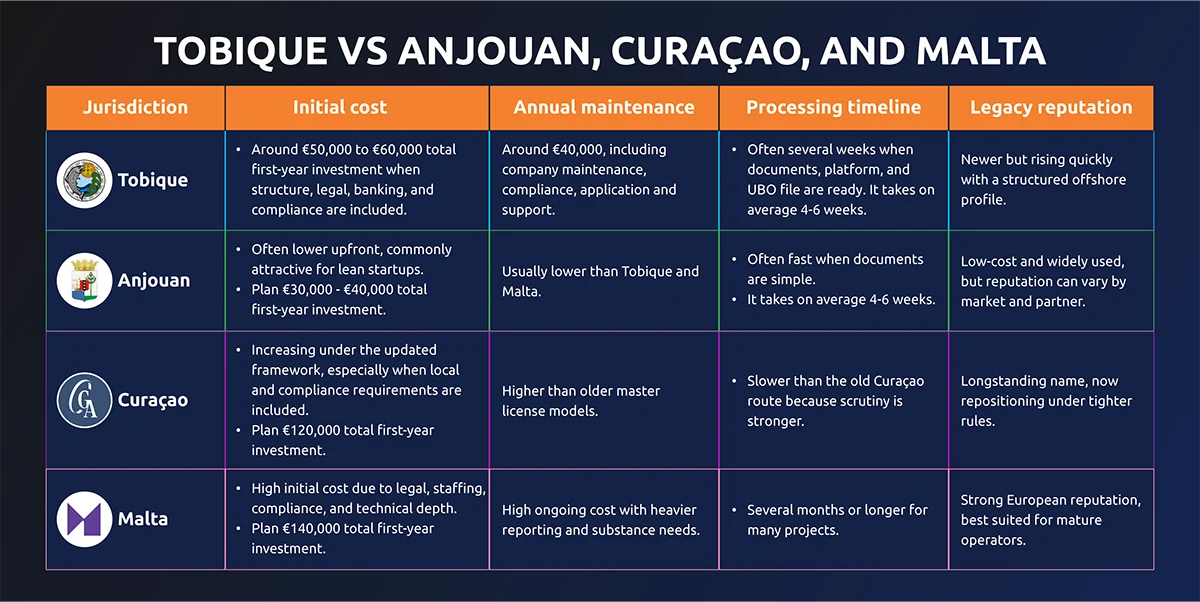
For early-stage founders, the real comparison is usually Tobique versus Anjouan. For operators with bigger payment, investor, or reputation needs, the comparison becomes Tobique versus Curaçao. Malta enters the conversation when the business has the budget, staff, and strategic reason to carry a European compliance structure.
Application Process Step by Step
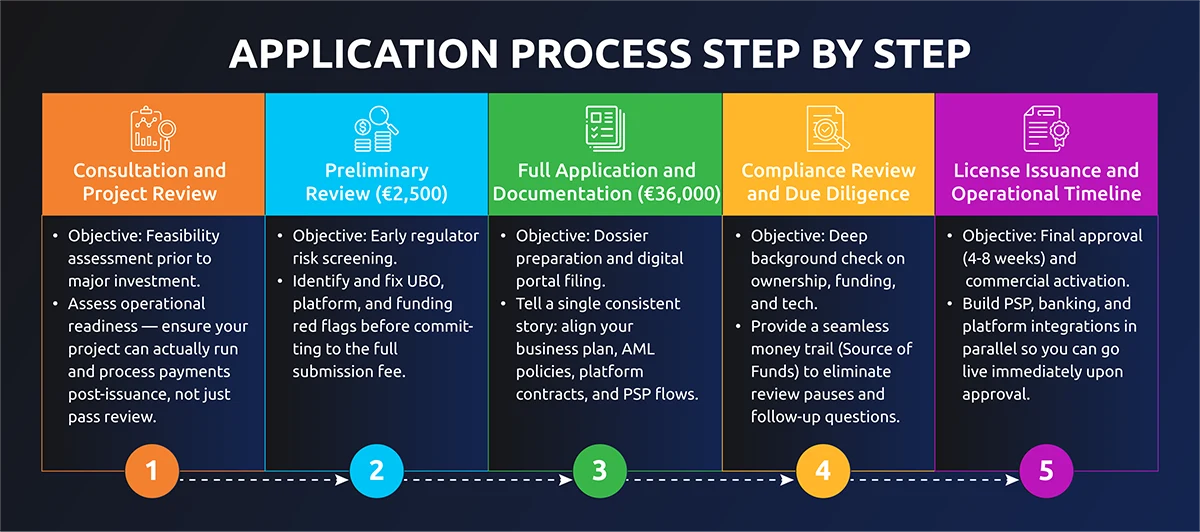
A Tobique application works best when the licensing process is treated as a structured project rather than a document upload exercise. The process starts with project review and ends with license issuance after documentation, due diligence, compliance checks, and technical readiness are complete.
Founders seeking a Tobique gambling license should begin by confirming whether the model fits B2C or B2B software. A good application is built in an orderly manner. First, the project is reviewed. Next, the preliminary filing confirms viability. After that, the License Gentlemen team prepares the full dossier, making life easy by getting everything correct from the beginning to reduce failure chances and increase speed.
The strongest applications usually move faster because all parties see the same story. The regulator sees a clean license file. The PSP sees a clear payment flow. The platform provider sees a realistic launch plan. The bank sees a company structure that can be explained in two minutes.
Consultation and Project Review
The first review should confirm whether Tobique is a good fit for the project before the founder spends money on the full application. The review should cover the product, ownership, target markets, platform provider, payment plan, crypto exposure, compliance staffing, and launch timeline.
A founder with a casino concept but no platform contract, KYC flow, or source of funds file is not ready for submission. A founder with a clear operating plan, signed supplier agreements, and organized shareholder documents can move faster because the main risk points have already been answered.
At LicenseGentlemen, the first practical question is rarely “Can you get the license?” The better question is “Can you operate after the license is issued?” A project with no realistic PSP route, weak supplier agreements, or restricted-market traffic may need restructuring before filing.
Preliminary Review (€2,500)
The preliminary review costs approximately €2,500 and checks whether the application is viable before the full license fee is committed. The review helps identify problems with ownership, documentation, business scope, or regulatory fit before the project enters the more intensive submission stage.
Preliminary review is useful because not every project should proceed immediately. A weak UBO file, risky market plan, unclear crypto flow, or unsuitable platform setup should be corrected early. Fixing issues before submission is always easier than explaining them after the regulator has already raised concerns.
The preliminary stage is also where founders should be honest about sensitive points. Previous gambling activity, crypto-heavy funding, nominee structures, multiple holding companies, or aggressive market plans can often be handled, but only when they are explained clearly from the beginning.
Full Application and Documentation (€36,000)
The full application stage is where the main licensing dossier is prepared and submitted through the digital DLAG application portal. The dossier should clearly explain the business, owners, funds, platform, games, compliance framework, risk controls, and operational plan.
Typical documents include certified passports, proof of address, CVs, corporate registers, ownership charts, source-of-funds documents, business plan, AML policy, responsible gaming policy, terms and conditions, privacy policy, platform agreement, game list, RNG certificates, payment flow description, and compliance officer details.
A strong dossier should feel consistent from page one to the final attachment. If the business plan states that the operator will target Latin America, the payment strategy should support deposits from that region. If the website says crypto-first, the AML policy should explain wallet screening and blockchain monitoring. If the platform agreement says one company controls the wallet, the application should not describe another company as the operator of record.
Compliance Review and Due Diligence
Compliance review and due diligence check whether the applicant is suitable to hold a Tobique license. The regulator looks at shareholders, directors, UBOs, funding sources, corporate structure, gaming model, payment risks, AML controls, and the operational team.
Due diligence tests whether the business story makes sense. A crypto casino without a blockchain monitoring plan, a sportsbook without an odds supplier, or a B2B provider without technical documentation creates avoidable concern. The application should answer obvious questions before they are asked.
Founders should prepare for deeper questions around the source of wealth when funds come from crypto trading, gaming affiliates, previous offshore companies, private loans, or third-party investors. The money trail should be explained without gaps.
License Issuance and Operational Timeline
License issuance can be completed within several weeks when the file is prepared, although 4 to 8 weeks is a safer planning range for many operators. Final timing depends on document quality, regulator questions, platform agreement readiness, due diligence results, and how quickly the applicant answers requests.
Operational launch should not wait for the license to be issued before beginning banking, PSP, platform, compliance, and website preparation. A license gives legal authorization, but the business still needs working payments, configured risk controls, tested games, approved terms, and a live compliance process before accepting players.
A smart timeline runs licensing and commercial readiness in parallel. Waiting until approval to start PSP conversations, game activation, website finalization, or compliance onboarding can turn a fast license into a slow launch.
The Platform Agreement Bottleneck (Start Early)
The platform agreement is one of the most common causes of Tobique application delays because the regulator wants the software arrangement to match the licensed business model. Operators should secure platform, game aggregation, sportsbook, wallet, and hosting agreements early, not after submission.
A casino founder may believe the license is the main item, but the platform contract often proves whether the business can actually operate. The agreement should show who owns the player relationship, who controls the wallet, who provides games, where data is hosted, how disputes are handled, and whether the platform can support KYC, AML, limits, exclusions, reporting, and responsible gaming tools.
Game aggregation deals also matter because many suppliers will not activate content without seeing the licensing path, company structure, and compliance setup. Start those conversations early so the license, platform, payments, and content stack move together.
Before signing a platform agreement, confirm that the provider has experience with Tobique, can produce technical documents quickly, supports your target markets, allows direct PSP integrations, and holds valid GLI-19 certification. Obtaining GLI-19 certification during the application process can significantly extend the licensing timeline, so choosing the right platform from the start is critical.
An accessible platform can quickly become expensive if it blocks banking, delays game activation, or cannot produce the compliance reports required by the regulator. Reach out to LicenseGentlemen for a readiness check before applying, and we can help confirm whether your platform, documentation, and operating structure are prepared for the Tobique licensing process.
Requirements: UBO, Business Plan, Source of Funds
Tobique license requirements in 2026 focus on clear ownership, credible funding, a real business plan, and documents that prove the applicant can operate responsibly. The regulator needs to know who controls the company, where the money came from, what the business will offer, and how risk will be managed.
The UBO file should include all ultimate beneficial owners, shareholders, directors, and controlling persons. Certified passport copies, proof of address, CVs, corporate documents, ownership charts, and evidence of source of wealth are usually required. Sources of funds can include salary income, dividends, proceeds from business sales, investment records, crypto sale records, bank statements, or audited company accounts, depending on the applicant.
The business plan should be practical. It should explain products, target markets, traffic strategy, payment methods, expected revenue, bonus approach, AML risk, responsible gaming controls, staffing, outsourcing, and launch roadmap. LicenseGentlemen usually strengthens this section because a clear business plan helps the regulator, banks, PSPs, and platform providers understand the same project in the same way.
A founder should avoid writing the business plan like a pitch deck. The regulator needs to see how the operator will acquire players, verify users, process payments, detect abuse, handle disputes, block access from restricted countries, and remain funded during the first operating year.
Compliance Officer and MLRO Requirements
A Tobique license applicant needs responsible compliance oversight, including a Compliance Director or compliance lead and a Money Laundering Reporting Officer. The MLRO is responsible for AML escalation, handling suspicious activity, monitoring procedures, and ensuring the operator’s policies work in practice.
A full-time senior compliance hire may not be realistic for every startup, especially during the pre-launch stage. Tobique does not apply a fixed deposit, revenue, or GGR threshold that automatically forces an operator to move from outsourced compliance to an in-house MLRO. Instead, the compliance structure is expected to develop alongside the business.
During the launch phase, when the platform has no active revenue, the UBO may serve as the designated MLRO to keep initial overhead under control. Once the operation begins generating active GGR and meaningful transaction volume, a qualified MLRO should be appointed.
Outsourced or part-time iGaming compliance officers can be a sensible option when the person has relevant experience, understands AML monitoring, maintains records, and responds quickly to issues. Outsourcing remains permissible as the operator grows and the decisive factor is whether the individual or compliance team has a documented track record in iGaming AML, banking compliance, or risk management. The Commission reviews the proposed MLRO’s CV directly before approving the appointment. The important point is accountability, as a name on paper with no operational involvement will not be enough.
The compliance function should cover KYC checks, enhanced due diligence, source-of-funds review, player risk scoring, transaction monitoring, sanctions screening, responsible gaming escalations, complaint handling, and monthly reporting. Founders who outsource should still understand the process because the license holder remains responsible.
If a PSP, regulator, or banking partner asks who reviews suspicious player activity on Friday evening, the operator should have a real answer. A strong MLRO setup includes decision authority, response times, escalation rules, and access to transaction data.
Technical Readiness: Website, Platform, and Game Certification
Technical readiness means the regulator can see a product that is fair, controlled, and ready to operate under the license. The website, platform, games, RNG certificates, security controls, and responsible gaming tools should be ready for review before launch pressure starts.
The website should include terms and conditions, a privacy policy, AML and KYC wording, a responsible gaming page, bonus rules, a complaint process, restricted jurisdiction notices, and clear company and license information. The platform should support identity checks, player limits, self-exclusion, transaction monitoring, bonus controls, audit trails, and reporting exports.
Game certification is especially important for casino products. Random Number Generator verification documents, game certificates, supplier approvals, and aggregation agreements help prove that games are fair, tested, and supplied through a legitimate chain. Sportsbook projects should include details on odds providers, risk management procedures, bet settlement rules, and market suspension controls.
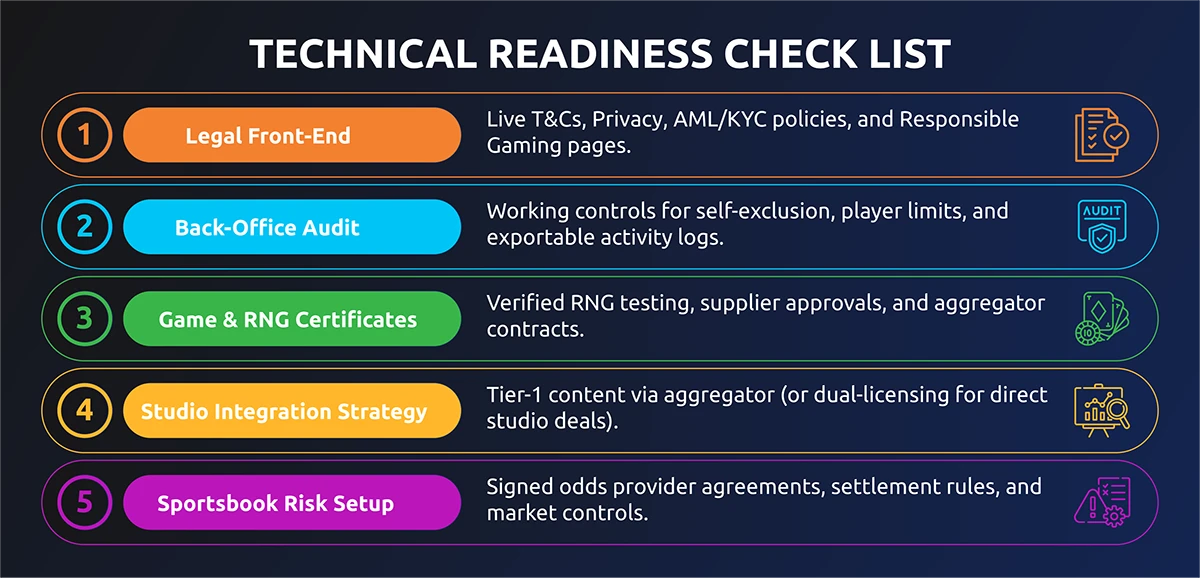
From a content-access perspective, Tobique generally performs at the same commercial level as Anjouan when games are obtained through an established aggregator. Operators can typically access major tier-one content, including Evolution titles, through a properly licensed aggregation partner.
The limitation appears when an operator wants to contract directly with a major studio. Some leading suppliers currently reserve direct integrations for jurisdictions with a larger established merchant base, meaning a Tobique operator may be accepted through an aggregator but not offered a direct studio agreement.
Operators seeking to remove aggregation fees or negotiate directly with top-tier studios may therefore need an Anjouan structure or a dual-licensing strategy combining Tobique and Anjouan.
Technical readiness should also include evidence that the operator can produce reports. Many founders focus on the front-end design, but regulators and PSPs care about the back office. Player history, deposits, withdrawals, limits, KYC status, bonus abuse markers, and suspicious activity notes should be easy to export and review.
LicenseGentlemen has extensive experience helping operators prepare these technical, compliance, and documentation requirements. We can coordinate the process and identify gaps, allowing you to stay focused on launching and running your business.
Ongoing Compliance and Reporting Obligations
Tobique reporting obligations require licensed operators to maintain regular compliance records, submit required reports, and keep the regulator informed about material changes. A license holder should expect monthly compliance work rather than occasional paperwork.
Player verification begins when the account is created, although full KYC does not always need to be completed before the player can begin using the platform. The operator must complete identity verification as soon as the first applicable trigger is reached, that is either 30 calendar days after the player’s initial deposit, cumulative wagering of €2,000, or the first withdrawal request.
The wagering trigger is based on total betting activity rather than the amount deposited. For example, a player who deposits €500 and cycles more than €2,000 through casino games must complete KYC immediately, even when this occurs on the first day. The operator’s platform and compliance workflow should therefore track account age, cumulative wagering, and withdrawal activity automatically rather than relying on manual review.
Ongoing obligations can include AML reporting, transaction monitoring records, player complaints, responsible gaming incidents, suspicious activity reviews, game or platform updates, payment changes, ownership changes, and annual renewal materials. The regulator may ask for evidence that policies are actually being applied, which means operators need logs, records, and internal accountability.
A Tobique gaming license can be suspended or revoked if the operator provides false information, hides ownership, fails to meet AML obligations, serves prohibited markets, ignores reporting obligations, uses uncertified games, changes platforms without approval, fails to pay fees, or creates serious player protection issues. The easiest way to protect the license is to run compliance as part of normal operations, not as an emergency task before renewal.
A good internal rhythm includes monthly compliance reviews, quarterly policy reviews, and immediate reviews after any major change in PSP, platform, game supplier, UBO, or target market. Regulators dislike surprises, and payment partners dislike them even more.
White Label Under Tobique: When It Makes Sense (and When It Doesn’t)
Under the Tobique framework, a white-label arrangement generally means that the platform or service provider holds both the required B2B and B2C licenses and is authorized to offer white-label services. As the brand operator, you work under the platform provider’s B2C license rather than holding your own independent license.
In this model, the platform provider controls the core licensed operation, including the platform, payments, compliance, player accounts, data, game suppliers, and operational decisions. Your role is largely focused on branding, player acquisition, and marketing, which means you do not have full control over the business infrastructure or the player relationship.
White-labeling under Tobique can make sense for founders who want faster market entry with shared infrastructure, but it should be treated as a launch shortcut rather than a permanent substitute for a proper licensing strategy. The model works best when the founder needs to test markets, validate traffic, or launch with a smaller operational team.
White labels can reduce early pressure because platform, games, payments, support, and compliance tools may already be bundled. However, in this setup, you should be willing to trade off control. The brand may have less freedom over PSPs, game suppliers, bonus rules, markets, data, compliance decisions, and long-term valuation. A white-label setup can also become expensive as the operator scales and revenue-share fees begin to outweigh the savings.
An independent Tobique license makes more sense when the operator has a serious budget, wants direct supplier relationships, needs stronger banking options, plans to raise investment, or wants to own the full player relationship. A clear upgrade trigger is usually revenue stability. When the brand has proven acquisition, retention, and payment performance, moving from white label to its own license can improve control and margins.
The warning sign is when the white-label provider controls every critical lever. If the founder cannot choose PSPs, negotiate better game fees, access player data properly, adjust risk rules, or move the brand without disruption, the structure may become a ceiling rather than a launchpad.
Restricted Jurisdictions and Market Access
A Tobique-licensed casino can serve many international markets, but it must block restricted countries and avoid markets where local licensing is required. Operators should build the market plan around permitted traffic, payment availability, advertising rules, sanctions risk, and the regulator’s expectations for restricted territories.
Restricted jurisdictions commonly include sanctioned countries, high-risk territories, and countries with strict local gambling monopolies or local license requirements. Operators should not accept players from the United States, United Kingdom, Ontario (Canada), New Brunswick (Canada), and other FATF restricted countries unless separate legal approval is in place.
In practice, geo-blocking is mandatory as the website should use IP blocking, country selection controls, document checks, payment BIN filtering, VPN detection where possible, affiliate restrictions, and terms that clearly prohibit players from restricted countries. A market list should also be reviewed regularly because laws change and payment access can shift quickly.
The Commission follows an operational approach instead of relying on complaints. It monitors active network connections and jurisdictional IP traffic through backend systems without accessing players’ personally identifiable information, allowing the regulator to distinguish occasional restricted-market activity from a genuine failure of the operator’s controls.
A small number of isolated visits, such as users arriving through an organic social media link, would not be treated the same as deliberate market targeting. Risk increases when restricted-jurisdiction traffic becomes consistent. When approximately 10% to 30% of total traffic originates from a prohibited market, the operator should expect a formal request for clarification, and failure to explain the activity or implement effective geoblocking can result in immediate license revocation.
The internal market list should be more detailed than the public restricted-country list. Public terms can say who is blocked. Internal operations should explain how the block works, which PSP rules apply, which affiliates are allowed to promote, and who reviews edge cases when a player appears to be in one country but documents show another.
Payments, Banking, and Offshore Company Setup
Payment and banking readiness often decide whether a Tobique license becomes a working business or an unused approval. The license only works commercially when the operator can move money, accept deposits, pay winners, and meet PSP due diligence requirements.
High-risk merchant accounts are available for gaming operators, but approval depends on the license, ownership, website quality, chargeback controls, processing history, target countries, and AML setup. In practice, PSP approval rates for well-prepared Tobique operators are broadly comparable to those seen under Curaçao and Anjouan. However, no offshore gaming license guarantees acceptance by every processor.
Some European and LATAM PSP compliance teams still rely on outdated jurisdiction lists and may need additional information before recognizing the framework. New operators may also be declined when they cannot demonstrate expected processing volume, a credible acquisition model, or sufficient operational readiness to justify the PSP’s integration resources.
Crypto payment gateways may also be available, especially for crypto casinos, but wallet screening, transaction monitoring, source-of-funds procedures, and withdrawal controls become even more important. LicenseGentlemen can materially improve the process by establishing relationships with PSP compliance teams often help resolve jurisdiction questions and position the operator’s application correctly from the beginning.
The offshore company structure should support the license, banking, contracts, and tax planning. Some operators use a main gaming company, a payment agent, or an IP-and-services structure, depending on the model.
LicenseGentlemen usually reviews the full flow before recommending the setup because a license in one place, a company in another, a PSP in a third, and a platform in a fourth can either work smoothly or create due diligence problems if the logic is unclear.
Our usual advice is to design the money flow before choosing the company structure. Decide where player funds land, who contracts with PSPs, who pays suppliers, where gaming revenue is booked, how affiliates are paid, and how crypto deposits are converted or stored. A clean payment map can save weeks during PSP onboarding.
FAQ
A Tobique gaming license usually requires a realistic first-year budget of €50,000 to €60,000, including the full setup. The total normally covers government fees, preliminary review, compliance access, company structuring, legal work, banking preparation, compliance setup, and professional support needed to make the license usable.