

How to Choose an Online Casino Platform in 2026: Complete Selection Guide
An online casino platform is the system that runs player accounts, games, payments, bonuses, and admin tools. Every core function, including registration, deposits, and withdrawals, flows through this operating layer.
The right platform depends on your target market, license, payment setup, data access, and how much control you want after launch. In 2026, the best platform is the one that matches your operational goals and supports the way the casino will actually operate after launch.
This iGaming platform selection guide explains how to compare systems and avoid bad contracts, weak support, hidden fees, and poor platform fit.
What an Online Casino Platform Is and Why It Matters
Behind every casino website or app is a set of systems working together to power both the player experience and business operations. A well-built platform allows players to interact and transact without slowing down payments, support, or reporting, while giving operators complete control over data, payments, and administration.
Specifically, a complete platform is composed of the following components:
- The Player Account Management (PAM) system stores all player information and tracks every action taken on the website.
- The game aggregator links the casino platform to a wide range of game content and providers, including slot studios, table games, and other interactive experiences.
- The payment module manages and tracks all financial transactions on the platform, particularly deposits, withdrawals, and, in some cases, cryptocurrency processing.
- The admin panel provides a central hub for overseeing all platform processes. Here, the team manages all key operational, player, and compliance tasks from a single dashboard.
These features work together to support everything displayed, managed, and operated on the website and within the business. Selecting the right platform determines how smoothly your key operations will function.
Platform Pricing Tiers in 2026
A low price does not always mean a good deal, and a high price does not always mean better support.
Platform pricing usually comes down to product quality, target market, integrations, support, and the level of operational control included.
Often, lower setup fees just cover the essentials. As time goes on, the bigger expenses tend to appear in the form of integrations, ongoing support, or charges for upgrades and changes after launch.
Taking all of this into account, operators generally consider these four price ranges when deciding which platform setup makes sense.
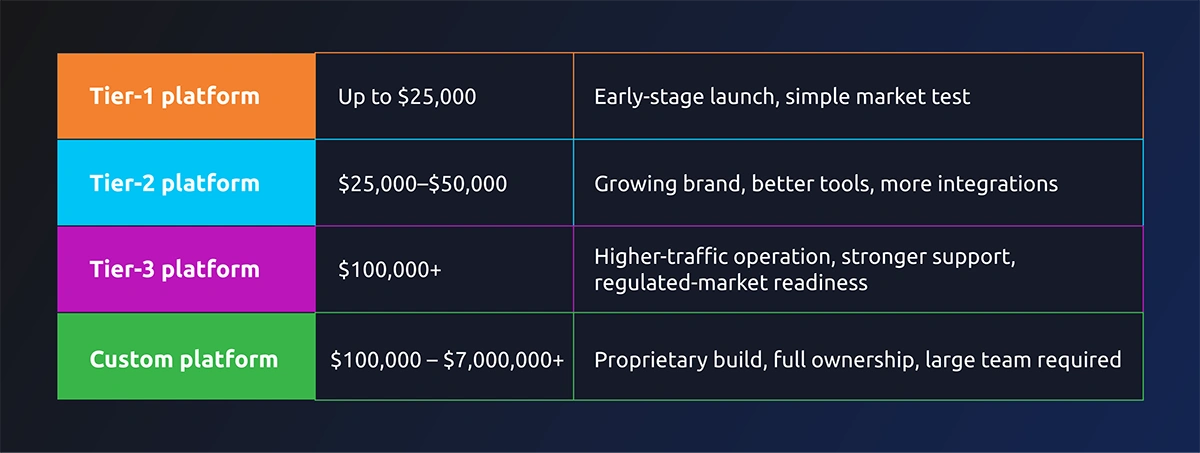
In practice, platforms targeting broader markets usually come with higher price tags because the costs often include licensing, legal setup, integrations, and compliance, increasingly exceeding the initial fee. As a result, a simple launch may start in the lower five figures, but complex projects, especially in strict jurisdictions, can reach the high six figures or more.
Tier-1 Platforms (Up to $25,000)
Platforms in the Tier-1 range generally provide basic functionality, including a standard admin panel, access to core games, simple reporting, and a few payment options.
This level is suitable for testing a limited number of markets where minimal customization is acceptable, which makes flexibility limited. Geo-specific payment integrations and advanced bonus features may be unavailable, and reporting may lack the detail required by finance or affiliate teams.
Platforms under $25,000 usually fall into two groups. Some are unfinished or underbuilt products sold cheaply by small teams that need cash flow while the platform is still maturing, and these products can sometimes be sold in the $10,000–$20,000 range. Others are priced low because they are built for markets with lighter technical demands, such as some African markets, where limited connectivity and a fast launch matter more than advanced features.
This does not make every low-cost platform useless, but it does mean the operator needs to understand whether the price reflects the product’s quality or the realities of the target market.
Tier-2 Platforms ($25,000–$50,000)
A Tier-2 platform typically offers enhanced reporting, more payment integrations, and greater flexibility in product setup. It is often the best fit for startups and growing operators that need to manage daily workflows like campaign management, payment monitoring, affiliate reporting, basic fraud prevention, and site content updates with more autonomy.
Many leading platforms sit in this range, along with newer options from teams focused on ongoing improvement. Provider teams in this tier can range from around 200 to 4,000 people, which means operators may be dealing with anything from a focused mid-sized company to a large organization with several departments, product lines, and support layers. It can give businesses a good balance between initial setup costs and room to scale.
The main risk is choosing the wrong provider. This range includes some of the strongest platforms on the market, but support quality can vary a lot. Some larger providers already have major clients generating millions every month, so smaller operators can end up waiting weeks for tickets to move.
Before signing, check who will actually handle your account, how requests are prioritized, and whether the provider has a real roadmap for your market.
Tier-3 Platforms ($100,000+)
Tier-3 platforms are usually built for large organizations with full teams working inside the system, sometimes across thousands of staff members and several departments. At this level, the platform should come with detailed documentation, FAQs, onboarding, and proper training, because the product is too complex to run effectively without clear manuals and internal processes.
To support high-traffic activities, these platforms combine multi-brand operations, detailed analytics, flexible payment setups, and advanced player management. They also make it easier for operators to control business data and avoid unnecessary barriers if the team needs to export or migrate information later.
A higher price often suggests a stronger product, but it does not guarantee better support. The Pragmatic platform costs around $100,000, yet many clients are unhappy with their support and are actively looking to switch because they are not getting value for their money. Some operators pay $100,000 or more and still struggle to get timely help after launch. It pays to note how quickly the provider responds when payments, reporting, integrations, or player issues need attention.
Custom-Built Platforms ($100,000–$7,000,000+)
A custom-built casino platform means developing a unique software system from the ground up, rather than using or adapting an existing solution. This gives the operator full control over every part of the operation, from features and integrations to security and user experience.
Custom builds aren’t common for startups with limited funding or resources. This path usually requires a full team of specialists and a long-term commitment to development, integration, and maintenance, requiring significant investment.
Launching even an initial version can take many months, and making the platform truly stable often takes longer. A custom build would make sense for operators with strong funding and a steady flow of players.
Platform Delivery Models: White Label, Turnkey, Custom
The right delivery model comes down to budget, timing, and the level of control needed. White-label options let you go live quickly with less effort, while turnkey solutions offer greater operational flexibility. Custom development gives full ownership, but also demands the most resources and involvement.
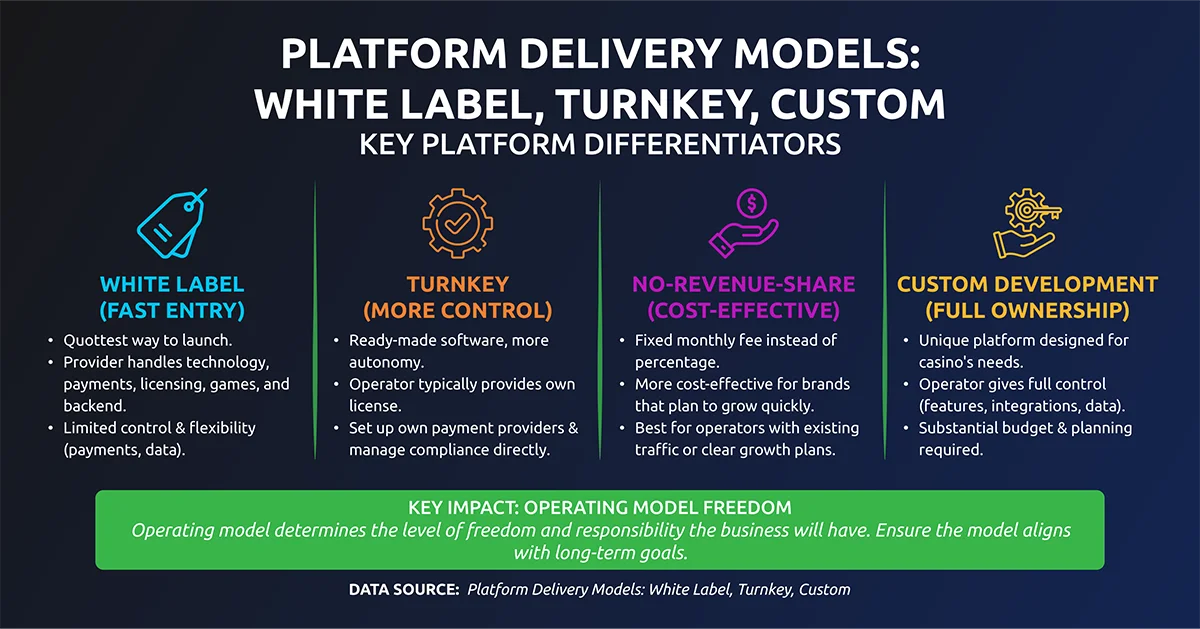
The choice of model shapes who manages critical areas like licensing, payments, player data, and future platform changes. In the long run, the operating model determines the level of freedom and responsibility the business will have.
White Label
A white-label casino solution is often the quickest way to launch. In this model, the operator runs its casino domain under the provider’s license and uses the provider’s platform, payments, games, and backend setup.
In the white-label model, providers usually hold both B2B and B2C licenses, one for platform operations, the other for player-facing sites. This setup allows new operator domains to launch under the provider’s license without securing separate approvals, streamlining and speeding up the process for partners.
The most popular jurisdictions for this model are Anjouan and Tobique.
Anjouan is especially common and accounts for roughly 80% of white-label projects because it is widely used, commercially practical, and familiar to many providers working with international casino operators.
This works well for operators that want to test a market without building the full legal and technical structure themselves.
However, full control is not on the operator as a white-label provider must protect its own license, so it usually controls the payment processor accounts, cash flow, and parts of compliance.
The operator mainly focuses on marketing, traffic, and player acquisition, while the provider manages the core operating layer.
This also means the operator may not have direct access to payment processors or full freedom to change providers, customize flows, or control all player data. White label is useful for fast entry and lower upfront risk, but it is not the right model for businesses that want full control over payments, licensing, data, and long-term operations.
Turnkey
A turnkey casino platform is a ready-made setup where the operator is renting the platform’s intellectual property but runs the business under its own company structure and license. The provider supplies the core software, backend, integrations, and often game aggregation, while the operator controls the license, domains, payments, policies, and cash flow.
The platform may also connect with aggregators and integration partners such as Altenar, Hub88, or BetConstruct, depending on the product mix, sportsbook needs, game content, payment setup, and target market.
A turnkey model offers more freedom than white label, allowing operators to choose payment providers, manage compliance, and tailor the platform to their market. Larger platforms may be slower to adapt, while smaller ones are often more responsive if their growth is tied to yours.
Turnkey is usually a good fit for teams that want a faster launch without giving up operational control. It requires more budget and responsibility than white label, but avoids the cost and complexity of building a proprietary platform from scratch.
Both white-label and turnkey models often include a GGR fee, commonly around 4–6%, depending on the deal. If the casino generates $1,000,000 in gross gaming revenue, a 5% platform fee would mean paying about $50,000 to the platform.
Custom Development
A custom or proprietary platform means the operator buys the source code and takes ownership of the product. The provider may help with the initial setup, but after that the operator needs its own development team or a separate support and development agreement with the provider.
This model gives the most control, but it also carries the highest responsibility. The operator owns the front end, back end, PAM, and the ability to build proprietary features, but also needs the team and budget to maintain the product properly.
Custom platforms can range from around $100,000 to $7,000,000 or more, depending on the product, source code, support terms, and development scope.
Choosing a casino platform? Check if it’s licensed for your target market.
The wrong choice can delay your launch or create compliance problems in regulated markets.
Critical Features Every Casino Platform Must Have in 2026
Every modern casino platform in 2026 should come with a strong foundation for PAM, payments, bonuses, risk management, CMS, game aggregation, reporting, and compliance.
Just as important, it should already have the right integrations for the target market.
Operators should not have to build CRM tools, payment gateways, risk systems, or aggregators from scratch just to run the business properly.
No platform works well across all markets. A platform built for LatAm can be fundamentally different from one built for Southeast Asia because the features, bonus systems, aggregators, payment providers, player habits, and compliance expectations are not the same.
A platform that performs well in one region often needs 1–2 years of additional development before it becomes viable in another. Operators should choose a platform that is already optimized for the target market, rather than assuming any strong platform can be adjusted quickly after signing.
The platform team also becomes a long-term partner, almost like a business spouse. The operator is choosing the team that will handle fixes, roadmap requests, integrations, market changes, and delivery timelines after launch.
Before committing to any platform, it’s important to check that all these areas are covered and can handle the demands of your daily business:
Player Account Management (PAM) and Reporting
Player Account Management (PAM) handles registrations, user data, and real-time operational reporting. When the PAM system is weak, support teams struggle to see enough history, compliance can’t trace player activity, finance has trouble matching numbers, and marketing can’t target the right segments.
A good PAM keeps all key player information, including profile details, wallet status, deposit and withdrawal history, risk notes, and more in one place. It should also help catch linked accounts and show real-time data so teams can monitor what’s happening across the business.
The right platforms make it easy to track all this information and let operators run the business instead of just reacting to problems.
Bonus and Promotion Engine
A casino’s bonus engine is what powers all player promotions. It offers the primary welcome bonus and helps the operator create targeted campaigns, including ongoing rewards and free spins, tournaments, cashback, VIP perks, and custom offers for different player groups.
Modern players expect bonuses that make sense for their habits and interests, rather than one-size-fits-all deals. A strong bonus engine lets the team fine-tune who gets what, set clear rules, and guard against abuse, all while keeping costs under control.
Risk Management and AI-Driven Fraud Detection
A modern online casino platform needs strong, automated controls to spot risky patterns, like bonus abuse, multi-accounting, or unusual withdrawals, before they become real problems. AI can help flag these activities, but clear rules and a structured review process are equally important.
Fraud in this scene usually occurs when a player makes repeated bonus claims, has several accounts tied to one device, or engages in payment activity that doesn’t fit normal play. The system should pick up on these early, so the team can investigate.
Good fraud tools use a mix of data points, device information, payment habits, betting behavior, and account links to build a fuller picture. After the system flags an item, staff should review the details and decide on an action. This mix of technology and human judgment is what keeps the operation secure.
Marketing Automation and CMS
The CMS and marketing automation tools should let the marketing team update content, run campaigns, segment players, and manage retention without waiting for developers. If every campaign needs technical support, the platform will slow growth.
Marketing automation handles the communication side. It can trigger email, SMS, push messages, in-app messages, bonuses, and retention flows based on player behavior. This means operators can run targeted retention campaigns or reward VIPs, all while tracking what works and what doesn’t.
Payment Gateway and Crypto Integrations
A payment gateway manages transactions and supports the payment methods that matter in your target markets, whether that’s local cards, e-wallets, bank transfers, or crypto. This is where many platforms get tested in practice by determining whether those options actually work for your license, risk profile, and players.
For crypto casinos, the platform should handle wallet management, transaction tracking, and clear reporting. If the system allows players to deposit in one coin and withdraw in another, it can raise compliance questions and even shift regulators’ views of the business.
Operators should be able to add or change payment providers without overhauling the whole system.
Game Aggregator Integrations
A game aggregator connects casinos to many game studios through a single technical integration. This can give the operator access to slots, live casino, table games, crash games, jackpots, and other content without having to sign separate technical builds for each studio.
The operator should check which providers are actually available under the license, target markets, and commercial setup. Some games may be region-locked. Some providers may not support certain licenses. Some content may require extra approval.
Operators should be able to easily track game revenue, provider performance, and player trends, so they know which content is working and where to adjust.
Licensing and Compliance Readiness
A licensed casino platform needs to meet the compliance standards of the markets it serves. This means supporting core requirements like player verification, anti-money laundering checks, location controls, responsible gaming tools, and detailed record-keeping.
Operators should always check where the platform is already certified and which regulators have approved it. It’s also important to know what adjustments might be needed for a specific license or market, since requirements can vary widely.
For example, a platform for Curaçao, Anjouan, Malta, or a U.S. state market will always require the same setup. The U.S. market is especially state-specific, and rules can differ by product type, market access, geolocation, KYC, payments, and reporting.
Compliance should be confirmed before committing to any platform, not after the deal is signed.
Total Cost of Ownership: Beyond the Platform Price Tag
Total cost of ownership is the full cost of running the platform after the setup fee. Ongoing expenses can include monthly fees, revenue share, payment processing, integrations, support, data storage, compliance tools, and even migration costs if you ever switch platforms.
Most platform deals include a minimum monthly fee, usually $5,000 to $10,000, plus a GGR-based fee. If the GGR fee is higher, only the GGR fee is paid.
Custom development is usually billed separately at $30–$150 per hour, depending on complexity and urgency.
To avoid hidden costs, operators should negotiate and document all fees upfront, covering setup, support, integrations, reporting, data exports, payment updates, custom features, and emergency support.
Some providers include basic help, while faster responses or weekend coverage may cost extra. If it’s hard to extract your own data from the system, leaving the platform can become expensive and complicated.
The smartest approach is to ask each provider for a realistic 12- or 24-month cost projection based on your expected traffic, payment mix, and support needs. If a provider can’t give a clear answer, that’s a sign to look more closely before moving forward.
How to Match Platform Choice to Your License and Target Markets
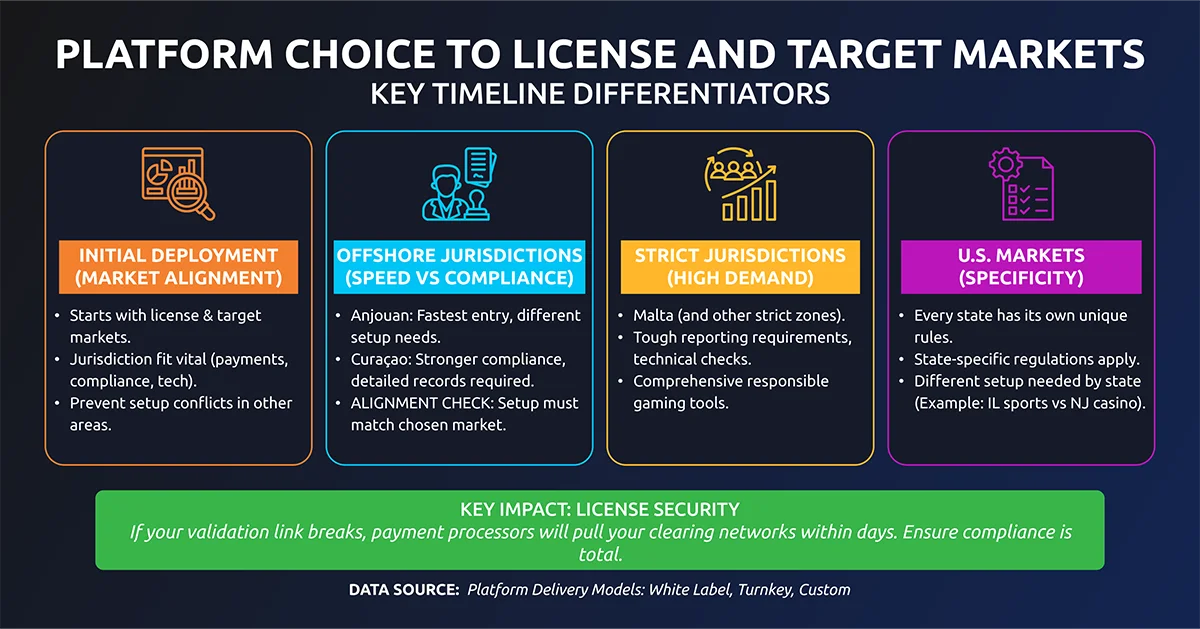
Platform choice should always start with your license and target markets. What works in one jurisdiction might not meet the payment, compliance, or technical requirements somewhere else.
For instance, launching with an Anjouan license can make international entry faster, but may need a different setup than Curaçao, which often requires stronger compliance and more detailed player records.
Anjouan also requires all B2B suppliers, including platforms and aggregators, to hold a B2B license. With over 1,300 licensees and roughly 90% of operators choosing Anjouan, most established platforms and aggregators are already familiar with and prepared to meet these requirements.
Malta and other strict jurisdictions may demand even more, with tougher reporting requirements, technical checks, and responsible gaming tools.
The U.S. is even more specific, since every state has its own rules for different types of gambling. What works for sports betting in Illinois won’t necessarily work for online casinos in New Jersey.
For operators targeting multiple markets, the business may need to launch a separate brand for each market or develop missing functionality for each region. Region-specific bonuses, loyalty features, local PSPs, reporting formats, and player flows can take 8-12 weeks each to build, so the platform should already match the target market as closely as possible.
A useful example is Parimatch, which uses its own proprietary platform in one market but a completely different platform and team for a new region because building the required features in-house would take 1-2 years.
This is the same decision smaller operators face: either choose a platform already built for the region or accept the cost and delay of developing missing functionality.
The key is not simply finding the best platform, but selecting one that aligns with your license, target markets, payment setup, and overall business objectives. The most effective choice always starts with these fundamentals.
Common Mistakes and Questions to Ask Before Signing
A common mistake is signing a platform contract without fully understanding who controls the core parts of the business, like data, payments, support, and exit options.
Features get a lot of attention in sales calls, but contracts set the terms for day-to-day operations.
For one, operators need to be able to take all essential information with them, including player records, account history, balances, bonus data, and financial reports. Without data portability, you might own the brand but not the system.
Two, some platforms encourage operators to rely on their entire suite. That can be convenient at first, but it makes switching out parts or upgrading tools more challenging down the line.
Generally, red flags are easy to spot: unclear pricing, vague or limited support, restricted access to your own data, no clear exit process, and incomplete contract terms. If the contract only talks about speed to launch but not about how things will run afterward, it’s not giving you the full picture.
A good platform contract should explain how the business will operate after launch, not just how quickly you can go live.
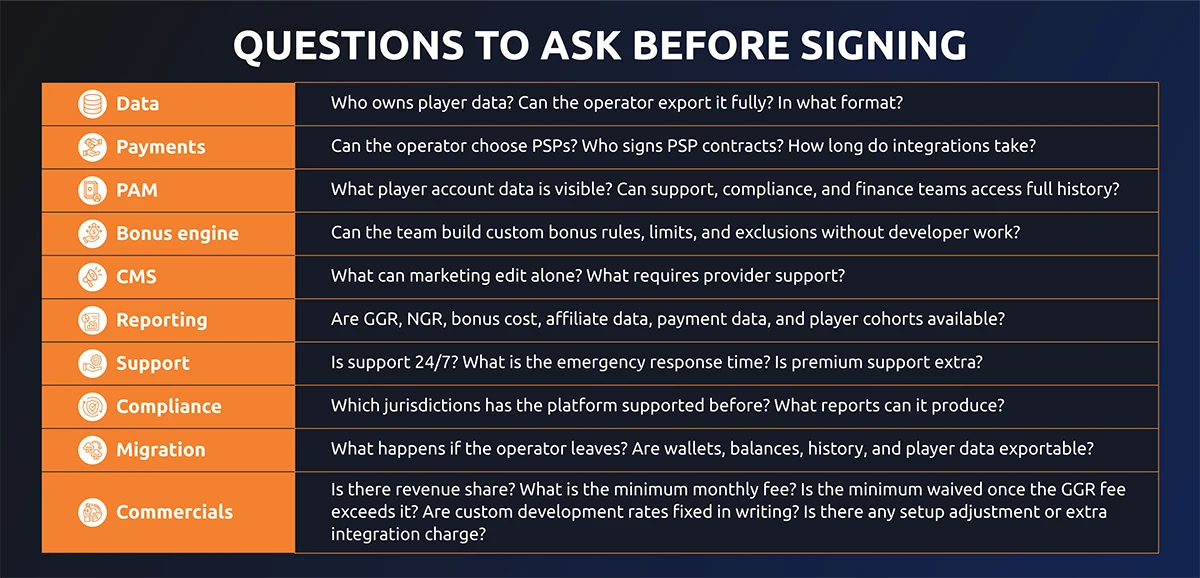
Before signing, ask direct questions about data ownership and access, flexibility with payment providers, the level of control over player accounts and bonuses, what the marketing team can do on its own, and what support is included. It’s also important to understand how reporting works, the platform’s compliance history, and the process if you decide to move to another provider:
This is where working with License Gentlemen can make the platform selection process more structured. Instead of looking at software in isolation, the team helps operators assess whether a platform fits the intended license, target markets, payment setup, and long-term operating model.
That means fewer assumptions before signing, clearer questions for vendors, and a better chance of choosing a platform that supports the business during and after launch.
Frequently Asked Questions
Online casino platforms can start below $25,000, with some unfinished or underbuilt products selling for around $10,000–$20,000. Stronger startup platforms often sit in the $25,000–$50,000 range. Enterprise platforms usually start around $100,000+, while custom or proprietary platforms can range from $100,000 to $7,000,000 or more depending on source code, setup, and support.