

Isle of Man Gaming License 2026: A Tier-One Operator’s Complete Guide
The Isle of Man gaming license is one of the strongest choices in 2026 for operators that want more than a quick offshore registration. It provides online casinos, sportsbooks, iGaming platforms, and crypto gaming businesses with a respected regulatory framework and a 0% corporate tax environment.
The trade-off is cost and depth. The Isle of Man is not built for lean test launches; it is built for operators that need credibility, operational substance, clean governance, and a license that can stand up to regulator questions, banking checks, investor diligence, or a future sale.
In practice, the weak points usually appear in the setup choices: ownership structure, payment flow, licensing route, hosting, compliance roles, and how clearly the team can explain the model. This is exactly where LicenseGentlemen comes in. With more than 500 licenses issued, we’ve helped operators avoid the costly mistakes that can delay an application for months before it even reaches the regulator.
If you’re considering an Isle of Man license, it’s worth speaking to our team before making any major decisions. The consultation is free, and it can save you significant time, cost, and unnecessary setbacks later in the process.
Why the Isle of Man Sits at the Top of the Licensing Pyramid
The Isle of Man ranks near the top of the licensing pyramid because it combines offshore tax efficiency with a serious regulatory reputation built over time. Operators choose it when credibility with banks, payment processors, investors, and future buyers matters as much as launch speed.
The island’s framework is overseen by the Isle of Man Gambling Supervision Commission, with online gambling regulated under the Online Gambling Regulation Act 2001. In a market where many lower-cost jurisdictions are being reassessed by payment companies and regulators, the Isle of Man still signals that an operator has accepted a higher standard of scrutiny.
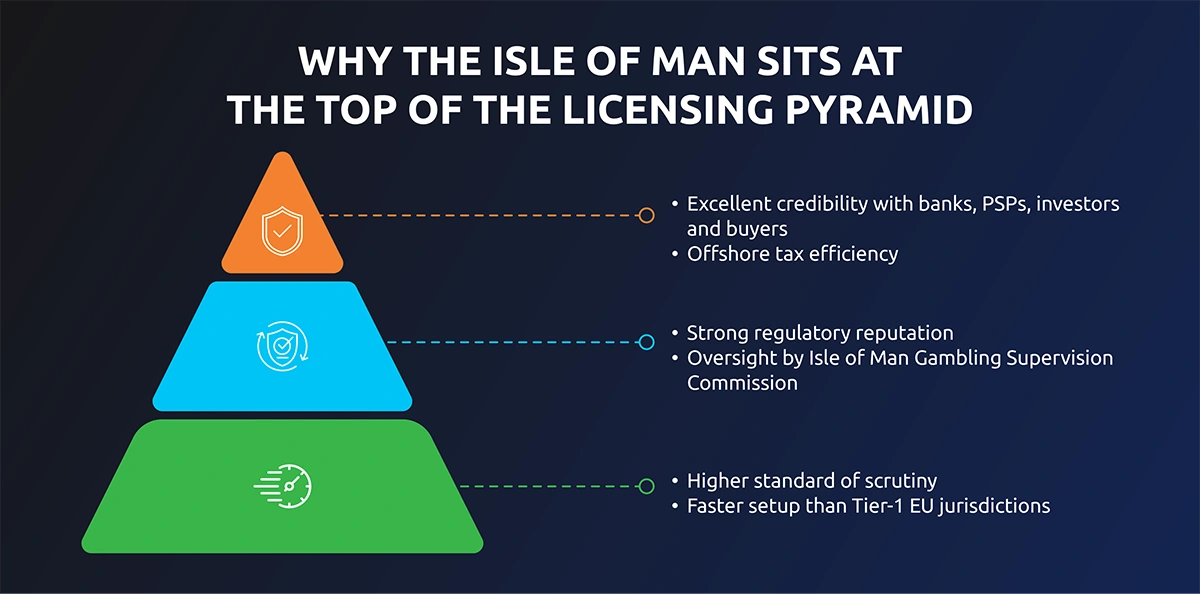
For payment partners, this can make the first commercial conversations easier. An Isle of Man license does not guarantee merchant approval, but it gives banks and processors a clearer file to review: recognized regulator, documented ownership, system controls, and rules for protecting player funds. For founders planning institutional partnerships, expansion through white-label structures, visibility in public markets, or a future sale, that reputation can become part of the commercial case for the business.
Who the Isle of Man License Is Actually For (and Who Should Skip It)
The Isle of Man license is for serious operators with enough capital, team depth, and compliance maturity to pass a demanding review. It is usually a poor fit for small bootstrap projects that need the cheapest possible first license.
If you are ready to get your iGaming business licensed for an enterprise-level launch, the Isle of Man makes sense when the business plan includes multi-brand operations, B2B partnerships, crypto or tokenized gaming models that need clear oversight, or eventual expansion into more regulated markets. It also suits operators preparing for a corporate exit because buyers tend to value clean licensing, banking history, and documented compliance.
You should probably skip it if your licensing budget for the first year is under roughly $200,000, if the business model is still experimental, or if you cannot support local substance, professional compliance support, technical certification, and a longer approval process. A cheaper jurisdiction may be more appropriate for a small MVP, provided the founder understands the banking and reputation trade-offs.
A simple test can help: if the license is nothing more than a box to tick at the outset, the Isle of Man may prove too costly. If, on the other hand, the license enhances the company’s credibility, its funding plan, access to payments, and future sales process, it may be worth it. So, is the Isle of Man license worth it for your iGaming business? The answer depends on whether that license is delivering real commercial value. In other words, if it enhances credibility, access to payments, investor confidence, and readiness for an exit.
If you believe an Isle of Man license could deliver that kind of commercial value, are you ready to get your iGaming business licensed? LicenseGentlemen can review the model, budget, target markets, payment route, and local substance requirements before you commit to the Isle of Man or choose a leaner jurisdiction.
The GSC, OGRA, and the License Types You Can Apply For
The Isle of Man framework is built around the Gambling Supervision Commission and the Online Gambling Regulation Act 2001, with different license routes for B2C operators, network platforms, sub-license structures, B2B software suppliers, and token-based models. Choosing the wrong route can slow approval or create commercial limits after launch.
In practical terms, this is where founders compare the types of gambling licenses in the Isle of Man before choosing a route. In broad terms, a B2C operator needs permission to take bets or wagers from players. A platform business may need a network services route if it is handling players connected through other jurisdictions.
Software suppliers may need recognition through the B2B supplier pathway if their games or systems will be used by licensed operators. Crypto and tokenized projects need early structuring because the Isle of Man does not treat token design, custody, AML, and player risk as afterthoughts.
Full OGRA License (B2C)
A Full OGRA License is the main route for a B2C operator that wants to control its own player base, platform, risk, and commercial model. It is the most substantial option and normally the one associated with a serious independent casino, sportsbook, lottery, bingo, poker, or multi-product gaming business.
This license gives the operator more control, but it also brings the most responsibility. The applicant must show the GSC that ownership is fit and proper, funding is transparent, systems are secure, player funds are protected, and AML controls are credible.
The structure also has to show that the operation can be managed properly from the Isle of Man. It can support sub-licensing arrangements where appropriate, but those arrangements must be designed carefully because the full license holder remains exposed to regulatory risk.
Sub-License
A sub-license lets a smaller operator run its own customer-facing brand while using the infrastructure of an Isle of Man full license holder. It can be a useful middle route for brands that need credibility and banking support but are not ready to build the full operational stack alone.
The commercial appeal is speed and shared infrastructure. The risk is dependency. A sub-licensee must understand what it controls, what the full license holder controls, who owns the player relationship, how funds move, and what happens if the master arrangement changes. For some brands, this route is efficient. For others, it limits long-term independence.
Network Services License
A Network Services License is designed for operators that want to accept or pool players connected through operators or jurisdictions outside the Isle of Man. It is especially relevant for networks, platforms, and liquidity models where players may already be registered elsewhere.
For network operators, the practical value is continuity. It allows operators to seamlessly import registered players from other jurisdictions without forcing them to re-register their accounts, which can reduce drop-off when players move through connected platforms, skins, or liquidity networks. That same flexibility also creates regulatory questions: where each player is registered, who holds the customer record, how AML and data controls work across the network, and which party is responsible if something goes wrong.
B2B Software Supplier and Token-Based Licenses
The B2B Software Supplier route is for suppliers that want their games or systems recognized for use by Isle of Man licensees. Token-based permissions support compliant structures for certain blockchain or gambling models built around crypto. These routes are specialized frameworks for businesses whose products are platform, software, token, or game infrastructure.
For B2B suppliers, registration can make integrations easier because licensed operators can assess the supplier through an official framework. This route places games on the GSC official registry to accelerate platform integrations. For token-based gaming, the important work happens before filing: token utility, custody, player redemption, AML risk, volatility, and consumer protection all need to be explained in plain regulatory terms.
Isle of Man Gaming License Cost, Taxes, and Total Setup Budget
The Isle of Man is a premium licensing route with a serious budget, not a low-cost offshore shortcut. In 2026, founders should plan for government application and annual fees, local substance, professional advisors, technical certification, compliance staffing, hosting, and working capital.
The headline attraction is tax efficiency: the Isle of Man has a 0% standard corporate income tax rate for most companies, and online gaming duty is charged on gross gaming yield through a sliding scale.
But the total budget for the first year is much larger than the government fee alone. The pressure usually comes from the parts that founders underestimate: local appointments, hosting, technical evidence, compliance roles, advisor time, payment setup, and GSC hearing preparation.
Application and Annual Fees
The official fee schedule lists application fees and annual license fees by license type, so operators should budget by route rather than relying on one generic number. The current government fee framework for OGRA licenses does not list a separate initial deposit.
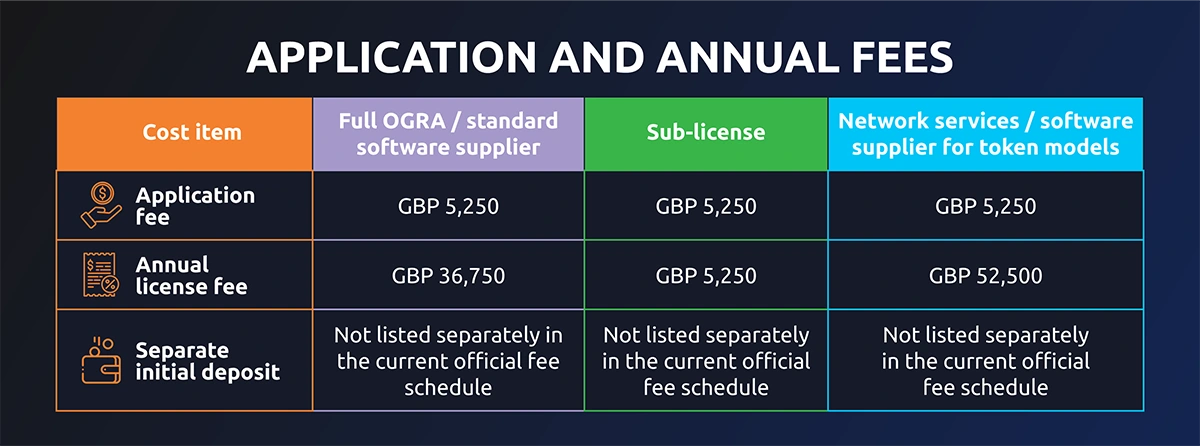
These figures are only the official licensing layer. They do not include legal drafting, corporate structuring, MLRO support, local director arrangements, office and payroll costs, technology audits, RNG certification, server hosting, payment onboarding, or ongoing compliance work.
This is where a low filing quote can become expensive. The missing work is often the work that determines if the structure will survive GSC review.
Gaming Duty Sliding Scale (Isle of Man GGR tax)
The Isle of Man online gaming duty is charged on gross gaming yield, with lower marginal rates as revenue increases. The structure is attractive for operators that can scale because the effective duty burden falls as GGY grows.
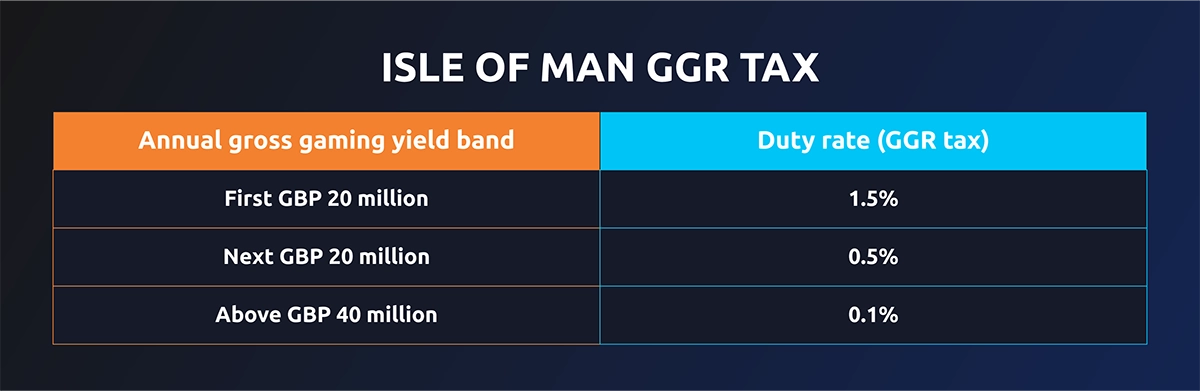
This works alongside the island’s 0% standard corporate tax model, which is one reason the jurisdiction remains attractive to operators with strong funding. The tax position should still be reviewed with proper tax advisors, especially where management, shareholders, players, payment flows, or group companies sit outside the island.
Local Substance and First-Year Total
A realistic Isle of Man budget for the first year should include government fees plus the cost of proving that the business can actually operate under the license. For many serious projects, the first-year total can move into six figures once advisors, local substance, compliance personnel, systems, audits, and launch preparation are included.
Local substance is not window dressing. The operator needs credible management, appropriate Isle of Man presence, approved or suitable hosting arrangements, qualified compliance oversight, and records that the regulator can inspect. A plan that looks cheaper on paper can become expensive if the team has to rebuild directors, hosting, compliance files, or payment documentation after the regulator starts asking questions.
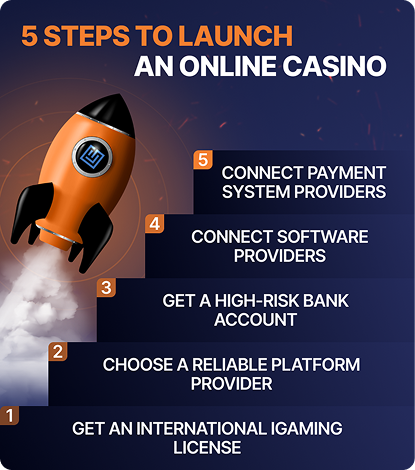
Ready to Launch Your Own Online Casino?
Get the full 5-step roadmap – from licensing to payments – with a real project timeline included.
Application Process and the GSC Hearing
The Isle of Man application process is a staged regulatory review that moves from corporate setup and document preparation to due diligence, system assessment, and a final GSC hearing. Applicants should treat the hearing as a business examination, not a formality.
The usual flow starts with deciding the license route and building the Isle of Man company structure. The applicant then prepares ownership disclosures, personal history forms, evidence showing the source of funds, business plans, AML and responsible gambling policies, technical architecture, game and RNG information, hosting details, and player fund protection arrangements.
After filing, the GSC reviews the business and may ask detailed follow-up questions. The hard part is not submitting documents; it is defending the model when the regulator asks how funds move, who controls the platform, who handles AML decisions, and what happens if a provider fails.
A polished deck is not enough if the answers are thin. Miscalculating local substance rules or misconfiguring the initial corporate filing can lead to rejection or delay at the hearing phase.
This is the point to get expert review before filing. LicenseGentlemen offers a free consultation for founders who want their local substance, corporate setup, and GSC hearing preparation checked before the application goes in.
Operational Requirements: Personnel, Hosting, and Technical Setup
An Isle of Man license requires more than incorporation; the operator must show that people, systems, controls, hosting, and reporting are fit for regulated gambling. The GSC will look for an operation that can be supervised in practice.
Key requirements normally include:
- Local governance: for a full Isle of Man setup, applicants should plan around at least two local individual directors, plus a Designated Official or Operations Manager where required.
- Compliance leadership: a qualified MLRO, AML/CFT Compliance Officer support, responsible gambling controls, and oversight at board level.
- Technical assurance: secure systems, reliable records, independent game or RNG certification where relevant, controls for player funds, complaints handling, returns, and continuity planning.
Hosting and technical setup deserve early attention. The Isle of Man framework expects the parts of the system used for player registration and gameplay services to be hosted on physical servers in the Isle of Man.
The architecture also needs to support regulator access, data security, disaster recovery, and system integrity. If the platform relies on third-party providers, the contracts, control points, audit rights, and responsibility split must be clear before filing.
Strategic Value: Banking, Market Access, and Exit Potential
The strategic value of an Isle of Man license is strongest when the operator needs banking credibility, cleaner payment onboarding, and a licensing profile that can support future investment or sale. The license can make the business easier to explain to serious counterparties.
This does not mean banks automatically approve every Isle of Man licensee. It means the starting point is stronger. A recognized regulator, transparent ownership, documented controls, and a premium jurisdiction can reduce perceived risk compared with lower-cost licensing setups. That matters when a PSP reviews cashier flows, card processing, chargeback exposure, settlement routes, and investor diligence.
It also matters at exit. A buyer reviewing an online casino or sportsbook will care about the license, but also about how cleanly the license has been maintained: filings, audits, controls for player funds, compliance logs, complaints, AML records, supplier contracts, and payment history. The stronger the evidence behind those items, the easier it is for banks, buyers, regulators, and payment partners to trust the structure.
Isle of Man vs Malta vs Curaçao vs Anjouan
The Isle of Man is usually the premium offshore choice, Malta is the regulatory route recognized in the EU, Curaçao is a reforming option for the middle of the market, and Anjouan is the most popular and a lower-cost launch jurisdiction. The right choice depends on budget, target markets, banking needs, and how much regulatory reputation the business needs from day one.
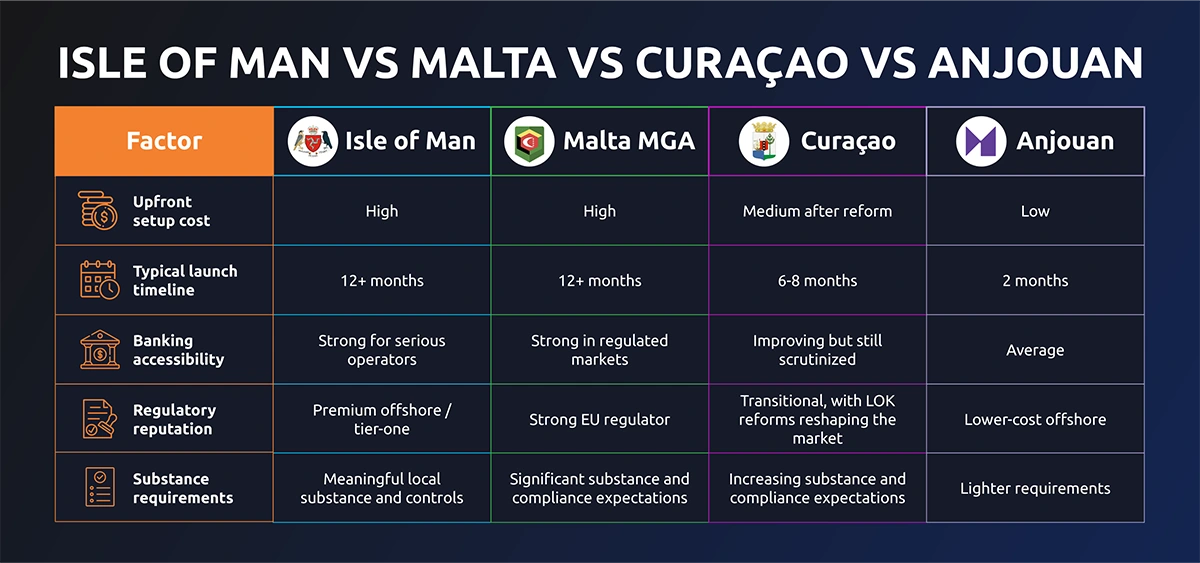
The Isle of Man generally wins when the operator needs a respected license, stronger payment discussions, and a cleaner diligence file for investment or sale. Malta may be stronger for businesses that need an EU regulatory story and can handle the cost and complexity.
Curaçao can suit operators that want a more affordable but improving framework. Anjouan may fit launches at an early stage where speed and cost matter most, but it is not a substitute for a premium regulatory base.
If you are comparing these routes, LicenseGentlemen’s work across 500+ approved licenses gives the team a practical view of how banks, regulators, and buyers assess gaming structures. The website application form is a practical way to share your budget, launch plan, target markets, and operating model so the team can map the jurisdiction fit before you commit to a filing path.
Ongoing Compliance, Audits, and Real Enforcement Cases
Keeping an Isle of Man license is an ongoing obligation after approval. Operators must maintain records, submit required returns, protect player funds, keep systems controlled, and respond properly to regulator concerns.
The GSC’s recent public statements show that enforcement is real. In July 2025, Celton Manx Limited received a GBP 3,937,500 civil penalty after an AML/CFT inspection found systemic issues around customer risk assessment, monitoring, enhanced due diligence, MLRO/compliance oversight, training, and record retrieval.
In February 2026, Shelgeyr Limited was required to pay a GBP 200,000 civil penalty after the Commission identified failings, including EDD, evidence of source of wealth, ongoing monitoring, controls over anonymous accounts, staff training, and the MLRO/compliance authority.
These are not minor paperwork examples. They show how governance, AML controls, records, and board oversight remain live regulatory issues after licensing.
Several high-profile cases in recent years have affected the reputation of the Isle of Man. With the possibility of the island being added to the EU’s grey list, the regulator has significantly tightened its licensing standards.
As a result, obtaining an Isle of Man gaming license has become a demanding and lengthy process, with a relatively low approval rate. Applicants should expect extensive due diligence, enhanced compliance requirements, and a much higher level of scrutiny than in previous years.
Even many approved licensees lost their licenses after in-depth audits, which of course, costed millions of dollars to those brands and many months of invested time.
Therefore, the Isle of Man license, is difficult to get and very difficult to keep. That’s why even many big brands avoid this license and choose something else.
For operators, the lesson is practical: build compliance routines before the first player deposit. The files that matter in an inspection are usually everyday operating evidence: quarterly returns, financial records, suspicious activity procedures, controls for player funds, audit trails, supplier oversight, and incident response. If those systems are added only after growth, the operator is trying to fix compliance while the regulator already expects evidence.
FAQ
An Isle of Man gaming license costs far more than the government application fee. Official fees include a GBP 5,250 application fee and annual license fees that vary by route, including GBP 36,750 for a full OGRA license and GBP 52,500 for a network services license. The current official fee schedule does not list a separate initial deposit. A realistic budget for the first year can reach GBP 150,000 – GBP 200,000 once local substance, advisors, compliance, hosting, and certification are included.