


VIP and High Roller Management Guide for Online Casinos in 2026
Your competitors are burning millions of dollars chasing thousands of casual signups while their actual profit engine leaks oil right out the back door.
The math of online gambling is brutal and absolute. A select group of high value players drives the overwhelming majority of your bottom line. Yet, team after team still manages these accounts like a minor marketing afterthought rather than the primary financial leverage point of the entire company.
The old playbook completely fails today. You can no longer protect your highest value relationships with a generic birthday email and a 20 free spins code.
In 2026, premium retention requires automated real time behavioral tracking, predictive churn engines, and a payout infrastructure built so your top accounts face zero transactional friction. When you lose just one of these players, you don’t just lose a customer. You lose the exact revenue engine that quietly carried last month’s net profit.
This guide is your practical, step by step playbook to spot these accounts early, support them flawlessly, and build an operational defense system around them so they never move their bankroll to a competitor.
Why VIPs Are 80% of Your Casino's Profit
Stop guessing. The math is simple, but it’s brutal. VIPs drive 15% to 20% of your total GGR. If your project is hitting €1,000,000 a month, that’s €150k to €200k coming from your top tier. And understand this: whales are volatile.
A single top-tier account can drop €80,000 NGR in one month, then win a massive chunk back the next. That’s the game. If you aren’t prepared for that swing, you aren’t managing a whale, you’re betting against your own bankroll. Plan your operational capacity for the variance, or the volatility will eat your profits alive.
Regulus Partners frames this reality even tighter in their market commentary: it is incredibly common for online gambling businesses to pull 25% to 40% of their total revenue from just the top 1% of active players.
One out of every hundred players is actively keeping the lights on and funding your growth. The top 1% carries the business. Lose one single true whale and the financial hit hurts worse than losing a hundred casual depositors combined.
- Casual players: They deposit small amounts, they churn incredibly fast, and they cost a massive amount of money to acquire through highly competitive affiliate networks and paid media campaigns. They often cost more to bring through the door than they ever pay back in customer lifetime value.
- Whales: The exact opposite engine. The longer they stick around, the more valuable they become. Their player lifetime value (LTV) features a compounding curve rather than a flat line.
Let’s look at how the actual numbers break down side by side when you model typical operator segments:
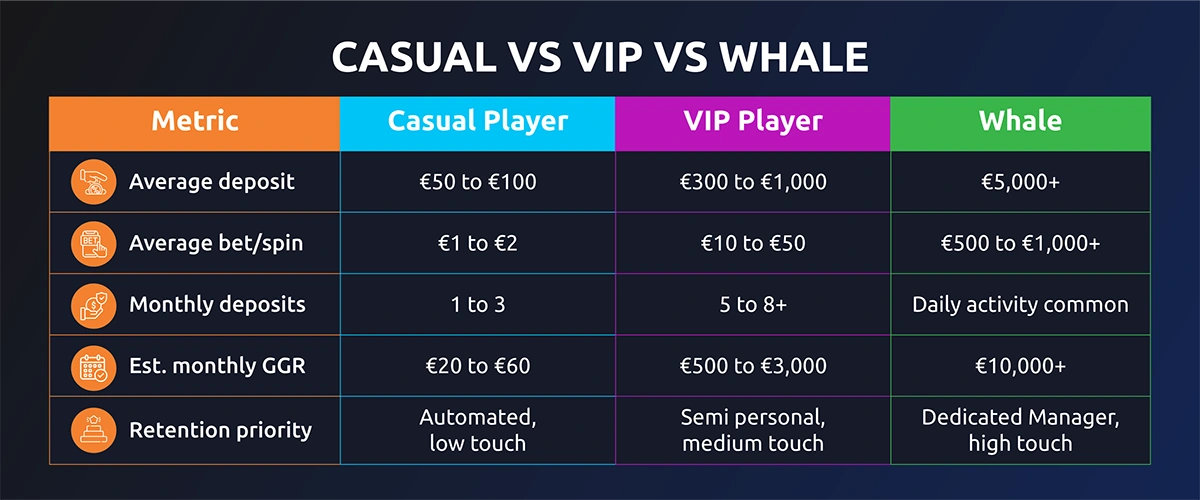
High rollers drive massive volume through your platform, but the cost of the rewards required to retain them means your net margin on that specific play is slightly lower. Yet, even with that lower net margin, this tiny fraction of your user base still carries the absolute majority of your net profit.
If you spend the exact same organizational energy chasing thousands of casual signups as you do protecting a handful of whale accounts, you are optimizing for the wrong number. You are burning your team out on low value acquisition while your high value retention leaks oil.
Do this specific exercise today:
- Pull your database from last month’s GGR.
- Sort your players by total deposit value from highest to lowest.
- Look at exactly where the curve bends.
Most operators running this exact data audit for the first time are completely shocked by how few individual accounts are actually driving the entire number. Sometimes it is the top 20 players. Sometimes it is even tighter than that. The exact shape shifts by platform and region, but the extreme concentration itself stays the same.
How to Spot a VIP: The Three Metric Framework
You do not spot a VIP by gut feeling, and you certainly do not wait for them to send a message to your support team asking for a bonus. You spot them with three specific numbers tracked together in real time.
If you miss any of these three core metrics, your entire detection system breaks. You will either flag one time big spenders who have no intentions of staying, or you will completely miss the quiet, highly profitable grinder whose lifetime value beats everyone else on your radar. Think of this system as a complex filter, not a simple single trigger alarm. Here is exactly how each metric works mechanically:
1. Average Deposit Size
A good baseline rule of thumb is 150% above your platform average. If your typical player deposits €100, someone consistently putting in €300 or more needs to be automatically flagged by your system for review.
In higher liquidity markets like the UK or crypto native platforms, operators usually push this starting threshold up to €500 or €1,000 because the baseline bankrolls are simply larger. This data point must also tie directly into your compliance engines. In regulated jurisdictions, tracking large velocity shifts in deposits helps you spot VIP potential while simultaneously triggering necessary responsible gambling and source of wealth reviews before they become an issue.
2. Average Bet Size
Deposit size tells you what they can afford to lose. Bet size tells you who they actually are as a player. A customer who deposits €1,000 but bets €1 per spin on a low volatility slot machine is cautious. They are a low risk, long term player, but they are not a whale.
On the other hand, a player betting €50 to €100 a spin on slots or putting down €1,000 a hand on live dealer baccarat? That pressures your table limits. That is your real, high conviction signal. You need to watch where bet sizes cluster against your limit structure. If you monitor table limit pressure, you will find your whales before your marketing CRM even processes the day’s batch report.
3. Deposit Frequency and the 5-Deposit Rule
The “5-deposit rule” is a vanity metric that kills your growth. Stop using it. A €500 deposit makes a VIP at a mom-and-pop shop, but it makes you a ‘beggar’ at a premium, high-liquidity casino. There is no magic number.
If you’re segmenting based on how many times a player clicks ‘deposit,’ you’re missing the signal. Track their behavior over a 1.5-month rolling window. If the math doesn’t align with your specific ADPU (Average Deposit Per User), you’re chasing shadows. Dynamic tracking isn’t a luxury; it’s the only way to keep your top players from leaving.
Turn Your VIPs Into Predictable Revenue
Download the VIP Player Monetization Framework (our proven 3-stage system for increasing retention, GGR, and VIP revenue.)
Core Components of Great VIP Support
There are four essential pillars to a modern high roller retention strategy. If you miss even one of these pillars, the entire customer experience drops, and the player will look for an exit.
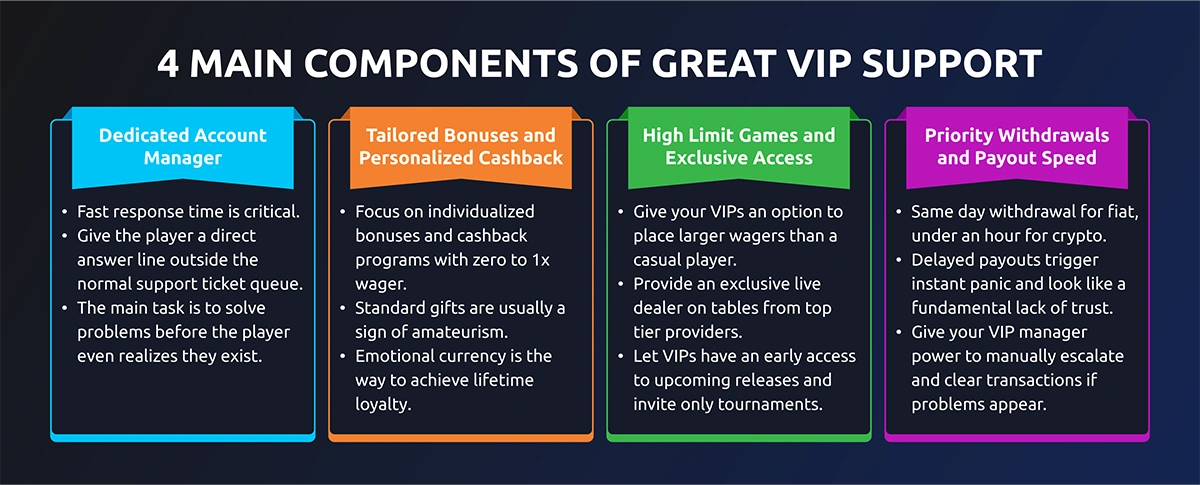
Dedicated Account Manager
Response time for your top tiers needs to be measured in minutes, not hours. If your account managers cannot hit an under five minute response time bar, you have an understaffing issue.
You must cap individual workloads at 30 to 50 active accounts maximum per manager. Anything more than that, and the service degrades into standard, reactive customer support. Give the player a direct, encrypted communication line outside the normal support ticket queue.
The job of a true VIP manager isn’t just reacting when a game crashes or a card fails. The job is knowing a player’s specific preferences, historical habits, and lifestyle well enough to solve problems before the player even realizes they exist.
Tailored Bonuses and Personalized Cashback
Sending a generic marketing blast featuring a €50 free spins promo with a 40x wagering requirement to a person who regularly deposits €10,000 a week is a mistake. It reads as automated noise, or worse, a mild insult. It instantly signals that you do not actually know who they are.
Instead, drop the generic promos entirely for this segment. Focus heavily on individualized cashback programs built around their net losses. Keep the wagering requirements at zero or 1x max.
Timing is everything here: an automated cashback drop landing in their account exactly twenty minutes before their historical Friday evening session begins will outperform a massive, rigid monthly bonus blast every single time.
Cashback represents the cost of doing business. If you don’t do it, you’re irrelevant. However, emotional currency is required to achieve lifetime loyalty. Generic physical gifts (like an iPhone) are a sign of amateurism; whales are capable of buying their own technology.
There are plenty of stories where we saw a whale lose $50,000. Most operators would have sent the standard gift. That is a mistake. Instead, the team discovered he was obsessed with tennis and arranged a private match with a local pro. The emotional connection? Unbeatable. You cannot buy loyalty with a gadget. Give them an experience that they can’t get for themselves.
High Limit Games and Exclusive Access
If your VIP tier does not let high rollers place larger wagers than a casual player, your program is just marketing fluff with a gold colored font. True high limit access requires dedicated live dealer tables from top tier providers like Evolution Gaming or Pragmatic Play Live.
It also requires custom, account level backend configurations that raise table ceilings for specific user IDs without altering the site wide safety defaults. Pair this high limit infrastructure with early access to upcoming game releases and private, invite only tournament brackets, and you build an ecosystem that is incredibly hard for a competitor to copy overnight.
Priority Withdrawals and Payout Speed
This is the single highest leverage pillar in the entire online gambling ecosystem. For crypto native operations, your target must be under an hour. For traditional fiat channels, it must be the same day.
A high roller will easily forgive a weak bonus or a minor technical glitch, but they will never forgive a slow withdrawal. Delayed payouts trigger instant panic and look like a fundamental lack of corporate trust.
To execute this, you must build automatic KYC preclearance for verified accounts, route high value transactions into a completely separate internal payments queue, and give your VIP managers the administrative power to manually escalate and clear transactions the moment a standard payment processor hits a snag.
Put your average VIP withdrawal speed directly on your executive weekly dashboard. If that average drifts even slightly past your internal target, treat it as a red alert operational crisis. High rollers notice these delays immediately, and they will tell their entire network about them.
To deliver premium service, your VIP managers need one thing. The explicit authority to manually bypass the standard financial queue. If a manager has to wait for a ‘financial review’ to clear a five figure withdrawal, you’ve already lost. Speed is the only currency that matters at this level. If the money moves slow, the player moves on. Empower your team to solve transactional issues instantly, or stop claiming you offer VIP service.
The Technology Behind VIP Support
To run a modern program at scale, you cannot rely on spreadsheets and manual alerts. You need a data stack consisting of three interconnected technology layers: a highly customized CRM, real time behavioral monitoring engines, and predictive churn machine learning models.
Predictive churn modeling is where the battle for high roller retention is won or lost. 27% of churned players can be successfully won back if you engage them on day one of their silence.
But if you wait three months? That reactivation success rate plummets to just 2%, and the long term future value of those players drops by 87%. Sending a generic, automated email after three weeks of radio silence is a completely useless retention move. But if your predictive analytics model catches a subtle 15% drop in average spin velocity or a slight shift in weekly login times, a personal phone call from their dedicated manager that afternoon can save the account before they ever log into a competitor’s site.
Your core CRM must unify deposit histories, game variances, cultural notes, and past chat logs into a single dashboard that loads in seconds. This data layer must be locked down completely. A data breach involving a high roller list isn’t just a compliance failure; it is a business killing public relations disaster.
Trying to bolt compliance onto a live, chaotic VIP system later is an incredibly expensive mistake that causes platform downtime, massive engineering rebuild costs, and regulatory audits that disrupt your entire company.
Communication That VIPs Actually Respond To
Standard corporate marketing emails have zero impact. They sit in the trash. It’s 2026. WhatsApp is the undisputed standard. 99% of high rollers expect it, especially in markets like Germany and Argentina.
If you’re forcing your top-tier accounts to open a support ticket or check their email, you’re treating them like casuals. Give them a direct, personal, and encrypted line of communication. If you don’t, your competitor will and they’ll take the account.
The golden rule here is simple: let the player dictate the communication channel. Do not force them into an onsite chat widget or a ticketing system. Offer WhatsApp, Telegram, or Signal as the default options for anyone who opts in, and preserve highly secure, encrypted in platform messaging as the mandatory fallback for privacy conscious users.
When managing proactive outreach, implement the strict operational cap below to prevent burning out the relationship:
- Day 1: Send a highly personalized check in message based on recent platform activity, ensuring there is zero marketing pitch or bonus pushing involved.
- Day 8: Follow up with a direct account status check in or a casual notice regarding exclusive platform updates, allowing a full 7 days of silence between communications.
- Day 15: Provide a final, soft personal check in. If the high roller does not respond to this third attempt, stop all outbound communications immediately and shift the profile to reactive status.
If you push past three unreturned messages, your proactive service quickly crosses the line into annoying, desperate marketing pressure. High rollers find this incredibly off putting.
Your communication tone must also completely adapt to regional and cultural expectations. Do not employ a single global script for your entire international database. You can consider the following:
- Japan and Germany: Keep your communications highly formal, precise, structured, and respectful of personal time boundaries. Never assume familiarity.
- Brazil and Latin America: Use a much warmer, deeply conversational, relational, and enthusiastic tone. Treat the relationship like an ongoing partnership.
When you are dealing with international accounts and are in doubt about how to approach them, simply ask the player directly how they prefer to be contacted and what tone they feel most comfortable with.
Case Studies From the Industry: Stake, SapphireBet, and Roobet
Understanding how these theoretical frameworks perform in the real world requires looking closely at actual operator execution across the global iGaming market.
Stake – The Seamless Withdrawal Standard
Stake consistently retains a massive share of global high roller crypto volume because they built their entire architecture on native crypto rails from day one. They completely bypassed the legacy banking networks and traditional verification bottlenecks that slow down older, fiat first operations.

When a VIP wants to withdraw €50,000, the platform processes the transaction with almost zero manual friction, delivering the funds to their wallet in minutes. Because players have absolute, verified certainty that they can access their capital instantly without a bureaucratic fight, they feel comfortable depositing massive amounts of liquidity into the platform without hesitation.
SapphireBet – What Bad VIP Support Costs You
SapphireBet provides a clear example of how rigid compliance implementation can destroy user experience. The platform reportedly triggered an intensive, thirty minute identity verification process over a minor €55 withdrawal request.

While the operator didn’t break any regulations, the clunky execution of the process sent a loud, negative signal to the user base. It proved that the system was built around operational paranoia rather than customer convenience. You do not need a public scandal to lose your best customers; slow, bureaucratic processes will quietly erode your retention rate one minor dispute at a time.
Roobet – Winning Loyalty in Under a Minute
Roobet successfully captured early market share by optimizing the payment experience for smaller, entry level transactions. The platform allows users to deposit, play, and withdraw smaller amounts in under sixty seconds with minimal identity barriers.

By removing friction early in the player journey before the user even has a chance to complain, they build massive psychological trust. When that player eventually graduates into a higher spending bracket and triggers deeper, mandatory regulatory checks, they willingly cooperate with the request because the platform has already proven its speed and reliability.
Common Challenges in VIP Support and How to Solve Them
As your operation grows, your VIP program will hit predictable friction points. Managing that growth requires balancing customer service against strict regulatory compliance.
Challenge 1: Scaling Headcount Without Lowering Quality
The exact moment your active VIP player base grows faster than your internal team headcount, your response times will slip, and your highest paying accounts will notice. To prevent this, you must monitor your first response metrics on a daily dashboard.
If response times drift upward, you must immediately hire more account managers or partner with a specialized, highly vetted outsourced VIP desk. If you go the outsourced route, your in house leaders must train that team extensively to mirror your brand’s specific protocols, ensuring they do not just read from a generic support script.
Challenge 2: Resolving Disputes Safely
When dealing with high value players, being technically right according to your terms and conditions matters far less than making the player feel respected. If a high roller is angry about an unexpected payment delay or a game malfunction, do not simply quote legal policy at them.
Instead, provide a transparent, human explanation of exactly what went wrong and immediately back it up with a meaningful goodwill gesture, such as a wager free balance drop or an exclusive real world perk. High rollers stick around platforms where they feel heard and respected as business partners during an operational issue.
Challenge 3: Balancing Fraud Prevention and Customer Experience
This is the single most complex operational tightrope in the modern iGaming industry. On a pure data sheet, a legitimate high roller and an aggressive bonus abuser look completely identical: both make massive deposits, place maximum bets, and display highly concentrated play sessions.
If you treat anti-money laundering (AML) and know your customer (KYC) compliance as a generic afterthought bolted onto your onboarding flow, you will either miss real financial crime or slow down your best players with offensive, slow verification checks. To solve this, operators work closely with LicenseGentlemen to design specialized VIP fraud prevention protocols that protect the platform’s integrity while maintaining a completely seamless, low friction pipeline for legitimate whales. The solution is implementing intelligent, tiered friction applied selectively based on the following historical tenure:
- New Account with a €5,000 Day One Deposit: Route to the high friction workflow. Require deep, immediate identity verification, source of wealth documentation, and comprehensive AML profile reviews.
- Vetted Account with 2 Year Clean Onsite History: Route to the Low Friction Workflow. Rely on automatic backend approvals, precleared payment limits, and high velocity transactional processing.
A verified high roller who has spent two years playing transparently on your platform should never face the same automated payment blocks or identity questions as an unverified, day one account. Tier your fraud checks to match your player tiers, and you will stop real bad actors without slowing down the accounts that keep your business profitable.
Challenge 4: Handling SoW and KYC for High-Value Withdrawals
Here is how you kill your VIP program: demand formal, intrusive Source of Wealth documentation the second a high roller hits a big win. In gray or unregulated markets, that’s not ‘compliance,’ it’s suicide. They aren’t there for a paperwork exercise; they’re there for instant action.
If you lock their funds to chase bank statements, they will churn. Use discreet OSINT (LinkedIn, Instagram, background monitoring) to verify them quietly. Keep the payout frictionless. The second you introduce bureaucracy into a whale’s withdrawal, you’ve handed them to your competitor on a silver platter.
Feedback Loops: Turning VIPs Into Your Best Advisors
Your high rollers are the absolute best product consultants you will ever find. They spend more hours on your platform and interact with your user interface more deeply than casual players ever will. They notice tiny bugs, broken navigation paths, and loading latencies that your regular QA testers miss entirely.
But they will almost never waste their time filing a standard support ticket about a broken button or a slow menu. If the friction annoys them enough, they will simply close the tab and play somewhere else. To capture this valuable insight, build direct feedback using the following channels:
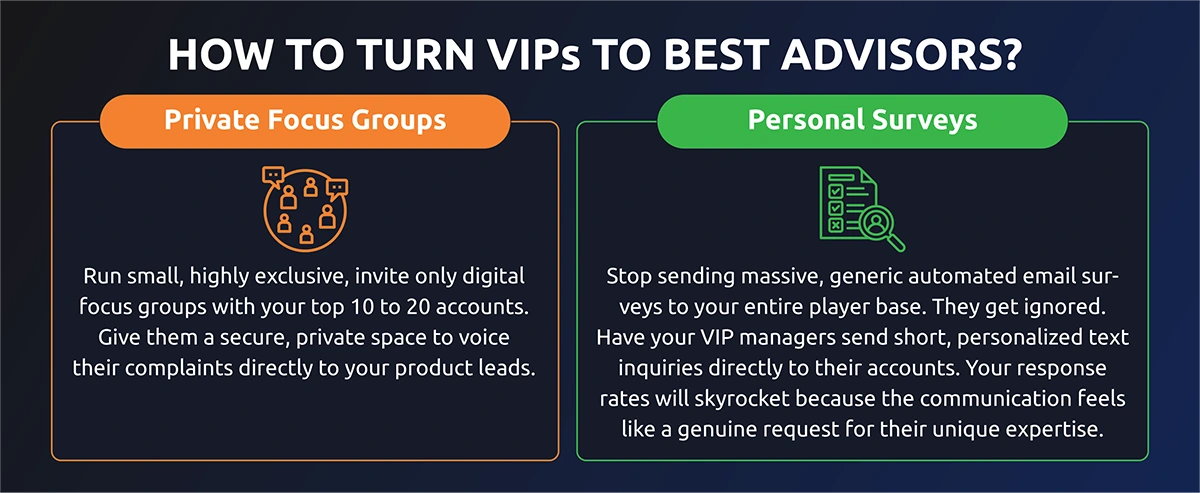
The final, crucial step in this loop is execution. When you actually deploy a software update or fix a UI layout based on a high roller’s piece of advice, have their dedicated manager send them a personal note informing them of the change.
Showing a user that their feedback directly altered the development roadmap of a global platform builds an incredible level of psychological loyalty that no amount of financial cashback could ever match.
The Future of VIP Support in Online Casinos
AI is reshaping high roller management in 2026, but not by replacing human VIP managers with chatbots. High rollers demand a premium, status driven experience that only a human concierge can provide. Instead, successful operators use AI as an invisible efficiency engine to analyze historical habits and prestage mathematically optimized offers right before a player logs in, letting the technology handle data while humans manage the relationship.
This hyperpersonalization has completely destroyed rigid, old school VIP tiers like bronze and gold. Modern systems build dynamic, individual profiles in real time; if a player hates slots and only plays live blackjack, their dashboard automatically adapts to feature table incentives alone.
But as you scale, never trade flashy tech for operational basics. Spending millions on unproven features while your withdrawal speeds slow down is a critical mistake. To ensure your backend infrastructure seamlessly aligns with tightening global rules, you can consult with LicenseGentlemen to build an operational framework that pairs maximum payout performance with absolute regulatory safety. Master the basics, treat high rollers like real business assets, and the math will take care of itself.
FAQ
Stop looking for a magic number. There isn’t one. A VIP at a micro stakes casino is different from a whale at a high liquidity site. If you’re relying on a specific dollar amount, you’re guessing. Focus on your ADPU (Average Deposit Per User). If a player’s behavior consistently sits well above your brand’s baseline, they are the ones you watch. The dollar amount is just a variable; the pattern is the signal.