
Online Casino Customer Support in 2026: Complete Operator’s Playbook
Customer support is the last thing operators budget for and the first thing players notice. They budget for games, bonuses, and traffic, then bolt on a help desk as an afterthought. That is exactly backwards. Customer support is not a cost center.
It is the infrastructure that determines whether a player stays or leaves, whether your churn is 30% or 60%, and whether your LTV calculations ever come close to what your spreadsheet projected.
In 2026, support is a direct revenue function. Headcount, shift structure, channel coverage, and AI configuration are business decisions with measurable impact on retention and LTV. This guide provides the operational framework needed to protect your player acquisition spend and hit your target lifetime value metrics.
Why customer support is the #1 driver of casino retention in 2026
Online casino customer support is the most controllable variable in player LTV. Games are commoditized. Bonuses are copied overnight. Support is the one thing that cannot be replicated with a template.
Casinos with response times exceeding 10 minutes experience 25 to 35% higher churn than platforms responding within three minutes. Players who hit a problem in their first session and receive slow support are twice as likely to leave permanently. That shows up in your deposit frequency data within 30 days.
The casino’s help desk is the primary trust indicator for new players. A player who makes a small first deposit must decide whether to commit more money. The speed and quality of the first support interaction either confirms or cancels the decision. You pay money to bring a player in. Your support desk determines whether that investment was worthwhile.
Customer support benchmarks every operator must hit
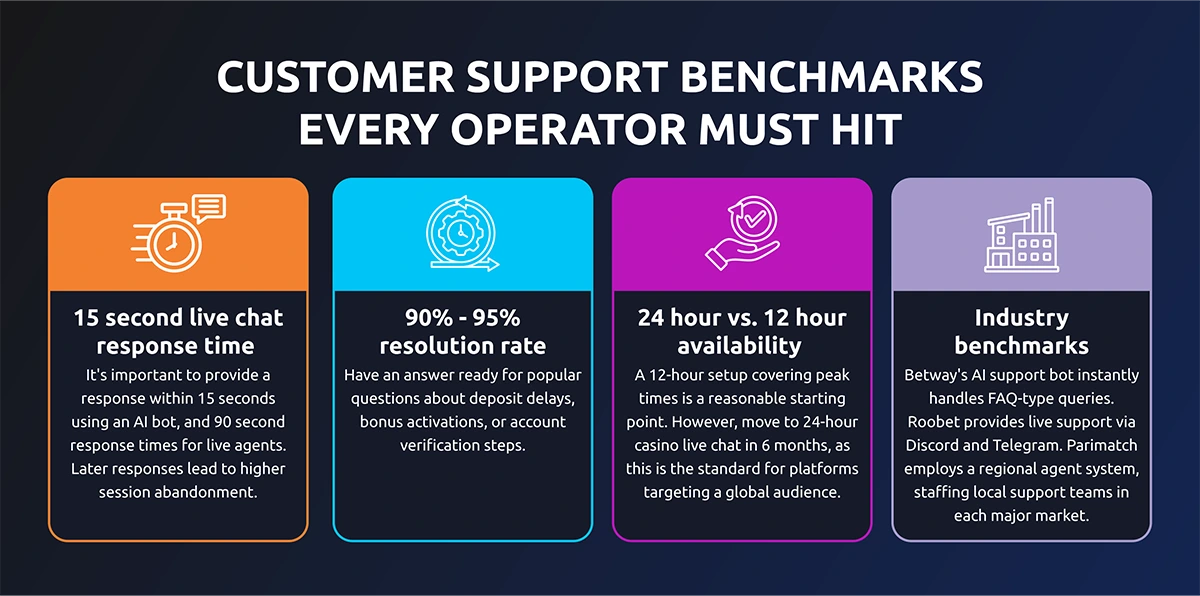
63% of players rank speed of response as the top factor in a support experience, ahead of resolution quality and channel availability. The 2026 benchmark standard is tighter than most operators plan for.
15-second live chat response time
The standard for live chat in iGaming is to provide a first response within 15 seconds for AI-assisted inquiries and within 90 seconds for live agent responses. The fastest performing regulated platforms consistently fire replies within 60 to 90 seconds during peak hours. Standard platforms average 2 to 5 minutes. The gap between those two outcomes shows up directly in session abandonment rates.
Achieving sub 15 second AI responses requires a properly configured chatbot with intent detection and clean routing. A poorly configured bot that makes players fight through menus before reaching an agent is worse than no bot. Set the escalation trigger: if a player types the same question twice, route to a human immediately.
90-95% first-line resolution rate
Industry benchmarks put First Contact Resolution at 60–80% across general customer service. iGaming should be targeting 90–95% for standard queries. If a player has a question regarding a deposit delay, bonus activation or an account verification step, they should never have to come back a second time on the same issue.
That requires agents with real-time access to the payment system, the bonus engine and the player account, not a ticketing system that escalates everything to a back-office team. Build a living internal document on every scenario your team faces; update it weekly and link performance reviews to FCR, rather than ticket volume. Ticket volume rewards speed. FCR rewards resolution.
24/7 availability vs 12/7 for startups
24/7 casino live chat is the standard for any platform targeting a global player base. The math is simple: players deposit at all hours, and problems do not follow business hours. A withdrawal query at 3am that goes unanswered until morning has already created a chargeback risk and a social media complaint.
24/7 from day one is not always realistic. A 12/7 setup covering peak hours combined with AI chatbot coverage for off-hours is a defensible starting position. Map your top three player geographies and build shifts around those windows. Move to 24/7 within six months as volume justifies it.
Industry benchmarks: Betway, Roobet, Parimatch
Betway operates a tiered support model: AI handles FAQ-level queries instantly, a front-line agent pool covers standard issues within 90 seconds, and a VIP desk routes high-value players to named account managers. The model keeps live agent time focused on queries that actually require judgment.
Roobet built its support reputation on community integration alongside traditional live chat. Discord and Telegram channels staffed by support agents give the platform direct access to player sentiment before issues become complaints. Response times under 60 seconds, proactive communication on known technical issues, and publicly visible resolution updates are the pillars of their support brand.
Parimatch uses a regional agent model, staffing native-language support teams for each of their primary markets. Brazilian Portuguese, Turkish, and Ukrainian-language agents handle queries in their native language rather than routing through translation. The result is faster resolution and higher CSAT scores in those markets. This is the gold standard.
When players talk to native speakers, the entire experience changes. It stops being a cold, corporate transaction. It becomes a connection. They bond with support because it feels like talking to a “homie.” Never shortcut this. Putting a European Portuguese agent on chat with a Brazilian player is a recipe for disaster. Just like that, the slang is all wrong, the vibe is completely off and player trust dies instantly.
Ready to Launch Your Own Online Casino?
Get the full 5-step roadmap – from licensing to payments – with a real project timeline included.
Staffing your casino support team
Building a support team without coverage gaps or burnout requires a headcount model, not a gut estimate.
Minimum staffing for 24/7 coverage
24/7 coverage across three rotating shifts requires a minimum of 12 full-time agents to maintain continuous coverage, account for sick days, training time, and the reality that no agent should work more than five consecutive days. The actual floor calculation: three shifts of two agents each, plus 50% headcount buffer for leave, training, and absence.
That gets you to 12 as your minimum. Below 12, you are one absence away from a single-agent shift, which is operationally unsustainable. One agent handles 3 to 4 simultaneous chats. Two agents per shift covers up to 8 concurrent conversations. Scale proportionally beyond that.
Shift structure: 6am-2pm, 2pm-10pm, 10pm-6am
The standard iGaming shift structure runs three eight-hour windows aligned to global time zones. The 6am-2pm UTC shift covers European morning and Asian evening. The 2pm-10pm UTC shift covers European prime time and North American afternoons. The 10pm-6am UTC shift covers North American evenings and Latin American prime time.
Overlap handovers by 30 minutes. Agents ending a shift brief the incoming team on open cases rather than dropping tickets in the queue. That habit prevents most context failures.
In-house vs outsourced support
In-house support gives you full control: brand voice, platform fata access and agents who know your product. A fully in-house 24/7 team runs $250,000-$600,000 per year depending on geography. Outsourcing iGaming BPO support cuts that cost significantly, as specialist providers in Eastern Europe, South Asia, and Latin America staff experienced gaming agents at a fraction of the domestic in-house cost.
The trade-off is less direct control, longer knowledge transfer timelines and the risk that the BPO treats your account as one of many. For most mid-tier operators, the best model is hybrid: a small in-house team that handles escalations, VIPs and brand-sensitive interactions and an outsourced team that handles standard query volume governed by strict SLA tracking protocols.
This is exactly where we come in. At LicenseGentlemen, we do a lot more than just check boxes for your licensing. We have seasoned online gaming experts who will map out your specific market, analyze your player base and help you choose the exact customer service setup your casino needs to scale without burning cash.
Hiring experienced vs entry-level agents
The right blend: senior supervisors at 20–25% for escalations and oversight; experienced agents at 30–35% for tier-two queries; entry-level agents at 40–50% working from a strong knowledge base on standard queries. Training entry-level agents on a solid playbook closes the skill gap faster than most operators expect. The bottleneck is almost always the knowledge base.
Case study: SapphireBet vs Roobet, what went wrong and what went right
Bad support and good support are separated by process, not budget.
SapphireBet: how bad support loses customers
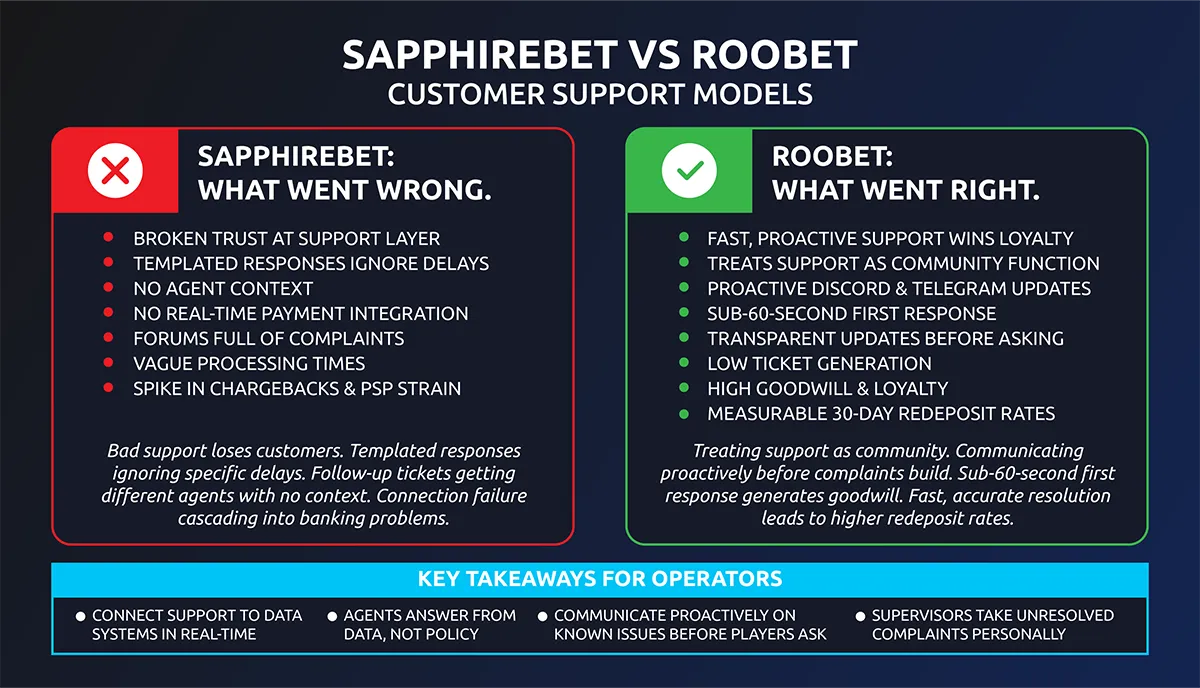
SapphireBet built a reasonable product and broke trust at the support layer. Players requesting withdrawals received templated responses that ignored the specific delay. Three days would pass. A follow-up ticket got a different agent with no context, who referenced standard processing times rather than the actual transaction status.
The problem was not agent quality. It was the absence of real-time integration between the support desk and the payment system. Players could see their withdrawal was still pending. Agents were citing standard processing times. That disconnect destroys trust faster than the delay itself.
SapphireBet’s player forums are filled with withdrawal complaint threads. Chargeback rates climbed. PSP relationships became strained. A support process failure cascaded into a banking problem.
Roobet: how fast, proactive support wins loyalty
Roobet treats support as a community function rather than a transactional one. When a known platform issue arises, a game provider outage, a delayed batch payment, or a promotion mechanic that is not working as described, Roobet communicates proactively through Discord and Telegram before the complaint volume builds.
Players who see a transparent update before they have to ask do not generate tickets. They generate goodwill. Sub-60-second first response means a player never has time to open a second browser tab and look at alternatives. Players who receive fast, accurate resolution show measurably higher 30-day redeposit rates.
Key takeaways for operators
Connect your support desk to payment and bonus systems in real time. Agents answering from policy rather than data are a liability. Communicate proactively on known issues before players ask. When a complaint reaches a second interaction without resolution, a supervisor takes it personally.
AI and human support: building the right mix in 2026
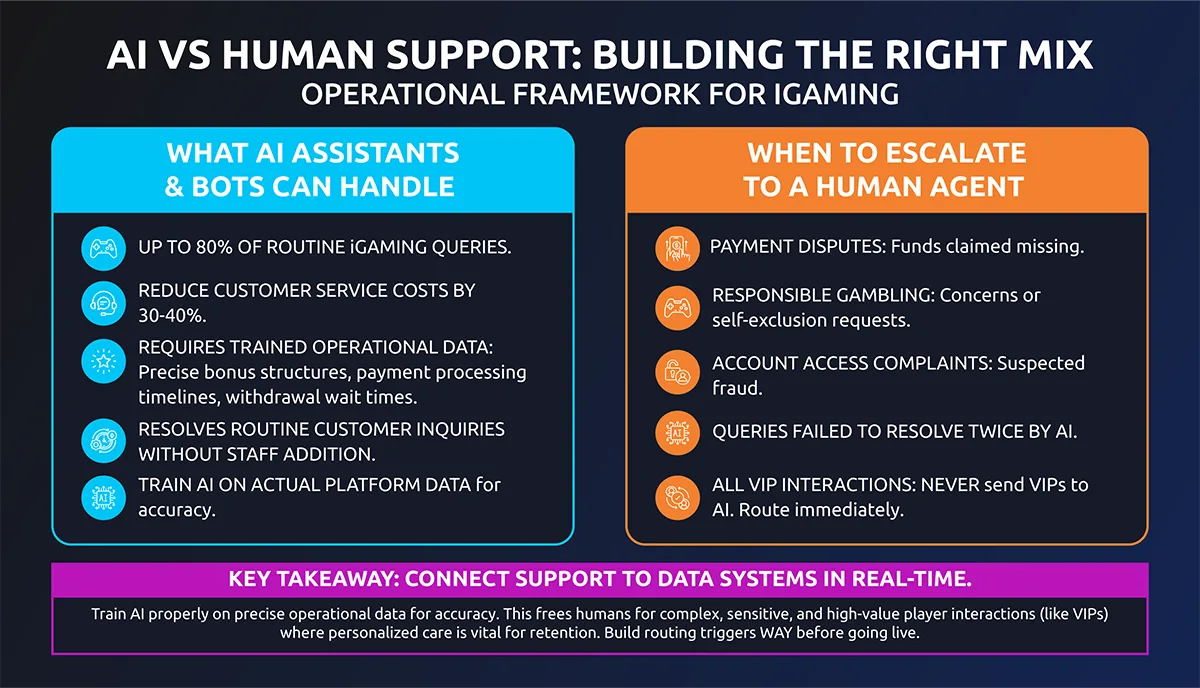
AI handles up to 80% of routine iGaming support queries. The question is not whether to use it but how to configure it so the 20% that needs a human gets one.
What AI chatbots can handle (70-80% of queries)
When implemented correctly, AI can help reduce customer service costs by 30-40%, as well as resolve a vast majority of routine customer inquiries without the addition of staff. To achieve these results, the platform must be trained on precise operational data, including exact bonus structures, active payment processing timelines, and withdrawal wait times, rather than relying on generic chatbot logic that can misinterpret terms and cause player disputes.
The key is implementing it properly. Training an AI to answer questions using generic chatbot logic, without proper iGaming training data, may result in bonus term answers that create future conflicts. Train your AI on your actual platform data.
When to escalate to a human agent
Escalation triggers that must route to a human immediately: any payment dispute where funds are claimed missing; any responsible gambling concern or self-exclusion request; any account access complaint involving suspected fraud; any query the AI has failed to resolve twice; and any VIP interaction regardless of query type. Don’t even think about sending your VIPs to an AI chatbot, ever. It’s the fastest way to make your highest-value players pack up and take their bankroll to a competitor.
The moment a high-roller reaches out, they shouldn’t have to fight through a single automated menu. They need a dedicated VIP manager on the other end, someone whose entire job is to keep them happy, hyper-engaged, and feeling like absolute royalty. These guys want a real, personalized connection, not a robotic script. Make sure you build these routing triggers into your system way before you hit the go-live switch.
Multilingual AI for global player bases
A properly configured multilingual AI handles 30+ languages without proportional headcount increases. For operators targeting Latin America, Southeast Asia, or MENA, a single bot replaces what would otherwise be four separate staffing pipelines.
The quality floor matters here. Native speakers in your target markets should review AI responses in their language before you go live. Machine translation produces technically correct language that sounds clunky. Players from Brazil can tell when their support response was not written by a Brazilian Portuguese speaker. Get it right.
Multi-channel support: live chat, email, messengers, social
To operate effective multi-channel casino support, operators must deploy live chat as the primary channel alongside email for complex disputes while integrating WhatsApp and Telegram for regional markets. Managing these channels requires routing all interactions into a single interface governed by centralized omnichannel helpdesk parameters to prevent communication silos.
One unified dashboard aggregating all channels is non-negotiable. An agent who cannot see a player’s Telegram history when they follow up by email is flying blind. Tools like Zendesk, Freshdesk, and LiveAgent handle these omnichannel helpdesk parameters at iGaming-appropriate price points to ensure seamless CRM data cascading.
Handling escalations, VIPs, and disputes
Resolving online casino escalations and high-value player disputes requires immediate routing via specialized priority queues, direct human intervention and your VIP manager on the case right away. Operators must avoid routing VIP accounts or financial complaints through standard helpdesk lines, establishing immediate supervisor ownership to protect lifetime value and prevent regulatory referrals.
First-line resolution authority
Front-line agents need enough authority to resolve standard queries without escalation: manual bonus activation where the system incorrectly blocked it, withdrawal reversal initiation for valid reasons, KYC upload window extensions, and courtesy credits up to a defined threshold. Without this, agents escalate things that should not be escalated.
Escalation to operations manager
Cases that route to operations management: payment disputes where the platform needs to investigate internally; any suspected fraud flag on a player account; responsible gambling cases identified by any channel; complaints that have passed 24 hours without resolution; and any player who references regulatory complaints or legal action. The operations manager tier is the function that stops complaints becoming regulatory referrals. It is not a delayed front-line queue.
VIP player routing and personalized service
VIP players must have a zero-wait path to a dedicated agent or account manager who knows their history. Routing a VIP through the standard queue is an operational mistake with predictable consequences. VIP accounts need a flag in the CRM so any incoming contact triggers immediate priority routing, a dedicated WhatsApp or Telegram channel for direct messaging, and account managers who can make commercial decisions without waiting for sign-off.
The higher a player’s lifetime value, the faster and more personal their support experience needs to be. This is not a philosophy. It is a retention calculation.
Third-party escalations (payments, platform)
A payment processor delay, a game provider outage, a platform bug. When the root cause is external, the support desk still owns the player relationship. The agent’s job is to be the player’s advocate with the third party, not to tell the player to wait and close the ticket.
Build direct escalation contacts at your key payment providers and platform provider. Know who to call when a withdrawal batch is stuck. The players do not care that the delay is at your PSP. They care that you are on it.
Proactive support and predictive churn detection
Winning on retention means intervening before the player decides to leave. A player who visits the cashier three times without depositing has hit a friction point. Seven days of no logins after an active run is a churn flag. These are support triggers.
Build a CRM rule routing behavioral anomalies to a proactive outreach workflow: an automated email, a WhatsApp from the account manager for VIPs, or a targeted bonus timed to re-engagement. Proactive contact within 48 hours of a churn signal retains a measurable share of players who would otherwise be lost.
Multilingual and localized support that actually works
English-only support loses players in every market where English is not the first language. The markets where localization most directly drives conversion: Brazil, Germany, Japan, Turkey, and MENA. Brazilian Portuguese casino support deserves specific attention. Brazil is the largest iGaming market in Latin America and players consistently cite language quality as a trust signal.
A fluent Brazilian Portuguese response tells the player the platform was built for them. A translated one tells them they are an afterthought. Regional agents, not translated bots, for your top markets. Use AI translation for low-volume languages only.
Self-service tools: FAQs, how-to guides, and knowledge bases
A well-built self-service layer deflects 20–30% of support volume before it reaches an agent. Rather than using static FAQ pages, modern platforms deploy dynamic self-service structures:
- Dynamic FAQ systems: Automatically surfaces contextually relevant articles based on exactly what the player is doing on-screen, significantly outperforming traditional help pages.
- Granular knowledge base coverage: Must explicitly cover step-by-step KYC instructions, bonus wagering terms with clear examples, and localized payment method guides.
- Operational essentials: Includes easily accessible responsible gambling tools, routine technical troubleshooting, and account security management fields.
Outsourcing casino customer support: cost vs control
Outsourcing to a specialist iGaming BPO: a 12 agent 24/7 team in Eastern Europe or South Asia runs $80,000–$150,000 per year versus $300,000–$600,000 for an equivalent in-house team in Western Europe.
The risks are real. Agents not trained on your specific platform produce generic answers. Contracts that measure response time but not resolution quality incentivize speed over substance. BPO providers managing dozens of gaming clients give each one proportional attention unless the contract forces otherwise. Negotiate SLAs that include FLR, not just response time. Require dedicated agents, not a shared pool. Keep an in-house team for escalations and VIPs regardless of how much you outsource.
Measuring support performance: KPIs and continuous improvement
Four metrics tell you almost everything about support performance:
- FLR: Target 90–95% for tier one queries. Track by query type via CRM data cascading to find what is dragging the average down.
- FRT: Under 15 seconds for automated replies, under 90 seconds for live agents. Track separately by channel.
- CSAT: Post-interaction survey, target 4.2+ out of 5. Tie performance reviews to CSAT, not ticket volume.
- Chat abandonment rate: Anything above 15% means queue time or user friction. Fix the routing.
- Escalation rate: High rates indicate knowledge base gaps or insufficient frontline authority.
Review weekly at the team level and monthly at the management level. Spot which agent, shift, or query category is pulling the average down and fix it before the churn data does.
Common customer support mistakes that kill casinos
These failures show up across casino support operations repeatedly:
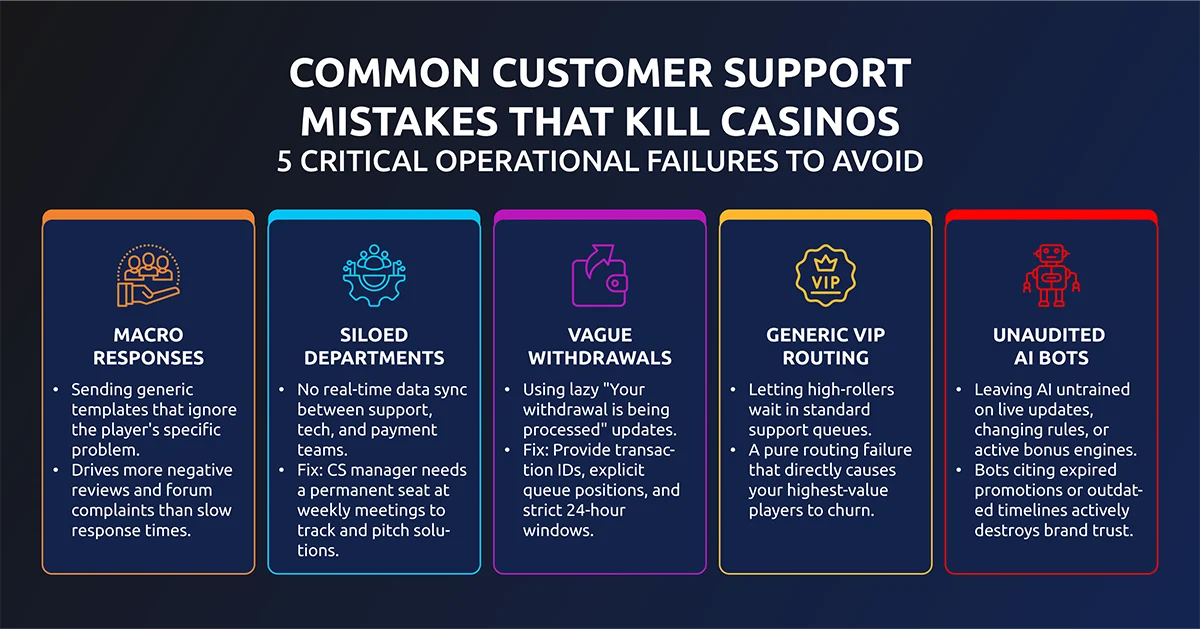
- Macro responses that answer a different question. Players know when a template ignores their actual situation. This drives more negative reviews than slow response times.
- No cross-department communication. Agents who cannot get real-time answers from payments or tech respond with vague timelines. When that happens, the problem stays unsolved and the frustration just compounds. To fix this, your customer support manager needs a permanent seat at the weekly meeting table. They shouldn’t just list out the biggest complaints and frequent requests; they need to proactively pitch the solutions. Once those updates get greenlit, it’s on them to track the development progress and make sure the fixes actually make it to the finish line.
- Vague withdrawal communication. “Your withdrawal is being processed” tells the player nothing. “Your withdrawal is in our standard processing queue and will typically clear within 24 hours; your transaction ID is X and we will notify you by email when it updates” tells the player everything. The second version generates fewer follow-up tickets and more trust.
- Treating VIPs like standard players. A VIP who waits in a standard queue is a VIP you are about to lose. The routing failure is an operational mistake, not a support agent failure, but the result is the same.
- Not auditing AI responses. Bonus terms change. Promotions end. An AI answering questions about an expired promotion or incorrect withdrawal timeline is actively damaging trust.
Conclusion
Customer support is a retention function and a revenue function. Operators who budget it accordingly build sustainable businesses. Operators who minimize it build churn. Hit the benchmarks on response time and resolution rate. Staff for your actual volume. Configure AI to handle the routine and escalate the rest. Build the VIP infrastructure before you need it.
None of this is complicated. Operators who skip it find out why it mattered after the players are already gone.
LicenseGentlemen works with operators at every stage of building their iGaming operations. With over 500 licenses issued across jurisdictions, we know what the operational setup needs to look like before players arrive. Book a free consultation.
FAQ
12 agents minimum for 24/7 coverage across three shifts with a 50% buffer for leave and training. Startups who cannot support that headcount should launch 12/7 with human agents during peak hours and AI chatbot coverage off-peak. Scale to 24/7 within six months.