


How to Manage High-Performance Casino Affiliates in 2026: Operator’s Relationship Playbook
Recruiting an affiliate can happen after a few emails, a conference meeting, or one good commercial offer, while keeping that affiliate productive over the next twelve months requires a much stronger operation behind the deal. Once real money starts moving, affiliates begin judging your casino through conversion, player value, reporting, NGR calculations, payment behaviour, communication, and how quickly your team reacts when something looks wrong.
Operators sometimes focus so heavily on getting links live that they underestimate how valuable the relationship can eventually become. In our earlier work with casino brands, we have seen top affiliates earning around $3 million per month in commissions for individual brands, with the player revenue behind those relationships reaching tens of millions.
Numbers at that level change the way you should think about iGaming affiliate management because a high-performance affiliate is effectively running a major acquisition channel for your business. Managing the relationship properly means giving that partner enough commercial confidence to keep sending good players, while protecting your own margins, licence, data, and reputation at the same time.
In this guide, we break down how casino operators can actually manage high-performance affiliate relationships in 2026, including how to structure commissions, protect NGR transparency, maintain reliable tracking, handle payments, prevent fraud, and build long-term partnerships that scale without breaking commercial margins.
Why Managing Affiliates Well Is Harder Than Recruiting Them
Managing affiliates well is harder than recruiting them because the initial deal only needs to look attractive once, while the relationship has to keep working every month that traffic continues. Affiliates quickly notice late payments, changing deductions, unexplained conversion drops, tracking gaps, or managers who disappear when a commercial problem becomes difficult.
Recruitment usually sits with one team and revolves around traffic, commission, geographies, and expected volume, although the relationship becomes much broader as soon as the first players arrive. Finance controls the payout, product affects conversion, CRM influences retention, compliance limits what can be promoted, fraud teams validate the traffic, and technology determines whether the affiliate receives credit for the players they sent.
When the same affiliate traffic converts for one brand and falls apart for another, the brand can be the problem. A stricter KYC flow, weaker product journey, or lost payment method can damage conversion even when the traffic source has not changed. Blaming the affiliate before checking the funnel can push good traffic away while the real problem remains untouched.
Good affiliate management connects those internal issues back to the partner quickly instead of leaving them staring at a dashboard and wondering whether the casino has quietly changed the deal.
The strongest programs generally protect five areas throughout the relationship.
- Attribution remains dependable, so clicks, registrations, FTDs, qualified players, and revenue reconcile with the underlying casino data.
- Commission calculations remain understandable, particularly when the operator deducts bonuses, taxes, chargebacks, payment fees, or jackpot costs.
- Payments follow an agreed rhythm, which allows affiliates to manage their own payroll, media spend, content costs, and cash flow.
- Commercial changes are communicated before they hurt earnings, especially when the casino changes bonuses, qualifying criteria, restricted markets, or commission rules.
- Somebody owns the relationship internally, which prevents every operational question from turning into a week-long chain of forwarded emails.
A slightly lower commission can remain competitive when those areas work consistently, while an aggressive headline offer starts losing its appeal once the affiliate has to chase every payment or argue over every monthly report.
Affiliate Size and What Each Segment Actually Wants
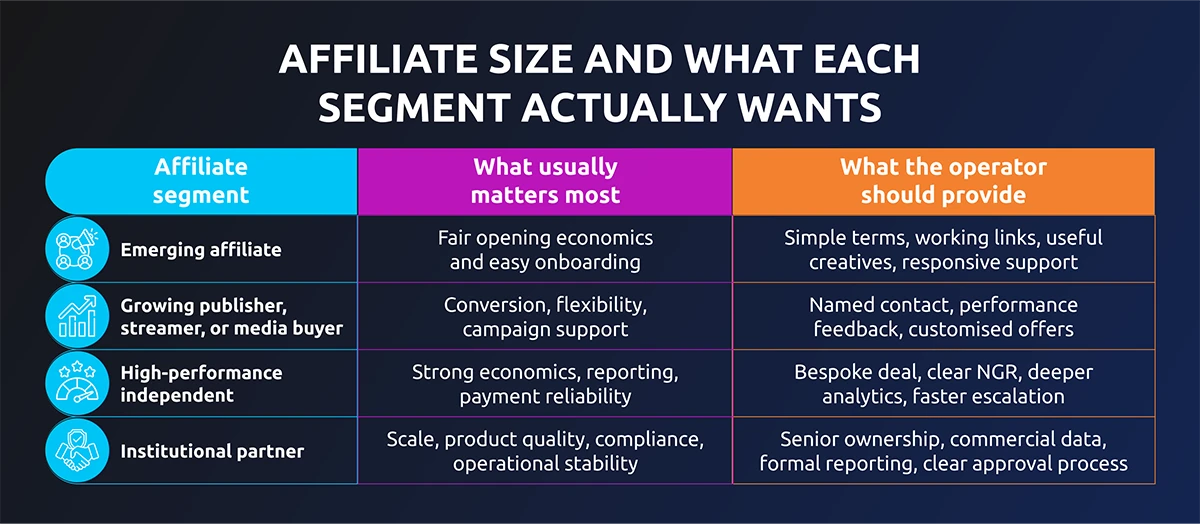
Affiliate expectations change significantly with size, traffic source, and commercial maturity, so operators should avoid treating every partner as though they want the same deal. Smaller partners often value access and flexibility, while institutional publishers expect proven conversion, reliable economics, strong compliance, and enough internal infrastructure to handle serious volume.
Small and Mid-Sized Affiliates
Small and mid-sized affiliates usually want a fair commercial opportunity with an operator that responds quickly and gives their traffic a realistic chance to convert. Clear terms, relevant creatives, usable landing pages, reliable reporting, and access to somebody who understands the campaign can matter more than adding another percentage point to RevShare.
Operators should not write off an affiliate simply because another casino got weak results from them. Traffic can underperform because the offer does not suit the audience, the product is wrong for the players, or the GEO simply does not fit, so past performance needs context before it becomes a verdict on the affiliate.
Imagine an SEO publisher whose audience searches heavily for crypto slots while the previous casino pushed card deposits, traditional table games, and a generic welcome page. Weak results from that relationship tell you very little about what the same publisher might produce for a crypto-first casino with the right cashier, offer, and landing experience.
Ask how the affiliate generates traffic, which geographies convert best, what content attracts their audience, and what deal structure gives them enough incentive to test the brand properly. A useful first campaign teaches both sides more than a long negotiation based entirely on somebody else’s historical numbers.
Institutional Partners (Catena Media, Better Collective)
Institutional partners such as Catena Media and Better Collective usually expect stronger commercial evidence because they can choose between many operators competing for the same valuable inventory. Your casino needs to show why its conversion, retention, brand, regulatory setup, and economics deserve placement before a large media group commits meaningful traffic.
Catena Media’s Q1 2026 numbers show the scale involved, with 34,573 new depositing customers generated from continuing operations during the quarter. The company has also made sub-affiliation a strategic priority through MRKTPLAYS+, which shows how large affiliate businesses are expanding beyond conventional SEO relationships into broader partner networks and distribution models.
Operators should approach negotiations at this level with real numbers covering target markets, registration-to-FTD conversion, payment acceptance, player retention, average deposits, NGR, licensing, and available promotional inventory. A large affiliate can send more traffic, although more traffic only makes an unprofitable funnel lose money faster when your product economics are still wrong.
What New Casinos Realistically Get
Brand-new casinos usually gain traction with specialist publishers, regional affiliates, streamers, communities, and performance teams before they become attractive to the strongest institutional partners. Operators that need meaningful data quickly can still buy larger placements early, although they should treat the extra cost as a deliberate testing expense rather than assuming the campaign will immediately produce efficient acquisition.
Smaller affiliates often prefer established casinos because their own margin for error is limited. Giving valuable inventory to an unknown startup can be a bigger commercial risk for a small publisher than working with a casino that already converts reliably.
We had a case that allocated €50,000 per month to a single affiliate for Q1, leaving no acquisition budget for anyone else. The affiliate delivered the volume, so the decision worked, but the operator had effectively put its entire acquisition test into one commercial relationship.
Paying more early can make sense when the operator has enough capital and knows what information it wants from the test. The first few cohorts can reveal whether payment acceptance is strong, which bonuses convert, where KYC creates friction, what Day-30 retention looks like, and how much NGR the average player actually produces.
Operators should therefore build early acquisition around learning rather than vanity volume.
- Track every stage from click through registration, FTD, second deposit, Day-30 activity, and eventual NGR.
- Compare different landing pages and offers before increasing affiliate spend.
- Investigate repeated conversion problems across several unrelated traffic sources.
- Use proven cohort economics when negotiating stronger partners later.
Commission Structures That Actually Retain Top Affiliates in 2026
The best casino affiliate commission structure gives strong partners enough upside to keep scaling while leaving the operator enough margin to support the players they bring. Public programs in 2026 still show a broad RevShare market, with current offers reaching 40% at Betsson, 45% at ComeOn Connect, and 50% at several programs using performance-based tiers.
Headline percentages become much less useful when separated from the rest of the commercial terms, which means operators should compare RevShare together with NGR deductions, negative carryover, qualification rules, payment timing, and any high-roller treatment.
RevShare (25-50% of NGR)
A practical casino RevShare range in 2026 remains roughly 25% to 50% of NGR, with the strongest rates normally reserved for affiliates producing enough value to justify them. Current public programs provide real examples across that range, including Onyx Affiliates with tiers from 25% to 50%, ComeOn Connect advertising up to 45%, and Betsson Group Affiliates advertising up to 40%.
Revenue share works particularly well when both sides believe the referred players will remain valuable over time because the affiliate continues participating in future NGR rather than receiving one acquisition payment and moving on.
One of our clients acquired a VIP player through an affiliate who deposited almost $1 million. Because the player came through a RevShare deal, the operator was looking at giving the affiliate hundreds of thousands of dollars from the value of that relationship. A percentage that looks reasonable while negotiating can feel very different when one player suddenly becomes exceptionally valuable.
A case like that is why we would not give away the highest available RevShare before understanding the traffic and the economics behind it. A 50% RevShare agreement leaves considerably less room for gaming taxes, provider costs, bonuses, payment processing, CRM, fraud losses, and other operating expenses, which can make a deal that looked aggressive during recruitment very uncomfortable once meaningful volume arrives.
CPA and Hybrid Deals
CPA suits affiliates that want predictable payment for each qualified player, while hybrid agreements combine upfront acquisition income with a smaller share of future NGR. Current programs still negotiate CPA individually rather than publishing one universal rate, with ComeOn Connect explicitly handling CPA on a case-by-case basis and offering hybrid structures alongside RevShare.
The most important operator decision involves defining exactly what qualifies as a payable acquisition. A registration alone is rarely enough, while an FTD definition may include a minimum deposit, KYC completion, wagering requirement, fraud review, or a waiting period before the commission becomes final.
Hybrid arrangements can work particularly well when a valuable affiliate wants enough immediate income to fund content or paid acquisition while still keeping an interest in the lifetime performance of the players. The operator gains some protection against paying the entire value upfront, while the affiliate receives more predictable cash flow than pure RevShare provides.
Tiered RevShare Progression
Tiered RevShare retains affiliates when the path toward a higher commission is visible, achievable, and based on metrics that actually matter to the casino. Public programs such as Onyx already use a progression from 25% toward 50%, which gives operators a useful model for rewarding increased performance without giving every new partner premium economics immediately.
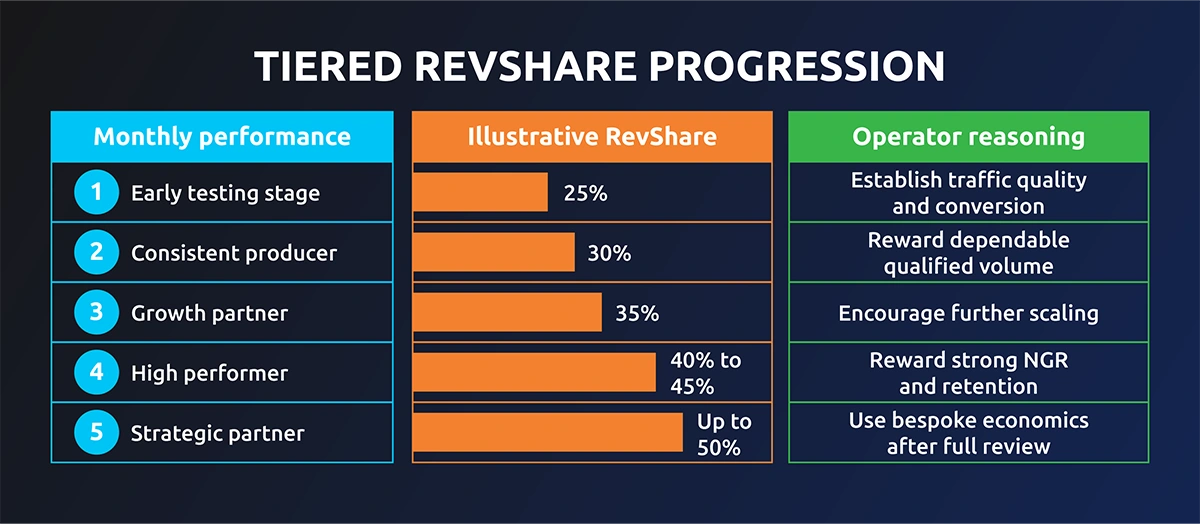
When an affiliate has potential but the economics still need to prove themselves, we prefer earning into the better deal rather than handing over the top rate immediately. A simple ladder can pay €300 when the affiliate reaches 100 FTDs and move to €350 after another 150, giving the partner a reason to keep scaling while the operator gets actual performance before improving the economics.
Volume alone should not decide the next tier because fifty players who keep depositing can be worth far more than one hundred FTDs who disappear after qualification. NGR, repeat deposits, fraud rates, and strategic market value can therefore sit alongside volume when the tiers are reviewed.
Negative Carryover: The Deal-Breaker Nobody Talks About
No-negative-carryover remains attractive to affiliates because one unusually lucky player cannot automatically wipe out several future months of commission. Current programs still promote the feature actively, with Betsson using no negative carryover subject to a defined high-roller exception and ComeOn Connect resetting negative balances at the beginning of each new month.
Betsson’s current terms offer a particularly useful example of how an operator can protect both sides. Ordinary negative balances do not carry forward, although a player creating at least €10,000 in negative commissionable revenue during a month can fall under the program’s high-roller policy and have that balance carried forward against future commission generated by the same player.
When we look at negative carryover, we care about the affiliate’s performance over the whole relationship rather than one ugly month. An affiliate that has consistently made the casino money can suddenly fall into the red because of one exceptional player result, and forcing that partner to spend the next few months earning their way back to zero gives them a very obvious alternative. They can move the traffic somewhere else and start again from zero immediately.
Protecting one negative month can therefore cost the operator a relationship that was profitable over a much longer period.
NGR Calculation Transparency: The Trust Killer
NGR transparency matters because the affiliate earns commission from the number remaining after deductions, which makes the formula as important as the advertised RevShare percentage. Two operators can both offer 40% while producing very different payouts if their treatment of bonuses, payment costs, taxes, chargebacks, fraud, administration fees, and jackpots differs.
We do not consider a 45% RevShare attractive simply because 45% looks generous on the affiliate page. Load enough deductions into NGR and the affiliate can end up earning two or three times less than they expected from the headline offer. Professional affiliates know how this works, which is why serious negotiations quickly move from “What percentage do you pay?” to “What exactly are you deducting?”
Current Betsson terms show how detailed a real NGR calculation can become. Depending on the product, Net Revenue can deduct winnings, bonuses, administration fees including applicable gaming taxes and VAT, fraud costs, chargebacks, returned stakes, jackpot changes, and transaction costs.
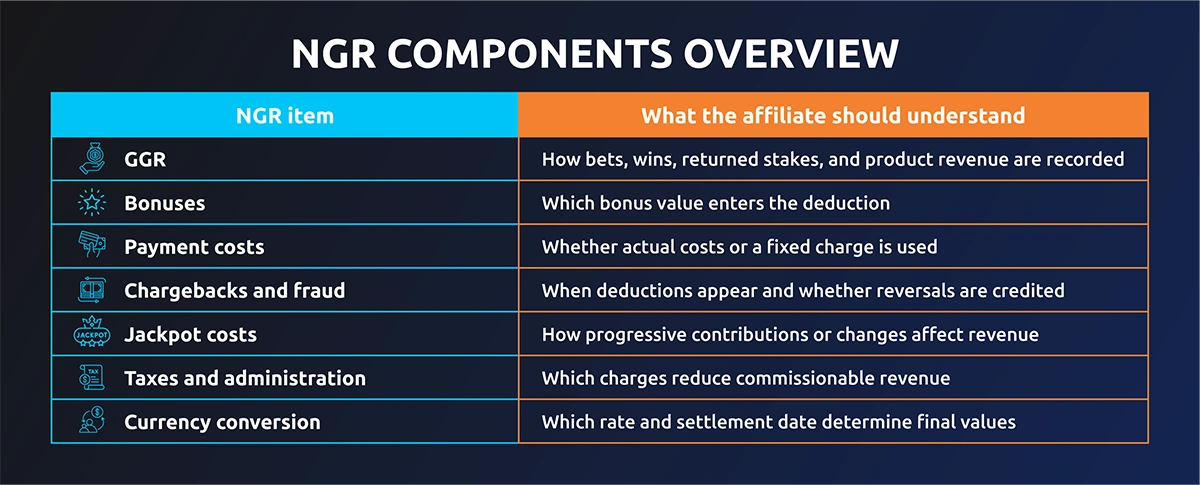
Affiliate managers should be able to explain the calculation before traffic begins rather than waiting for the first large dispute. A partner expecting €40,000 from what appears to be €100,000 of NGR will understandably become suspicious when the dashboard suddenly shows €72,000 after deductions nobody discussed.
Finance should therefore be able to reconstruct the journey from player revenue to final commission for a specific month, campaign, or cohort whenever a material discrepancy appears.
Tracking Infrastructure That Survives 2026 Browser Restrictions
Casino affiliate tracking should use server-side validation for valuable conversion events because browser privacy controls can make client-only attribution unreliable across different users and devices. Firefox currently enables Total Cookie Protection by default, while Chrome continues to give users control over third-party cookie access and has retired several earlier Privacy Sandbox technologies, leaving operators with a fragmented tracking environment rather than one universal browser standard.
The practical solution involves preserving the affiliate click identifier inside the operator’s first-party systems and matching it with backend events such as registration, KYC, FTD, CPA qualification, deposits, and revenue. Server-to-server postbacks can then send validated events into the affiliate platform without relying entirely on a cross-site browser cookie surviving the complete player journey.
A resilient setup should cover several controls.
- Preserve unique click and campaign identifiers through the permitted attribution window.
- Validate registration, FTD, qualification, and revenue events from the casino backend.
- Keep sub-affiliate and traffic-source identifiers available for investigation.
- Reconcile affiliate-platform numbers against casino data regularly.
- Test real acquisition journeys before a high-volume campaign launches.
- Document rules for returning players, attribution windows, and cross-device accounts.
A premium affiliate sending thousands of clicks is the wrong partner to use for discovering that your FTD postback stopped firing several weeks earlier, so operators should treat attribution testing as part of onboarding rather than waiting for a discrepancy to expose the problem.
Payment Discipline and Multi-Currency Payouts
Affiliate payments should follow a predictable schedule with clear settlement rules because partners build their own business expenses around the money your program owes them. Current programs still commonly operate monthly schedules, with Betsson paying monthly by the tenth of the following calendar month once the minimum threshold is reached and ComeOn Connect paying within ten working days after month-end or receipt of the invoice.
A strong payment policy should clearly state the cutoff date, invoice requirements, minimum balance, settlement currency, available payment methods, transaction costs, and expected payment window.
Multi-currency agreements deserve particular attention when traffic and commissions span several regions because exchange-rate movements can create disputes even when the underlying NGR calculation is correct. Operators should decide which source determines the FX rate and whether conversion happens at month-end, invoice date, or settlement date, then apply the rule consistently.
When only part of a payment is disputed, finance should also consider paying the undisputed amount while the remaining calculation is reviewed. Affiliates remember operators that protect their cash flow during a genuine reconciliation problem, especially when the alternative is freezing an entire month’s commission over one questionable line.
Personal Relationship Management at Scale
Personal affiliate management should become more intensive as the commercial value and complexity of the relationship increase. Strategic partners need somebody who understands their traffic, deal history, payment issues, campaign plans, and compliance limits, while smaller accounts can receive effective support through good systems until their performance warrants dedicated management.
Affiliate managers earn trust when they tell a partner about an operational problem before the affiliate discovers it through falling conversion. If a casino loses an important payment method, our advice is simple. Tell the affiliate immediately and pause the traffic if necessary. Letting them continue paying for clicks into a cashier you already know is broken turns an internal problem into their financial loss.
The industry’s informal networks also matter far more than many new operators realise. We are part of a Skype group with around 600 people from different casinos where managers ask whether somebody has worked with a particular affiliate and share what happened. Nobody needs a formal blacklist when several experienced operators immediately respond that a partner never delivered the traffic they promised. Affiliates talk to each other as well, so operators should assume their own payment behaviour and commercial reputation travel through the industry just as quickly.
Specialised iGaming affiliate consultants and advisors become particularly useful when relationships involve institutional publishers, complex NGR models, several markets, sub-affiliate networks, or large bespoke commercial commitments. An experienced advisor can challenge the proposed economics, benchmark the commercial structure, review whether the operator can actually support the volume, and identify where licensing, payments, product, or tracking will weaken the partnership before the agreement becomes expensive.
LicenseGentlemen can support that wider review when affiliate acquisition overlaps with licensing, payment infrastructure, corporate setup, or market entry, which often gives founders a clearer view of whether the casino is commercially ready for premium traffic before committing a large acquisition budget.
Fraud Vigilance in Ongoing Affiliate Operations
Affiliate fraud monitoring should continue after approval because weak or manipulated traffic can initially appear extremely successful when the operator looks only at registrations and first deposits. The most useful warning signals appear later through player behaviour, which makes Day-30 activity, second deposits, KYC outcomes, chargebacks, bonus patterns, device overlap, and sub-affiliate sources essential parts of ongoing review.
Sports betting affiliates whose audiences are heavily focused on strategies for making money from bookmakers are a traffic type we treat cautiously. The acquisition numbers can look attractive while those players turn out to be unusually good at extracting promotional value, and under a CPA deal the affiliate may already have been paid before the operator understands how poor the cohort economics are.
Day-30 cohort collapse deserves similar attention because an affiliate producing record FTD volume followed by almost no repeat activity may be optimising for the qualification event rather than genuine player value. Poor retention alone does not prove fraud, since payment problems, KYC friction, weak CRM, or a bad welcome offer can produce the same pattern, which means the cohort needs to be compared with similar traffic before action is taken.
Operators should investigate combinations of warning signs such as repeated device overlap, identical deposit behaviour, unusual bonus concentration, failed verification after the validation period, traffic arriving from undisclosed geographies, or one sub-affiliate suddenly producing most of the account’s conversions.
A friend of ours in the industry lost €250,000 on bad traffic after working under unclear agreements. Once that amount of money is moving, vague promises about traffic quality, sources, and what qualifies for payment stop being minor commercial details. By the time the cohort proves worthless, the operator may already have paid a very expensive lesson.
Synthetic brand abuse adds another layer in 2026 because low-cost generative tools make fake casino pages, cloned social profiles, misleading review sites, and operator-style promotional materials easier to produce at scale. Contracts should therefore require traffic-source disclosure and give the casino the right to investigate sub-affiliates, while internal teams preserve screenshots, tracking identifiers, player-level evidence, and campaign history before making a fraud decision.
Compliance Guardrails by Jurisdiction
Affiliate compliance should be managed as part of the operator’s normal commercial process because regulated casinos can remain responsible for marketing carried out by contracted partners. Affiliates therefore need clear rules covering approved traffic sources, promotional claims, direct marketing, restricted markets, responsible-gambling messaging, sub-affiliates, and the removal of non-compliant content.
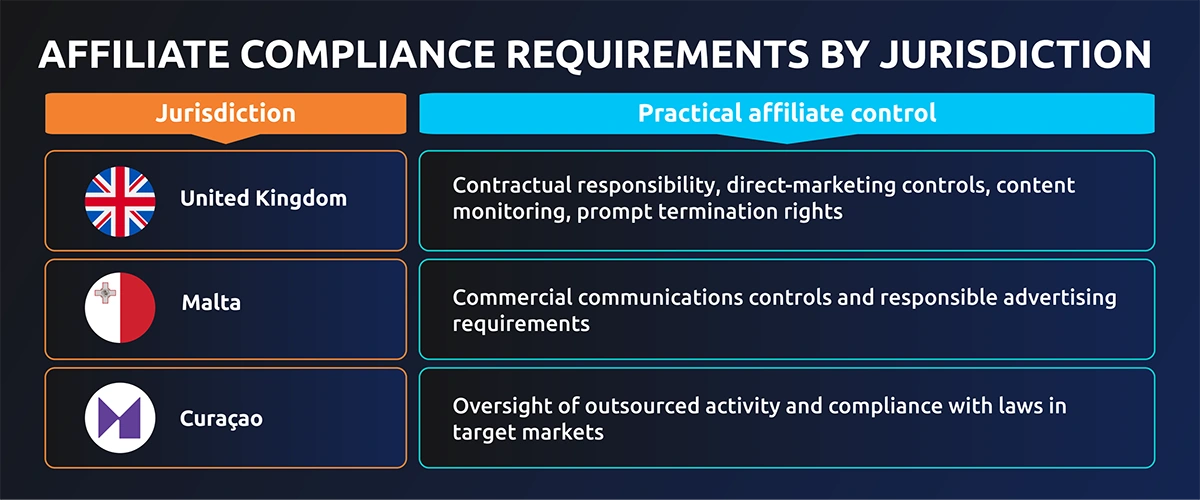
UKGC rules are particularly important in 2026 because licensees remain responsible for third parties carrying out activities on their behalf, while contracts must require appropriate compliance and allow prompt termination when an affiliate breaches relevant advertising requirements. The Commission also treats gambling businesses as primarily responsible for breaches involving affiliates conducting direct marketing.
A newer UK requirement also affects how affiliate-driven email and SMS campaigns should be managed. LCCP provision 5.1.12 requires remote operators to give customers marketing choices by product and channel, with the options set to opt-out by default, which means affiliates cannot be allowed to operate from an isolated marketing list that ignores the customer’s current casino preferences.
Malta’s 2026 World Cup guidance provides another current reminder that third parties acting for licensees must follow the applicable Commercial Communications Regulations, with advertising remaining socially responsible and avoiding harm to minors or vulnerable persons.
Curaçao’s current indefinite-term online gaming licence conditions require operators to take appropriate measures so outsourced third parties follow applicable laws and regulations, while operators must also respect the laws of jurisdictions where they offer remote gambling.
Affiliate expansion across several markets rarely stays confined to marketing. Licence conditions, restricted countries, payment setup, and corporate structure often begin affecting the same commercial decisions, which is why LicenseGentlemen approaches affiliate strategy as part of the wider market-entry setup.
Reviewing those moving parts before a major campaign launches usually creates a cleaner commercial relationship than trying to rewrite affiliate rules after traffic has already started.
Common Mistakes That Lose Your Best Affiliates
The most damaging affiliate management mistakes make earnings unpredictable or make ordinary problems unnecessarily difficult to resolve. High-performing affiliates rarely abandon a profitable casino because of one small inconvenience, although several months of delayed payments, confusing reporting, weak communication, and changing terms can gradually make another operator look easier to work with.
Common problems include the following.
- Offering a premium commission before finance has checked whether the economics remain profitable at scale.
- Changing NGR deductions after the affiliate has already built traffic around the original deal.
- Missing payment dates without warning the partner before the money becomes overdue.
- Allowing tracking discrepancies to remain unresolved while the affiliate continues sending traffic.
- Replacing account managers without transferring the history of custom deals and past disputes.
- Reversing commission for fraud without documenting the traffic or contractual reason behind the decision.
- Using identical commercial terms across markets with very different player value and acquisition costs.
- Ignoring affiliate feedback when several partners report the same landing-page, cashier, or conversion issue.
- Letting sub-affiliates operate without enough visibility into where their traffic actually comes from.
Commission eventually reaches a ceiling because the casino still needs enough margin to run the business. Once the commercial offer is already competitive, another few percentage points of RevShare will not repair a relationship damaged by late payments, unexplained deductions, unreliable communication, or numbers the affiliate no longer trusts.
Top affiliates have plenty of other places to send traffic, so being commercially predictable eventually becomes part of the deal itself.
FAQ
Top affiliates usually leave when they stop trusting what they will earn or how reliably the operator will deliver the agreed deal. Payment delays, unexplained deductions, persistent tracking differences, sudden term changes, and managers who cannot resolve commercial problems gradually make competing programs easier to justify.
A partner producing €100,000 of monthly commission will naturally care deeply about a recurring five-percent discrepancy because the issue represents meaningful operating income rather than a minor reporting error.