

How to Increase Player Retention in Your Online Casino or Sportsbook in 2026
Casino player retention in 2026 comes down to one uncomfortable fact: acquiring new players is becoming more expensive every quarter, and the operators pulling ahead are the ones who keep the players they already paid to win. Every deposit you generate from a player in your retention program is worth more than a fresh signup, because you already covered the acquisition cost.
This calculation becomes even clearer when we look at GGR sports betting, meaning gross gaming revenue after payouts. Because a retained player who places bets every week increases GGR in a way that a one-time sign-up bonus never will. To increase player retention, online casino performance should start to treat retention as its own discipline, not a leftover line item after acquisition spend.
This guide walks through the benchmarks, the segmentation logic, and the five strategies that actually move your retention rate and boost customer LTV in 2026.
We’ve developed it based on solutions that have proven effective for LicenseGentlemen’s clients. If you’d like your customer retention strategy tailored to your specific business, schedule a free consultation.
Why Retention Is Now the #1 Profit Driver in iGaming
Why retention matters for a casino comes down to simple economic principles: retaining a player costs 5 to 7 times less than acquiring a new one. That fact should end most budget arguments before they start. A small percentage of players, often under 5%, generates the majority of gross gaming revenue (GGR), so revenue concentration in the casino business isn’t a theory; it’s the foundation of the entire business. Take care of this group before you spend another dollar on acquiring new customers.
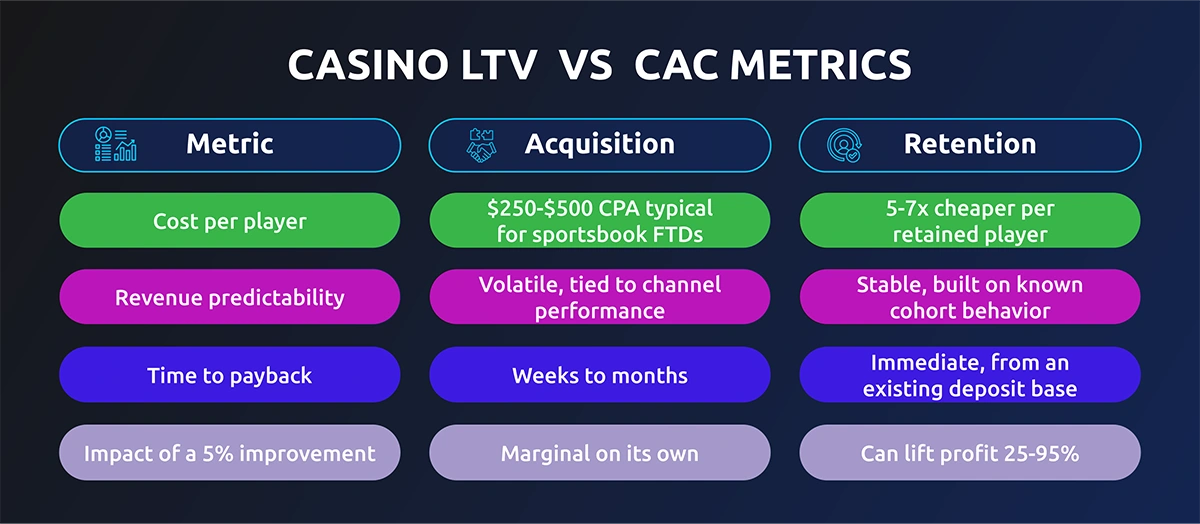
Based on our conversations with operators, a 5% bump in retention can lift profit by 25% to 95%, depending on your vertical and player mix. That’s the number that belongs on your dashboard next to CPA, not buried three pages into a quarterly report nobody actually reads.
Complete a brief self-assessment of your company:
- Do you know what share of GGR comes from your top 5% of players?
- Are you tracking LTV alongside CAC, or only CAC?
- Has anyone modeled what a 5% retention gain does to this year’s profit?
If you answered no to any of those, casino retention profitability isn’t running the show yet. Here’s what changes that.
2026 Retention Benchmarks Every Operator Should Track
Casino retention benchmarks are used to answer one question: Does your retention program actually change player behavior, or does it simply reward those who would have stayed anyway? In 2026, the answer lies in three metrics: D1, D7, and D30 retention, compared separately between gamified and non-gamified player groups, rather than in relation to a single combined average.
D1, D7, D30 Retention Benchmarks
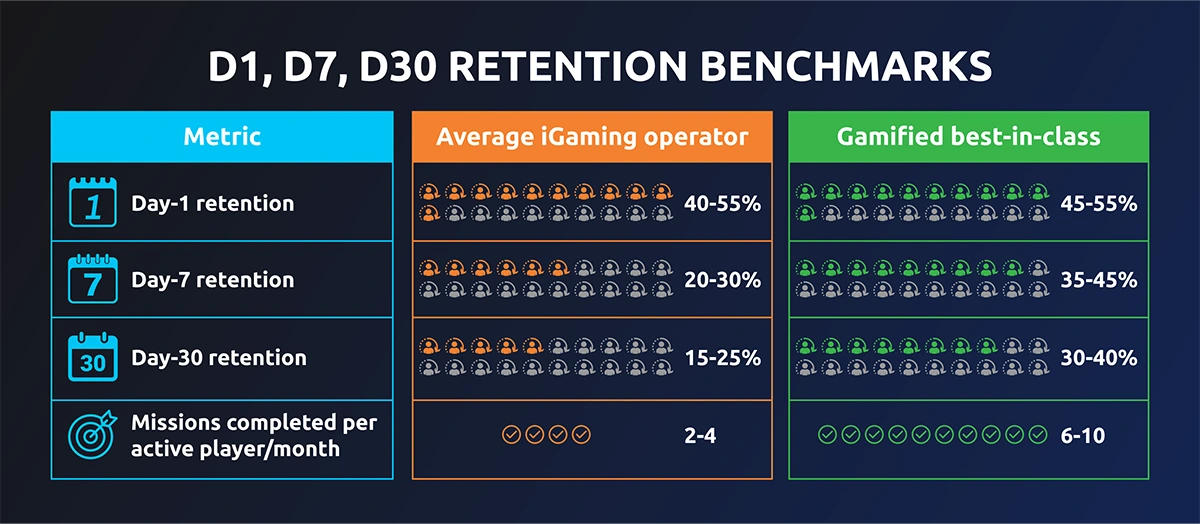
Day-1, Day-7, and Day-30 retention metrics diagnose different stages of your player journey. D1 shows whether the player onboarding process was successful. D7 indicates whether early CRM efforts outperformed competitors’ advertising, which would otherwise have lured the player away. D30 provides the clearest signal of long-term customer lifetime value (LTV).
Based on our conversations with operators, the average iGaming operator achieves a D30 retention rate of 15% to 25%, while the industry’s top operators that use gamification elements achieve rates of 30% to 40%, roughly double the average. Compare this to general metrics for mobile apps, where D30 retention ranges from 3% to 6%, and you’ll understand why comparing a sportsbook to “Candy Crush” leads to serious misconceptions.
When we talk about industry-average retention, iGaming figures also show a wide gap versus other consumer sectors. The overall customer retention rate in the iGaming industry ranges from 37% to 40%, which is significantly lower than the 84% recorded in traditional media, mainly because a player can switch to an almost identical competitor with just two clicks, one that offers the same odds and a larger welcome bonus.
Gamified vs Non-Gamified Retention (75% vs 50%)
Platforms that use gamification see retention improve by roughly 30-40% compared with platforms that don’t use gamification at all. That 25-point difference is currently the clearest gamification retention uplift figure in the industry, and it holds up whether you’re running missions, tier progression, streaks, or leaderboards, provided the mechanics respond to player behavior in real time rather than running on a static points system.
LTV Uplift from Unified Platforms
Combine data from your CRM system and loyalty program on a single platform, and you kill the batch-processing lag that quietly wrecks reward timing, unlocking LTV gains anywhere from 30% to nearly 200% depending on where you’re starting from. Picture a player who completes a mission at 9:00 p.m. during gameplay but doesn’t receive the reward until 6:00 a.m. the next day. The moment’s gone by then. A unified data layer fires that reward in the same session, while the win is still fresh.
Reactive vs Predictive Retention: The 2026 Shift
Predictive retention casino systems flag risk before it shows up as a lapsed account. You predict player lifetime value in sports betting by scoring deposit velocity, session frequency, and bet-size trends against historical churn patterns before a player shows visible signs of disengaging, not after. That’s the shift defining retention strategy across iGaming in 2026.
Here’s how the two approaches actually play out on the same player:
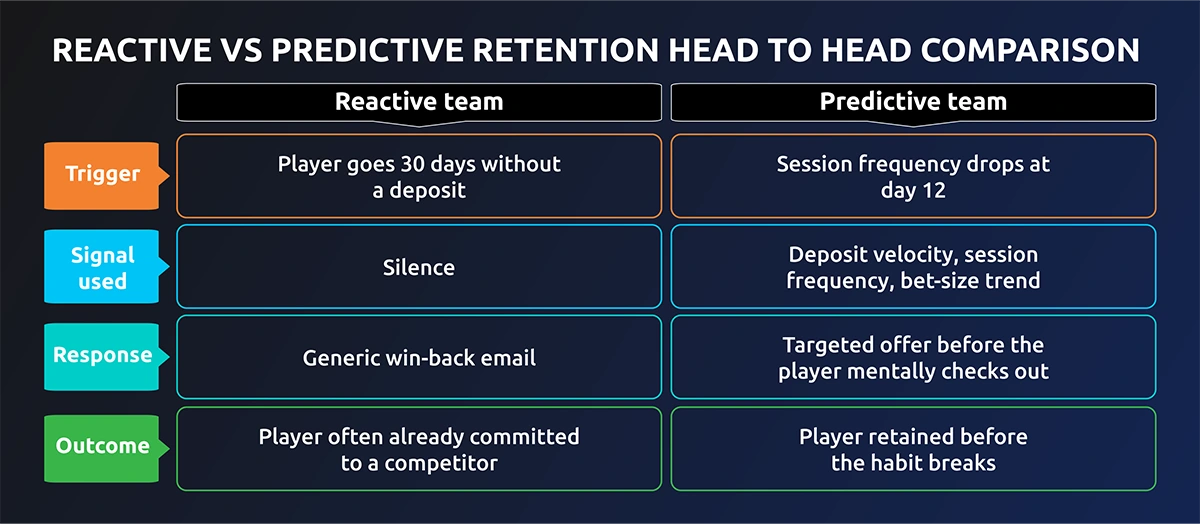
The reactive vs predictive iGaming lifetime value in sports betting comes down to feeding machine learning models early behavioral signals, first-week bet frequency, and product mix to forecast future spending before a full history even exists. That’s the line between reactive vs predictive retention. Reactive retention waits until a player goes dark, then fires off a generic reactivation bonus. Predictive retention for casino operators catches the login dip or the shrinking bet size before the player has mentally checked out, and steps in while there’s still something worth saving.
When a player remains inactive for 60 days, direct channels alone stop generating conversions. At this point, recipients are already overwhelmed by emails, SMS, and push notifications, so your communication becomes ineffective. Syncing hashed contact lists from this inactive group with external ad networks for retargeting allows you to reach players who have stopped opening your emails but are still viewing content elsewhere.
It works best when combined with a shift away from generic deposit-match offers toward exclusive promo codes and invitations to VIP events, since that combination also rebuilds sender reputation on the channels that still work.
Here’s a statistic that most operators ignore: the size of the first deposit isn’t the strongest indicator of long-term value. What really matters most is the range of products used during the first 30 days. Players who try their hand at both sports betting and casino games early on stick around far longer than single-product bettors. Almost no one creates segments based on this information. Everyone’s still fixated on the size of that first deposit.
What predictive retention actually watches for:
- Login frequency sliding week over week
- Average bet size shrinking with no obvious trigger
- Session duration dropping even while login frequency holds
- Zero cross-product engagement in the first 30 days
The clearest signs show up long before the dashboard flags any issues. A reduction in the duration of a VIP user’s session from two hours to thirty or sixty minutes indicates a decline in engagement long before the total deposit amount changes.
A decrease in deposit amounts shows the same thing from a different perspective – a player who regularly deposits €100 several times a week and suddenly lowers the amount to €50 has already reduced the value they assign to your platform. A spike in failed payment attempts, followed by the player switching to a second payment method, is another early warning sign, and if that second attempt also fails, the difficulties escalate so quickly that they can completely discourage the player from using the platform.
Catch two or more of these early, and you can land a targeted offer before the player has mentally moved on. Wait for all four, and you’re sending a welcome-back bonus to someone who already opened an account elsewhere.
The Habitual Behavior Foundation of Retention
The habitual behavior casino operators build their retention programs around is the automatic, low-effort return visit a player makes without consciously deciding to. It’s the difference between a player who logs in because a promotion caught their eye and a player who logs in. After all, checking their favorite slot or scanning tonight’s match lines is just part of their evening.
The player habits iGaming brands cultivate don’t form from a single big bonus. They form from repetition. A player who has played your platform once is measurably more likely to come back than one who hasn’t, even when a competitor is waving flashier graphics and a bigger sign-up match. The habit strength compounds with every return session, which is exactly why the highest-leverage moment in your entire retention funnel is getting a player to their second deposit, not their first.
Casino loyalty psychology works against you the moment friction creeps in. Habitual behavior is fragile when the cost of switching is low, and in iGaming that switching cost is close to zero. Protecting the habit loop matters as much as building it in the first place. The usual culprits that quietly break a habit weeks in the making:
- A cashier page that loads slowly at the moment of deposit
- A mobile app that lags or crashes mid-session
- A support queue that takes ten minutes or more to answer
- A missing local payment method the player expected to see
- A promotion that ignores what the player actually plays
Fix these before investing further in acquisition. A leaking habit loop wastes every dollar spent filling it.
Player Profiling and Segmentation That Actually Works
Casino player profiling starts with recognizing that your player base is not one audience wearing different jersey colors. A high roller placing five-figure weekly bets and a casual player depositing $20 on a Friday night respond to entirely different triggers, and blasting them with identical promotions wastes budget on one group while under-serving the other.
The Three Core Profiles (High Roller, Casual Gamer, Social Gambler)
Most operator player bases break down into three broad archetypes, each needing a distinct retention approach:
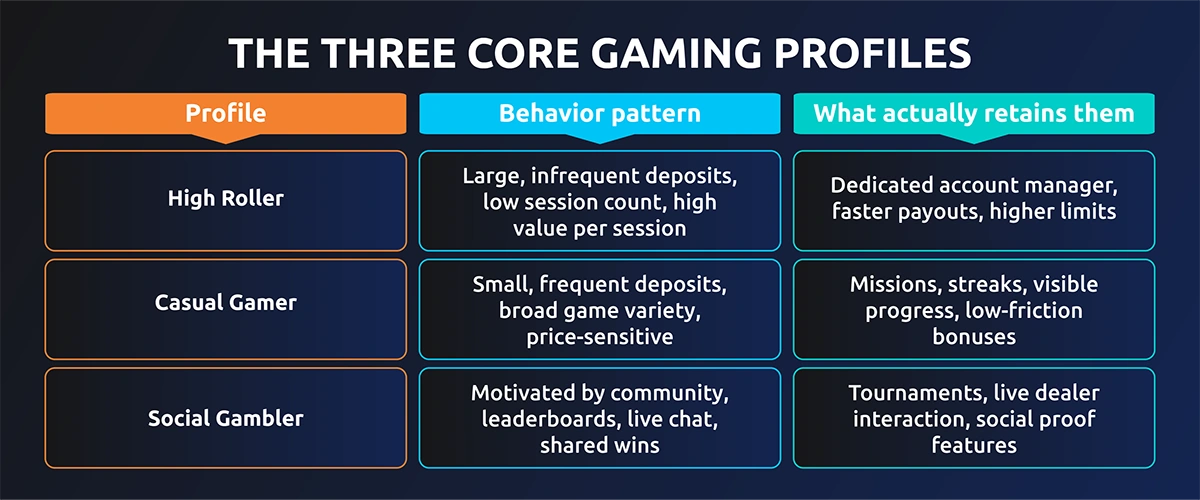
Build one loyalty tier for all three, and you get a program that feels generic to everyone. A high roller doesn’t care about a badge for five days of logins. A casual gamer doesn’t care about a VIP event they can’t afford to attend.
A win exceeding €100,000 is the moment when a “high roller” player’s profile is put to the real test. Enforcing standard daily withdrawal limits and paying out funds in scheduled instalments such as €5,000 per day rather than a single lump sum, keeps the high roller logging in daily instead of cashing out and disappearing. Pair that payout schedule with tailored, high-value offers and a temporarily increased betting limit, and a big win becomes a reason to keep betting rather than an excuse to stop playing.
RFM Analysis and AI Micro-Segmentation
iGaming RFM analysis scores every player on recency, frequency, and monetary value, then groups them into segments that tell you exactly who needs attention right now.
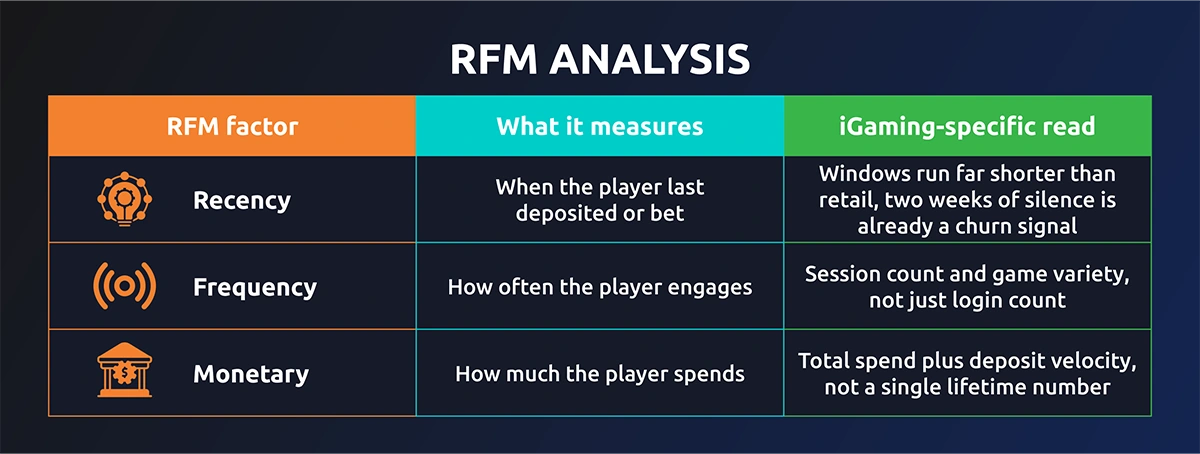
Modern AI micro-segmentation layers machine learning on top of raw RFM scores to catch patterns a manual analyst would miss entirely, like a high-value player whose bet sizing is trending down even though their login frequency looks stable.
Operators often have the raw transactional data necessary to perform this type of segmentation, but they never use it in actual campaigns, meaning that truly predictive signals remain untapped in a dashboard that no one checks on a daily basis.
LicenseGentlemen has helped over 500 sportsbook and casino operators get licensed, and along the way we’ve helped dozens of them to fix exactly this problem: the raw transactional data needed for real segmentation exists, but it never makes it into an actual campaign, so predictive signals sit untapped in a dashboard nobody opens daily.
Schedule a free call if you would like to learn what options your current licence offers for using this data and how it can help you to increase your customer retention rate.
Real-Time Behavioral Triggers
Real-time behavioral triggers fire a targeted offer the moment a player’s activity crosses a meaningful threshold, not hours later through an overnight batch process. A few worth automating first:
- Unusually large loss: a same-session, low-key check-in outperforms a generic bonus email sent the next morning
- Deposit frequency spike: three days running above a player’s usual pattern is the moment to surface a loyalty milestone, not a week later
- Session drop-off mid-week: an early nudge before the pattern cools off entirely beats a full win-back campaign after the fact
Five Retention Strategies That Actually Move Metrics
Casino retention strategies that move real metrics share one property: they change player behavior rather than simply rewarding behavior that was already happening. Below are the five iGaming retention tactics with the strongest 2026 evidence behind them, forming a retention framework you can implement in order of impact.
Exclusive Games and Gamification Journeys
Proven casino retention gains start with giving players a reason to stay that a competitor can’t copy overnight. Exclusive game content and structured gamification journeys, missions, streaks, and tier progression keep players engaged in ways a generic slot library never will. The strongest mechanics in 2026 are mission-based rather than static points systems: a cross-sell mission that rewards a sports bettor for trying a casino product, or a live-betting streak that builds a daily session habit around a high-margin product, both outperform flat points accumulation on every retention metric that matters.
An effective version of this offer is a promotion structured as follows: “Place a €20 bet on a major sports event to unlock 50 free spins on a popular slot title”. This provides sports bettors with real value in the form of a high-margin casino product without forcing them to play at the casino, and when players use the spins, a significant portion of this group converts into regular casino players.
The retention pillars worth building your gamification roadmap around:
| Mechanic | Best for | |
| Progress bars | Extending mid-tier player sessions | |
| Badges | Retaining VIPs and aspirational players | |
| Leaderboards | Increasing high-frequency bettor activity | |
| Missions | Cross-sell and reactivation | |
| Streaks | Building daily active-user habits |
Tournaments and missions with a fixed structure consistently generate the highest profits. Players who engage with these mechanics achieve ARPU and LTV metrics that are two to three times higher than those of players who do not participate in them at all.
Daily reward wheels and loot boxes are a completely different story. They rarely have a direct impact on profitability, since the operator covers the cost of the prizes without any guarantee of revenue, but they’re still worth implementing because of their impact on daily login habits. Even a feature with a low direct ROI can be the reason a player opens the app every morning.
Fast, Localized Payments and Withdrawal Speed
Withdrawal speed is one of the most measurable drivers of early churn. Roughly 27% of players walk away from a platform over deposit or withdrawal friction alone. A player in Brazil expects entirely different payment rails than a player in Malaysia, and offering the wrong ones is functionally the same as offering nothing. Slow withdrawals do the most damage of all: nearly 39% of players name them as a top frustration, ahead of slow deposits.
The effect is sharpest in markets where players have learned to expect the opposite. In regions like Turkey and Latin America, where plenty of operators still stall or withhold withdrawals, a player who completes their first instant cashout treats that moment as proof the platform is legitimate. D30 retention in these markets jumps accordingly once automated, instant withdrawals go live, because the doubt that usually keeps a new player cautious gets removed in a single transaction.
Payment retention checklist:
- Localized payment methods for every core market you serve
- Withdrawal processing under 24 hours as a baseline, faster for VIP tiers
- Zero hidden friction at the exact moment a player wants their money out
How quickly you can resolve this depends on the license you hold. Operators operating under flexible jurisdictions, such as Curaçao, Anjouan, and Tobique, enter the market with a ready-to-use payment system within a few months, rather than in over a year, as required by a top-tier European license.
The downside is that these licenses do not provide a direct connection to acquiring banks in the EU, so an appropriate corporate structure behind the license is needed to ensure local payment coverage and maintain competitive withdrawal processing times.
Tiered Loyalty and the Cost of Disconnect
A well-built tiered loyalty program does more than hand out rewards; it creates a genuine cost of switching. A player who has climbed three tiers, earned a dedicated VIP host, and built a personal bonus history has real reasons to think twice before starting over on a competitor platform with none of that history intact.
Time-to-next-tier is the metric that separates a working loyalty program from a decorative one. If your progression mechanics take longer than the benchmarks below, players lose the sense of momentum that keeps the habit loop alive:
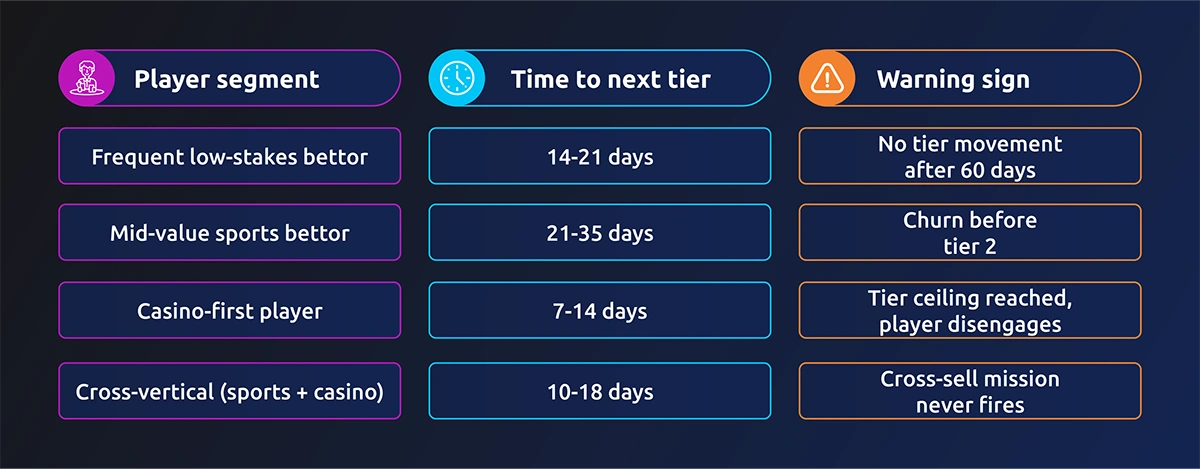
Faster, mission-accelerated progression consistently outperforms deposit-only tier requirements, because it rewards the repeated behavior that actually correlates with long-term value.
Personal Touch and Direct Feedback Loops
Advertisers increase lifetime value through targeted casino promotions by narrowing the offer to what a specific segment actually values, rather than blasting the same bonus to your entire database. A high roller getting a generic free-spins email alongside your casual base reads as a signal they aren’t actually known, and that erodes the relationship faster than any single missed payout would.
Direct feedback loops matter just as much as segmentation. Operators who actually call their repeat players, not a script-driven survey, but a real conversation asking what would make the platform worth recommending, consistently report stronger rapport and lower churn among the players they reach. It doesn’t scale to your entire base, but it doesn’t need to. Reserve it for the segment funding your growth.
iGaming-Specific CRM
You use customer lifetime value in sportsbook marketing by letting LTV segments, not blanket campaigns, decide who gets which offer, how often, and through which channel. A CRM built specifically for iGaming makes that possible because it ties wagering behavior, deposit history, and support interactions into one player view, something a generic e-commerce CRM was never built to do.
The practical payoff shows up fastest in segmentation you couldn’t run manually: automatically flagging a player who bets slots regularly but hasn’t logged in for 30 days, then triggering a targeted reload offer for that specific game type rather than a blanket promotion. A properly configured CRM turns that from a monthly manual export into a live, always-running campaign.
The CRM Tech Stack for Retention in 2026
The best casino CRM in 2026 is the one unifying loyalty, segmentation, and bonus engine data on a single real-time platform, not the one with the longest feature list. Platform-bundled CRMs baked into your casino or sportsbook software cut integration headaches but chain your retention capabilities to your platform vendor’s roadmap. Standalone retention software built specifically for gaming costs more to bolt on but buys you independence and, often, sharper predictive tooling.
The current iGaming CRM tech stack landscape breaks down roughly like this:
| CRM approach | Strength | Trade-off |
| Platform-bundled (built into your PAM) | Lower integration cost, faster setup | Vendor lock-in, roadmap dependency |
| Standalone real-time CRM | Deeper segmentation, faster event processing | Higher integration effort and cost |
| AI-layer add-on | Behavioral personalization, churn prediction | Runs alongside, not instead of, a core CRM |
Before signing with any vendor, check the platform against this list:
- Processes player events in real time, not on an hourly or overnight batch
- Shares one data layer across CRM, loyalty, and gamification, no manual reconciliation between tools
- Supports mission-based and streak mechanics, not just static points
- Integrates natively with your PAM and payment stack
- Gives your team AI-driven segmentation without a data science queue
Specialized retention software casino operators are increasingly choosing runs on unified data layers precisely because sync delays between separate loyalty and CRM tools create the same trust erosion as a slow withdrawal. The player completed the qualifying action. The platform didn’t respond in the moment. That gap is where retained players start drifting.
Customer Support: The Last Line of Defence
If a player’s ticket goes unanswered for six hours during a live game, no other factor matters at that moment. It doesn’t matter how precise the segmentation is in the CRM system or how quickly withdrawals are processed. One bad customer support interaction can undo months of loyalty-building in a single chat conversation.
To secure the best 24/7 support, casino operators must offer the best possible level of service – it’s essential. Casinos answering live chat within 60 seconds see 25% higher retention than platforms with slower response times. That single number should reset how your team thinks about support staffing. Speed isn’t a courtesy; it’s a factor that drives customer retention and delivers a measurable return on investment.
Customer service fulfills two functions that are particularly important for retaining players:
- Solving the immediate problem. A player mid-session with a stuck withdrawal needs an answer in minutes, not a ticket number and a 24-hour SLA.
- Protecting the habit you’ve built. One bad support experience can undo weeks of loyalty-building, since the cost of switching to a competitor is close to zero.
Multichannel, round-the-clock support – live chat, in-app messengers, WhatsApp, or Telegram – wherever your players actually are, bridges the gap between a frustrated player and a churned one.
Bonus Abuse Controls: Protecting the Retention Spend
Casino bonus abuse retention damage is bigger than most operators realize, because it doesn’t show up as a clean line item in financial statements; it quietly inflates your CRM’s success metrics while draining the budget behind them. Bonus abuse now accounts for nearly 64% of detected iGaming fraud, and European operators are losing 10% to 20% of marketing turnover to it.
The casino bonus economics get distorted in a specific way: fraud rings claiming repeat promotions across multiple accounts make your retention dashboard look healthy while the “returning players” behind those numbers were never going to generate real value. Operators without a dedicated bonus abuse detection report losses running 4% to 11% of bonus-funded gross gaming revenue, money spent chasing fake loyalty instead of building real loyalty.
The source of the leak is usually a single specific point: fully automated mechanisms for granting cashback and instant top-ups, operating without dynamic transaction monitoring. Criminal groups mathematically model the bonus conditions and achieve a positive expected value across linked accounts, and because this mechanism is automated, no one detects it until the budget has already been exhausted. The transition from a general, automated cashback system to segmented mechanisms verified based on activity eliminates this loophole without slowing down the reload process for real players.
Signals worth flagging before they inflate your retention numbers:
- Dormant accounts reactivating right as a loyalty threshold resets
- Clean, verified accounts showing near-identical bet timing or sizing across devices
- A cluster of accounts sharing device fingerprints, IPs, or payment details
- Loyalty tier progression with no matching increase in genuine session activity
- Bonus redemption rates rising faster than genuine deposit growth
Protecting your retention ROI casino spend requires lifecycle-aware fraud controls, not just tighter bonus terms at signup. More than half of betting and gaming operators still struggle to get a unified data view across the player lifecycle, and that’s exactly the blind spot fraud rings exploit.
LicenseGentlemen has helped launch over 500 sportsbook and casino operators end-to-end, licensing, structure, and the operational build that comes after it. That’s also where we see this exact gap: the fraud layer and the CRM layer running on separate data, with bonus spend quietly funding churn nobody catches.
Schedule a free call to get your licence, fraud and CRM systems audited before your next bonus cycle.
FAQ
A Day-30 retention rate of 15-25% is average for iGaming operators in 2026, while best-in-class gamified programs push 30-40%. Anything under 15% is a signal your onboarding or early lifecycle CRM needs attention now, not next quarter.