


How to Identify Good vs Bad Casino Affiliates in 2026: Complete Operator’s Guide
Affiliate marketing remains one of the largest player acquisition channels in iGaming as it gives operators access to established audiences without requiring them to build every traffic source internally. A strong affiliate can introduce players who already understand the product, trust the publisher making the recommendation, and continue depositing long after their first casino session.
Weak vetting can turn the same acquisition model into a source of bonus abuse, chargebacks, misleading performance data, and regulatory exposure.
At LicenseGentlemen, we help operators assess whether an affiliate strategy matches their license conditions, target markets, and compliance obligations before traffic goes live, because a partner capable of producing hundreds of first-time depositors, commonly called FTDs, can still expose the business to serious risk when the traffic source or geographic targeting does not withstand scrutiny.
In this guide, we explain how to identify good and bad casino affiliates in 2026, compare commission and traffic models, detect common fraud patterns, structure safer contracts, and allocate your budget according to your casino’s stage of development.
Why Affiliate Quality Defines Your Casino's ROI
Raw acquisition numbers can give operators a misleading view of return on investment (ROI), because the commercial result appears only after retention, bonuses, payment fees, gaming costs, chargebacks, and affiliate commission are considered. Fifty well-matched players can generate more sustainable revenue than 500 incentivized depositors who leave after using the welcome offer.
Net Gaming Revenue, commonly shortened to NGR, gives operators a more realistic basis for comparison. NGR generally refers to gaming revenue after the deductions defined in the affiliate agreement, which may include bonuses, payment costs, game-provider fees, taxes, chargebacks, and other agreed expenses.
Operators should judge each affiliate through a player cohort, meaning a group of users acquired from the same source or campaign and monitored over a defined period.
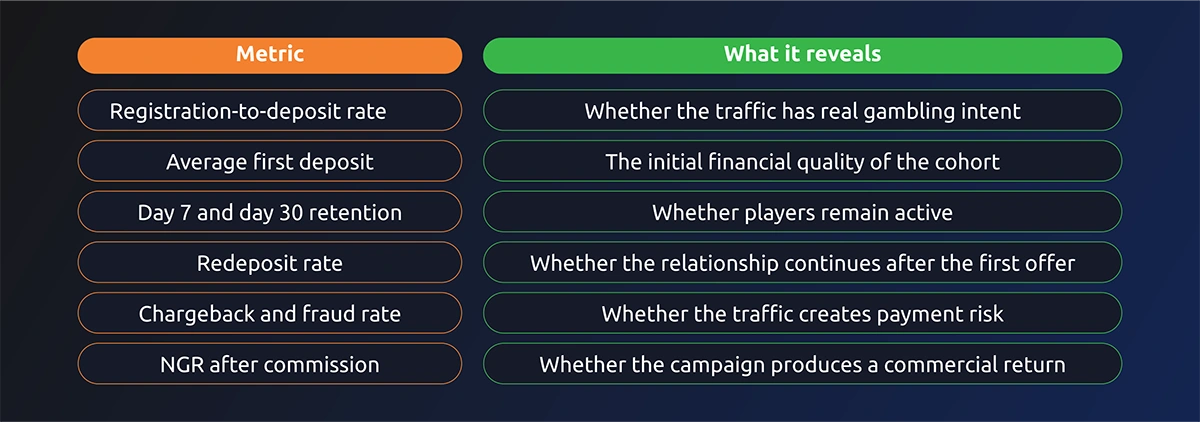
A high-performing affiliate sends players from permitted markets at a cost the casino can recover within an acceptable period. Large volumes can still be useful, but volume should support the operator’s commercial objective rather than replace proper performance analysis.
How Casino Affiliate Programs Actually Work
A casino affiliate program connects a publisher’s traffic with the operator’s player and revenue data. Tracking links, cookies, affiliate identifiers, server events, and qualification rules determine which partner receives credit and whether a commission becomes payable.
When a player clicks an affiliate link, the tracking platform may record the affiliate, campaign, landing page, device, geographic market, and time of the visit. Geographic markets are commonly called GEOs in affiliate reporting.
Browser cookies can retain the referral information for a defined attribution window. Browser privacy controls, cookie deletion, ad blockers, and cross-device journeys can interrupt that process, so many programs also use server-to-server tracking, commonly shortened to S2S.
An S2S postback sends a conversion event directly between the casino platform and the affiliate system. The event may confirm registration, Know Your Customer verification, commonly called KYC, a first deposit, or another qualifying action.
A standard process may include:
- The user clicks the affiliate’s tracking link.
- The platform records the affiliate and campaign identifiers.
- The user registers with the casino.
- KYC, deposit, and wagering events are recorded.
- The casino sends an S2S conversion postback.
- The commission remains pending during the review period.
- The operator approves or rejects the conversion.
Sub-affiliate arrangements require additional visibility. A large network may distribute an offer among smaller publishers, streamers, or media buyers, so every underlying source should receive a distinct sub-affiliate identifier, commonly called a sub-ID.
Without sub-ID reporting, an operator may identify poor traffic at the network level but remain unable to isolate the publisher responsible.
Holding periods of 14 to 30 days give the casino time to review KYC completion, payment legitimacy, wagering behaviour, duplicate accounts, chargebacks, and GEO compliance. A technical conversion should not become payable until the player also satisfies the commercial rules in the agreement.
Commission Models: RevShare, CPA, Hybrid, and Negative Carryover
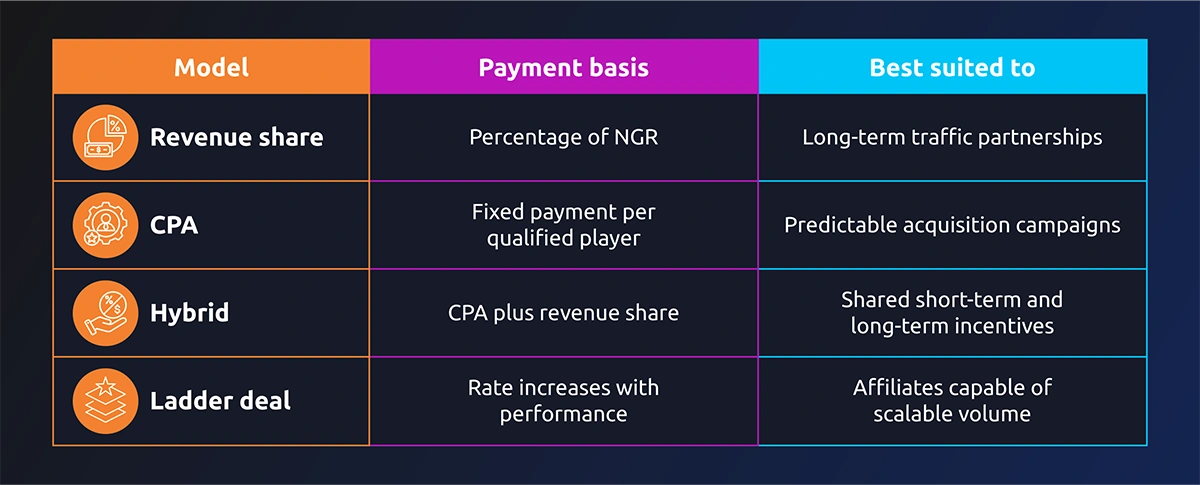
Commission models determine how acquisition risk is divided between the operator and the affiliate. Revenue share usually connects commission to real player performance, while a large upfront Cost Per Acquisition payment, or CPA, places more early risk on the casino.
Revenue Share (25-50%)
Revenue share, commonly shortened to RevShare, pays the affiliate an agreed percentage of the NGR produced by referred players. Commercial rates often fall between 25% and 50%, depending on the market, volume, player quality, and strength of the affiliate.
Operators need to define NGR clearly as different programs apply different deductions. A contract should explain whether the following costs reduce commissionable revenue:
- Bonuses and promotional credits
- Payment processing fees
- Gaming taxes
- Game-provider royalties
- Chargebacks and refunds
- Jackpot contributions
- Administrative deductions
Revenue share aligns the affiliate’s earnings with long-term player performance. An affiliate who sends retained players can continue earning commission, while the operator avoids paying a full acquisition fee for accounts that produce no revenue.
Lifetime RevShare creates a continuing liability, so operators should model the arrangement before approving a high percentage. A generous rate may become difficult to sustain when it is combined with high bonuses, expensive payment processing, or no negative carryover.
CPA and Hybrid Deals
A CPA payment should become payable only after the player meets defined qualification standards. Registration or a token deposit alone does not prove that the player has real value.
Qualification rules may include:
- Completed KYC
- A minimum first deposit
- Use of an approved payment method
- A minimum wagering threshold
- No chargeback during the holding period
- No linked or duplicate account
- Residence in an approved GEO
- No self-exclusion
When multiple players deposit exactly €20 while the operator pays €200 or more for each acquisition, the casino should investigate whether the traffic reflects genuine player interest or a campaign designed only to trigger CPA payments.
Hybrid deals combine an upfront CPA with ongoing RevShare. A structure such as €100 CPA plus 20% RevShare gives the affiliate immediate cash flow while preserving an incentive to deliver players who remain active.
Hybrid arrangements can work well during trial periods as both parties share the risk. The operator avoids a large upfront commitment, while the affiliate retains long-term upside.
We have handled negotiations where experienced media-buying teams rejected a move to pure RevShare even though they understood that the model could generate more value over the lifetime of the player, since their immediate concern was covering salaries, advertising accounts, proxies and media spend while the campaign remained active. The same objection appears far less often with solo affiliates or smaller organic publishers whose monthly overhead is limited, but for a larger operation, waiting several months for LTV to materialize can make an otherwise attractive deal commercially unworkable.
In those cases, we have achieved better results by restructuring the agreement as a hybrid rather than asking the affiliate to abandon CPA completely, with the upfront component providing enough liquidity to maintain campaign volume and cover acquisition costs while the RevShare component preserves long-term upside for both parties. The change works because it addresses the affiliate’s actual constraint, which is usually cash flow rather than a lack of confidence in the casino or the quality of the players.
Negative Carryover Explained
Negative carryover applies when a referred player cohort produces a negative balance, usually because players win more than they lose or because chargebacks and adjustments exceed positive NGR. The deficit is carried into the next commission period and must be recovered before further RevShare becomes payable.
No-negative-carryover programs reset the affiliate balance to zero at the start of the next period. Affiliates prefer the reset because a large player win does not reduce future earnings.
Operators should consider the commercial behaviour created by the clause as an affiliate facing a substantial negative balance may move its traffic to another program instead of spending several months recovering the deficit.
High-roller wins can make even a healthy affiliate account look disastrous for several months. In one program we managed, almost every RevShare partner went six months without receiving a commission because a small number of large player wins absorbed the available revenue, despite the program operating under a no-negative-carryover model. None of the serious partners walked away, because experienced affiliates understand that one player can distort a reporting period and judge the relationship over a much longer cycle.
A balanced policy may:
- Carry forward fraud and chargebacks
- Treat a verified high-roller win separately
- Reset balances for proven partners
- Apply stricter rules to unusually high RevShare deals
The chosen policy should appear in the agreement and affiliate dashboard. Changing the calculation after a large player win creates disputes and damages trust.
Ladder-Type Performance Deals
Ladder deals increase commission when the affiliate reaches agreed performance levels. The structure motivates growth without granting the highest rate before the affiliate proves its value.
A simple example could increase RevShare or CPA after the affiliate reaches specific monthly FTD thresholds. Quality requirements should remain in place so the partner cannot unlock a premium tier using duplicate accounts or minimum-value deposits.
Useful conditions include:
- Minimum average deposit
- Maximum chargeback rate
- Minimum retention level
- Approved GEO distribution
- Minimum NGR per player
- No unresolved compliance breaches
Building an Affiliate Program Affiliates Actually Want to Promote?
See how successful casino brands structure rev share, payouts, no negative carryover, and high roller policies to attract and retain top affiliates
Volume vs Value: How to Balance Traffic Sources by Business Stage
Traffic strategy should match the operator’s current infrastructure, cash flow, and retention capability. A new casino may need controlled volume to test its systems, while an established brand usually has stronger reasons to prioritize player lifetime value, commonly called LTV.
When You Need Volume (500 FTDs a Month)
A new platform may need several hundred FTDs to test its payment gateways, KYC queues, game aggregation, bonus rules, Customer Relationship Management systems, commonly called CRM, and customer support.
CPA and pay-per-click advertising, commonly called PPC, can produce enough activity to expose operational weaknesses quickly. The operator should still begin with daily caps rather than releasing the full monthly budget immediately.
Before scaling, confirm that the casino can handle:
- Deposit failures and payment retries
- KYC review demand
- Withdrawal verification
- Bonus calculations
- Fraud alerts
- Customer support volume
- CRM segmentation
- Restricted-country controls
Volume becomes dangerous when the operator cannot identify whether poor conversion comes from the affiliate or from the casino itself. A broken cashier, weak landing page, missing payment method, or slow KYC process can destroy a legitimate campaign.
When You Need High-Value Players (50 FTDs, Longer LTV)
Established casinos can focus on smaller cohorts that deposit more frequently and remain active for longer. Organic review portals, specialist comparison sites, and niche publishers often attract players with clearer product intent.
Operators should evaluate these players over several months rather than judging the source after the first deposit.
Relevant signals include:
- Repeat deposits
- Limited bonus dependency
- Stable payment behaviour
- Continued casino or sportsbook activity
- Low chargeback exposure
- Positive NGR after commission
Fifty retained players can outperform several hundred low-value users when the smaller cohort produces repeat deposits without creating excessive bonus, payment, and support costs.
Traffic Source Realities: SEO, PPC, Facebook, Streamers, Portals
Search Engine Optimization, or SEO, refers to traffic earned through unpaid search visibility. PPC refers to paid advertisements that charge according to clicks or another campaign action.
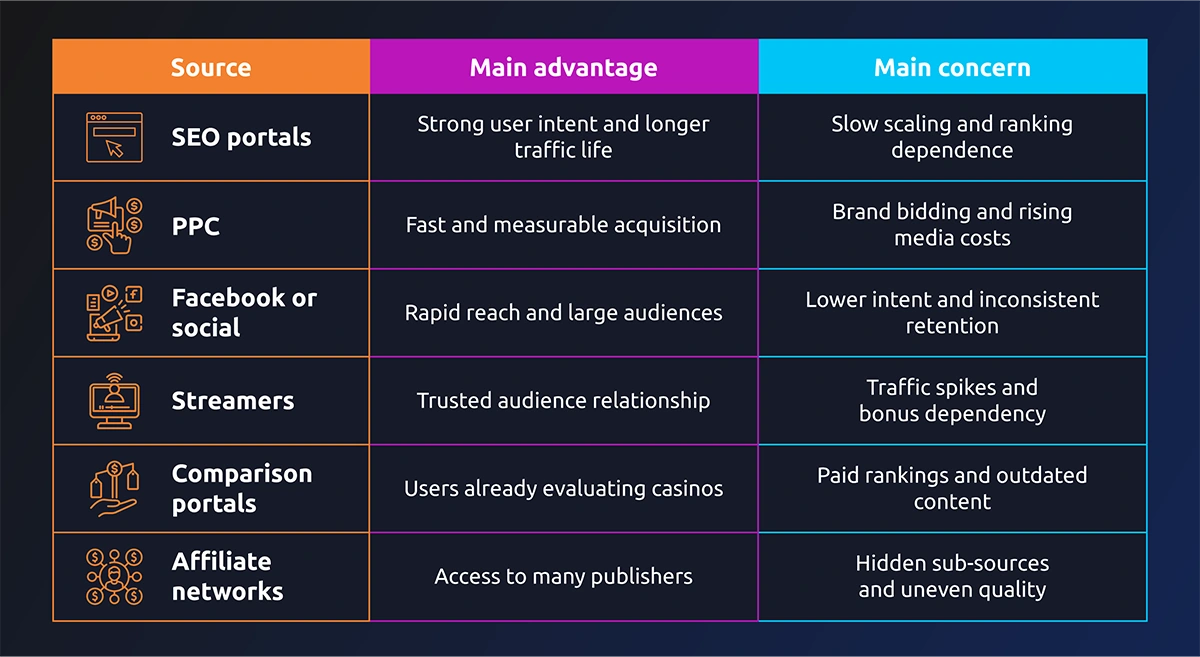
Some affiliates may present cheaper Facebook traffic as premium PPC traffic, so operators should verify the real source instead of relying on the label used in a sales conversation.
PPC traffic can be valuable when it targets legitimate non-brand searches. Unauthorized bidding on the casino’s own name allows the affiliate to collect commission from users who were already looking for the brand.
We have dealt with a case where our client had affiliates who quietly bought their brand keywords and then used that traffic to push competing casinos. The affiliate was effectively charging the client for players who were already searching for the brand, while cross-selling them elsewhere at the same time. Fortunately, brand PPC had been prohibited in the agreement, which allowed our client to shut down the campaign and void the related commission. Without that clause, the commercial argument becomes much less comfortable, regardless of how obvious the behaviour may appear.
When the agreement does not contain a usable brand-bidding restriction, or the affiliate operates through entities that make legal recovery impractical, the operator’s remaining leverage is often reputational.
We have seen disputes move quickly once the evidence reaches affiliate forums, private industry groups and the people managing programs at other casinos, because established affiliates depend on being trusted with campaigns, tracking access and regular payments across several brands. Operators should still preserve search results, ad copies, landing pages, timestamps and tracking paths before raising the matter publicly, since a documented account of what happened carries far more weight than an angry accusation and gives the affiliate a final opportunity to remove the campaign or agree on a commercial resolution.
Streamer performance should be judged after the broadcast. A large registration spike may look impressive, but redeposits and later retention reveal whether the audience had genuine interest.
2026 Traffic Quality Benchmarks: ROI Timelines by Source
ROI timelines vary according to the traffic source, commercial deal, market, and quality of the casino’s own conversion process. Operators can often identify obviously poor traffic within days, although reliable LTV analysis requires a longer cohort review.
Genuine players may deposit more, show real interest in games, and continue engaging, while fraudulent players often ignore CRM messages, self-exclude, block their accounts, or disappear after meeting the minimum condition.
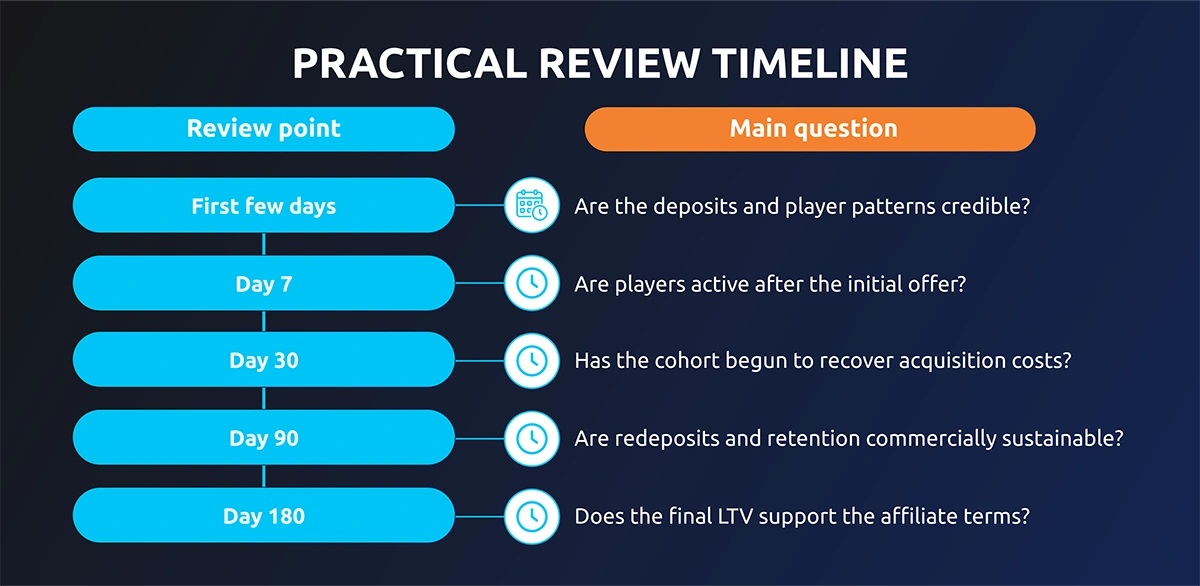
The casino should assess performance after bonuses, payment costs, gaming fees, chargebacks, and commission. An affiliate can appear profitable in the tracking platform while producing a loss after the full cost base is considered.
Affiliate Fraud: Types, Damage, and Detection
Affiliate fraud manipulates attribution, player activity, or qualification rules so the partner earns commission without delivering legitimate acquisition value. The damage includes false CPA payments, bonus losses, chargebacks, distorted analytics, and increased compliance exposure.
The 8 Common Fraud Types (Click Stuffing, URL Hijacking, Bots, Fake Conversions)
The most common fraud types are:
- Click stuffing
Automated systems generate affiliate clicks without genuine user intent. - Brand hijacking
The affiliate bids on the operator’s brand name or close variations. - Bot traffic
Software imitates visits, registrations, or shallow account activity. - Fake conversions
Fabricated or controlled users meet weak CPA conditions. - Incentivized deposits
Players receive outside compensation for registering and depositing. - Cookie manipulation
Attribution cookies are inserted, removed, or replaced unfairly. - GEO spoofing
Virtual Private Networks, commonly called VPNs, or proxies make users appear to come from approved markets. - Proxy and device manipulation
IP addresses, browsers, and device identifiers are rotated to hide linked accounts.
Uniform Resource Locator hijacking, commonly called URL hijacking, may involve domains that closely resemble the casino or affiliate site. A user reaches the genuine brand after visiting the misleading address, while the fraudulent affiliate claims the referral.
One of the more common tricks is also one of the oldest, that is to advertise a bonus the casino never approved and let customer support deal with the fallout. We reviewed a case where player complaints revealed that an affiliate had been promising an offer our client could not honour. Once we traced the claims back to the affiliate’s domain, the traffic was disqualified from payment. Supplying approved banners is useful, but guided operators also check what affiliates are publishing when they think nobody is looking.
Self-Referral and Multi-Accounting
Self-referral occurs when an affiliate registers through its own tracking link or controls users who complete the qualifying actions. Multi-accounting extends the scheme across several identities, devices, payment methods, or crypto wallets.
Operators should look for:
- Shared devices
- Repeated Internet Protocol addresses, commonly called IP addresses
- Sequential email addresses
- Linked payment cards
- Shared wallets
- Identical wagering patterns
- Coordinated withdrawals
Contracts should prohibit self-referrals, employee accounts, household referrals, and any account under common control unless the operator has granted written approval.
Bonus Abuse Rings
Bonus abuse rings coordinate multiple accounts to claim welcome promotions while generating affiliate commission. The affiliate receives the CPA payment, while the users extract value from the bonus.
Minimum-deposit clusters are among the clearest early warnings. A group of supposedly unrelated players making the same small deposit, choosing the same games, and withdrawing at similar times should be reviewed as a connected cohort.
The operator should compare account relationships rather than reviewing each player in isolation.
Detection Mechanics (IP, Device Fingerprint, Payment, Timing)
Fraud detection works best when the operator combines network, device, payment, and behavioural data. Device fingerprinting compares browser, hardware, operating-system, and configuration signals to identify accounts using the same device.
Important signals include:
- Several accounts using one device
- Repeated IP addresses or proxy networks
- Shared payment instruments
- Reused crypto wallets
- Deposits made at identical intervals
- Very short click-to-deposit times
- Identical wagering sequences
- Coordinated withdrawals
Operators without a large fraud team can still group suspicious accounts by affiliate and sub-ID, compare the shared signals, and hold commission while the affiliate provides an explanation.
Detection Tools (Bluepear, Group-IB, AdPlexity)
Specialist platforms can support different parts of the monitoring process. Bluepear is used for affiliate compliance and brand-bidding monitoring. Group-IB and SEON provide fraud, identity, device, and behavioural analysis. AdPlexity provides advertising intelligence that can help operators inspect creatives, landing pages, and campaign placements.
Note that no tool replaces the operator’s internal data. The strongest review combines external monitoring with deposits, withdrawals, CRM engagement, chargebacks, affiliate IDs, and sub-IDs.
Red Flags When Vetting a New Affiliate
The strongest red flag is an affiliate that refuses to disclose where its traffic comes from. Broad claims about having every GEO and every source often indicate weak specialization or hidden acquisition methods.
Use a controlled checklist before approving a new partner:
- Confirm the affiliate’s identity and business contact details.
- Request the domains and channels where the casino will appear.
- Verify the intended GEOs.
- Ask whether PPC, social, streaming, or sub-affiliates will be used.
- Confirm whether brand bidding is prohibited.
- Request references from previous operator relationships.
- Begin with a limited trial.
- Apply a payment holding period.
- Require sub-ID reporting.
- Review the first cohort before increasing the rate.
We have handled onboarding reviews where an affiliate’s reported performance could not be confirmed once we asked to see the dashboard refreshed live, which is why static screenshots are no longer accepted as sufficient evidence when larger commercial agreements are being discussed. Depending on the size of the deal, we request either a video showing a live refresh or a screen-share during the call, while references are checked separately with other affiliate managers because the market is tight-knit and a genuine working history can usually be confirmed quickly.
Some of our more serious cases involved reference contacts who had never worked with the applicant, while others appeared to be spoofed brand-manager accounts controlled by the affiliate itself, allowing the same person to answer their own background check. A live dashboard may confirm whether the reported figures exist, although direct verification with people who actually managed the relationship is what establishes whether the claimed partnership was genuine.
LicenseGentlemen can help operators review affiliate risks alongside their license conditions and target-market restrictions before a new traffic source is approved.
Flat-fee listings also require scrutiny. A high placement fee may be justified when the website has real traffic and the position is visible, but small listings across many weak sites can consume the budget without generating meaningful exposure.
How to Structure Contracts and Manage Affiliates Properly
Affiliate contracts should define what the partner may promote, where the traffic may come from, and when commission can be rejected or recovered. Clear terms reduce the chance that a fraud or compliance issue becomes a payment dispute.
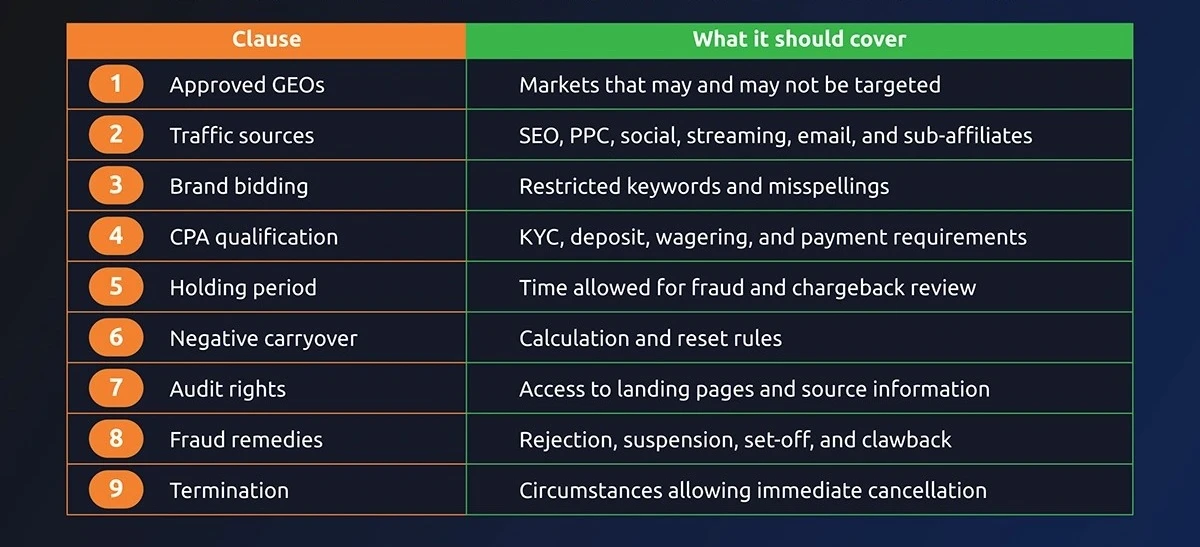
Affiliate performance should also be measured through Key Performance Indicators, commonly called KPIs. Suitable KPIs include qualified FTDs, average deposits, retention, NGR per player, chargeback rates, and restricted-GEO incidents.
Daily management is equally important. Affiliate managers should communicate payment failures, paused markets, conversion problems, and campaign limits before the affiliate continues spending money.
When an operator loses an important payment method, the affiliate should be told to stop or reduce traffic rather than discovering the issue through a sudden collapse in conversions. Weekend availability can also matter because affiliates may be spending heavily while the casino team is offline.
LicenseGentlemen can review whether affiliate terms align with the operator’s license, market restrictions, advertising obligations, and payment structure before the campaign begins.
Regulatory and Licensing Realities for Affiliates in 2026
Operators remain responsible for understanding how affiliates promote their gambling products in regulated markets. Contracting with an external publisher does not remove the license holder’s compliance duties.
In Great Britain, the United Kingdom Gambling Commission, or UKGC, states that licensees are responsible for third parties they contract with. Operators must conduct adequate due diligence, maintain sufficient oversight, require third parties to follow relevant license conditions, and retain the right to terminate relationships when affiliates breach applicable requirements. Regulatory failures can lead to financial penalties, suspension, or loss of the operating license.
The UKGC also considers operators primarily responsible for direct-marketing breaches committed through affiliates, including failures involving self-excluded customers.
Operators licensed by the Malta Gaming Authority, commonly called the MGA, should ensure affiliate communications follow the advertising and commercial-communication rules applicable to the licensed business.
Swedish market exposure requires particular care. The Swedish Gambling Authority states that promoting unlicensed gambling through marketing, affiliate links, technical services, social media, or livestreams can constitute unlawful promotion.
Affiliate approval in the United States depends on the individual state and commercial model. Operators should obtain local legal advice before using affiliates in any regulated state.
Before approving a campaign, confirm:
- The operator can legally accept players from the market.
- The affiliate is permitted to promote the product.
- The creative and bonus comply with local rules.
- Restricted users and self-excluded players are suppressed.
- The campaign can be stopped quickly when a breach occurs.
When a non-compliant affiliate advertisement appears in a strict market, the first priority is not debating intent with the affiliate. At LicenseGentlemen, we handled this by freezing the campaign, disabling the tracking links, and preserving the creative before it disappears.
The affiliate is then required to disclose every placement, campaign date, targeted GEO and sub-affiliate involved so the operator can build a proper regulatory file. The uncomfortable reality is that the affiliate may lose a commission, while the operator can lose money, reputation or, in the worst case, its license.
Affiliate compliance should be reviewed alongside the operator’s licensing strategy rather than after campaigns have already launched.
LicenseGentlemen has supported iGaming founders through more than 500 license applications and operational setups, giving our team practical insight into how affiliate marketing, restricted markets, payment arrangements, and regulatory responsibilities need to work together.
The CRM Layer: How to Convert High-Volume, Lower-Value Traffic
CRM can improve the value of legitimate affiliate traffic by guiding players from registration toward a second deposit and longer engagement. CRM cannot convert fraudulent traffic into profitable traffic, but it can reduce avoidable churn caused by weak onboarding.
The first seven days may include:
- KYC completion reminders
- Deposit-method guidance
- Clear bonus explanations
- Product recommendations
- Support for failed payments
- Re-engagement messages where legally permitted
- VIP contact for qualifying players
Acquisition and CRM teams should discuss major deals before traffic begins. When an operator purchases a large number of daily FTDs, the CRM team needs to understand the traffic source, campaign offer, expected player profile, and payback assumption.
Weak retention does not always mean the affiliate sent bad traffic as payment failures, unsuitable bonuses, slow customer support, and poor onboarding can reduce the value of legitimate players.
We have handled cases where traffic was dismissed as low quality before the operator had properly separated weak engagement from incentivized acquisition. Traffic from task-based offerwalls, where a user may deposit $10 only because the affiliate is paying a $20 or $30 reward for completing the action, usually reveals itself quickly through minimum deposits, limited product interaction and an immediate collapse in activity, leaving CRM with little room to improve the result because genuine gambling intent was never present.
We have also worked with non-incentivized cohorts that showed similarly low activity at the beginning but became profitable once the affiliate and operator coordinated their retention efforts, with the affiliate re-engaging users through push notifications, giveaways, influencer authority and social proof while the operator used targeted bonuses, gamification and leaderboard campaigns. In several of those cases, casual first-time players eventually retained for longer than high-volatility gamblers who arrived with larger deposits but showed little interest in continuing.
Feedback should therefore move in both directions. Affiliate managers need CRM performance data, while CRM teams need accurate information about each traffic source.
Budget Allocation and Real Operator Cautionary Tales
A €30,000 monthly budget should place most spending with verified partners while reserving a controlled amount for testing. Operators should avoid spreading the money across many insignificant listings or committing the entire budget to one untested affiliate.
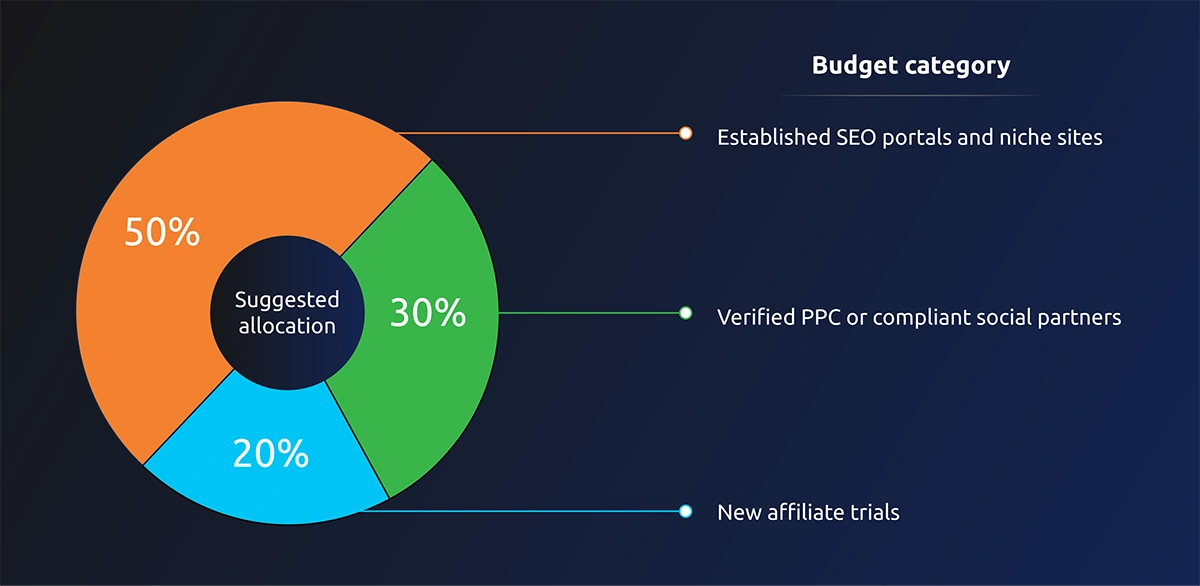
The testing allocation should be divided into capped pilots. Better terms can be offered after the traffic demonstrates credible deposits, retention, and compliance.
Concentrating a large quarterly budget with one partner creates unnecessary risk when the agreement and traffic quality have not yet been proven. One of our clients learned this after affiliates delivered a large volume of traffic and subsequently requested payment under commercial terms that had not been defined carefully enough. By the time the operator identified that much of the traffic was fraudulent, the contractual position still required the payment to be made, resulting in losses of approximately €250,000.
A capped trial, together with clear provisions covering traffic sources, validation criteria and payment exclusions, would have allowed the operator to assess the players before committing a substantial budget.
A practical budget review should ask:
- Can the traffic source be verified?
- Is the placement commercially meaningful?
- Can the casino support the expected volume?
- Does CRM know what type of players will arrive?
- Is the holding period long enough?
- Can the operator pause the source immediately?
- Would one failed partner threaten the monthly cash flow?
Strong budget control depends on coordination between acquisition, CRM, fraud, payments, and customer support.
FAQ
The biggest red flag is refusal to disclose the real traffic source. A credible partner should explain which domains, paid campaigns, social channels, streamers, or sub-affiliates will promote the casino. Operators should be cautious when an affiliate claims to have unlimited traffic from every market.