
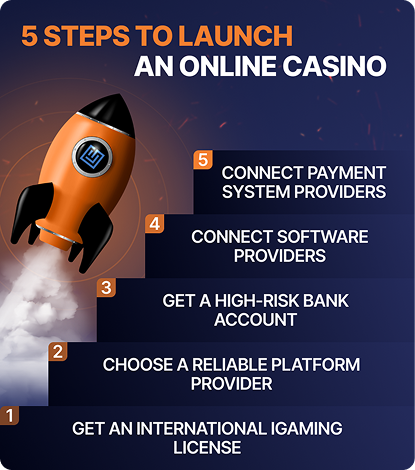

How to Choose the Right Payment Solutions for Your Online Casino
Most online casino founders spend months building out a killer platform, only to realize at launch that their biggest bottleneck has zero to do with the game library or marketing. It is payments. Getting a reliable payment gateway for online casino processing off the ground is a brutal hurdle. Mess it up, and you aren’t just losing daily revenue because a bad setup will get your entire operation shut down.
As per the 2026 standards, iGaming payment solutions aren’t just a basic checkout form plug-in. You are looking at a complex web of front-end gateways, back-end clearing engines, automated route managers, and underwritten corporate banks. If you are classified as a high-risk merchant, any single point of failure can block player deposits, freeze your reserves, or close your corporate accounts over a weekend. Here is exactly how that tech stack works under the hood, what it really costs, how the newest regulatory shifts affect your runway, and how to build a payment setup that actually stands its ground.
Payment Stack: Gateway, Processor, Orchestrator & Merchant Account
Most operators use these core financial terms interchangeably. They shouldn’t. Confusing them causes bad contract terms, bloated pricing models, and massive engineering delays.
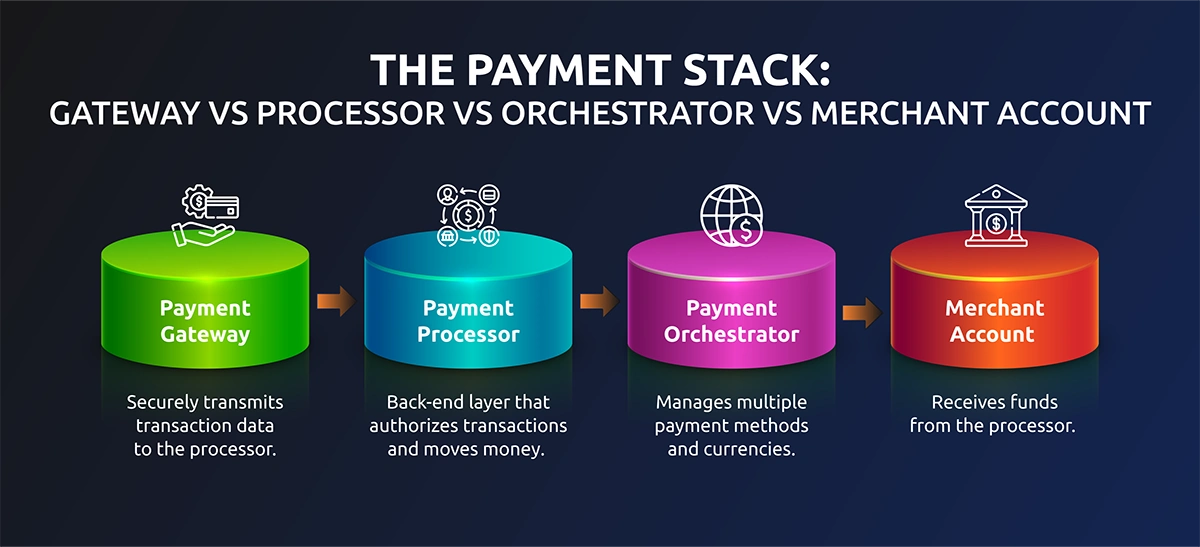
Payment Gateway vs. Payment Processor
The friction in a payment gateway vs. processor loop comes down to customer-facing card capture versus actual money movement. A gateway sits on your site as the front-end software layer. It securely grabs the player’s payment data, encrypts it on your cashier page, and passes it along. Many startups route through a dedicated gateway wrapper just to keep their platform clear of heavy security compliance.
If you’re trying to wrap your head around what is a payment processor and why it matters, just think of it as the backend powerhouse doing all the heavy lifting with the banks. It communicates with issuing banks to authorize the funds and settle the actual cash. This processor determines your merchant descriptor, the text players see on their bank statements. If that billing name does not mirror your public casino brand, expect an immediate wave of player disputes. Note that if your casino platform lacks built-in PCI DSS validation, players get redirected to an ugly external checkout iframe, which completely kills your deposit momentum.
What is Payment Orchestration (and Why It Matters in 2026)
Payment orchestration acts as an intelligent traffic cop between your front-end cashier page and your back-end bank partners. It analyzes every deposit attempt in real time, running smart routing models to find the specific acquirer most likely to approve that exact transaction based on location, card tier, and bank habits.
If the primary bank kicks back a soft decline, the system activates payment cascading instantly. The system routes that exact same transaction to a backup bank in seconds, all without forcing the player to retype their card numbers. With global gambling card decline rates sitting around 20% to 40%, orchestration turns failed checkout drops into hard profit. It keeps the cashier running without a single glitch.
Merchant Accounts for High-Risk iGaming
Your operating capital lands in a high-security bank account under MCC 7995, the global category tag for gambling. Getting a high-risk merchant account approved requires passing rigorous, manual human underwriting with zero automated shortcuts. Risk teams dig into your corporate license tier, volume history, and player geography before opening up your official gaming merchant account.
Standard digital retailers skate by on a 2.9% fee bracket. Gambling brands get hit with 5% to 10% rates, plus rolling reserves and monthly volume minimums. Knowing this environment early is your only real leverage when negotiating contract terms. It keeps you from overpaying before you scale your transaction numbers.
Why iGaming is High-Risk (and What That Actually Costs You)
Payment clearing networks treat online gambling as an absolute maximum risk scenario. That classification translates directly into heavy operating expenses that drain your margins if left unoptimized.
Chargeback Ratios: iGaming vs. Standard eCommerce
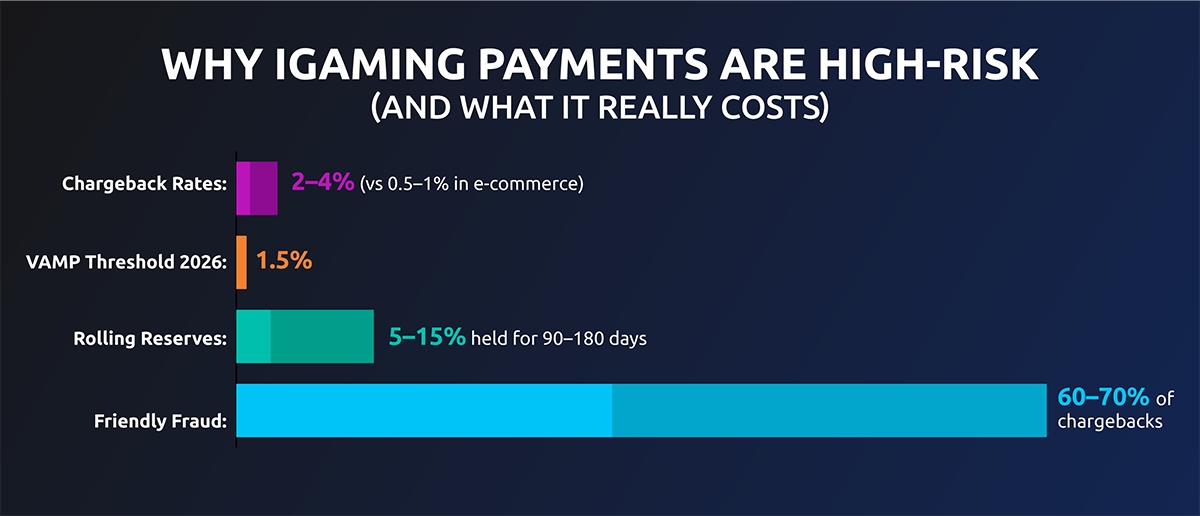
Navigating high-risk payment processing means tracking your transaction disputes meticulously. Standard e-commerce brands live with a stable chargeback ratio below 1%. Meanwhile, the baseline chargeback ratio iGaming startups experience regularly drifts between 2% and 4%.
The primary culprit is friendly fraud: players lose an expensive bet, regret the spend, and claim unauthorized use to their bank. Every $100 lost to a player dispute ends up costing your casino around $207 once network penalties and dispute management fees hit your balance sheet. It’s a structural leak you have to patch before you run traffic.
Visa VAMP 2026: The New 1.5% Threshold
On April 1, 2026, Visa updated its global monitoring system, dropping its excessive VAMP threshold from 2.2% to 1.5%. This strict math combines actual TC15 chargebacks with TC40 pre-fraud alerts. If you hit 1.5% alongside 1,500 monthly alerts, Visa hits you with uncapped penalties, and long-term compliance failures will land your founders on the global match list.
Mastercard also added a flat $0.03 penalty on every single declined card-not-present attempt. If your startup clears 500,000 monthly transactions at a standard 13% unoptimized decline rate, that is a $1,950 invisible tax on failed deposits alone. This rule change makes smart routing mandatory if you want to protect your merchant standings.
Rolling Reserves: The Hidden Capital Killer
Underwriters manage their exposure by locking up a slice of your daily volume. A standard rolling reserve gambling clause lets the bank retain 5% to 15% of your gross processing volume for 90 to 180 days.
If you clear $100,000 a month with a standard 10% reserve on a 180-day hold, you have $60,000 in liquid capital frozen in an escrow bank. That is real cash pulled directly out of your user acquisition budgets, marketing plans, and platform development. Crypto routes and account-to-account tools skip this lockup because those payment paths carry zero chargeback liability.
PSP Account Termination Risk
High-risk payment companies pull accounts with minimal notice. When an unexpected PSP termination lands in your inbox, your entire cash engine goes cold. Onboarding a high-risk backup partner from scratch usually takes two to four months of underwriting.
If you operate your casino cashier through a single connection, you are one risk committee meeting away from an operational blackout. Building out a multi-channel payment rail is your only real protection against a sudden shutdown.
Why Big PSPs Decline Startups
Mainstream brands like Stripe, PayPal, and Adyen explicitly block all gambling merchants. Tier-one corporate banks actively cap their high-risk exposure slots, automatically turning down startups to save portfolio space for established global operators.
Without extensive processing history or audited statements, expect high fee brackets and steep reserve requirements during your first year. The playing field levels out significantly after you stack up twelve months of clean transaction histories. Meticulous corporate documentation is your best weapon during this initial launch phase.
Payment Methods: Coverage Map by Region
A single global cashier layout will not convert players. Data shows 46% of online players abandon checkout if their preferred local option is missing, and 84% won’t return to a brand after a clunky deposit experience. Picking the right iGaming payment methods means tailoring your cashier to match the exact financial habits of each target country.
Cards (Visa, Mastercard)
Cards carry massive transaction volume across North America and Western Europe but present significant technical challenges. On top of standard decline rates hitting 40% due to bank-side filters, European transactions require mandatory 3D Secure biometric confirmation screens under PSD2. They carry expensive processing fees from 2.5% to 4.5% and a high dispute footprint, meaning they should be your cashier baseline, not your standalone strategy.
E-Wallets (Skrill, Neteller, PayPal, MuchBetter)
Because players fund these digital wallets externally before depositing, payment approval rates sit near 100%. If a player opens a dispute, the claim is handled entirely within the wallet network instead of hitting the card clearings, protecting your primary merchant standing. Expect transaction fees to hover between 1.5% and 3.5%.
A2A / Open Banking (Trustly, Brite, Zimpler, Pay N Play)
Account-to-account bank integrations are completely changing the open banking gambling landscape across Europe. By linking a player’s mobile banking app straight to your corporate ledger, you settle funds instantly for low 0.3% to 1% fees with zero chargeback risk. Following recent SEPA Instant rollouts, real-time banking transfers are the new baseline. Trustly’s Pay N Play takes this further by pulling verified bank KYC details during the deposit loop, removing registration forms completely.
Local Alternative Payment Methods (PIX, UPI, SPEI, M-Pesa)
Emerging markets operate on entirely unique regional payment rails. PIX controls over 96% of the Brazilian gaming market, making it the non-negotiable tool for that territory. Across India, UPI cleared 24.2 billion transactions in late 2024, though banking shifts require smart, localized routing to prevent transaction drops. Mexico runs on SPEI bank transfers and cash-backed OXXO store vouchers, while M-Pesa is mandatory across East Africa.
Crypto and Stablecoins
Bitcoin keeps processing alive when fiat channels break, but it brings high network fees and wild price shifts. To fix this, high-volume operators rely on casino crypto payments processed via stablecoins like USDT on the TRON network, hitting 1 to 5 minute clearance times with low costs and zero rolling reserves. For European player bases, these decentralized assets must align perfectly with the newest MiCA regulatory frameworks.
Bank Transfers and Direct Debit
Traditional bank wires are useful for managing high-net-worth VIP player balances and executing large corporate pay-outs. Their fixed 0.5% to 1.5% fee design makes them highly cost-effective for large tickets, but the standard 1-3 day clearing delay makes them useless for mainstream retail conversions.
Mobile Wallets (Apple Pay, Google Pay)
Apple and Google Pay act as tokenized containers around standard cards, meaning they share the same 2.5% to 4% core merchant fees and chargeback liabilities. Their real value lies entirely in mobile conversion optimization, replacing manual number entry with native biometric scans. With 80% to 90% of Asian casino traffic running on mobile phones, biometric tokenization is an absolute survival requirement.
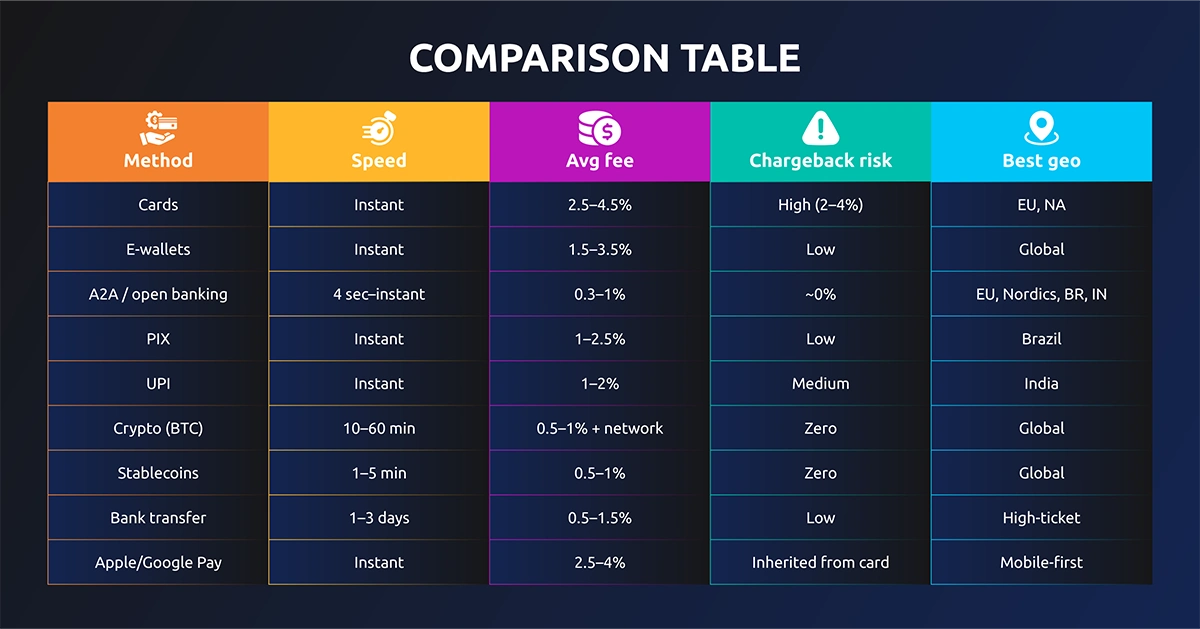
Comparison Table
| Method | Speed | Avg Fee | Chargeback Risk | Best Geo |
| Cards | Instant | 2.5–4.5% | High (2–4%) | EU, NA |
| E-wallets | Instant | 1.5–3.5% | Low | Global |
| A2A / Open Banking | 4 sec–instant | 0.3–1% | ~0% | EU, Nordics, BR, IN |
| PIX | Instant | 1–2.5% | Low | Brazil |
| UPI | Instant | 1–2% | Medium | India |
| Crypto (BTC) | 10–60 min | 0.5–1% + network | Zero | Global |
| Stablecoins | 1–5 min | 0.5–1% | Zero | Global |
| Bank transfer | 1–3 days | 0.5–1.5% | Low | High-ticket |
| Apple/Google Pay | Instant | 2.5–4% | Inherited from card | Mobile-first |
Market-by-Market Playbook
Every geographic zone operates on its own proprietary payment networks and carries distinct localized fraud trends. You have to match the exact payment methods casino storefronts feature to the financial realities of each country.
LatAm: PIX-First Reality (Brazil, Mexico, Argentina, Colombia)
Brazil requires a dedicated, localized PIX iGaming setup. Traditional credit card usage is incredibly low, and fewer than 30% of local consumers own cards enabled for international billing. If your checkout page relies strictly on cards, you miss most of your addressable market. Mexico depends on cash-stamped OXXO store vouchers and SPEI bank transfers, while Colombia maps to PSE networks. Due to regional identity theft risks, running device fingerprinting at checkout is mandatory.
Asia: Fragmented, Fraud-Heavy (India, Japan, SEA, Malaysia)
Asia presents major regional fragmentation challenges. Keeping a stable UPI India casino route alive is highly complex because local enforcement actions frequently freeze payment channels without warning. European payment processors do not clear these instruments natively, requiring local peer-to-peer integrations. Southeast Asian corridors divide between Thailand’s PromptPay, Vietnam’s MoMo, and Indonesia’s QRIS, which all demand a mobile-first interface.
Europe: Regulated vs. International License Gap
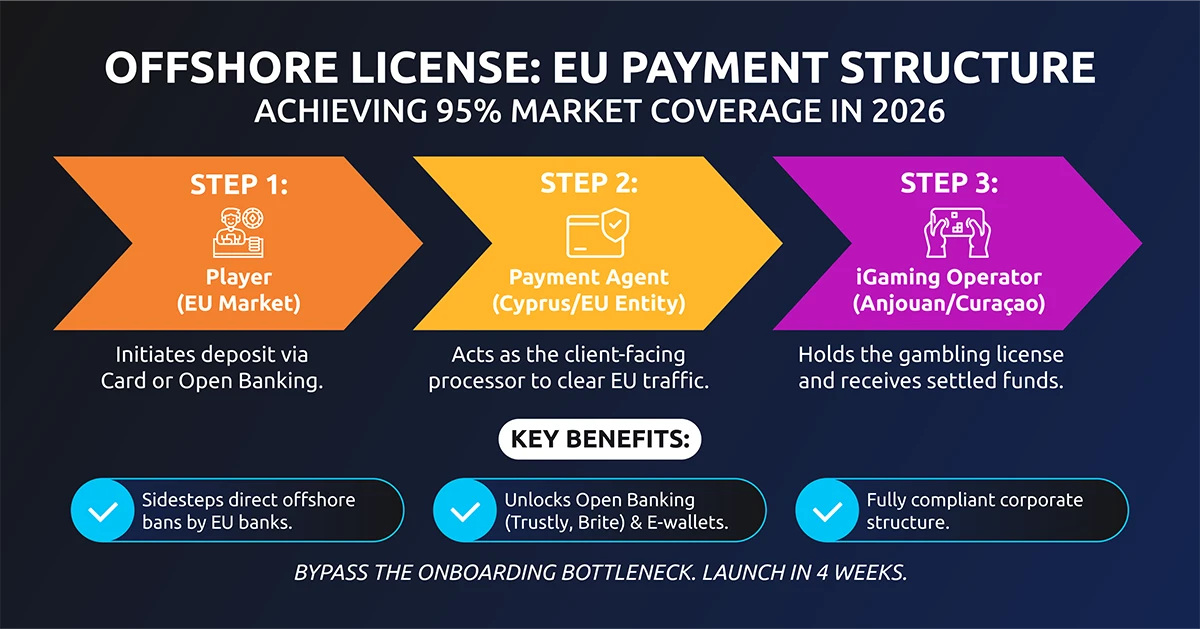
Europe brings the highest player value but features a tightly controlled regulatory landscape. Operating on an international offshore structure means standard Eurocard processing faces extreme filtering from regional card issuers. To bridge this gap, offshore brands route through European iGaming payments built on account-to-account open banking frameworks, bypassing card networks while matching local user habits.
CIS and Russia: Post-2022 Reality
Following the massive payment channel shakeups of 2022, traditional credit card clearings are completely dead in this zone. The market has shifted heavily toward alternative setups using decentralized stablecoins and localized peer-to-peer network agents. This corridor morphs rapidly, requiring dedicated regional team members to actively monitor route performance.
Africa and MENA: Mobile-First
Sub-Saharan Africa runs on telecom mobile money rails rather than traditional banks. Integrating M-Pesa gambling routes is a baseline requirement across Kenya and Tanzania, while West Africa maps directly to MTN MoMo and Airtel Money. In the MENA zone, strict anti-gambling bank blocks mean you have to rely heavily on decentralized stablecoins and digital vouchers.
Do you want to start your online casino?
Download a free whitepaper and learn five steps to launch an online casino or sportsbook.
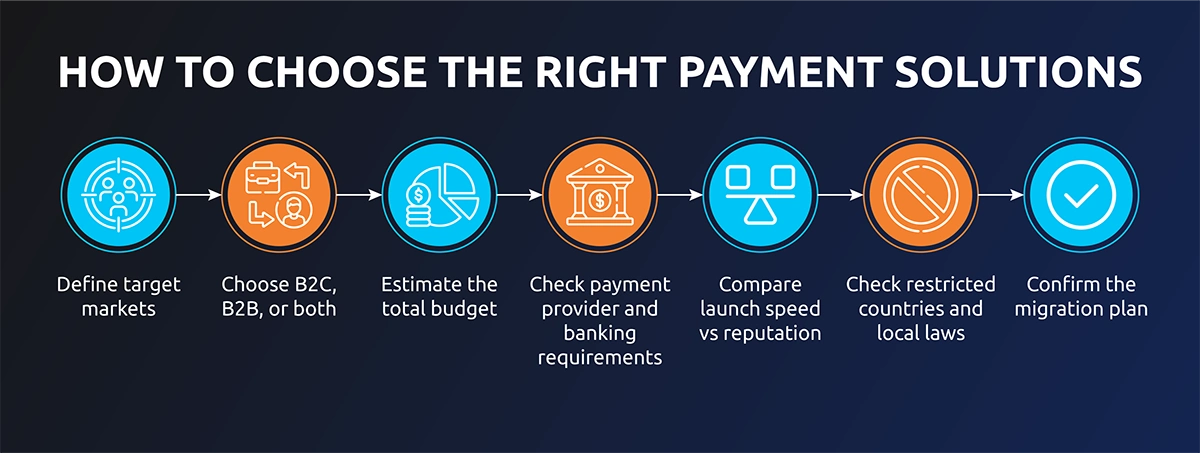
What to Evaluate When Choosing a Provider
Never buy payment services based strictly on the cheapest advertised transaction percentage. A low sticker price often hides abysmal completion rates.
Transaction Speed and Authorization Rates
The absolute most critical variable to track is your provider’s verified payment gateway approval rate inside your exact target territory. A 3% merchant fee paired with a 60% approval rate loses you money compared to a 6% fee that converts at 85%. Since nearly 40% of players who hit a failed deposit will never try to check out again, your metrics must focus entirely on net transaction success.
Smart Routing and Cascading
Verify that your processing partner operates a modern smart routing iGaming layer equipped with automatic cascading. The engine must be able to instantly pass a transaction to a secondary clear network the moment a primary acquirer returns a soft decline. If your provider lacks this automation, your casino cashier will suffer from massive checkout drop-offs.
Geographic Coverage and Acquirer Network
A payment company linked to only a single underlying bank represents a dangerous operational bottleneck. If that single bank shifts its internal risk metrics, your whole checkout system goes black over a weekend. Make sure your payment provider maintains active processing paths with multiple independent regional banks.
Fee Structure
Get a formal, itemized contract detailing every single casino payment fees element before signing anything:
- MDR: The core volume percentage sliced off every transaction.
- Onboarding & Fixed Costs: Upfront integration fees ($500 to $2,000) and monthly processing minimum floors.
- Dispute Penalties: Direct administrative costs ($20 to $100) applied per player chargeback.
- Reserves & Conversions: The exact rolling reserve split, holding window timelines, and international currency conversion markups.
Compliance: PCI DSS, PSD2/SCA, AML/KYC, MiCA, DORA, PSD3
Your processing engine should have native, built-in Tier-1 PCI DSS status. Without it, users are forced off your web domain to complete card data entry, which drops checkouts. Make sure your partners comply with regional frameworks like Europe’s data security mandates and shifting open banking liability rollouts.
Integration Effort and Time-to-Live
Do not rely on polished marketing pitch decks. Map out a realistic payment integration timeline with your lead developers, accounting for API variations, sandbox testing setups, and multi-currency accounting structures.
Support SLA and Account Management
When your deposit system crashes at 11 PM on a Friday night, standard email ticketing support queues are completely useless. Ensure your contract guarantees enterprise-level payment provider support backed by a named account manager and an explicit 24/7 critical issue resolution SLA.
Setting Up Payments from Zero to Live
The mechanics of financial onboarding require tight sequencing to prevent long delays.
Realistic Timelines
If you are mapping out how to set up payment gateway casino frameworks, a soft launch with a single payment service provider requires roughly four weeks of corporate paper routing. Setting up a fully optimized cashier with localized cards, alternative regional options, and open banking links requires a 6-8 week runway. Work backward from your target go-live date with payments as your absolute primary constraint.
Volume Forecasting and PSP Negotiation
Compliance teams price processing rates based on your operating history, corporate jurisdiction, and target volumes. Startups can balance out a lack of processing numbers by submitting professional 12-month projections and accepting higher initial reserves that scale down at pre-set volume milestones.
Why You Need Multiple PSPs
Relying on a single payment service provider creates an immediate vulnerability for your cash engine. Shifting your treasury to a structured multi-PSP setup gives your platform essential payment redundancy. If one banking partner updates its rules or suffers a system crash, your orchestrator shifts transaction volume to your backup rails without interrupting active players.
Common Setup Mistakes
Most launch errors are completely preventable if you don’t cut corners on corporate basics:
- Postponing Player Identity Validation: Waiting to run KYC checks until a user requests an outbound cash-out leaves your merchant accounts wide open to early chargeback fraud.
- Using Clunky Card Descriptors: Using a generic corporate billing name that does not match your public casino site name triggers immediate consumer confusion and drives dispute rates through the roof.
- Failing to Run Live Failover Tests: Many setups link secondary backup processors but never run live transaction simulations, leaving them totally blind during an actual outage.
- Accepting Default Rolling Reserves: Signing an onboarding bank’s initial rolling reserve proposal without mapping out clear performance-based reduction tiers leaves massive capital locked up unnecessarily.
Working with International Licenses (Anjouan, Curaçao, Kahnawake)
Your chosen gaming jurisdiction shapes your available payment processing networks and defines your regional compliance steps.
PSP Acceptance by License Type
Mainstream European permissions like the MGA give you instant entry into top tier regional banks but demand steep setup costs and multi-month vetting timelines. Conversely, agile international alternatives like Anjouan license payment gateway models or standard Curaçao licensing allow for much faster corporate launches. You just have to build out the correct corporate entities to back them up.
The Anjouan/Curacao EU Coverage Problem
European acquiring banks do not onboard offshore companies directly. Trying to apply for standard credit card clearings using an unbacked offshore entity registered in Anjouan or Curaçao will get you immediately rejected by risk underwriters.
To run a stable Curacao casino payment provider engine or an equivalent Anjouan payment channel, you have to deploy a multi-tiered corporate architecture. This means setting up a European operational subsidiary running under an explicit inter-company service contract to act as your regional billing hub and pass bank compliance checks cleanly.
How LicenseGentlemen Achieves 95% EU Coverage
Securing stable payment pipelines under an offshore license requires deep banking relationships that new operators simply do not have. Trying to build these financial paths independently usually takes six to twelve months of development and involves a pile of bank rejections.
LicenseGentlemen simplifies this setup through an established network of high-risk banking integrations and proven corporate blueprints. We construct the compliance structures and intermediary corporate layers required to lock down your international gambling license payments architecture. This setup unlocks up to 95% European market coverage for international licensed operators, radically speeding up your time-to-market.
Compliance Layer Specific to Anjouan / Curacao
To keep your payment networks stable under an offshore license, you need a compliance framework that goes well past basic local requirements. Financial underwriting teams demand real operational transparency. This means running automated player verification, clear geo-fencing filters to block restricted territories, and visible responsible gaming blocks built directly into your checkout layout.
Conclusion
Payment setups are not a single project you check off before launch; they are core business infrastructure that directly shapes your daily cash flow and player retention numbers.
Build your cashier correctly from day one: map out your merchant account tiers, deploy system redundancy long before you face an outage, localize your checkout paths per market, and evaluate processors on their real authorization data rather than headline percentages. LicenseGentlemen has built this exact financial foundation for top online casino brands. To protect your incoming capital from day one, book a consultation with our payments advisory team.
FAQ
While advertised processing percentages usually stay between 2.5% and 4.5%, the addition of rolling reserves, setup costs, and chargeback penalties pushes the true cost of card transactions to 7% to 10% of gross volume for new casino operators.