

Handling Player Disputes and Complaints: 2026 Operator’s Playbook
If you run an online casino, you will hear a lot of complaints from your players. Things like: “I can’t withdraw my money.” “Your bonus doesn’t work.” “Why is my account locked?” appear daily. Ignore those messages, and you’re already in trouble from a regulatory perspective. Process them poorly, and your players walk away, taking their deposits and their word-of-mouth with them. Therefore, to address and resolve player casino disputes, management is forced to go far beyond the scope of customer service.
Every casino, sportsbook, or crypto gaming brand operating in 2026 gets judged by its licensing authority on one thing above nearly everything else: how it handles the moment a player says, “I’m not satisfied.” Most founders still allocate resources to complaints the way they’d staff a technical support line: a few agents, a shared inbox, a set of canned responses, and that’s rarely enough. However, a well-organized casino complaint process helps operators resolve issues faster, document decisions properly, and show licensing bodies they’re actually compliant. Handling player issues consistently and fairly cuts churn and keeps disputes from escalating to regulators in the first place. This significantly protects both the company and its reputation.
iGaming dispute resolution is getting more attention across licensed markets, and for good reason. You know the pattern: a player messages you furious at 2 am about a stuck withdrawal, you handle it, you move on, and assume that’s the end of it. It isn’t. Every message is a data point somewhere, and the licences being issued right now, Anjouan and Tobique, make ADR mandatory from day one, not an afterthought. Malta and the Isle of Man play a different game: they send auditors in and make the operator foot the bill for being investigated. Curaçao requires it too.
So, the real question isn’t whether you need a dispute process. It’s whether yours survives contact with a regulator who keeps a list of approved providers. That’s why understanding casino complaints handling and factors ADR casino 2026 frameworks matters: it helps operators build processes that support compliance, keep players confident, and avoid unnecessary operational costs.
This guide walks through what a fully compliant, 2026-ready complaint resolution process looks like, from the first message in live chat to the worst-case scenario of a lawsuit, along with the operational habits that keep you out of court.
For operators building or refining their compliance framework, LicenseGentlemen advises on licensing, operational structures, and regulatory requirements, and a free consultation is a reasonable place to start if you’re figuring out the right approach for your operation.
Why Disputes Are Every Operator's Responsibility (and Why Regulators Hate Getting Involved)
Regulators aren’t keen on resolving player complaints themselves. They expect operators to do it, and licensing bodies are built for oversight, not for mediating individual cases.
Anjouan, Tobique, and Curacao all hold to the same principle: complaints get handled first, always, through the operator’s own internal procedure. Resolving casino operator responsibility disputes is a basic part of running a licensed online casino, not an optional extra.
The regulator only steps in when that internal process fails, or when it starts revealing a pattern. Their role is to make sure operators have fair, transparent procedures as part of a broader player protection framework, while expecting the bulk of disputes to get resolved internally.
This isn’t laziness. It’s structural: a single mid-sized operator can generate thousands of complaints a month, and no regulator has the staff to adjudicate individual withdrawal disputes at that volume. None wants to, either.
Therefore, licensing frameworks push the operational burden downward, requiring fair, transparent, documented complaint procedures from operators, while independent ADR bodies act as the pressure-release valve for anything an operator can’t settle on its own. What the regulator actually does is audit the pattern rather than the case: a regulator complaint escalation review checks whether an operator’s complaint volume, ADR referral rate, and repeat-issue categories point to a systemic breach of licence conditions.
The iGaming complaint cost asymmetry is the part that founders tend to underestimate. A single unresolved payment dispute might involve a few hundred euros. A regulator that spots a pattern of unresolved disputes can suspend a licence, impose a financial penalty, or demand a full remediation plan, and any of those costs far more than the original complaint ever did.
Curaçao’s CGA now requires B2C operators to submit twice-yearly reports detailing complaint volumes, ADR referrals, and legal escalations, specifically so it can catch these patterns without touching individual cases. The lesson: sloppy complaint handling isn’t a support-team failure. It’s a compliance failure that happens to start at the support desk.
Complaints vs Disputes: Why the Difference Matters Legally
Although the terms are often mistakenly used interchangeably, there is an important legal distinction between a complaint and a dispute. Every licensing framework – MGA’s Player Protection Regulations, Anjouan’s gaming regulations, Tobique’s Gaming Authority requirements, and Curaçao’s LOK – offers a legal complaint definition iGaming operators can rely on, treating a specific escalation point as the legal trigger for external oversight. That definition generally covers an initial expression of dissatisfaction: poor customer service, a technical problem, a payment delay.
A dispute, on the other hand, is a complaint that remains unresolved after the operator has completed its internal review process and is then referred to an independent body where applicable. Understanding this complaint vs dispute casino distinction helps both operators and players follow the correct resolution process.
The table below maps out the main casino grievance types at each stage.
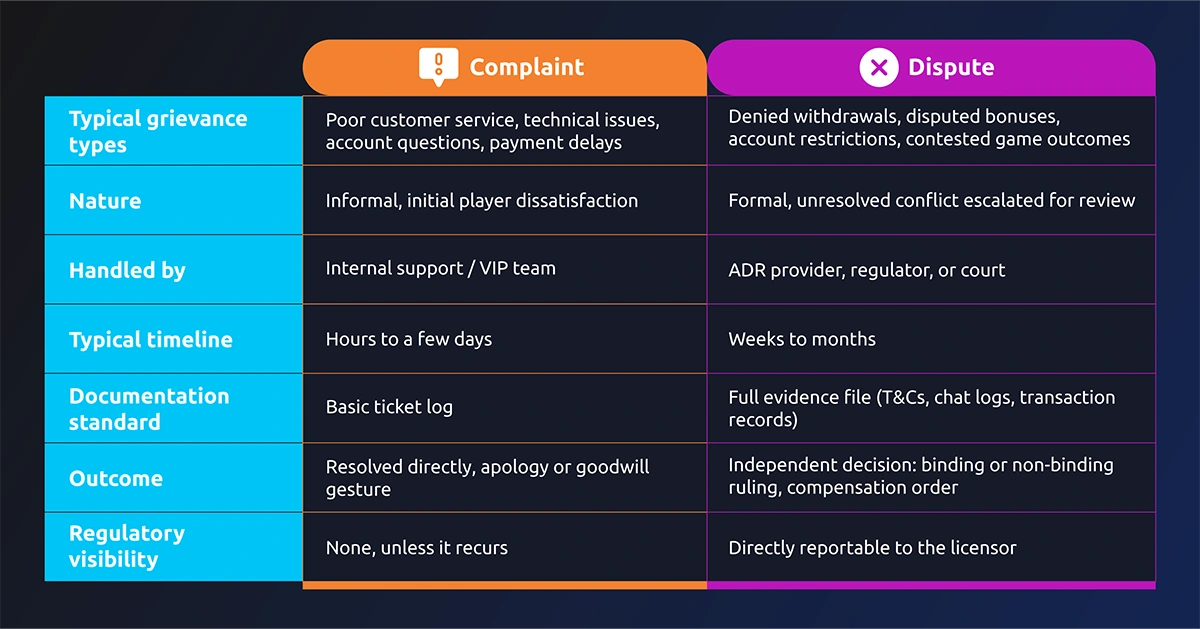
For players, the best way to complain about poor service at a casino is usually to start with the operator’s official support channels and follow the published complaints procedure. A lot of service issues get resolved internally without ever becoming a formal dispute.
Only once a complaint can’t be resolved through the operator’s process does it typically become a formal vs informal player issue worth escalating, where the licensing framework allows it. That split isn’t semantic. It decides which deadlines apply, what documentation is legally required, and whether an outside adjudicator can force an operator’s hand.
Worth answering directly, since players search for this constantly: the best way to complain about poor service at a casino often depends on the licence itself. With several modern licences, Anjouan is a good example; the regulator builds the complaint channel directly into the licence validation seal on the casino’s website. A player just clicks the validator, presses a “write a complaint” button, and the message goes straight to the regulator; no need to draft an email or hunt down addresses. Also, there is no risk of getting buried in a shared support inbox.
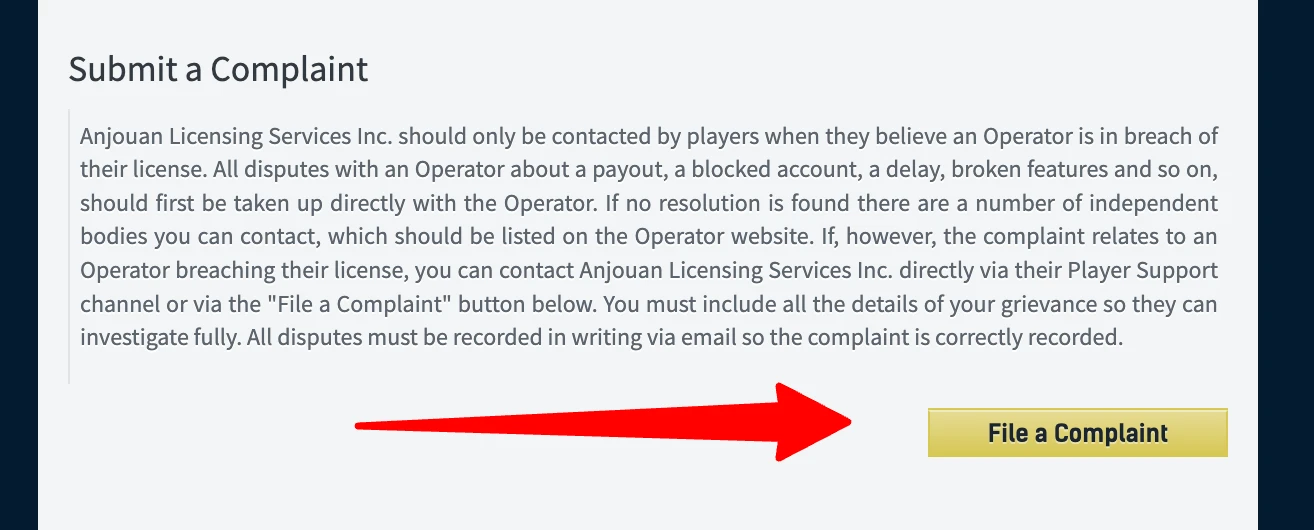
Where that option exists, it’s usually the fastest, most traceable way to escalate, since the regulator has a timestamped record of the complaint the moment it’s filed. Where it doesn’t, the fallback is the operator’s official complaints channel in writing, an email or a dedicated complaint form rather than casual live chat, stating explicitly that it’s a “formal complaint” while asking for a written response, the exact moment a formal vs informal player issue turns into something a regulator can actually act on. That phrase alone starts the regulatory clock and builds the paper trail needed if things escalate later. Here’s what that looks like on the Anjouan side:
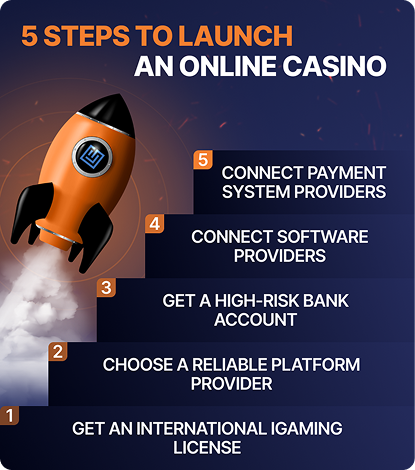
Ready to Launch Your Own Online Casino?
Get the full 5-step roadmap – from licensing to payments – with a real project timeline included.
The Six Complaint Categories Every Operator Sees
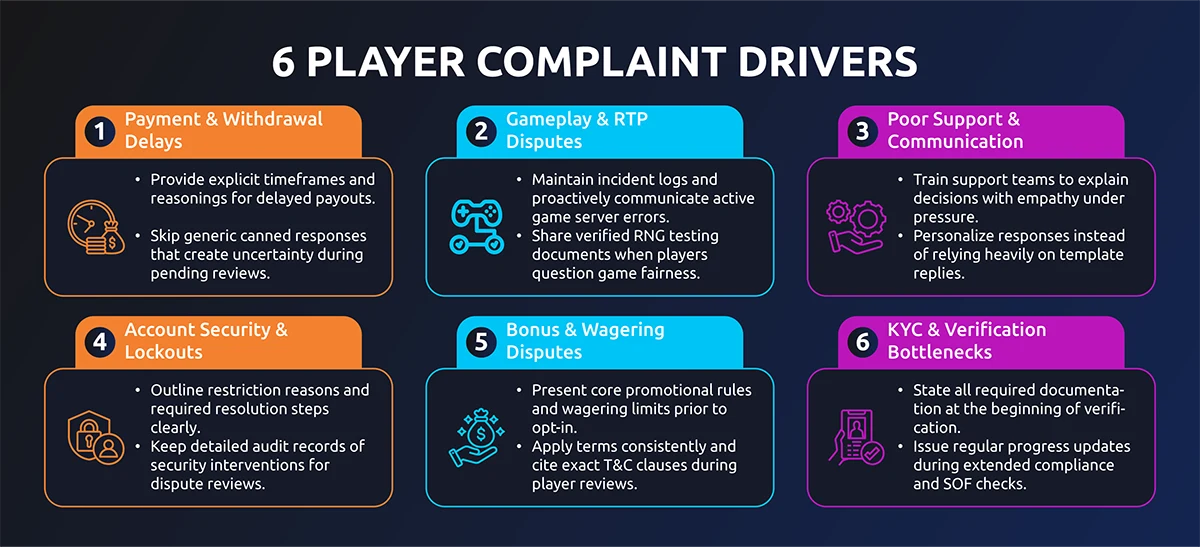
Most types of casino complaints fall into a handful of recurring categories. The details vary case to case, but these iGaming complaint categories usually come down to payments, gameplay, customer support, account access, bonuses, or identity verification. Recognizing the pattern early lets operators fix internal processes and resolve casino player grievances before they escalate into formal disputes.
Payment and Withdrawal Complaints
Delayed withdrawals, pending payments, declined payouts, and payment processing issues are among the most common player complaints casino operators see. Delays might come from internal verification, banking processes, or payment provider timeframes, but players get frustrated fastest when they hear little or nothing about the status of their request.
- Provide clear updates through the withdrawal process, including expected timeframes and reasons for any delay.
- Keep support channels open for players with pending withdrawals, and skip generic responses that create unnecessary uncertainty.
Gameplay, RTP, and Fairness Complaints
Players question game fairness after technical interruptions, unexpected disconnections, or losing streaks that feel unusual to them. Others ask about advertised Return to Player (RTP) figures or want information on game certification and random number generation (RNG).
- Keep records of technical incidents and communicate openly if a known issue affected gameplay.
- Be ready to share information about game certification and testing when players want reassurance.
Customer Service and Communication
Poor communication turns a simple issue into a formal complaint faster than almost anything else. Players report slow response times, repetitive template replies, and difficulty getting updates during payment reviews or technical incidents.
- Train support teams to explain decisions clearly and respond with empathy, especially under pressure.
- Personalize responses wherever possible instead of leaning on canned messages.
Account Security, Lockouts, and Data Concerns
Security complaints usually involve account lockouts, suspected unauthorized access, multi-account investigations, or questions about personal data and privacy rights. These cases need a balance between fraud prevention and clear communication with the player.
- Explain why an account was restricted and what steps are needed for review, whenever that’s possible to share.
- Keep detailed records of security actions and player communications in case the matter needs further review.
Bonus, Wagering, and Promotion Disputes
Bonus complaints commonly come from wagering requirements, maximum bet rules, promotional eligibility, or forfeited winnings. Most stem from players misunderstanding promotional terms rather than an actual technical error.
- Present the important bonus conditions clearly before players opt in to a promotion.
- Apply promotional rules consistently, and explain decisions by referencing the relevant terms directly.
KYC and Identity Verification Issues
Identity verification is another frequent source of casino player grievances. Delays in document reviews, repeated requests for additional information, or source-of-funds (SOF) checks create frustration fast if expectations aren’t managed properly.
- Tell players exactly which documents are required at the start of verification, not partway through.
- Give regular progress updates if extra compliance checks extend the review period. This alone cuts down a lot of follow-up complaints.
The 2026 Escalation Ladder: Internal → ADR → Regulator → Court
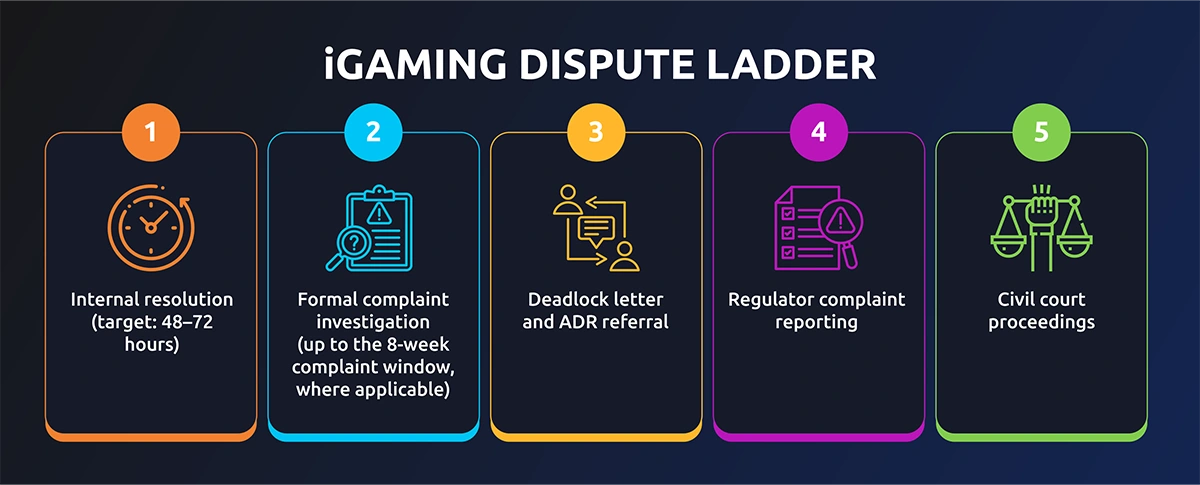
Every player complaint follows some kind of progression, though most cases get resolved long before the final stages. A structured casino complaint escalation process helps operators resolve issues efficiently, meet regulatory expectations, and cut the odds of costly legal action. Requirements vary by jurisdiction, but the iGaming dispute ladder generally runs through five steps:
- Internal resolution (target: 48–72 hours)
- Formal complaint investigation (up to the 8-week complaint window, where applicable)
- Deadlock letter and ADR referral
- Regulator complaint reporting
- Civil court proceedings
Stage 1 — Internal Resolution (Target: 48–72 Hours)
The first stage focuses on resolving the issue through customer support or, where it makes sense, VIP account managers. Prompt responses, clear communication, and collecting the relevant information, payment records, chat history, and gameplay logs often stop complaints from escalating any further.
Stage 2 — Formal Complaint Investigation (Up to 8 Weeks)
If the issue can’t be resolved right away, it moves into a formal internal review. In jurisdictions like the UK, operators are generally expected to finish this investigation within an 8-week window before the player can seek independent review. Maintaining accurate records and giving regular updates during this period helps demonstrate the complaint is being handled fairly, which matters more than it sounds.
The exact internal window varies a lot by licence: Anjouan gives operators 30 days to resolve a dispute internally before the player can escalate to the appointed ADR service, Tobique extends that to 60 days, and Curaçao sets no fixed internal deadline at all, though once a case is formally opened, its ADR body has up to 90 days to resolve it and must notify the operator if it needs an extension.
Stage 3 — Deadlock Letter and ADR Referral
If the eight-week window closes without resolution, or the operator and player simply can’t agree, the operator has to issue a formal deadlock letter to the casino confirming the complaints process has ended and directing the player to the operator’s named ADR provider. This letter isn’t optional paperwork. Regulators specifically flag its absence as a common and serious compliance failure, because without it players don’t even know their right to escalate exists.
A deadlock letter, in practice, is a formal notice stating a final, unalterable ruling, voiding disputed winnings over a T&Cs breach, for example, and confirming that internal options are exhausted. Fewer players actually escalate after receiving one than most operators assume: based on operator data, roughly 10% of players who get a formal deadlock letter go on to file an official claim with an ADR provider.
Stage 4 — Regulatory Reporting
Once a case reaches ADR, or a player bypasses the process for a direct regulator complaint casino report, that complaint becomes a data point in the operator’s compliance file. Enough of them trigger an audit sweep, a common form of ADR gambling escalation that sits outside the operator’s control. Regulators don’t resolve individual claims at this stage; they look for patterns, repeated payment delays, high ADR-referral rates, and ignored deadlock obligations that suggest a systemic licence breach. This is also the stage where Curaçao’s twice-yearly mandatory complaint reporting matters most: those reports are how the CGA builds its risk profile of each operator without adjudicating cases itself.
Stage 5 — Legal Proceedings
Civil court is the last resort, reserved for disputes above ADR’s binding threshold or cases where a player rejects the ADR outcome, and it’s the single most expensive and reputation-damaging outcome an operator can reach. Court cases are public record, take months or years, and typically cost many multiples of the disputed amount in legal fees alone. That’s precisely why every stage before this one exists.
Understanding these escalation stages matters most for operators entering new regulated markets. LicenseGentlemen helps businesses navigate licensing frameworks and operational requirements, including complaint handling and dispute resolution, and a free consultation is available for operators building out that process.
Alternative Dispute Resolution (ADR): The 2026 Reality
Alternative dispute resolution in gambling plays a real role in regulated iGaming markets by giving players and operators an independent way to resolve disputes that can’t be settled directly. Depending on the jurisdiction, working with an approved ADR provider iGaming can be a licensing requirement or a strongly recommended part of the complaints process. As frameworks keep evolving, understanding ADR casino 2026 requirements is now a basic part of staying compliant.
Why ADR Is Now Mandatory Across MGA, UKGC, Curaçao LOK, Anjouan, Tobique, and Kahnawake
All three major licensing regimes now require an active, named ADR partnership as a condition of holding the licence, not just a best-practice recommendation. UKGC’s LCCP has required this for years under social responsibility code provision 6.1.1.2. MGA formalized it through its Alternative Dispute Resolution Directive, tied to Malta’s Gaming Act and Player Protection Regulations, requiring B2C licensees to name a compliant ADR entity. The biggest 2026 shift is Curaçao. Under the new LOK framework, ADR moved from nonexistent to mandatory, with the CGA confirming that licensed operators must offer players access to an approved, independent ADR provider, a dramatic change from the old NOOGH regime, where players had essentially no formal escalation path at all.
Choosing an ADR Provider (eCOGRA, IBAS, CasinoReviews, SiGMA ADR, Tobique, Anjouan, and Curacao)
The right ADR provider depends on which licence you hold and how fast you need cases resolved. Among eCOGRA, IBAS, CasinoReviews and the regulator-run channels under Tobique, Anjouan, and Curaçao, the major players differ meaningfully on cost structure, turnaround, and who’s actually reviewing the case.
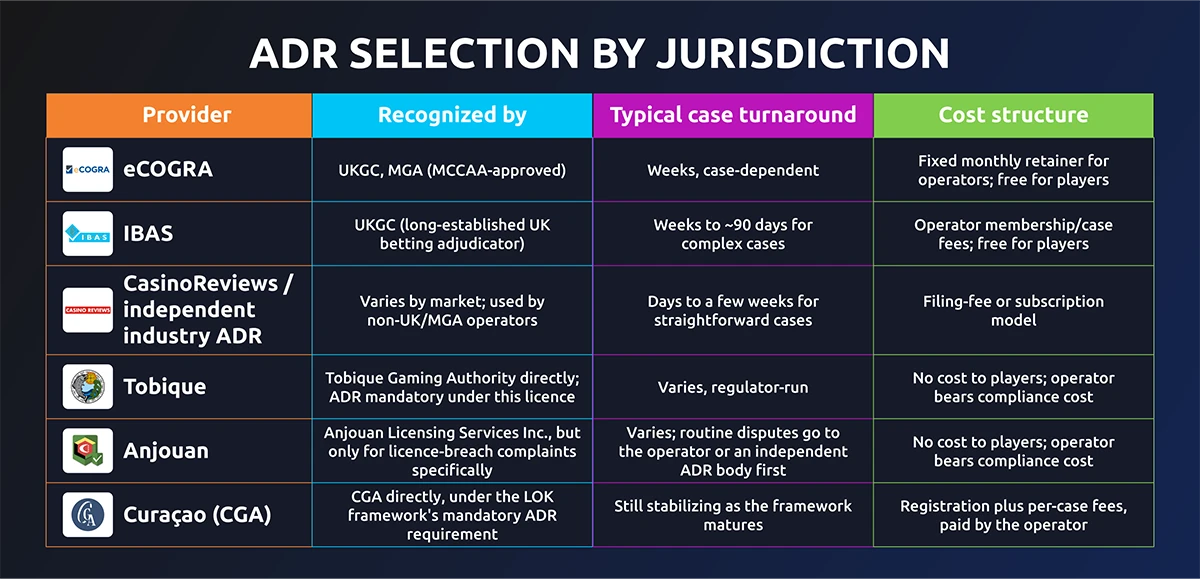
Curaçao’s ADR market is still consolidating. As of early 2026, only a small number of entities (including ADR Curaçao) carry public CGA certification, so operators should verify a provider’s certification status directly with the regulator’s portal before signing anything, rather than relying on a provider’s own marketing claims. Tobique and Anjouan, by contrast, route complaints straight through the regulator’s own channel rather than an accredited third party, so there’s no separate certification to check, just the regulator’s published complaint process itself.
ADR bodies also filter cases more aggressively than most operators expect. Minor or frivolous claims, a missing bonus payout, for example, typically get redirected straight back to the operator’s frontline support rather than opened as a formal case, since ADR intervention is generally reserved for disputes that carry real regulatory or reputational risk. Response targets vary by provider too: one representative example, Aegis, works up to 7–10 business days depending on case complexity and how quickly the operator supplies evidence.
Binding vs Non-Binding Rulings
A legally binding ADR outcome only applies to the operator if the player accepts it and the claim falls under the provider’s binding threshold. In the UK, that threshold aligns with the small claims court limit of £10,000. Above that threshold, or where the player rejects the outcome, the ruling is advisory only, and the player keeps the right to pursue court proceedings instead. Licence holders are barred from using contract terms that strip a player’s right to go to court; ADR can only add a faster, free option, never remove the legal one.
ADR isn’t purely a player-protection mechanism either. Reputable providers are just as tasked with protecting operators from malicious or exaggerated claims, and in most disputes that actually reach a ruling, the operator wins because the player overstated the issue or was attempting to extract funds outright. When an operator presents clear evidence of a T&Cs violation or fraud, the ADR body sides with the operator.
What ADR Costs the Operator
ADR is structured to be free for players and paid for by the operator, typically through a mix of a fixed registration or monthly retainer fee plus per-case charges once a dispute is actually filed.
Beyond the provider’s own fees, the real operational cost is internal: building a clean, organized evidence file (chat transcripts, transaction logs, T&Cs version history) for every case that reaches this stage. That’s why the operators with the fewest ADR cases are usually the ones who invested earliest in documentation discipline, not the ones who found the cheapest ADR contract.
Pricing varies more than most operators assume, and it isn’t always retainer-based. Aegis, for example, charges no annual fee, no monthly fee, and no setup fee, just a flat €350 per case, applied only once a dispute actually clears the threshold to be accepted. Dispute volume is also lower than commonly assumed: the idea that a mid-tier operator handles 30–50 ADR cases a year doesn’t hold up in practice. Real averages run closer to 1–2 cases a month for a mid-tier operator, or once every 3–4 months for smaller brands, and mid-tier operators rarely if ever reach 30–40 formal cases annually.
Response SLAs and Documentation Every Operator Must Nail
A clear casino response time SLA helps operators manage player expectations while showing that complaints get handled consistently. Specific requirements vary by jurisdiction, but operators are generally expected to acknowledge complaints promptly, keep players informed through the investigation, and deliver an outcome within the applicable regulatory timeframe. Where an 8-week internal review period applies, missing that window can let the player seek external dispute resolution regardless of who’s right on the merits.
Good record-keeping matters just as much. Effective complaint documentation and casino procedures capture every stage, from the initial report through to the final decision. Accurate records help operators respond to regulatory requests, support ADR investigations, and explain how a case was actually handled. Operators should retain:
- Complaint submissions and support correspondence
- Internal investigation notes and decision records
- Payment, account, and verification history relevant to the complaint
- Technical information, including gameplay records where applicable
Maintaining chat log retention, iGaming policies and meeting a game log storage requirement matters most when disputes touch gameplay, account activity, or payment processing. These records provide the evidence preservation casino teams need during ADR reviews or regulatory inspections.
Many licensing frameworks also require retaining complaint-related records for extended periods; a 5-year retention period is a common benchmark in several regulated markets, though the exact period depends on jurisdiction and the type of information involved. Complete, well-organized records don’t just support compliance. They let operators resolve disputes faster when questions come up months or even years after the original complaint.
The Real Cost of Mishandled Complaints
The real cost of complaints casino operators face rarely comes from a single mishandled ticket. It comes from the chain reaction it triggers across chargebacks, payment processors, and licensing status, which is what turns “just resolve the ticket” into a genuine business priority.
It typically starts with a player disputing a charge directly with their bank rather than waiting for the operator’s process. In the UK, that can mean a Section 75 chargeback casino claim under the Consumer Credit Act for credit-card transactions between £100 and £30,000, which makes the card issuer jointly liable for the operator’s breach of contract, or a standard chargeback for other card types.
This chargeback risk in iGaming exposure doesn’t stay a banking-side problem for long. Processors monitor rising ratios closely, and operators who cross internal thresholds face penalty fees, reserve requirements, or termination of the merchant account, close to an existential threat for a digital-only business.
A real-world scenario illustrates this well: if a player recovers part of their funds through a bank chargeback, say $600 out of a $1000 disputes amount, and then approaches an ADR provider for the remaining $400, the ADR body will typically reject that claim if the original deposit were legitimate and the funds were fairly lost under the operator’s terms. The only exception where ADR will still intervene after a chargeback is if the operator committed serious Responsible Gaming (RG) violations or allowed Underage Gambling. In that scenario, ADR can still require the operator to refund the remaining balance owed.
Layered on top is the casino license risk complaints dimension: a pattern of chargebacks and unresolved complaints is exactly the signal that triggers a licensing audit, and audits revealing systemic failures can lead to penalties, licence conditions, or suspension. Underneath all of it sits reputation damage online casino brands can’t easily undo. A public ADR ruling against an operator does slower, but longer-lasting, damage to acquisition than any single fine.
Prevention: Reducing Complaints Before They Start
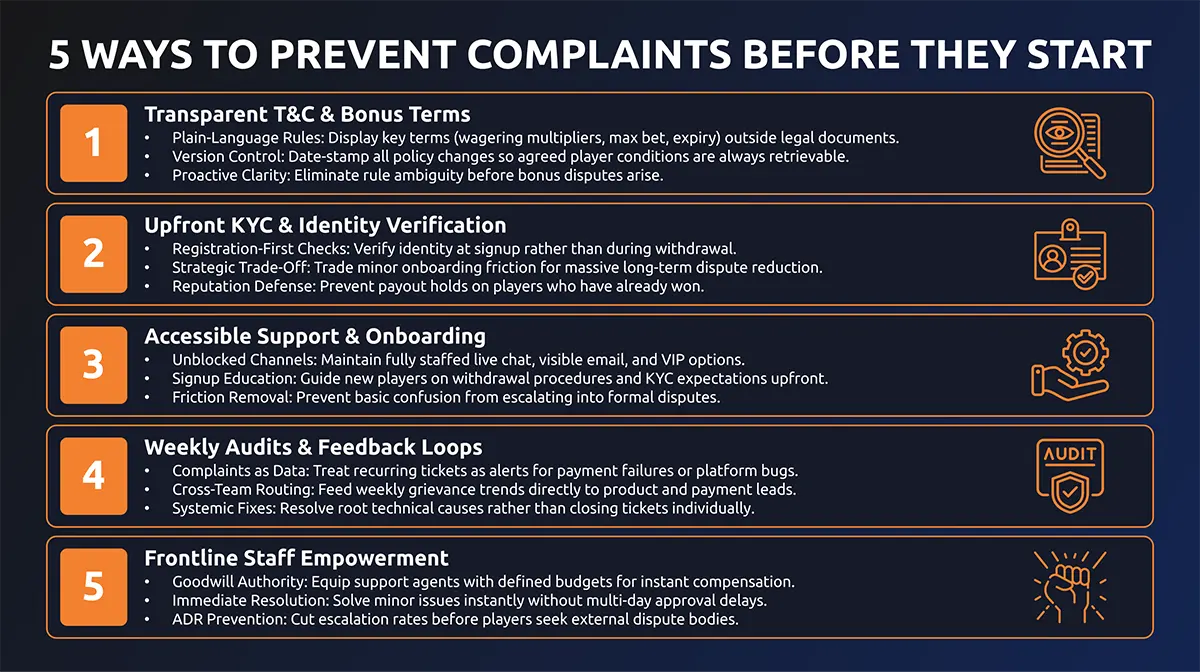
The cheapest way to prevent casino complaints is to stop them before they’re ever filed. Operators with the lowest complaint volumes in 2026 tend to share one trait: they invest in prevention infrastructure before scaling acquisition, not after the complaint queue backs up.
Transparent T&C and Bonus Terms
Transparent T&C casino documents reduce wagering-related conflict at the source by eliminating the “I didn’t know that was the rule” moment that drives most bonus disputes. Write bonus terms in plain language for genuine bonus policy clarity, surface the key numbers (wagering multiplier, max bet, expiry) outside the legal document itself, and version-date every change so a player’s specific agreed terms are always retrievable.
Upfront KYC and Identity Verification
Upfront KYC casino checks run at registration, rather than at withdrawal, and prevent the single most common trigger of KYC-related complaints: a player who’s already won money being asked to prove who they are before they can access it. Front-loading this friction costs a small amount of registration conversion, and saves a much larger amount of complaint volume and reputational damage later.
Clear Communication Channels
Making support genuinely easy to reach, a live chat that’s actually staffed, a visible email address, and a real phone line for VIP tiers prevents complaints from festering into disputes simply because the player couldn’t find anyone to talk to. Pairing that access with basic player education, iGaming teams can deliver at signup (how withdrawals work, what KYC involves, where to complain), head off a large share of confusion-driven tickets. Hidden or slow contact channels don’t reduce complaint volume. They just delay it and make the eventual complaint angrier.
Regular Audits and Feedback Loops
With a working feedback loop, casino teams can actually trust turns complaint categories and volumes into an early-warning system for systemic bugs, payment routing failures, or a specific game’s technical issues. The same complaint appearing fifty times in a week is a product signal, not fifty separate incidents. Review complaint data on a fixed schedule, weekly at a minimum, and route recurring categories directly to the product or payments team, not just to support leadership.
Staff Training and Empowerment
Giving frontline support supervisors a defined, limited budget of financial authority, a small goodwill credit or a minor wagering-breach waiver lets them resolve a meaningful share of complaints on the spot, before the player ever feels the need to escalate. This single change tends to reduce ADR referral rates more than any policy document, because it removes the multi-day internal approval chain that turns a minor grievance into a frustrated formal complaint.
Technology That Actually Helps Resolve Disputes Faster
The right casino complaint software stack turns complaint handling from a reactive scramble into a measurable, auditable process. In 2026, that stack has three core components: a purpose-built ticketing CRM, automated screening tools, and AI-driven complaint analytics. A dedicated casino CRM disputes module, rather than a generic help-desk tool, ties a support ticket directly to a player’s transaction history, KYC status, and bonus activity in one view, which cuts resolution time compared to agents toggling between systems.
Automated blockchain and payment screening tools matter most for crypto casino operators, where a withdrawal delay complaint is often actually a compliance hold triggered by wallet-risk scoring.
Giving agents visibility into why a screening tool flagged a transaction resolves a large share of crypto payment complaints without escalation, often through an AI chatbot complaints layer that handles first response. A broader dispute tracking system iGaming teams rely on, paired with complaint analytics and casino dashboards, pattern detection across ticket text, categorization, and sentiment, increasingly flags complaints likely to escalate to ADR before they do, letting supervisors intervene early.
This matters particularly for skill-based mobile gaming platforms, where the line between a “fairness” complaint and a genuine game-balance bug is often only visible in aggregate data, not in any single ticket.
LicenseGentlemen’s consulting work with new operators regularly starts with exactly this kind of stack audit, since founders launching their first platform tend to underinvest in complaint tooling relative to acquisition tooling. It’s almost always the reverse of what actually protects the licence.
Common Operator Mistakes That Turn Complaints Into Regulator Cases
The mistakes that turn ordinary complaints into regulatory cases are almost always process failures, not judgment failures. Operators rarely get the substance of a decision wrong; they get the procedure wrong. Ignoring the eight-week (or four-week, under Curaçao’s newer rules) statutory timeline is the single most common breach regulators flag, often because the clock started on a complaint the operator never formally logged as one.
Failing to issue a deadlock letter is close behind. Without it, players don’t know they have a right to escalate, and regulators treat that silence as an active barrier to redress rather than a passive oversight. Leaning on unhelpful canned templates might resolve a ticket count internally, but it’s a leading driver of complaints that escalate purely out of player frustration with the process itself, separate from the original issue.
And overlooked basics- a non-compliant Impressum, an outdated or broken link to the named ADR provider, missing complaint-procedure information on the site- are exactly the kind of “small” gaps that recent UKGC reviews of licensee complaint policies flagged repeatedly. Regulators treat them as evidence of a wider compliance gap, not a one-off oversight.
FAQ
A complaint is an informal grievance handled directly between the player and the operator’s support team, while a dispute is a formally unresolved complaint that has escalated to an ADR provider, regulator, or court. The distinction matters legally because disputes trigger documentation requirements, statutory timelines, and external oversight that ordinary complaints don’t.