
Online Gambling License Cost: Comparing 7 Jurisdictions 2026
In 2026, an online gambling license can cost around €35,000–€55,000 for a lean international setup, while Tier-1 jurisdictions such as Malta MGA or Isle of Man can require €150,000–€300,000+ once company setup, compliance, banking, payment onboarding, audits, and advisory work are included.
More than the cost, the operator must know whether the license actually fits its banking route, PSPs, target markets, game providers, crypto or fiat model, and compliance setup. Choosing the wrong jurisdiction can add 3–6 months of delays and €40,000–€80,000 in additional costs if the team has to address payment access issues, restricted-market rules, T&Cs, ownership documents, or regulator-fit issues after filing.
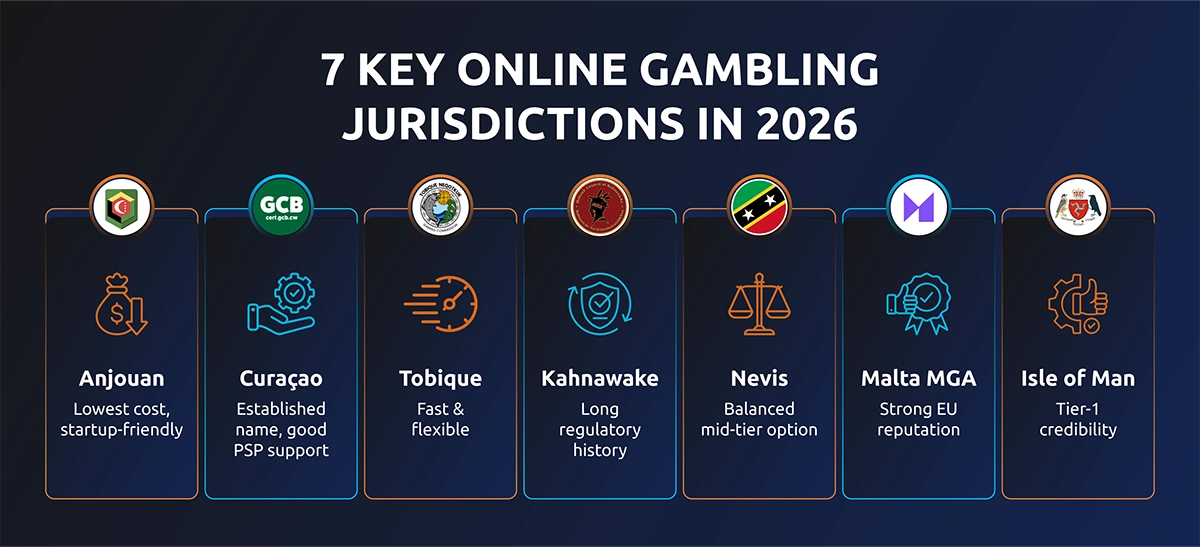
This guide compares Anjouan, GCB Curaçao, Tobique, Kahnawake, Nevis, Malta MGA, and Isle of Man for online casino founders, sportsbook operators, crypto casino teams, B2B providers, and iGaming startups that need to understand the full first-year cost before choosing a license.
What Is an Online Gambling License and Why Do You Need One?
An online gambling license is the approval that allows an operator to offer real-money gaming under a specific regulator, but in practice, it is also what banks, PSPs, game providers, affiliates, and players look at before deciding whether they can work with or trust the business.
Without the right license, an operator may struggle to open payment accounts, onboard suppliers, pass partner checks, advertise in target markets, or prove that player funds, complaints, fraud controls, and game fairness are being handled properly.
Legal Compliance and Player Protection
A license sets the standards for how an operator runs the business, covering AML/KYC procedures, age verification, responsible gambling measures, payment processing, complaint resolution, and player fund protection. Part of this is requiring operators to produce safeguards against fraud, support fair play, and often include independent game testing and RNG certification.
Together, these requirements create a level of accountability that players, banks, suppliers, and regulators can trust and verify.
Banking and Payment Provider Access
Payment access is often the real test of a gambling license because, beyond the license, banks and payment providers want to understand how the business operates, where players are coming from, how risk is managed, and whether the operator can meet ongoing compliance expectations before approving an account.
A local license, such as one issued for a specific regulated market, can make banking and payment onboarding easier within that jurisdiction, but it usually comes with higher costs and stricter regulatory obligations. Tier-1 licenses such as Malta MGA or Isle of Man are also viewed favorably by many financial institutions, although the stronger reputation typically comes with a heavier compliance burden and a larger operating budget.
For many startups, Tier-2 jurisdictions such as Anjouan, Curaçao, Tobique, or Kahnawake offer a more practical entry point because they allow operators to launch internationally without the cost and complexity of a Tier-1 framework. Even then, payment providers will still expect to see a credible compliance setup and clear controls around customer verification, transaction monitoring, and market restrictions before they are willing to support the business.
Global Market Expansion
An international gambling license can help operators reach suitable markets, but it does not give automatic access to every country. Each license has restricted territories, and each target market can have its own rules on advertising, payments, tax, player eligibility, and local licensing.
Types of Online Gambling Licenses
A startup may only need one fairly priced international license to launch, and Anjouan is often the first option operators look at because it is widely used, fast, and commercially practical. A larger operator may need a more complicated structure involving multiple companies for different jurisdictions, several licenses to support different parts of the operation, and a setup that matches the full business model rather than just the first website going live.
Crypto does not usually require a separate crypto gambling license. In most cases, it is still a general online gaming license that either supports crypto payments or does not. For a crypto online casino, the real question is whether the license can support strong game providers, reliable crypto processing, wallet screening, source-of-funds checks, transaction monitoring, and restricted-country controls.
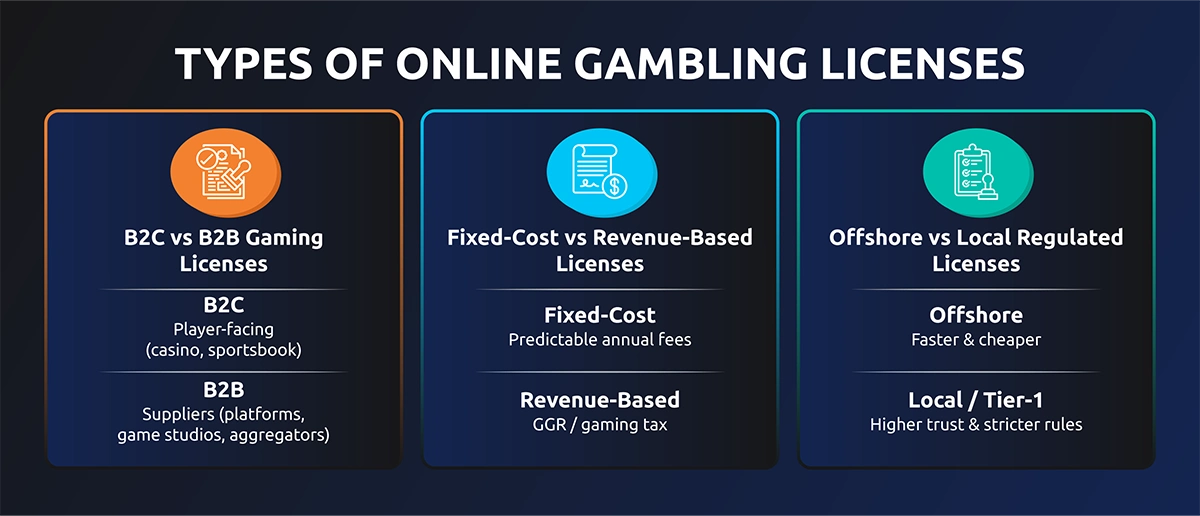
B2C vs B2B Gaming Licenses
A B2C gaming license is for companies that offer gambling directly to players. Online casinos, sportsbooks, poker rooms, bingo sites, lotteries, and crypto casinos usually need this type of authorization.
A B2B gaming license is for suppliers. This can include platform providers, game studios, sportsbook technology companies, live-dealer suppliers, payment infrastructure providers, and white-label operators.
In plain online casino licensing terms, B2C covers the player-facing business, while B2B covers the companies behind the product. Some jurisdictions separate the two clearly. Others offer broader license structures that can cover multiple activities.
Fixed-Cost vs Revenue-Based Licenses
Fixed-cost licenses are easier to forecast because the operator pays set fees, such as application fees, annual license fees, domain fees, supervision fees, or renewal charges. Revenue-based licenses add gaming tax, duty, or compliance contributions tied to GGR, which means gross gaming revenue.
For operators comparing how much a gaming license costs, the fee model matters because two licenses with similar application fees can create very different yearly costs.
Offshore vs Local Regulated Licenses
Offshore or international licenses and local regulated licenses serve different business strategies. International licenses such as Anjouan, Curaçao, Tobique, Kahnawake, and Nevis can help operators launch faster and work across suitable markets with a more flexible structure.
Local regulated licenses are usually required for specific countries or states. They can offer stronger local market access, but they often involve higher fees, stricter reporting, local company requirements, and heavier compliance.
What Is the Total Cost of an Online Gambling License?
The total online gambling license cost includes much more than the application fee. Operators should budget for regulator fees, company setup, legal work, compliance documents, platform testing, payment onboarding, banking, annual renewal, audits, tax, and reporting.
A lean international setup can stay relatively affordable when the ownership structure is clean, the platform is ready, the payment plan is realistic, and the compliance file is prepared before filing. Costs rise when the company needs local directors, MLRO support, technical testing, extra legal drafting, multiple payment routes, several domains, or a more complex structure across different jurisdictions.
Upfront Costs: Application, Setup, Legal
Upfront costs are the expenses needed to prepare and submit the license application. These usually include:
- Application or license issuance fees
- Company formation
- Registered office or local agent
- Legal drafting
- Business plan preparation
- AML/KYC manuals
- Responsible gambling policies
- Source-of-funds documents
- Platform and technical documentation
- Local director or compliance officer, where required
Curaçao is a good example of why operators should not judge a license by the government fee alone. The official fees may look manageable, but the first-year cost can increase once company formation, local representation, directorship, MLRO or compliance support, hosting, policy drafting, technical setup, and ongoing administration are included.
For that reason, operators should compare the full operating setup, not only the regulator fee. A license needs to support banking, payments, platform approval, game providers, and market entry.
Ongoing Costs: Annual Renewal, Audits, Compliance
Annual renewal, company maintenance, compliance updates, regulator reporting, audits, payment monitoring, KYC systems, technical checks, and regulator communication all create recurring costs, and these are often the expenses founders underestimate when comparing licenses based only on the application or filing fee.
Hidden Costs Operators Often Miss
Operators often budget for the license fee but overlook the practical costs that determine whether the business can actually launch. Hidden expenses frequently include:
- Payment provider integration
- Bank account opening
- Rejected applications and resubmissions
- Additional compliance documentation
- RNG or game certification
- Platform audits and penetration testing
- KYC/AML provider costs
- Crypto compliance tools
- Tax structuring
- Delays caused by incomplete ownership, source-of-funds, platform, or policy documents
Low-cost licences can quickly become expensive if the operator needs to rebuild the compliance file, update T&Cs, strengthen AML/KYC controls, switch payment providers, complete extra technical testing, or wait months after a rejected first submission. Beyond the government fee, the full cost of launching and operating must be considered.
Online Gambling License Cost Comparison: All 7 Jurisdiction
The table below compares the seven licensing routes by headline fee, estimated first-year cost, timeline, main advantages, limitations, and best-fit operator type.
| Jurisdiction | 2026 Setup / License Cost | Annual Renewal / Ongoing Fees / Tax | Timeline |
|---|---|---|---|
| Anjouan Gaming License | €18,000 license issuance |
|
Approx. 2–6 weeks |
| GCB Curaçao Gaming License | ANG 9,000 application fee, with due diligence and domain fees where applicable |
|
Approx. 3–6 months |
| Tobique Gaming License | €36,000 issuance; €42,000 total acquisition cost |
|
Approx. 4–8 weeks |
| Kahnawake Gaming License | US$40,000 Client Provider Authorization application fee |
|
Approx. 6–12 weeks |
| Nevis Gaming License | Full Nevis setup can run around €40,000–€50,000 according to License Gentlemen; detailed official public fee schedule was not located during review | Final renewal, tax, and ongoing fees should be confirmed before filing based on company structure, compliance support, and license scope | Approx. 8–9 weeks after setup/documents |
| Malta MGA Gaming License | MGA publishes a €5,000 application fee |
|
Approx. 6–12+ months |
| Isle of Man Gaming License | Exact setup cost depends on license type and structure | Final annual fees, local requirements, and tax treatment depend on license type, company structure, and operating model | Approx. 3–6+ months |
Choosing the right gaming license isn’t just about cost – it’s about finding the best fit for your business. The table below gives a quick overview of each jurisdiction’s key benefits, drawbacks, and the types of operators it’s best suited for.
| Jurisdiction | Benefits | Disadvantages | Best Fit |
|---|---|---|---|
| Anjouan Gaming License |
|
|
Startup, crypto-friendly casino, lean B2C, early B2B |
| GCB Curaçao Gaming License |
|
|
Scaling operators, B2C, B2B, PSP-focused businesses |
| Tobique Gaming License |
|
|
Startup, crypto-friendly casino, sportsbook, fast international route |
| Kahnawake Gaming License |
|
|
Casino, poker, sportsbook, experienced operators |
| Nevis Gaming License |
|
|
Scaling startup, B2C, B2B, white-label platform |
| Malta MGA Gaming License |
|
|
Established, EU-facing, B2B, investor-backed operators |
| Isle of Man Gaming License |
|
|
Established, B2B platform, blockchain gaming, global brand |
*Final pricing can change depending on company setup, payment structure, license scope, and local requirements. License Gentlemen has helped secure over 500 gambling licenses and can provide a free consultation before operators choose a jurisdiction.
Anjouan, Curaçao, Tobique, and Kahnawake are often practical starting points because they allow operators to launch, connect with suitable partners, process payments, and generate revenue without incurring Tier-1 costs and bureaucracy too early.
Malta (MGA) and the Isle of Man are stronger institutional licenses, but they only make sense when the operator has the budget, team, documentation, banking needs, and commercial reason to maintain that level of regulation.
Crypto casinos, sportsbooks, B2B platforms, and larger multi-market operators may all need different structures, so the right choice is not always the cheapest license or the most prestigious one, but the license that fits the payment plan, suppliers, target markets, and long-term setup.
Anjouan Gaming License
Anjouan is one of the most used international gaming licenses because it is fast, fairly priced, and practical for operators that want to launch without building a heavy Tier-1 structure from day one.
The official fee schedule lists €17,828 for license issuance and €17,828 for annual renewal, with €500 for each additional domain or URL, which makes the cost easier to plan compared with licenses that add GGR-based fees or more complex local requirements.
Best fit: startup, crypto-friendly casino, lean B2C operator, early B2B supplier.
Not Sure Which Markets You Can Enter with an Anjouan License?
Download the free geo-restriction guide — blocked zones, red zones, and grey zones all in one place.
GCB Curaçao Gaming License
Curaçao is still one of the best-known names in online gambling licensing, but the new GCB direct licensing model is more formal than the old sublicensing setup, so operators need to treat it as a proper regulated structure rather than a cheap shortcut.
The public fee schedule includes application, annual, monthly, due diligence, and domain fees, but the real first-year cost can rise once company setup, local representation, directorship, MLRO or compliance support, hosting, technical infrastructure, policy drafting, and ongoing administration are added.
Best fit: B2C operator, B2B supplier, scaling startup, operator seeking PSP familiarity.
Tobique Gaming License
Tobique is usually considered when speed matters and the operator needs a flexible international license for an online casino, sportsbook, or crypto-friendly model.
Public schedules list €36,000 for license issuance, a €7,000 annual compliance fee, €42,000 total acquisition cost, and €25,000 annual renewal, so it is not the cheapest route, but it can still be a practical option when the launch plan, payment setup, and compliance file are already clear.
Because Tobique is newer than Kahnawake, Malta, Isle of Man, and Curaçao, banking and PSP acceptance should be checked before filing rather than after approval.
Best fit: startup, crypto-friendly casino, sportsbook startup, operator seeking a fast international route.
Kahnawake Gaming License
Kahnawake has been around much longer than many newer international licensing routes, which is why some operators still prefer it when they want a name with more regulatory history behind it.
The Kahnawàke Gaming Commission fee schedule lists US$40,000 for a Client Provider Authorization application, US$20,000 as the annual fee, and US$5,000 for the renewal application every five years.
Best fit: casino operator, poker operator, sportsbook operator, experienced team seeking a recognized international license.
Nevis Gaming License
Nevis sits between the very lean international licenses and the heavier Tier-1 options, so it can make sense for operators that want more structure than a basic launch route without taking on Malta or Isle of Man-level cost and administration.
A full setup can be around €40,000–€50,000, including the license, company registration, compliance officer, and go-live essentials, although final pricing should be confirmed before filing because a detailed official public fee schedule was not located during review.
Best fit: scaling startup, B2C operator, B2B provider, white-label platform, operator balancing cost and structure.
Malta MGA Gaming License
Malta MGA is a Tier-1 license, so operators usually look at it when they need stronger recognition with banks, PSPs, suppliers, investors, or EU-facing partners, not when they simply want the fastest or cheapest way to launch.
MGA publishes a €5,000 application fee, a €25,000 fixed annual B2C license fee, 5% gaming tax, and compliance contribution requirements, but the full cost is much higher once legal work, company setup, audits, compliance staff, technical checks, reporting, and ongoing management are included.
Best fit: established brand, EU-facing operator, B2B provider, investor-backed iGaming company.
Isle of Man Gaming License
Isle of Man is a Tier-1 option for established operators, B2B platforms, and companies that need a high-trust jurisdiction. It suits teams with mature governance, stronger budgets, and a clear compliance structure before filing.
The value of Isle of Man is reputation, banking confidence, and partner trust. The challenge is the level of documentation, local expectations, ongoing compliance, and management time required to keep the structure working.
Isle of Man can be valuable when regulatory reputation matters more than speed. It is usually not the default starting point for operators that need the fastest route to market.
Best fit: established operator, B2B platform, blockchain gaming supplier, global brand, operator seeking stronger banking trust.
Cheapest Online Gambling License: Best Options for Startups
The cheapest online gambling license among the seven is usually Anjouan, based on its official fee schedule of €17,828 for issuance and €17,828 for annual renewal. A better way to frame this for founders is how to start an online casino on a budget, rather than treating the license as lower quality.
Anjouan and Tobique can be strong choices when the operator has a lean launch plan, suitable payment partners, clear T&Cs, proper KYC, restricted-country controls, and a realistic compliance roadmap. These licenses are widely used because they help businesses start faster without taking on the cost and bureaucracy of Tier-1 licensing too early.
Problems usually appear when the license is chosen without checking banking, PSP acceptance, game providers, fraud controls, and target markets. A team may launch for €40k and later spend far more fixing payment routes, compliance files, or corporate structure.
Tobique can work for startups with a slightly higher budget. Kahnawake may suit operators with more capital and a need for a longer regulatory history.
Some founders compare License Gentlemen with fast offshore packages based only on the headline fee. A better comparison looks at whether the provider can help build the right corporate structure, licensing route, payment plan, and compliance file.
Most Trusted Online Gambling Licenses: Tier-1 vs Tier-2
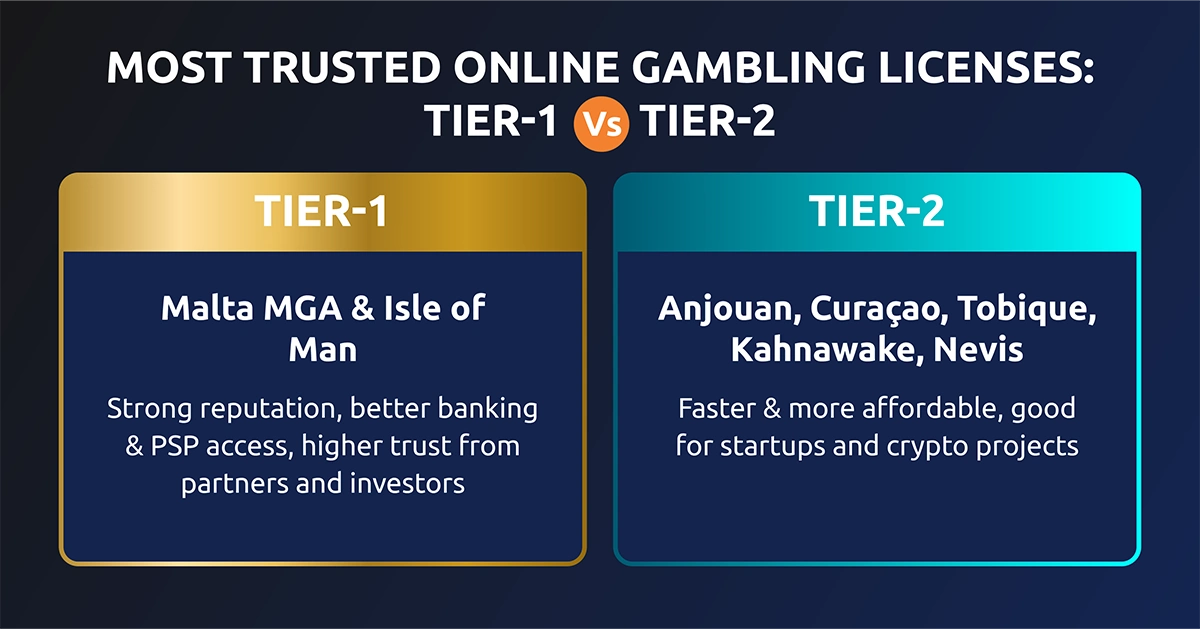
Tier-1 licenses such as Malta MGA and Isle of Man are valuable when the business needs stronger banking, Tier-1 PSP access, investor confidence, and long-term scalability. They carry stronger regulatory reputation, but they are difficult to obtain, expensive to maintain, and more demanding from a compliance perspective.
Tier-2 international licenses such as Anjouan, Curaçao, Tobique, and Kahnawake are often the practical choice for startups, crypto-friendly casinos, sportsbooks, and scaling operators. They are popular because they allow operators to launch, test markets, process payments through suitable partners, and build revenue before moving into more complex structures.
License Gentlemen helps operators choose the route that matches the real business model, rather than pushing the most expensive license by default.
How to Choose the Right Gambling License for Your Business
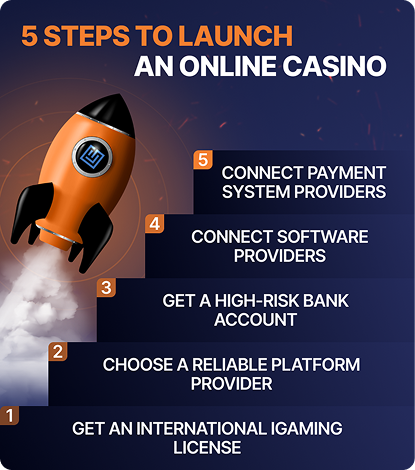
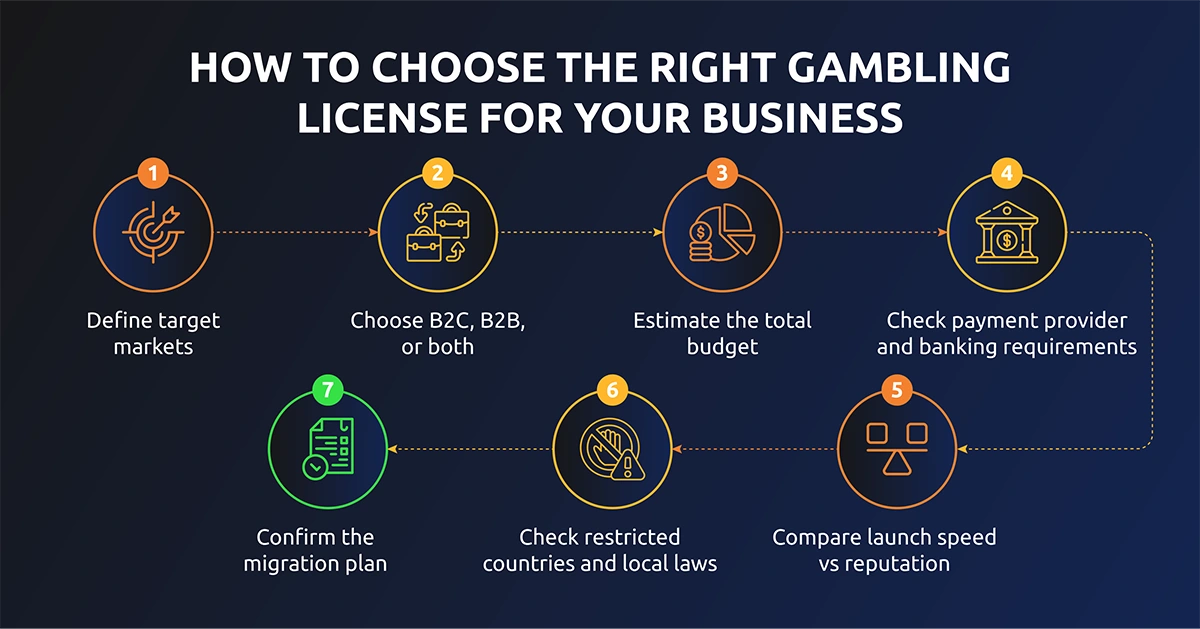
A clear step-by-step plan should begin with the business model and target markets, then move into cost, payments, compliance, and filing. Operators researching how to get online gambling licence step by step should narrow the jurisdiction before paying application fees or preparing the full license file.
- Define target markets: Identify where players will come from and remove markets that require local approval or have major restrictions. A license should be checked against the real traffic plan, not only the countries the operator wants to advertise in.
- Confirm the business model: Decide whether the business is B2C, B2B, white-label, crypto-focused, or a mixed model, as this affects the license scope, company setup, compliance file, and payment route.
- Set the full budget: Calculate the total yearly cost, including licensing, company setup, compliance, technical testing, payment onboarding, KYC/AML tools, advisory work, and ongoing operational expenses.
- Check banking, PSP, crypto processor, and game provider fit: Confirm that banks, payment providers, crypto processors, and suppliers support the chosen license before filing. A cheap license can become expensive if the operator cannot open accounts, process payments, onboard suppliers, or support the planned crypto or fiat model.
- Decide whether speed or reputation matters more: Choose between a faster launch route or a jurisdiction with stronger reputation and long-term credibility. Anjouan, Tobique, Curaçao, and Kahnawake can work well for faster international setups, while Malta MGA and Isle of Man usually make more sense when reputation, banking confidence, and institutional trust matter more than speed.
- Remove restricted countries: Review restricted territories before accepting players, payments, affiliates, or registrations. The United States should be treated as a restricted high-risk market for international licensing because online gambling is regulated state by state, and international licenses normally restrict or exclude US traffic. Spain, France, the UK, Ontario, and other highly regulated markets should also be reviewed carefully.
- Speak to licensing specialists before filing: Before committing to a jurisdiction, operators should check whether the license, company structure, payment route, compliance file, and target markets work together.
Before filing, it is also worth reviewing the practical details that often create delays after approval. This includes Terms and Conditions, bonus policies, AML/KYC procedures, age-verification and responsible-gambling measures, dispute-resolution processes, source-of-funds requirements, and any revenue-based taxes or local licensing obligations that may affect the business model. Operators should also confirm technical requirements such as RNG certification, platform testing, penetration testing, payment onboarding, MLRO support, local director requirements, and server infrastructure.
Addressing these points early can help avoid payment freezes, PSP rejection, supplier termination, ad account blocks, player disputes, regulatory issues, and unnecessary launch delays.
With over 500 licenses secured across key jurisdictions, License Gentlemen can help founders understand which corporate structure and license route best fit the business. Operators can reach out for a free consultation before committing to a jurisdiction.
Frequently Asked Questions
An online gambling license can start from around €17,828 in Anjouan, while Tier-1 routes can require much larger yearly budgets once company setup, compliance, payment onboarding, technical checks, and advisors are included. The useful number is the full launch budget, not only the government fee.