

How to Choose a Game Aggregator for Your Online Casino Business
Choosing the right casino game aggregator for your online casino might be one of the most important decisions you make before launch. On the face of it, picking an aggregator is simple and takes pressure off the core team. Simply integrate the APIs, and your online casino suddenly has the same depth of games as the biggest names in iGaming.
However, the reality is more complex. A casino game aggregator integration requires a huge amount of consideration because once the excitement of having the games live on your casino wears off, the complexity of the process becomes more apparent and starts showing up on your bottom line.
This article will help you choose the best game aggregator for your online casino in 2026 by getting into the details of how individual aggregators work. It will cover the top aggregators, their integration timelines, costs, technical structure, and regional limitations. And then explain how the leading online casinos move beyond purely aggregator models to a hybrid system that works directly with providers
What is a Game Aggregator (and How It Differs from a Platform)
Aggregator vs. Direct Provider vs. Platform
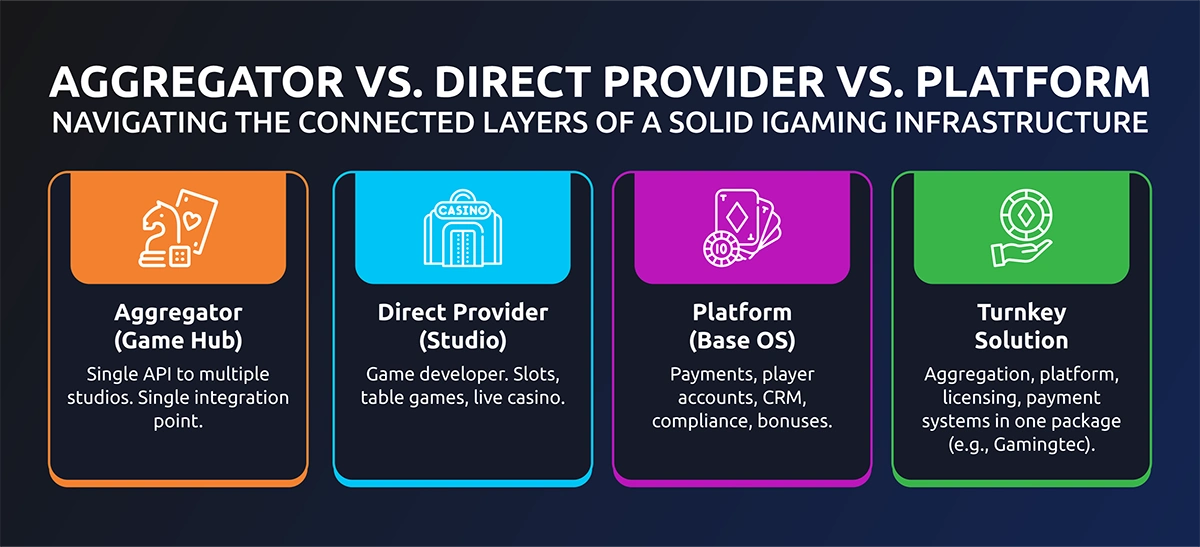
An aggregator is a company that connects multiple game providers into a single integration layer. Instead of connecting your casino to dozens of separate studios one by one, the aggregator gives you access through a single API. A direct provider is the actual game studio creating the slots, table games, or live casino content. A platform is the wider operating system behind the casino itself, covering areas like payments, player accounts, bonuses, CRM tools, and compliance.
Operators often confuse these layers because they overlap considerably. Many companies now offer a mix of aggregation, platform infrastructure, and even white-label services under one brand. For this reason, it is critical to clearly distinguish between the three before signing any agreement or starting development work.
The overlap is easiest to understand with turnkey providers like Gamingtec. A company like this may offer the casino platform, the game aggregator, payment systems, bonus tools, and even licensing support together as part of one wider package. But that doesn’t mean they are the same thing.
The Three-Player Chain: Provider → Aggregator → Operator
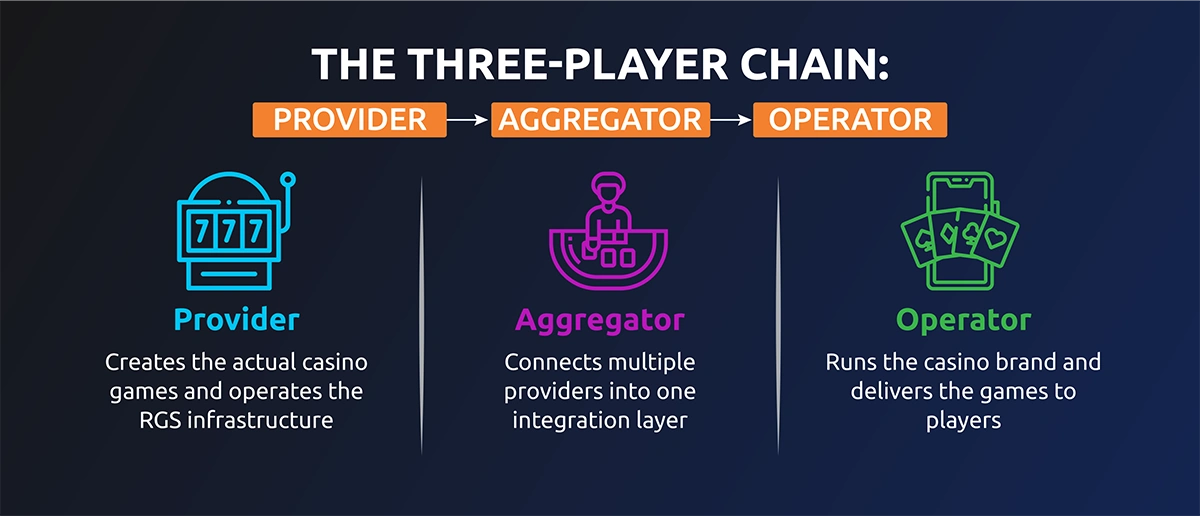
| Layer | Role | Example |
| Provider | Creates the actual casino games and operates the RGS infrastructure | Pragmatic Play, Evolution |
| Aggregator | Connects multiple providers into one integration layer | SOFTSWISS, Slotegrator |
| Operator | Runs the casino brand and delivers the games to players | Online casino / sportsbook brand |
In summary, the provider builds the games, the aggregator distributes them, and the operator brings them to the player. This structure allows casinos to scale much faster, since operators no longer need to negotiate and integrate every studio individually.
Once all three layers of the structure are live, the next major consideration is how funds move between the provider, aggregator, and casino platform. This is where wallet architecture comes into play.
Seamless Wallet vs. Transfer Wallet
There are two main types of wallet infrastructure used in casino aggregation today: seamless wallet and transfer wallet. A seamless wallet keeps the player’s balance connected directly to the casino platform, even when the user moves between different game providers. A transfer wallet works differently. Funds are temporarily moved between the casino wallet and the provider wallet each time a game session starts.
This matters much more in 2026 because players expect fast transitions with no interruptions between games. A poorly configured transfer wallet can create loading delays, balance sync issues, or failed bonus tracking. Much of this process is handled through the provider’s RGS (Remote Game Server), which controls how the games communicate with the aggregator and casino platform in real time.
For most online casino operators in 2026, a seamless wallet setup is the preferred option. If a player opens five different games in one session, they expect balances, bonuses, and session history to update instantly without repeated loading screens or wallet transfers happening in the background.
Why Operators Use Aggregators (The Real Economics)
Cost of Direct Integration ($2K × 30 providers = $60K)
Arguably, the primary reason operators use aggregators is cost.Direct integrations quickly become expensive once multiple providers are involved. Costs often include:
- Technical integration and API development
- Certification and compliance approvals
- Dedicated server infrastructure
- Ongoing maintenance and version updates
- Commercial agreements with individual providers
- Testing, QA, and bonus system configuration
Even if a single provider integration costs only $2,000, integrating 30 providers separately can quickly push total costs beyond $60,000 before launch.
Time-to-Market: 1 Year Direct vs. Days via Aggregator
You could launch an online casino in 2026 using only direct provider integrations, but your time-to-market plans will be seriously delayed. The power of using an aggregator is not only about finances, but it is also about speed. A strong aggregation setup can reduce deployment timelines from potentially a year to weeks or even days.
This is largely possible because aggregators already have pre-certified integrations in place. Instead of building and testing every provider connection from scratch, operators connect to infrastructure that is already live and operational. Companies like Slotegrator heavily market this advantage through products like APIgrator, where much of the technical and compliance work has already been completed before the operator even enters the process.
KYC Simplified – One Compliance Package Instead of 30
Know Your Customer (KYC) is always a slightly frustrating aspect of launching any casino venture. So anything a team can do to reduce the burden KYC places on internal resources is generally a massive advantage. One of the biggest benefits of using an aggregator is that it streamlines the process through compliance compression.
Instead of completing separate onboarding and compliance checks with dozens of individual game providers, operators usually go through a single KYC and compliance process with the aggregator itself. In practice, this can save a huge amount of time. Rather than repeatedly submitting corporate documents, shareholder information, source of funds checks, and compliance policies to every studio individually, much of the process is centralized through one relationship.
Always-Fresh Content
In 2026, online casinos that regularly bring new games into their roster avoid the danger of losing player interest. With so much competition in the market, players will quickly abandon a platform if their attention is not captured by new games with different payouts, multipliers, mechanics, and animations.
Aggregators do a lot of the heavy lifting in this area because they act like content curators. Top aggregators reject poor providers, in some cases turning away up to 80% of applicants. They also carry out RNG quality control and monitor operational reliability before adding games to the network. This removes a huge amount of pressure from the casino team and improves the platform’s ability to retain players over the long term.
The Downsides Operators Discover Too Late
The advantages of aggregations are numerous. But, it’s not all upside. There are some downsides to using an aggregator; however, most of these can be mitigated by understanding how aggregators work and which ones are suited to your online casino.
Latency: When Servers Are in the Wrong Region
One of the main possible downsides of an aggregator is regional latency. This can be especially damaging for live casinos that require a very strong ping between the player and the server. The impact becomes very obvious in crash games, where almost instant communication is needed between the player pressing the “Cash Out” button and the server processing the information.
For this reason, operators should always consider where an aggregator’s servers are located and where their online casino user base is likely to be concentrated. A setup that works perfectly in Europe may perform very differently in regions like Latin America, Africa, or Southeast Asia if the infrastructure is poorly distributed.
Revenue Share Markup (5-15% on top of provider rates)
Nothing in the online casino industry is free. Everyone wants their cut, and aggregators are no different. Provider rates can often come with unforeseen additional markups of 5–15% layered on top of the original commercial terms. Over time, this can have a noticeable impact on a casino’s margins, especially once player volume starts scaling.
Again, this is a potential disadvantage, but teams that conduct thorough research and sign airtight contracts can usually avoid major surprises. The key is to understand exactly how the revenue-sharing structure works before the integration goes live.
Lost Direct-Provider Incentives
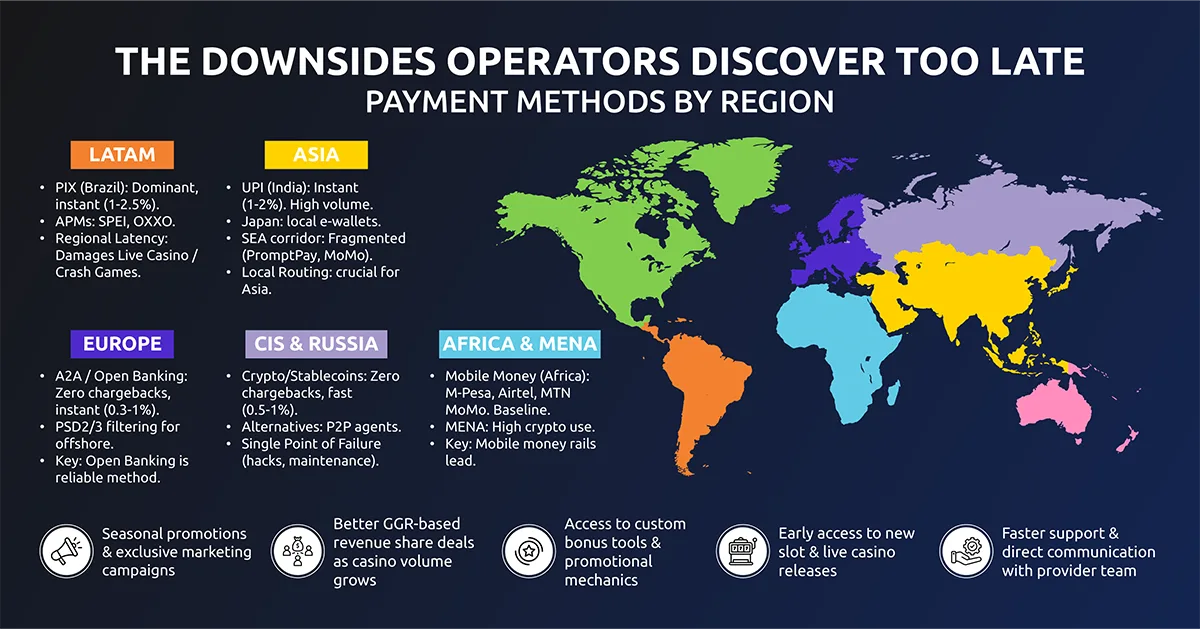
There are some downsides to not working directly with the game providers themselves. When an aggregator sits between the casino and the studio, operators can miss out on incentives that are often reserved for direct integration partners. These can include:
- Seasonal promotions and exclusive marketing campaigns
- Better GGR-based revenue share deals as casino volume grows
- Access to custom bonus tools and promotional mechanics
- Early access to new slot and live casino releases
- Faster support and direct communication with the provider team
For smaller operators, these losses may not matter early on. But as an online casino scales, missing direct-provider incentives can start affecting both profitability and long-term player retention.
Bonus System Lag — When Free Spins Don’t Sync
Lag in a bonus system can be very frustrating for online casino users. There’s nothing more frustrating than completing all the necessary steps to claim a welcome bonus or rakeback only to have it vanish. This can occur when using an aggregator due to cross-provider bonus engine issues and possible wallet synchronization delays.
The best way to manage it is to look at the reviews of aggregators and test them out before integrating them into your casino.
Limited Data Access for Risk Management
Partnering with an aggregator means forfeiting some data access, meaning that your risk management capacity is, to some extent, hindered. Depending on the setup, operators may not receive full player-level data or detailed game information directly from the provider. Some aggregators also limit RTP analysis visibility and deeper reporting access.
Over time, this can create blind spots around player behavior, bonus abuse, and suspicious activity. The end result is weaker fraud detection visibility, which becomes a much bigger issue as a casino scales and transaction volumes increase.
Single Point of Failure (Maintenance, Hacks)
The threat of a single point of failure, hack, or technical glitch does increase with the use of aggregators. The issue is that a single outage within the gaming portfolio may spread across the entire network, which in some instances might include a large portion of the casino’s entire offering. This operational dependency risk is difficult to avoid entirely, but by working with reliable aggregators, the chances of it happening can be reduced significantly.
Not All Providers Sign with Aggregators (Playtech case)
Not all providers work with aggregators. These are generally premium providers who are not interested in their games being operated as part of large bundles. As a result, a casino that opts to use aggregators may not have access to these games.
One of the best examples is Playtech. Playtech has historically been far more selective about distribution and often prefers direct commercial relationships with operators or tightly controlled infrastructure partnerships. This type of exclusivity structure allows premium providers to maintain tighter control over branding, compliance standards, revenue share agreements, and where their games ultimately appear.
Platform Lock-In: When Your Platform Forces Their Aggregator
Some casino platforms force operators into using their own built-in aggregator rather than allowing free choice. On the surface, this seems convenient because everything is bundled together under one system. However, over time, this can create platform lock-in, where changing the aggregator later becomes technically difficult and commercially expensive.
This issue is common in turnkey ecosystems where the platform, aggregator, bonus engine, and payment systems are deeply connected. If an operator later wants better provider access, lower fees, or stronger reporting tools elsewhere, migrating away from the original setup can become a major operational challenge.
Choosing a casino platform? Check if it’s licensed for your target market.
The wrong choice can delay your launch or create compliance problems in regulated markets.
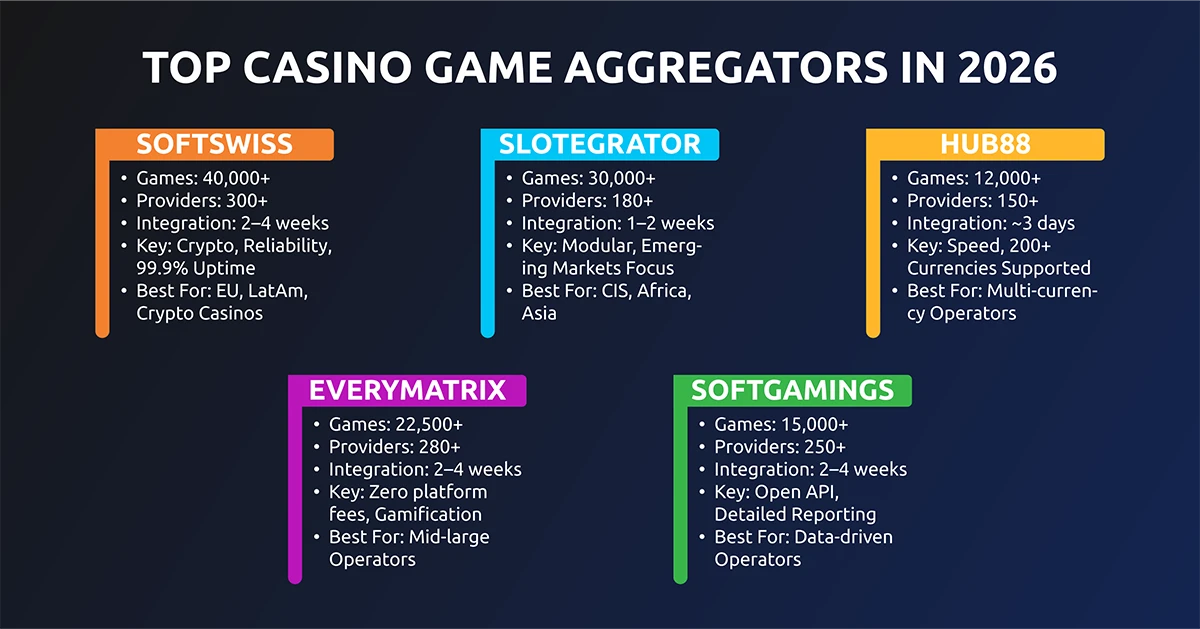
Top Casino Game Aggregators in 2026
SOFTSWISS Game Aggregator
SOFTSWISS is one of the leading casino game aggregators in 2026. The platform offers access to more than 40,000 games from over 300 providers through a single integration layer, with most deployments taking around 2–4 weeks, depending on the casino setup.
Its biggest strengths are reliability, strong crypto infrastructure, and reported uptime levels of 99.9%. SOFTSWISS is particularly popular among casinos targeting the EU and Latin American markets, where multi-currency support, stable wallet architecture, and fast onboarding have become increasingly important.
SOFTSWISS generally has positive reviews on third-party sites with a 4.1/5 on TrustPilot.
Slotegrator APIgrator
While Slotegrator is not as well-known as SOFTSWISS, it is still a solid candidate among the leading aggregators. It is especially popular because of its fast integration speeds, with deployments often completed within 1–2 weeks. The platform offers access to more than 30,000 games from over 180 providers and has built a strong presence in CIS markets, Africa, and Asia.
Its modular structure is one of its biggest strengths. However, its Trustpilot reviews leave plenty to be desired, with an overall score of just 2.8/5, although this is based on only a small number of reviews. Meanwhile, iGaming Directory gave the platform a strong 8.8/10 review score, deducting points mainly for higher revenue sharing compared to some competitors.
EveryMatrix CasinoEngine
The EveryMatrix CasinoEngine provides an all-in-one gaming system for online casinos. The official website provides plenty of details on the benefits this aggregator offers, including scalable API architecture and 24/7 gaming support.
The platform also promotes a continuously growing gaming portfolio alongside a turnkey structure capable of supporting full-stack platform growth. This makes it particularly attractive to operators planning to scale beyond a small startup casino into a larger long-term operation.
The official EveryMatrix blog also shows regular platform updates for customers. One recent post explained how licensing approval for Canada had been granted to the project, showing continued expansion into regulated markets. However, there are limited reviews available on third-party websites like Trustpilot, making independent user feedback harder to assess compared to some competitors.
Hub88
Hub88 offers a single API integration for all online casino needs. The team claims that they provide some of the most reliable latency in the market with minimal downtime, alongside access to more than 12,000 games from over 100 providers.
The product is designed to be startup-friendly, with an extremely compatible API process that can be customized and adapted rapidly depending on the needs of the casino. This flexibility has helped Hub88 become increasingly popular among operators targeting fast deployment timelines.
Again, independent reviews are slightly harder to find compared to larger competitors. However, platforms like GoodFirms have given Hub88 solid feedback, while Gambling Insider has also responded positively to the company’s infrastructure and aggregation model.
SoftGamings Slots Bundle
SoftGamings Slots Bundle is a very strong option in the aggregator market. The company has been around for well over 15 years and has carved out a solid share of the market. Its API is linked to more than 60 leading providers and can be integrated relatively quickly compared to many competitors.
The SoftGamings website states that the company focuses heavily on speed during the onboarding process, and this has also been backed up by several reviews on Trustpilot. Fast setup times and responsive technical support are regularly mentioned as positive aspects of the service.
Overall, SoftGamings is a solid choice of aggregator for a 2026 online casino launch.
| Aggregator | Games | Providers | Integration Time | Strength | Best For |
| SOFTSWISS | 40,000+ | 300+ | 2–4 weeks | Crypto, reliability, 99.9% uptime | EU, LatAm, crypto casinos |
| Slotegrator | 30,000+ | 180+ | 1–2 weeks | Modular, emerging markets focus | CIS, Africa, Asia |
| Hub88 | 12,000+ | 150+ | ~3 days | Speed, 200+ currencies supported | Multi-currency operators |
| EveryMatrix | 22,500+ | 280+ | 2–4 weeks | Zero platform fees, gamification | Mid-large operators |
| SoftGamings | 15,000+ | 250+ | 2–4 weeks | Open API, detailed reporting | Data-driven operators |
Pricing: Revenue Share, Setup Fees, and Hidden Costs
Revenue Share Models (full-service vs technical-only)
The difference between a full-service and a technical-only revenue share model is the level of infrastructure and operational support included in the agreement. A full-service setup usually includes the aggregator, casino platform, payment systems, bonus engine, support tools, and sometimes even licensing assistance as part of one wider package.
A technical-only model is much narrower. The aggregator simply provides the API connection layer and game access, while the operator manages most other parts of the casino independently.
Setup Fees and Monthly Minimums
Setup fees and monthly minimums vary not just across different aggregators but also across contracts, as teams will often negotiate different terms depending on the size of the agreement. Larger operators with stronger projected volume can usually secure more favorable pricing structures than smaller startups entering the market for the first time.
The best approach is to reach out directly to the aggregators that appear best suited to your casino startup and enquire about their specific pricing structure. All providers mentioned in this article offer contact or consultation options directly through their websites.
GGR-Tiered Pricing and Negotiation Leverage
GGR-tiered pricing is a model where the revenue share percentage changes depending on how much Gross Gaming Revenue (GGR) the casino generates. In simple terms, the more revenue an operator produces, the stronger their negotiating position becomes. This is especially important when planning to scale a casino, since larger operators can often negotiate lower fees, better commercial terms, and additional provider incentives over time.
Hidden Costs: Currency Conversion, Premium Content, Live Casino Surcharge
Hidden costs can really hurt your casino’s bottom line. A game aggregator revenue share can often seem cheap at first, but then costs from currency conversions and live casino surcharges start adding up. Make sure you clearly check the following costs before signing anything:
- Currency conversion fees
- Live casino surcharges
- Premium provider fees
- Monthly maintenance costs
- Minimum GGR clauses
- API support charges
- Bonus engine fees
- Additional wallet integration costs
- Regional compliance charges
- Data reporting add-ons
Selection Checklist: What to Evaluate Before Signing
There are a few aspects of any aggregator deal to carefully check before signing. Remember, all these aggregators want to work with you, so use your position to get the strongest deal before committing.
Portfolio Coverage
The first thing on your checklist should be the portfolio coverage offered by the aggregator. A large game library means very little if it does not include the providers most relevant to your target market. Always check for major names alongside region-specific studios that perform well with your expected player base.
Backend Quality
Backend quality matters far more than many operators initially expect. Look closely at the tagging system, lobby builder, filtering tools, and reporting dashboard because these directly affect how efficiently the casino can manage and display content.
Server Location and Latency by Region
Server location is especially important for live casino products and crash games. If the infrastructure is too far from your target region, latency issues can quickly damage the player experience.
Cross-Provider Bonus Engine
A strong cross-provider bonus engine allows promotions and free spins to work smoothly across multiple studios.
Real-Time Data and RTP Monitoring
Operators should always check what level of real-time analytics the aggregator provides. Strong RTP monitoring and player-level reporting improve both fraud detection and long-term risk management visibility.
Regulatory Certifications
Always verify the regulatory certifications held by the aggregator and its providers. For casinos launching under structures like an Anjouan license, it is still important to check areas like RNG certification, ISO 27001 security standards, and approvals tied to regulators such as the Malta Gaming Authority and the UK Gambling Commission, especially if expansion into regulated markets is planned later.
24/7 Multilingual Support and Time-Zone Coverage
Online casinos operate globally, so 24/7 support and proper time-zone coverage are extremely important. Fast multilingual support can prevent small technical problems from turning into major operational issues.
Contract Terms: Exclusivity, Termination, Data Portability
Always check exclusivity clauses, termination terms, and data portability before signing. Operators should clearly understand whether player and reporting data can be transferred if they later switch aggregators.
Hybrid Strategy: Direct Top-5 + Aggregator for the Long Tail
Why Hybrid Beats Pure-Aggregator at Scale
A hybrid approach is usually better than a pure aggregator approach when operating at scale. Large casinos often directly integrate their highest-performing providers to secure better commercial terms, lower latency, and stronger data access, while still using aggregators for the long tail of smaller studios.
Which Providers to Go Direct With
There are a handful of providers that can be a good direct integration option. They include the following:
- Pragmatic Play: slots, live casino, strong global reach
- Evolution: premium live casino infrastructure
- NetEnt: established slot portfolio
- Play’n GO: high-retention slot titles
- Playtech: premium enterprise content
When to Migrate: GGR Thresholds and Platform Requirements
A moment might come when migration is required. This could occur once a casino reaches stronger GGR levels and needs better commercial terms, lower latency, or more direct provider access. The process will usually involve moving wallet infrastructure, bonus systems, player data, and provider integrations onto a more scalable setup.
Technical Aggregator as a Gateway (1–3% flat fee model)
A technical aggregator is often the best gateway toward a more scalable hybrid casino structure. Instead of running a full-service setup, the operator uses a technical-only aggregation layer focused purely on API connectivity and game distribution, often through a flat 1–3% fee model. This gives larger casinos more operational control while still simplifying provider integrations.
Should Startups Use an Aggregator? Yes — Here's the Roadmap
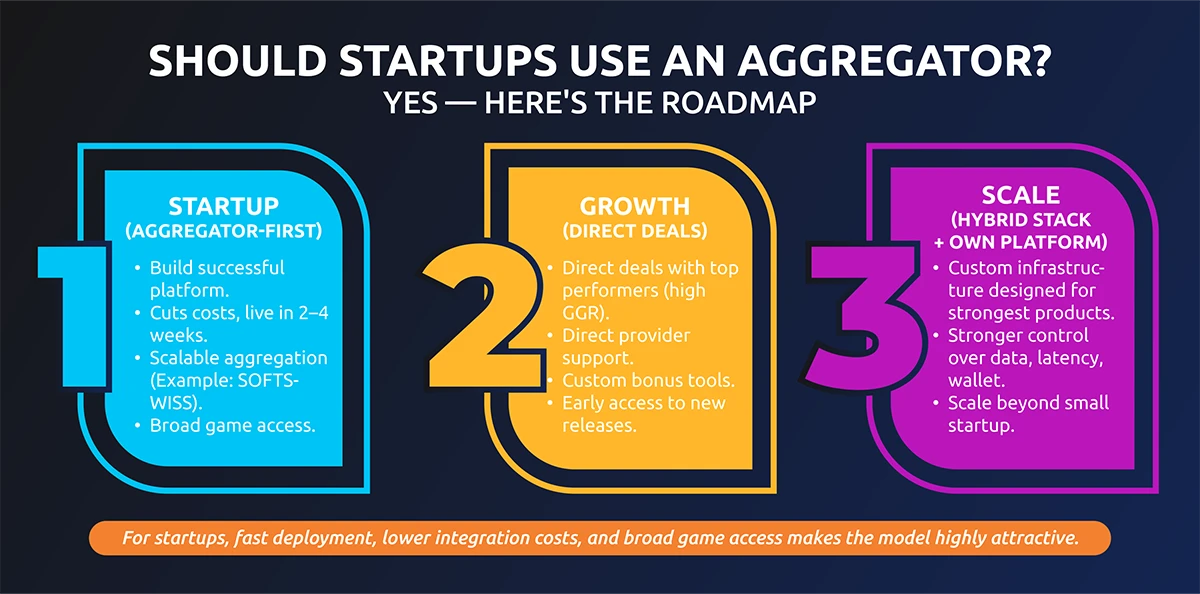
An online casino startup should almost always use an aggregator. It makes sense both financially and technically.
Startup Stage: Aggregator-First
A casino startup aggregator opens the door to building a successful platform. It cuts costs and reduces the amount of time a team needs to invest to get live and start building a revenue stream.
This is one reason why major brands like 1xBet, Mostbet, and Parimatch initially benefited from scalable aggregation infrastructure. For startups, the combination of fast deployment, lower integration costs, and broad game access makes the model highly attractive.
Growth Stage: Direct Deals with Top Performers
Once your casino startup has started building revenue using the aggregator integration, you can start planning direct deals with the top performers. These are usually the games and providers generating the highest GGR and strongest player retention on the platform.
Direct agreements can improve margins, reduce latency, unlock better promotional support, and give the casino stronger long-term control over its highest-performing content.
Scale Stage: Hybrid Stack + Own Platform Considerations
Once the hybrid model has been running for a while and revenue is clearly growing, it may be time to push further toward direct deals in order to accommodate specific platform considerations. At this stage, larger casinos often want more control over latency, data access, wallet systems, and commercial agreements.
This process usually involves reducing reliance on full-service aggregation and building a more customized infrastructure stack designed around the casino’s strongest-performing products and target markets.
Final Thoughts on How to Choose a Game Aggregator for Your Online Casino
The online casino market is predicted to exceed $140 billion in revenue, according to Business Research Insights. The market is growing at breakneck speed. Startups looking to secure a share of this market need to be able to launch quickly with minimal overhead costs, and one of the best ways to approach this is through one of the aggregators reviewed in this article. These aggregators allow teams to deploy hundreds or even thousands of games onto their platforms in a matter of weeks, if not days.
However, the work does not stop there. Really successful casino startups will eventually build long-term hybrid models, moving toward direct contracts with providers in order to create the best possible online casino experience for users in 2026. This gives operators stronger control over margins, latency, bonus systems, and player retention strategies.
Before signing with any aggregator, operators should spend time properly browsing the market and requesting personalized quotes. Areas like data ownership, wallet integration, compliance requirements, and future migration paths should all be evaluated carefully before entering agreements.
License Gentlemen can help operators navigate the market and secure a globally recognized gambling license within weeks rather than months, allowing teams to start integrating with aggregators quickly in 2026.
FAQs
A casino game aggregator connects multiple game providers into one integration layer. Instead of integrating dozens of studios individually, the operator connects through a single API and gains access to thousands of games at once.