

Agent Systems for Online Casinos in 2026: Complete Operator’s Guide
Affiliate links don’t work in a country where half your target players don’t have a bank card. That’s the reality driving casino agent systems in 2026. A network of local recruiters who deposit cash, extend credit, and pay out winnings by hand in markets where digital payment rails simply don’t reach. If you’re building for Africa, Southeast Asia, LATAM, or the CIS, the agent system isn’t a nice to have channel. It’s often the only acquisition engine that actually works.
This guide explains what a casino agent system really is, how the commission math operates, where the fraud risk is, and what the licensing exposure looks like, so you can develop one that scales rather than one that blows up on you six months in.
What an Agent System Actually Is (and Why It's Not the Same as Affiliate Marketing)
A casino agent system is a network of local recruiters that manage players from end-to-end (deposits, credit lines, cashouts, and support) instead of just driving clicks to a signup page. And that’s the whole point of the difference between an agent and an affiliate. It’s a bigger difference than most operators realize when they compare both on a spreadsheet.
An affiliate is paid for the traffic they bring. The affiliate’s job is over the second the player hits your site. Your platform takes care of everything else. This includes deposits, KYC, payout and support tickets. An agent does the reverse. The agent is the domestic payment rail. They will take cash from a player in person or via a mobile money app and manually credit the player’s account. Then when that player wins, the agent pays them from their own float before even going into your platform’s withdrawal system. Affiliates work in digital trust. In markets where digital trust has not yet been established, agents rely on personal trust.
This also answers a question that trips up a lot of newer operators. Agent software is not the same thing as a social casino acquisition tool. Social and sweepstakes casino platforms deliberately avoid direct cash purchase. Players buy a virtual currency with no cash value, then get a second currency as a bonus that can be redeemed for real money, structured that way specifically to sidestep the legal definition of gambling in many jurisdictions. There’s no real cashout tied to a real wager, so there’s no role for someone to physically handle a player’s money. Agent systems exist specifically for real money iGaming and sports betting, where someone has to bridge the gap between a player’s cash and your platform’s ledger. If there’s no real payout, there’s no role for an agent.
Why Agent Systems Dominate Emerging Markets in 2026
Agent networks outperform digital ad channels in emerging markets because the barriers aren’t about targeting; they’re about infrastructure. Low credit card penetration, large unbanked populations, deep distrust of online payment gateways after years of scam sites, and currency volatility all break the standard digital acquisition funnel before it even starts. An agent solves all four at once, because an agent is a human being the player already trusts, holding cash the player can already use.
Africa
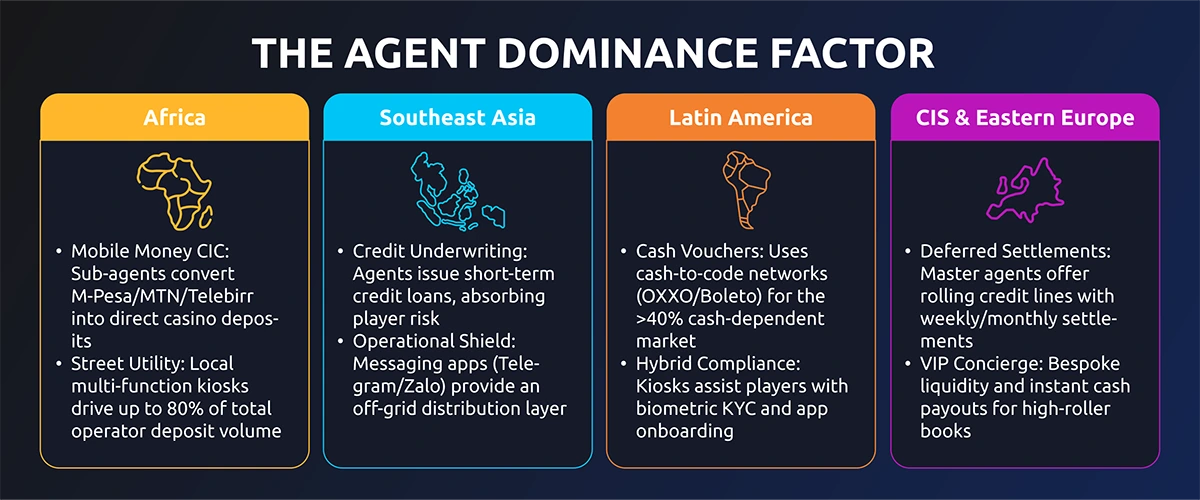
Retail agent networks are the kings of African iGaming acquisitions, as they can rely on the already well-established mobile money platforms (M-Pesa, MTN), which have low card penetration and unbanked players. In major markets like Kenya, Nigeria, Ghana and Uganda, up to 80% of the total amount of deposits for local sportsbooks and online casinos comes from physical sub-agent networks.
- Mobile Money Integration: Sub-agents are human CICs (cash-in/cash-out). Players send real money or make direct transfers through M-Pesa, MTN Mobile Money, Airtel Money, or Telebirr and the agent immediately deposits the money into the player’s account ledger in the casino.
- Street-Level Touchpoints: These are sub-agent outlets that are multi-function outlets where airtime sales, utility bill payments, SIM registrations and betting top ups all occur. This is a daily utility that builds high trust in the community and reduces the barrier to initial player registration.
Southeast Asia
Agent-driven iGaming in Southeast Asia operates through private credit networks and underground distribution channels in order to circumvent the harsh regulations in the region on gambling and banking. Many markets, such as Thailand, Vietnam, Indonesia and the Philippines, are based on agent systems that are similar to the traditional junket model, rather than on digital advertising.
- Credit Based Bookmaking: Senior agents are credit underwriters. Rather than lending money to the player, agents will provide a short-term loan to trusted gamers and take on the risk, credit limit and settlement process themselves.
- Macau Junket Architecture: Master agents use private messaging apps such as Telegram, Line, Zalo and WeChat to communicate and take care of liquidity outside of centralized payment platforms.
- Regulatory Avoidance: Direct online gambling platforms are blocked by heavy ISPs and have a lot of restrictions in many countries, and the agent layer is a complete operational safety belt, which is responsible for player onboarding, local settlement and direct customer support.
Latin America
To connect the unbanked population to emerging regulated online platforms, Latin American iGaming is using physical agent networks and cash-voucher systems. Although markets such as Brazil, Colombia, Peru and Mexico are quickly maturing, more than 40% of the adult population is still using cash for entertainment spending.
- Cash in Voucher Networks: Agents use local cash-to-code networks (like Boleto Bancário, OXXO, or Baloto) to provide players without bank cards or who aren’t sure about online checkout systems with vouchers to deposit cash on the spot.
- Hybrid Acquisition Model: Agents are becoming more than just cash handlers, as they support users with digital onboarding, biometric KYC and app download in the context of formal regulations that are coming into effect (such as Brazil’s regulated framework).
- Retail Integration: Lottery agents are assigned to local lottery kiosks, corner stores and sports bars, where they can make high dollar cash deposits without having to open a physical betting shop.
CIS and Eastern Europe
The iGaming agent system in CIS and Eastern Europe is based on a credit system offline, which is master-agent and circumvents strict financial monitoring and regional currency restrictions. Master agents like the credit officers in Armenia, Georgia, Kazakhstan and Uzbekistan are local agents who handle the player risk and high-roller accounts.
- Deferred Settlement Cycles: Master-agent networks issue rolling credit lines to players who have proven themselves to be successful and settle wins and losses weekly or monthly instead of per bet basis.
- Informal Risk Assessment: Agents have small and close books of business. Player underwriting is done on a direct personal relationship and local community verification basis, as the agent takes on direct financial responsibility for default.
- VIP Segments: Agents offer personalized concierge services, immediate cash settlements and bespoke credit terms that are not legally or practically offered by a centralized online platform in VIP segments.
Multi-Level Agent Hierarchies and How They Actually Work
An agent system runs on a tiered pyramid, where commission cascades down from the operator through several layers of recruitment before it ever reaches a player. Most agent management software supports unlimited tiers in theory, but in practice, four to five levels is where the structure actually stays manageable.
- Super Agent / Master Agent: Sits closest to the operator, purchases the largest credit limits, and recruits a network of agents beneath them. Earns override commission on everyone in their downline, not just their own direct players.
- Agent: Manages a defined group of sub-agents or players directly, handles day-to-day cash-in/cash-out, and reports upward to their master agent.
- Sub-Agent: Typically the street-level or community level operator, closest to the player, often running a physical shop or a personal WhatsApp based book of clients.
- Player: The end user, whose activity generates the GGR that flows commission back up through every tier above them.
Commission cascades down the tree, and it also cascades up as revenue. A player’s losses generate GGR, the sub-agent takes their cut, the agent above them takes an override, and the master agent takes a smaller override on top of that. Everyone above the player has a direct financial incentive to keep that specific player active and depositing.
Commission Structures: CPA, RevShare, Hybrid, and Tiers
Revenue share, not CPA, is the dominant commission model in agent systems because agents are managing ongoing relationships rather than one time referrals. A flat CPA payout makes sense for an affiliate who never talks to the player again. It makes much less sense for an agent who’s personally extending credit and handling that player’s cashouts every week.
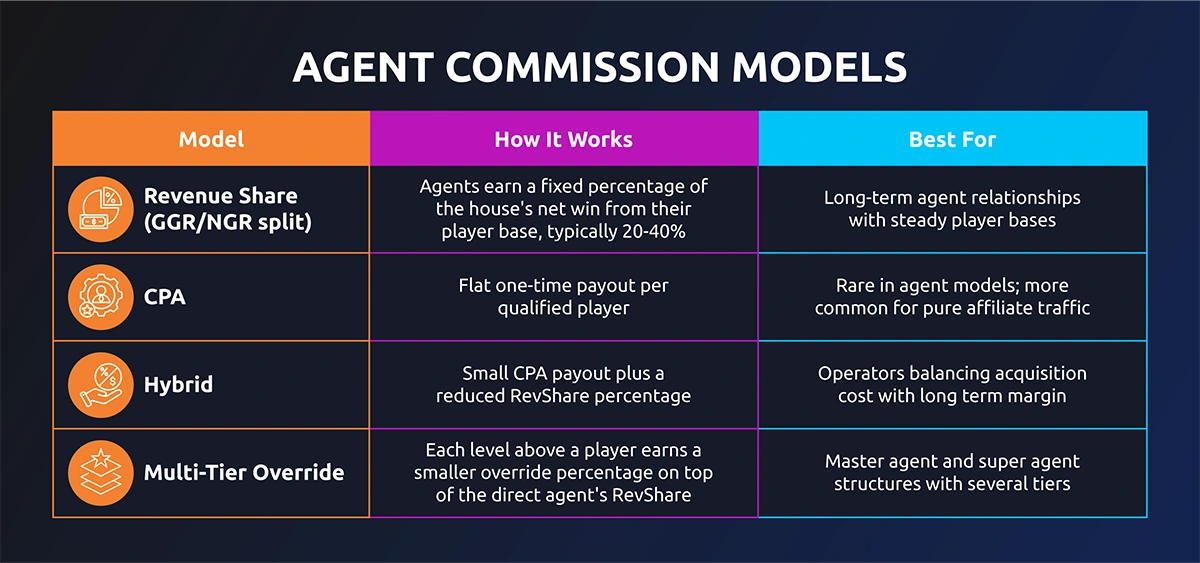
The override structure is what actually makes multi-level recruitment worth it for senior agents. A master agent might earn 30% RevShare on their own direct players, plus a 5% override on everything their sub-agents generate. A 5% override might appear minor initially, but once a master agent establishes a network of forty sub-agents, this passive commission can easily eclipse the revenue from their own direct clients.
Roles and Responsibilities of an Online Casino Agent
A casino agent’s day-to-day job splits into five core functions, and an agent who’s weak in any one of them tends to lose their book to a competitor within a few months.
- Player Acquisition Through Local Networks: Agents recruit face to face and through word-of-mouth, building on existing community trust rather than digital advertising. A new player almost always comes in through a personal introduction (a friend, a family member, someone from the same neighborhood or workplace), because the agent’s entire value proposition is “I vouch for this platform, and you can trust me specifically.”
- Cash-in/Cash-out Handling: Agents physically collect cash, process mobile wallet top-ups, and manually pay out withdrawals from their own float. This is the mechanical core of the job: a player deposits through whatever channel is locally trusted, and when they win, the agent settles that payout personally, often within minutes rather than waiting on a platform’s standard withdrawal queue.
- Player Support and Retention: Direct messaging through WhatsApp and Telegram, informal credit extensions to trusted VIPs, and personalized retention efforts are how agents keep a book active. An agent who notices a regular player has gone quiet for a week will usually reach out personally, sometimes with a small credit extension or a friendly check-in: the kind of retention touch a centralized CRM can’t replicate at this level of intimacy.
- Sub-agent Recruitment and Management: Senior agents scale revenue by recruiting sub-agents rather than trying to manage every player personally. A master agent who caps out at managing 50 direct players can instead recruit five sub-agents who each manage 50, turning a personal ceiling into a network that generates override commission on 250 players.
- Compliance and KYC Assistance: Agents collect basic ID documents, verify local player identity in person, and help prevent duplicate account creation within their community. Because agents often know their players personally, they’re positioned to catch obvious identity issues that a purely digital KYC flow might miss, but that same personal closeness is exactly where compliance gaps tend to open up.
Financial Responsibility: Why Agents Pay Winnings From Their Own Funds
Agents purchase credit limits upfront from the operator and pay player winnings out of their own local cash float. This is the core risk-shifting mechanism that makes the entire agent model work for operators. Instead of the casino holding payout risk on every single local transaction, the agent effectively becomes a private banker for their book of players, fronting the cash and settling with the operator on a recurring cycle.
Here’s how it plays out in practice. An agent buys, say, a $10,000 credit line from the operator. Players deposit into that agent’s float and play against it. When a player wins, the agent pays them directly from that same float, with no operator payout system involved. Periodically, the agent settles their net position with the operator: if the float grew because players lost more than they won, the agent nets a profit on top of their commission. If a run of player wins drains the float, the agent absorbs that short-term hit and has to replenish it to keep operating.
This is exactly why credit limit rules and agent settlement terms need to be spelled out clearly in the licensing and operating agreement, a topic LicenseGentlemen works through directly with operators, since the terms of an operator’s license often dictate how much financial exposure can legally sit with a third-party agent versus the platform itself.
Fraud and Risk in Agent Systems
Agent networks carry a fraud surface that centralized digital acquisition simply doesn’t have, because the agent sits between the player and the platform with hands-on control of both trust and cash. Modern agent management software addresses most of this with automated limits, velocity checks, and cross-account pattern detection, but the risk categories are worth understanding before you build.
- Self-Dealing and Chip Dumping: Malicious agents can manipulate gameplay between linked accounts they control to drain bonus funds or manufacture fake net losses. The typical pattern involves an agent controlling two or more player accounts and deliberately transferring value between them through gameplay: one account “loses” to the other in a way that looks like normal play but is actually just moving the agent’s own money around to trigger bonuses or manipulate reported net position.
- Fake Account Creation: Rogue agents create ghost players to claim baseline registration bonuses or inflate their reported active player counts. Since agents often handle identity verification personally, a dishonest agent can register accounts under real or fabricated identities that never represent independent players, collecting welcome bonuses or padding the metrics their override commission is calculated against.
- KYC Compliance Gaps: Agents bypassing identity checks for friends or high-value players is one of the most common and hardest to catch vulnerabilities in the system. Because the entire agent model runs on personal trust, an agent has every incentive to wave a friend or a big spender through verification rather than risk losing that player to friction, which is precisely the gap that creates real compliance exposure for the operator sitting above them.
- Bonus Abuse Through Agent Networks: Systematic arbitrage schemes exploit deposit match bonuses or cashback offers across an agent’s subtree of accounts. A coordinated agent can spread deposits across a dozen player accounts they effectively control, claim matching bonuses on each one, and extract value through minimal, low risk play. It’s hard to spot at the individual account level but clear once behavioral analytics cross-reference accounts by shared IP, device, or agent referral.
Agent System Vendors and Platforms in 2026
Most operators building an agent system in 2026 aren’t building the software from scratch. They’re licensing an agent module from an established B2B iGaming platform provider.
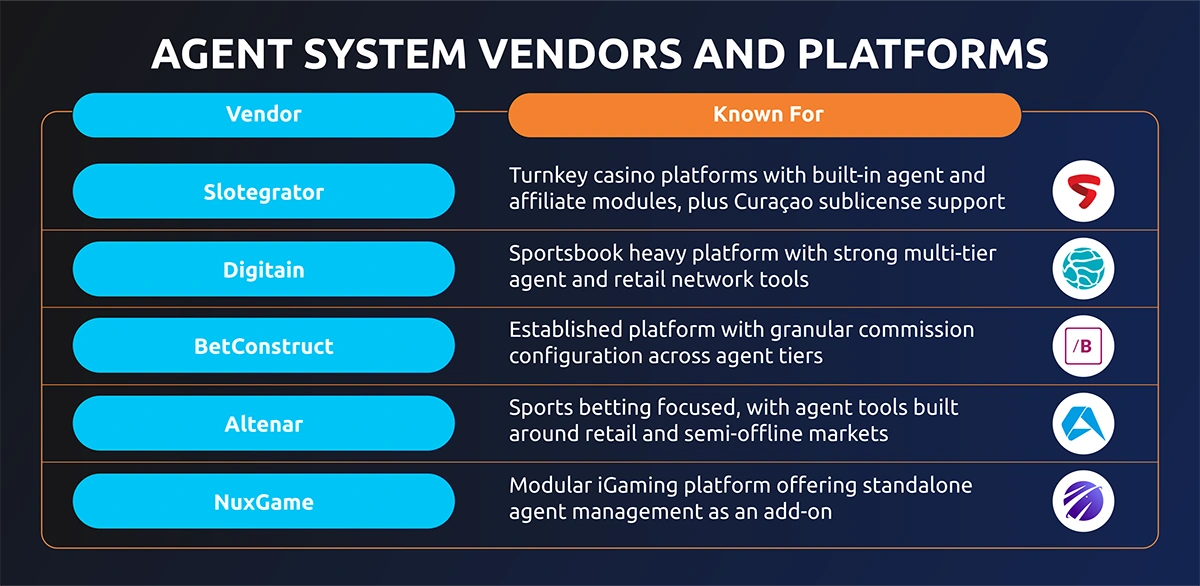
None of these vendors are interchangeable; the right pick depends on whether you’re sportsbook heavy, casino heavy, or need retail shop support baked in. Pilot two before committing to a full rollout.
Real Operators Winning With Agent Systems
A mid sized operator targeting Southeast Asia is a useful, anonymized illustration of how fast a well-run agent framework can move the needle. Starting at roughly $50,000 in monthly GGR with a purely digital affiliate model, the operator layered in a 3-tier agent framework. A handful of master agents recruiting sub agents across three cities, each sub-agent running a small local book of players.
Within twelve months, monthly GGR climbed to approximately $1.5 million. The growth came from compounding recruitment, not a single viral moment. Each new sub-agent brought their own trusted network of players, and each master agent had a direct financial incentive to keep recruiting rather than resting on their existing book. Acquisition cost per player also dropped significantly compared to the digital-only phase, since agents absorbed much of the trust-building and support work that would otherwise require paid marketing and a larger support team.
Regulatory Considerations Under Modern Licensing
Agent systems carry real legal exposure, and the risk sits squarely with the operator, not just the agents on the ground. Offshore licensing frameworks like Curaçao’s LOK system, Anjouan, and Tobique are commonly used by operators targeting emerging markets (alongside Panama and Costa Rica, which show up almost as often in this space), but holding one of these licenses doesn’t automatically make an agent network compliant in every market it touches. Local gambling law, AML rules, and cash-handling regulations still apply on top of whatever license the platform operates under.
This matters most in the exact markets where agent systems thrive. Several of the Southeast Asian markets covered earlier restrict or prohibit domestic online gambling entirely, and operating an agent network there carries a materially different risk profile than operating in a market with a clear licensing pathway.
The US market shows how sharp these lines can get even in a single country. Only eight states (Connecticut, Delaware, Maine, Michigan, New Jersey, Pennsylvania, Rhode Island, and West Virginia) permit full online casino games, while over 30 states allow online sports betting, and states like Utah and Hawaii ban all forms of gambling outright. Federal law layers on top of that patchwork. The Wire Act applies to sports wagering that crosses state lines, and the Unlawful Internet Gambling Enforcement Act blocks payment processing tied to gambling that’s already illegal under state or federal law. Neither statute criminalizes a player placing a bet. The exposure sits almost entirely with the operator and whoever is handling payments on the operator’s behalf, which in an agent model means the agents themselves.
The scale of the risk isn’t abstract. The FBI has estimated that Americans wager roughly $673.6 billion a year through illegal and unregulated gambling markets and has flagged that this activity frequently funds organized crime, including human trafficking and drug distribution. That’s the backdrop regulators are operating against when they look at any cash-heavy, relationship driven acquisition network. An agent system built without proper controls can look uncomfortably similar to the exact structures that statistic describes, even when every individual transaction is legitimate.
Anti-money laundering compliance is the practical pressure point that follows from all of this. Agents handling cash outside a digital paper trail are exactly the kind of structure regulators scrutinize first. This is why credit limit rules, settlement audit trails, and agent-level KYC protocols need to be built into the system from day one rather than retrofitted after a regulator asks questions.
LicenseGentlemen works with operators specifically on structuring agent programs so they sit inside the compliance boundaries of the license they hold, rather than accidentally operating outside them.
Beyond streamlining the application process, LicenseGentlemen has a proven track record of helping over 500 clients successfully secure their licenses. Whether you are navigating complex regulatory requirements or seeking a seamless setup, their team offers expert, end to end support tailored to your business needs. Best of all, you can book a free initial consultation to discuss your specific goals and get clear, direct advice with zero obligation
Agent System vs Affiliate Marketing: Cost and ROI Comparison
Agent systems cost more to set up but tend to retain players longer and convert unbanked populations that affiliate marketing simply can’t reach. The tradeoff is real infrastructure, agent management software, credit control processes, and settlement auditing that a pure affiliate program doesn’t need.
For context on what you’re comparing against: digital customer acquisition cost across the broader online casino industry typically runs $20-$250 per player, depending heavily on market and channel. Agent-driven acquisition doesn’t show up as a clean per player ad cost the same way, since the “spend” is baked into commission paid on activity rather than a fee paid to acquire a click, but in markets where card based acquisition simply doesn’t function, the affiliate CAC figure is close to meaningless anyway, because there’s no digital funnel to measure it against.
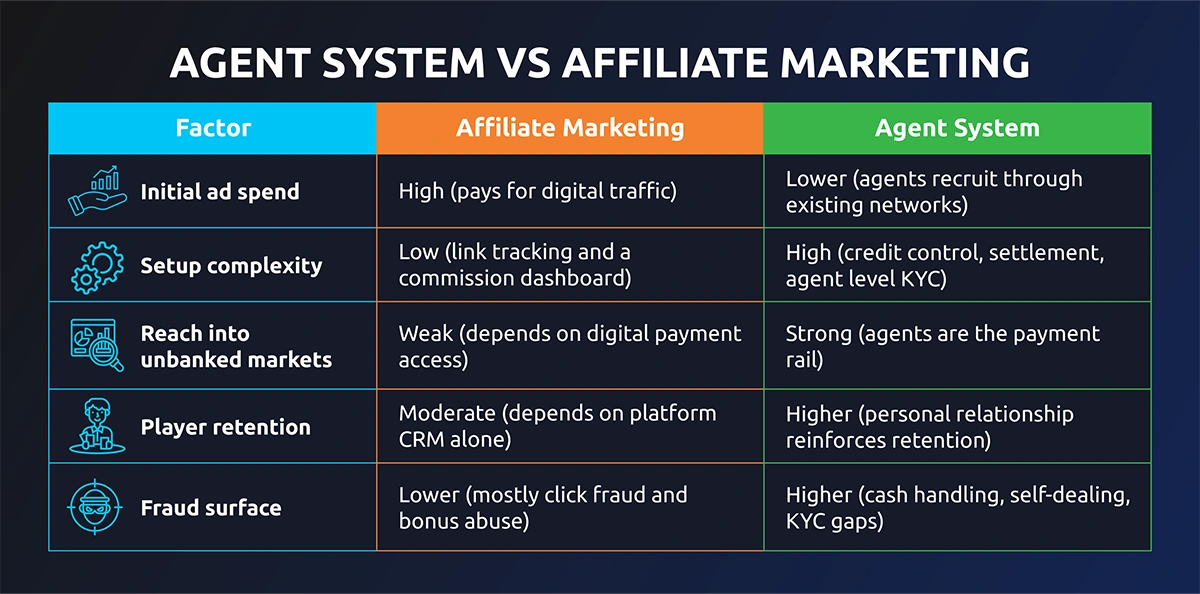
The honest answer to “which one should I use” is usually both. Affiliate marketing still wins in markets with strong digital payment infrastructure, where a player can deposit by card in thirty seconds without needing anyone’s help. Agent systems win everywhere that assumption breaks down.
How to Launch an Agent System: Step-by-Step Framework
Launching an agent system comes down to five sequential steps, and skipping the order tends to be where new operators get burned.
- Platform & Agent Module Selection: Pick a B2B platform with an agent module that matches your primary vertical, whether that’s sportsbook-heavy, casino heavy, or a hybrid. Run a short pilot with your top one or two candidates before committing.
- Financial Credit & Limit Rules: Set clear credit limit tiers per agent level, define settlement cycles, and build the audit trail before a single agent starts operating. Retrofitting financial controls after agents are live is far more expensive than building them first.
- Master Agent Recruitment: Recruit a small number of trusted master agents first, ideally people with existing local networks and a track record in the market you’re entering, rather than opening recruitment broadly from day one.
- Compliance & KYC Protocols: Build agent-level identity verification and duplicate account detection into the onboarding flow itself, not as an afterthought. This is a stage worth building in partnership with a licensing specialist like LicenseGentlemen, since compliance requirements vary sharply by the license and target market involved.
- Escalation & Audit Monitoring: Set up automated velocity checks, cross account pattern detection, and a clear escalation path for flagged agents before you scale past your first handful of master agents. Backed by a track record of securing 500+ licenses, LicenseGentlemen handles the heavy lifting of compliance for a seamless launch. Get started with a free consultation to map out your process.
FAQ
An affiliate generates digital traffic and is paid when a referred player converts. An agent manages the entire player relationship from beginning to end. Handling local cash deposits, extending credit, and personally distributing winnings. Agents work through personal trust and physical or mobile money transactions, whereas affiliates use links.