

iGaming Risk Management in 2026: Tools, Strategies, and Vendor Selection
iGaming risk management in 2026 starts with the launch decisions most likely to break first: player checks, payment routes, bonus rules, provider contracts, and live alerts. Zero-trust telemetry gives the operator evidence from accounts, devices, wallets, admin access, vendors, and gameplay before damage spreads.
Use that lens when choosing casino risk management tools, gaming fraud detection, KYC/AML casino tools, and the wider iGaming security stack. A controlled MVP can start lean, but crypto payments, multiple markets, or aggressive bonuses make vendor selection part of launch planning and license strategy.
What Modern iGaming Risk Management Actually Covers
Modern iGaming risk management keeps an operator able to onboard players, move money, keep games live, and defend decisions to partners or regulators. It applies to online casinos, sportsbooks, poker rooms, live dealer games, bingo, lottery-style products, eSports betting, and hybrid formats.
In 2026, that framework has to work beyond the security team. Compliance, payments, product, CRM, platform access, and provider decisions need to inform each other because one payment pattern can affect KYC review, bonus exposure, and license risk.
Financial risk management in iGaming controls cash-flow risk from deposits, withdrawals, payouts, chargebacks, fraud, liquidity pressure, and compliance failures. It connects betting activity, payment methods, PSP exposure, review queues, and reporting duties while traffic moves quickly.
At minimum, the framework covers player identity, AML monitoring, responsible gaming, payment controls, bonus-abuse detection, cybersecurity, regulatory reporting, and partner-chain checks. These controls cannot sit in silos: the same player can pass KYC, exploit bonuses, use risky payment behavior, and trigger responsible-gaming signals.
The Seven Categories of Risk Management Tools Every Operator Needs
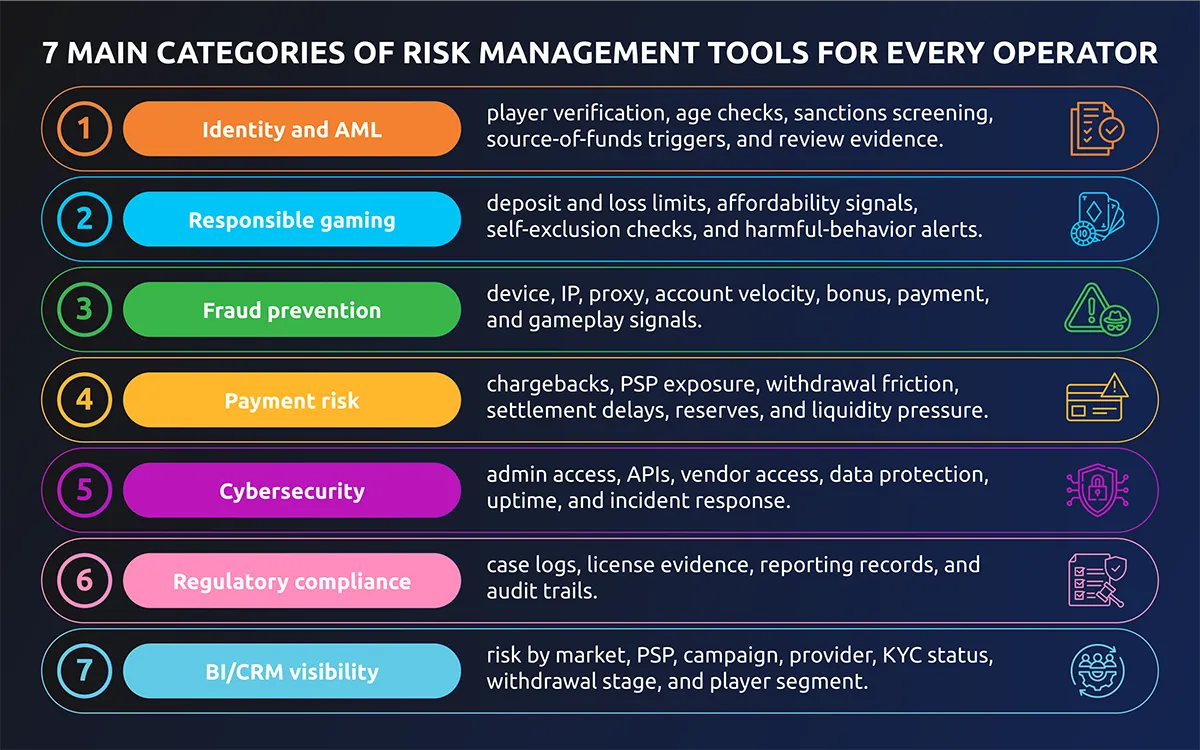
Every operator needs seven control categories: identity and AML, responsible gaming, fraud prevention, payment risk, cybersecurity, regulatory compliance, and BI/CRM visibility.
A risk stack earns its budget when separate signals turn into decisions: approve the player, hold the withdrawal, suppress the campaign, escalate the case, or adjust the PSP rule before losses spread.
The seven categories to map before choosing tools are:
LicenseGentlemen can review the risk stack before the operator buys tools that do not fit the license route, PSP plan, or KYC/AML workflow, among others. A short call can show whether the setup works as a single operating model rather than seven separate vendor decisions.
KYC and Identity Verification
KYC tools confirm that a player is real, old enough, and using identity details that match the account. A practical workflow covers document capture, validation, face match, liveness checks, screening, and fast decisions for legitimate users. Track pass rates, validation time, manual review SLA, and false positives: slow KYC hurts registration; loose KYC creates withdrawal and fraud risk.
KYC teams need to separate low-volume deepfake attempts from more common forged-document abuse. Deepfakes may require liveness, injection checks, face-environment consistency, and light-angle analysis. Forged documents can be cheaper and more common; operator insight suggests some cost only $20-$50. Cross-project face matching helps when the same face appears under different names.
AML and Transaction Monitoring
AML and transaction monitoring tools track money movement after onboarding. Good KYC/AML casino tools connect identity, transaction behavior, sanctions screening, source-of-funds questions, wallet-risk signals, and spikes by currency, payment method, wallet, and market. They should flag new payment instruments, rapid deposit-withdrawal cycles, high-risk wallets, and activity that crosses enhanced due diligence thresholds.
For example, an AML workflow may flag 10 accounts depositing from the same IP within an hour, repeated deposit attempts at near-identical intervals, fiat deposits followed by crypto withdrawals, or a player whose IP location does not match the KYC document. Fast deposits, minimal play, withdrawal cycles, as well as fragmented micro-transactions should also trigger review, especially when wallet analysis reveals exposure to cryptocurrency risk.
Cases should route by risk level. Low-risk activity can keep moving, medium-risk activity should enter review, and high-risk activity should trigger step-up verification, withdrawal holds, account restrictions, or suspicious activity documentation. Crypto casinos need wallet screening so risky funds do not move through unnoticed.
Responsible Gaming and Self-Exclusion
Responsible gaming tools identify harmful or erratic behavior before damage spreads. A practical setup includes deposit limits, loss limits, cool-off periods, affordability signals, reality checks, national self-exclusion database checks, and behavioral alerts. In markets such as Sweden, verified identity, player-set limits, and national self-exclusion controls belong inside the operating setup.
Useful responsible-gaming monitoring looks for deviation, not only static limits. Larger deposits, late-night play spikes, repeated failed withdrawals, chasing behavior, or a pattern that moves away from a player’s norm should trigger limits, cool-off prompts, affordability review, self-exclusion checks, or manual intervention before the case becomes serious.
Fraud Detection and Prevention
Gaming fraud detection covers behavior KYC cannot see: device fingerprints, canvas signals, IP routing, proxy-shield identification, emulators, account velocity, bonus behavior, payment behavior, and gameplay patterns. Device and proxy signals help expose linked accounts hiding behind VPNs, residential proxies, emulators, or clean browser sessions.
Device intelligence is one layer in a wider fraud model. Combine it with payment history, promotion usage, KYC history, CRM data, and gameplay behavior. SEON is useful for digital-footprint risk; TheGreco is closer to gameplay and bonus-abuse patterns. Together, they help expose professional multi-accounting before it becomes a withdrawal or bonus-cost problem.
That wider model is especially useful in bonus-abuse cases. A player may use opposite-market bets to hedge bonus funds, then repeat the same pattern through linked accounts. Once the pattern is confirmed, the operator can block the account, void abusive winnings, keep the original deposit available, and restrict the affected product without removing the player from the whole casino. If the same behavior appears across a linked cluster, the accounts can be banned before payout.
Case Insight: automated risk monitoring flagged a cluster of 10 accounts making 15 deposits from a single IP within one hour — all registered via disposable email domains. The cluster was blocklisted before any funds left the platform. That same evening, pattern recognition exposed a bot parser making automated deposit attempts at rigid ~9-second intervals, auto-banning 18 parser accounts instantly. In a separate investigation, identifying a linked three-account cluster executing identical opposite-market hedging saved the operator over €10,000 in fraudulent payouts prior to verification.
Payment Risk Management
Payment risk controls chargebacks, stolen payment methods, settlement delays, deposit abuse, withdrawal friction, rolling reserves, PSP exposure, and liquidity strain.
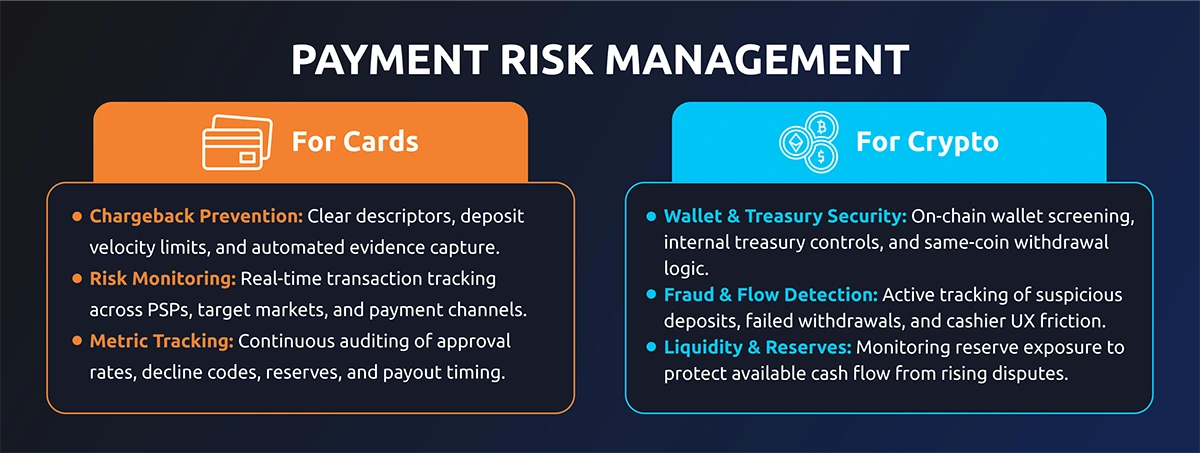
For cards, chargeback prevention starts before the dispute arrives. Clear descriptors, deposit velocity limits, risk-based friction, evidence capture, fast support workflows, and monitoring by PSP, market, and payment method reduce expensive disputes. Track approval rates, decline codes, reserve changes, payout timing, and abnormal refund patterns.
For crypto, the risk shifts toward wallet screening, treasury controls, same-coin withdrawal logic, and cashier UX. Rolling reserves leave less available cash if chargebacks or refunds rise. Monitor failed withdrawals, chargeback ratios, reserve exposure, suspicious deposits, and support complaints by PSP and market.
Cybersecurity and Data Protection
Cybersecurity tools protect platform access, player data, admin accounts, payment flows, and uptime. In iGaming, cybersecurity means more than SSL and database encryption. Operators need endpoint security, privileged access controls, penetration testing, DDoS mitigation, backups, logging, vendor controls, and incident response.
Turnkey coverage breaks down when the operator treats platform security as outsourced. Providers may supply hosting and core infrastructure, but staff access, data governance, payment exposure, incident escalation, and compliance evidence still sit with the operator. In a zero-trust model, every user, device, vendor, API, and admin action is limited, logged, monitored, and revocable.
Before treating a turnkey platform as full risk coverage, LicenseGentlemen can review how the license route, platform contract, vendor access, data controls, payment exposure, and incident-response duties fit together. A short consultation can help operators see which controls sit with the provider, which remain internal, and where missing evidence could create problems with PSPs, regulators, or partners later.
Regulatory Compliance and Reporting
Regulatory compliance tools help the operator prove what happened. A compliant launch can still fail later if records are scattered or missing. Useful workflows include case logs, KYC audit trails, AML review notes, responsible-gaming records, suspicious activity documentation, license-maintenance evidence packs, and reporting pipelines that pull case outcomes into one record.
License maintenance audits should run as recurring operational checks. The RegTech layout needs to show which systems feed the compliance record: KYC provider, AML monitor, payment gateway, responsible gaming tools, BI dashboards, CRM, and case-management logs.
Business Intelligence, Analytics, and CRM
BI, analytics, and CRM tools turn risk telemetry into decisions teams can act on. A useful dashboard shows fraud, payment friction, bonus cost, responsible-gaming alerts, and player value by market, PSP, campaign, payment method, KYC status, withdrawal stage, and risk tier.
BI protects player lifetime value by stopping bad campaigns before they launch. A player with strong deposits but active fraud flags, withdrawal friction, or responsible-gaming alerts should not be treated as a normal retention target. Metabase, Power BI, and MicroStrategy are visibility layers rather than risk engines.
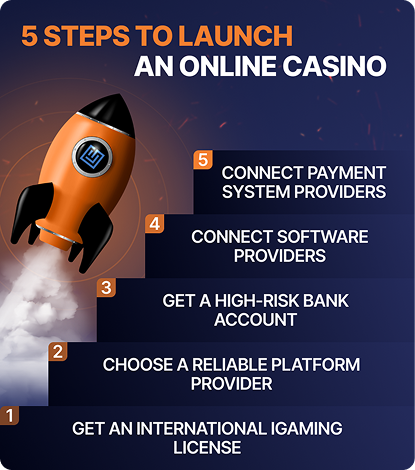
Ready to Launch Your Own Online Casino?
Get the full 5-step roadmap – from licensing to payments – with a real project timeline included.
2026 Tech Shifts: Deepfake KYC, Generative AI Fraud, and Behavioral Biometrics
Fraud is cheaper to scale in 2026, so AI fraud detection in iGaming needs live evidence during sessions and reviewable records after them. Operators need to see identity, device, wallet, bonus, support, and gameplay signals together.
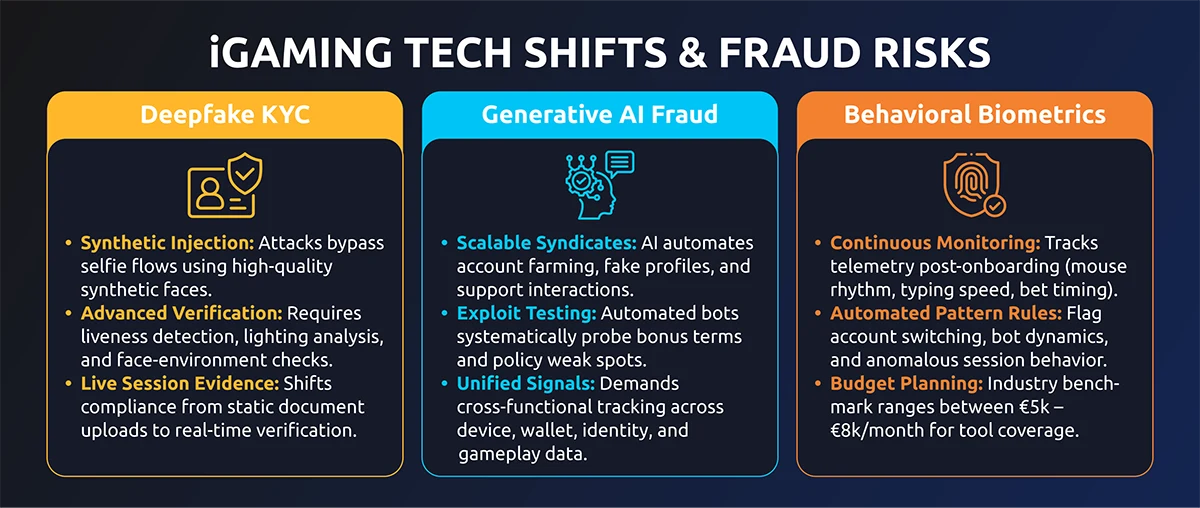
A deepfake facial injection can feed a synthetic face into a weak selfie flow. Better checks look for injection signals, liveness failure, face-environment mismatch, and odd light angles. Generative AI also helps syndicates scale profile variations, support messages, bonus-rule testing, and account farming.
Behavioral biometrics casino tools close the gap after onboarding. Mouse movement, typing rhythm, bet timing, account switching, gameplay patterns, and session telemetry support session-level fraud detection. Operators may use €5,000 – €8,000 per month as a rough planning range for continuous monitoring before internal review capacity is included.
Recommended Vendors and Their Real Use Cases
An iGaming risk vendor belongs on the shortlist only if its evidence can survive the operator’s target markets, payment routes, license file, and review workflow when traffic scales. Start every tool comparison with the job the vendor must perform, the decision it must support, and the evidence the team can defend.
KYC — Sumsub, iDenfy, Veriff
Sumsub, iDenfy, and Veriff all support identity verification, but the fit is different. Sumsub is strong for fast mobile KYC and KYC/AML workflow, iDenfy for modular checks and review, and Veriff for identity UX and liveness. Compare coverage, age checks, pass rates, SLA, integration effort, and market support.
Use a broader KYC/AML/case-management setup when onboarding, screening, and reviews must sit in one workflow. Use leaner identity verification when speed, price, or a narrow market takes priority. Selection question: Can it handle target-country documents and withdrawal escalations?
AML and Fraud — SEON, TheGreco, ComplyCube
SEON, TheGreco, and ComplyCube solve different parts of AML and fraud. SEON is strongest around digital footprint, device, email, phone, IP, and online behavior signals. TheGreco focuses on gameplay analysis and professional bonus-abuse syndicates. ComplyCube is a broader KYC, KYB, and AML infrastructure.
SEON-style signals are useful for digital footprint, device, email, phone, IP, or velocity risk. They are weaker when professional players manipulate device fingerprints or when bonus abuse only appears in gameplay. Selection question: Can alerts be explained and defended during payment, compliance, or player-dispute review?
While broad identity engines handle onboarding, specialized tools fill critical operational gaps: NH Deposit-monitoring flags real-time deposit velocity anomalies, BetBy handles bet-tagging and dynamic limits, Tron Scan enables deep crypto-chain tracing, and Hub88 verifies win eligibility and game integrity directly with providers before authorizing high-value payouts.
CRM — FastTrack, Optimove, Smartico
CRM tools become risk controls when campaign suppression is as visible as campaign targeting. FastTrack, Optimove, and Smartico support segmentation, retention, and real-time communication.
For risk management, CRM should suppress campaigns for flagged players, trigger responsible-gaming messages when behavior changes, and let loyal, low-risk players receive rewards without manual checks.
Choose real-time CRM when responsible-gaming alerts, fraud flags, and bonus suppression must reach campaigns immediately. Selection question: Can risk flags suppress campaigns in real time, before bonus leakage or responsible-gaming exposure turns into a support or compliance case?
BI and Analytics — Metabase, Power BI, MicroStrategy
BI tools give risk, finance, compliance, and CRM teams a shared view of exposure. Metabase, Power BI, and MicroStrategy help teams visualize where risk is building and where performance is being lost.
A startup may use Metabase for quick dashboards. A mid-market operator may choose Power BI if finance and compliance already use Microsoft systems. Larger operators may need MicroStrategy-style governance, permissions, and cross-brand reporting.
If dashboards cannot show pass rates, review SLA, PSP declines, chargebacks, withdrawal holds, false positives, wallet risk, and CRM suppression, BI is still too shallow. Selection question: Can management see exposure by PSP, market, and campaign without waiting for a manual report?
Payment Risk: Setting Limits That Actually Work
Payment risk works when limits protect cash flow without turning legitimate deposits or withdrawals into support tickets. In practice, casino payment risk management keeps deposits, withdrawals, PSP terms, chargebacks, and limits from creating PSP freezes, withdrawal delays, or avoidable liquidity pressure. Bad thresholds either invite fraud or damage Average Net Deposit Per User (ANDPU) by adding too much friction.
Financial risks in iGaming include chargebacks, stolen payment methods, bonus-driven deposit abuse, high-velocity deposits, withdrawal manipulation, settlement delays, rolling reserves, PSP freezes, and AML-triggering fund movement. Payment risk means setting thresholds around deposits, velocity, withdrawal review, card or crypto limits by market, and step-up checks when behavior changes.
PSP selection still belongs inside the risk framework. A high-risk iGaming PSP needs regulatory fit, AML/KYC compatibility, chargeback controls, fraud monitoring, reliable settlement, transparent reserve terms, and responsive support. A processor that hides fees or delays settlement can create more risk than it solves.
The Sweden model shows how payment thresholds affect both player protection and conversion. Registration, verified identity, and player-set loss or deposit limits sit inside the flow before gambling starts. If an operator uses €60 as an example ANDPU threshold for a target market, a very low minimum deposit may invite bonus hunters, while an overly high minimum may hurt conversion. Thresholds should be set by market, payment route, promotion, player-risk signal, and the review capacity available when alerts increase.
Cybersecurity: In-House vs Turnkey Provider Responsibility
Turnkey cybersecurity is shared responsibility, not a transfer of risk. Operators using Digitain, Betconstruct, NuxGame, or similar providers still need to know which controls are native, which are configurable, and which remain internal. SSL and encryption are baseline casino data protection, but they do not cover staff access, vendor permissions, incident response, payment exposure, or the evidence needed after an incident.
Even strong turnkey platforms may not cover every operator-side control, especially staff access, vendor access, API keys, crypto risk, monitoring, and incident response. Zero-trust iGaming means no user, device, vendor, API, or admin action is trusted by default. The operator should control MFA, access logs, admin permissions, endpoint security, API-key rotation, monitoring, and revocability.
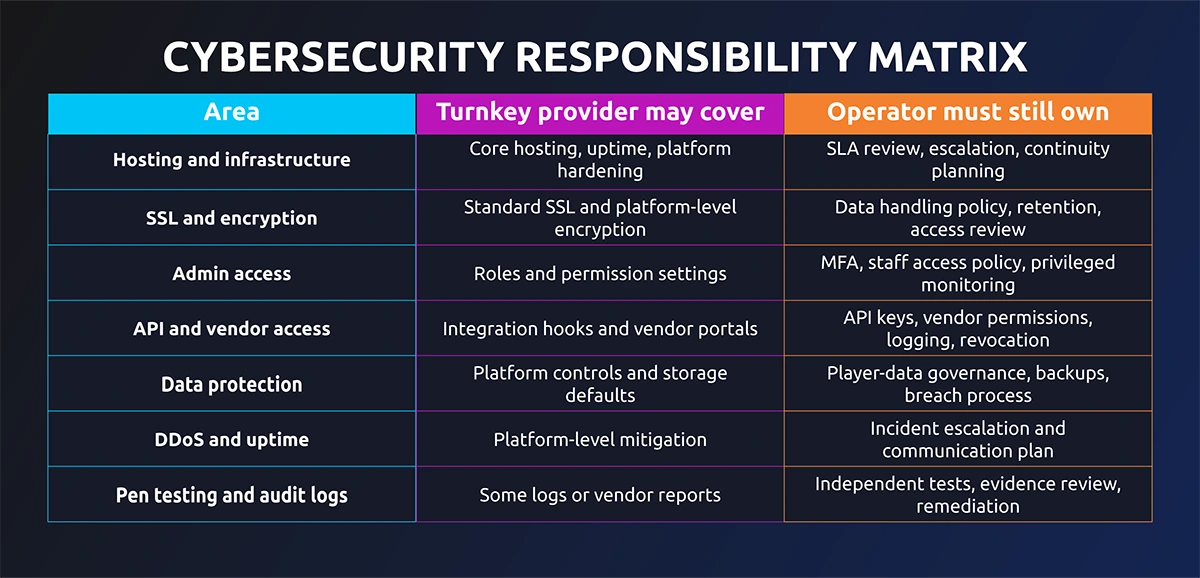
Before signing a platform contract, operators should confirm whether the turnkey setup, internal zero-trust controls, PSPs, provider list, and target markets can work together under the intended license route.
Regulatory Compliance and Partner Chain Risk
Partner-chain risk is the risk that an upstream provider’s license, compliance status, or technical failure blocks the operator from offering games, payments, or platform services. Treat it as an operating risk, not paperwork: a missing supplier permission can force game removal, provider replacement cost, payment concern, or failed license maintenance.
For Malta, the MGA split between B2C Gaming Service licenses and B2B Critical Gaming Supply licenses affects provider selection directly. If a required B2B supplier authorization fails, an MGA-licensed B2C operator may have to remove games, interrupt an integration, or replace a provider quickly. Operators planning Curaçao exposure should review how the LOK transition affects provider checks, reporting duties, and license-maintenance evidence before locking the risk stack.
For Anjouan-facing projects, partner-chain review should happen before the game lobby is built. Recent Anjouan Gaming guidance requires B2B suppliers working with Anjouan-licensed operators to hold either an Anjouan B2B license or formal recognition, depending on provider status and eligibility. Operators should confirm the provider’s current status, product scope, renewal dates, restricted markets, termination rights, fallback suppliers, and the owner responsible for keeping that evidence current.
RegTech iGaming workflows and iGaming regulatory compliance tools should keep upstream partner license checks, certificates, contract status, restricted markets, review dates, and escalation notes in one evidence trail. Directories and casino listings can show a commercial footprint, but they are not proof that a provider can be used safely under the operator’s license.
Choosing the Right Risk Stack for Your Business Stage
Choose the risk stack the business can operate, not the most impressive tool list. Stage, traffic, markets, payment methods, license route, budget, and review capacity decide what belongs in the stack. A lean MVP should cover the risks the team can act on; an enterprise framework only works when the business can staff, tune, and govern the complexity.
Tool budgets also need hidden costs: manual review, AML monitoring, PSP fees, chargebacks, cybersecurity, BI infrastructure, and the people who act on alerts. From there, the setup changes by stage: startup, mid-market, or enterprise.
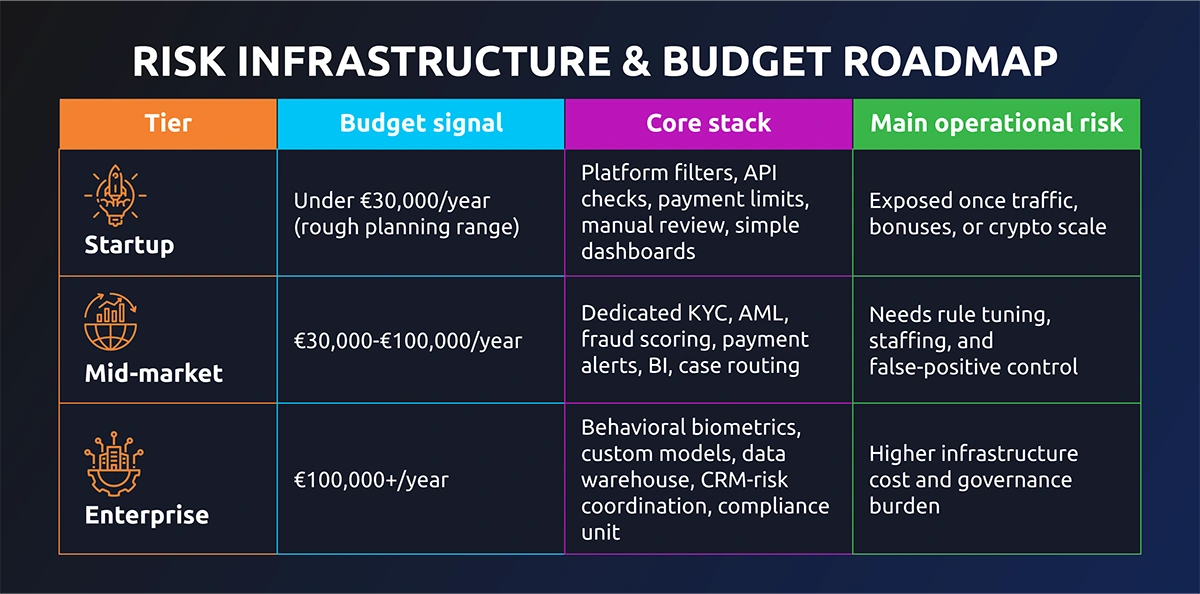
Startup Stack (Rough Planning Range Under €30,000/year)
A €30,000/year startup stack is a rough planning range for a controlled MVP, but it leaves little room for advanced fraud, AML, payment-risk, and monitoring coverage once traffic grows.
At this level, the business usually relies on platform filters, low-cost API checks, payment limits, manual review, simple fraud rules, and lightweight analytics. That can support a controlled MVP; aggressive acquisition, crypto-heavy deposits, or multi-market scale need stronger controls.
Mid-Market Stack (€30,000–€100,000/year)
A mid-market stack should move from basic controls to dedicated modular tools: stronger KYC, fraud scoring, AML monitoring, payment-risk rules, dashboards, and automated case routing. Tools such as Sumsub or SEON usually become easier to justify here.
The first upgrades should remove the losses that basic controls miss: failed KYC escalations, bonus abuse, payment alerts, AML monitoring gaps, gameplay-risk blind spots, and manual review backlog. Someone must own rule tuning, false-positive review, and escalation, or the new tools only create more queues.
Enterprise Stack (€100,000+/year)
An enterprise stack is a real-time, zero-trust framework across identity, payments, gameplay, AML, responsible gaming, cybersecurity, and BI. It is expensive because tools, data infrastructure, people, and governance all have to work together.
This is where behavioral biometrics, custom models, data warehouses, CRM-risk coordination, in-house compliance, and dedicated risk officers make sense.
Common Mistakes When Building an iGaming Risk Framework
Risk frameworks fail when tools are bought faster than ownership is assigned. Operators may have KYC, fraud, payment, CRM, and BI tools in place, yet still miss cases because signals are not connected, rules are not updated, and nobody owns the decision when behavior changes.
Common mistakes include:
- Relying only on built-in platform tools
- Making KYC so rigid that registration and deposits suffer
- Ignoring chargebacks, reserves, settlement delays, and withdrawal friction
- Treating compliance as paperwork
- Forgetting partner-chain risk
- Letting CRM reward players already flagged by fraud or responsible gaming systems
- Buying tools without a staffing review
A stronger setup maps risks, assigns owners, connects data, reviews alerts, and adjusts thresholds when behavior changes.
How Risk Management Turns Into Competitive Advantage
Risk management becomes a competitive advantage when it lowers losses, protects player trust, keeps PSPs, regulators, and providers confident in the operating model, and improves Net Gaming Revenue.
NGR is gaming revenue after payouts and deductions such as bonuses, chargebacks, taxes, commissions, fees, and promotional costs. Lower fraud losses, bonus abuse, chargebacks, and compliance drag can improve NGR without buying more traffic.
It also improves player experience: legitimate players pass onboarding faster, withdrawals feel more predictable, and support teams spend less time explaining blocked transactions.
LicenseGentlemen reviews those decisions together because license choice, PSP access, platform contracts, provider risk, and fraud controls rarely fail in isolation. Before spending on traffic or signing long-term vendor commitments, the operator should test whether the risk stack can support the license route and markets it plans to enter.
A short free consultation with our team can help test those decisions before the business spends more on acquisition or locks itself into vendor terms that are hard to unwind.
FAQ
A new online casino needs KYC, AML screening, basic fraud detection, payment limits, responsible gaming controls, cybersecurity basics, and simple reporting. That stack can support a controlled MVP, but it is not enough for aggressive acquisition, crypto-heavy deposits, multi-market traffic, or complex bonuses. Those models need stronger fraud, payment, AML, and review workflows before scale.