
Kahnawake Gaming License 2026: Complete Operator’s Guide
The Kahnawake Gaming Commission (KGC) has been licensing corporate operators since 1999, making it one of the oldest, most structured and highly respected offshore iGaming regulators in the world. For founders entering the international market in 2026, the KGC offers a regulatory framework that balances corporate credibility with structural cost efficiency.
Located in the sovereign Mohawk Territory of Kahnawake just outside Montreal, the Commission provides a transparent, highly secure environment for online wagering platforms. With over twenty-five years of flawless regulatory enforcement, the jurisdiction remains a top choice for scaling international brands that prize banking access, direct licensing relationships, and complete fiscal efficiency.
Why the Kahnawake License Remains a Top Choice After 26 Years
Twenty-six years without a regulatory implosion is a real differentiator. When you sit down with a PSP or a banking partner, you are not explaining what Kahnawake is. They know. That recognition shortens conversations that would otherwise take months with a newer jurisdiction.
The tax structure is genuinely clean. There is no gaming tax on gross revenue, no corporate tax within the territory, and no capital gains tax. Every dollar of gross gaming revenue (GGR) your platform earns stays in the business. For operators moving from European frameworks where effective gaming tax runs 5% to 20%, that difference compounds fast.
One Client Provider Authorization (CPA) covers the full product range, including online casino, sports betting, poker, lotto, eSports, live games, fantasy sports, bingo, and cryptocurrency gambling. You do not buy separate authorizations for each vertical. Multiple brands and skins operate under the same license. Since April 2025, the KGC charges USD 500 per domain per year beyond 6, but it’s still better to manage 10 brands under one authorization than 10 separate regulatory filings.
The KGC issues the license directly to you. No master license holder sits between you and the regulator and there are no sublicenses. You own it outright. That distinction will matter when you go through acquisition due diligence, negotiate with Tier-1 partners, or eventually move to a more regulated jurisdiction.
The Kahnawake Gaming Commission (KGC) Explained
In 1996, the Mohawk Council of Kahnawake, an indigenous community in Quebec that has self-governing rights, created the commission to oversee gaming activities in the Mohawk Territory. It is this sovereign status that gives the KGC the freedom to do what it does, and it is on this basis that the whole structure is built.
The KGC issues and removes five license categories, audits RNG performance and fair gaming controls across all permit holders, employs a full-time Dispute Resolution Officer for player complaints, and enforces AML standards that mirror Canadian federal requirements. Operators file suspicious transaction reports through the same framework they would use in a regulated Canadian environment.
What sets the KGC apart from most offshore regulators is that it has continuity. It has been doing this for a longer time than most of the offshore regulators that exist today and that is reflected in the way it conducts compliance reviews, audits and resolves disputes. It manages active licenses, enforces its rules and revoked authorizations from operators that didn’t meet standards. It’s that history that the banking and PSP discussions are based on.
Kahnawake License Types: CPA, IJA, CSPA, LDSA, and Key Person Permits
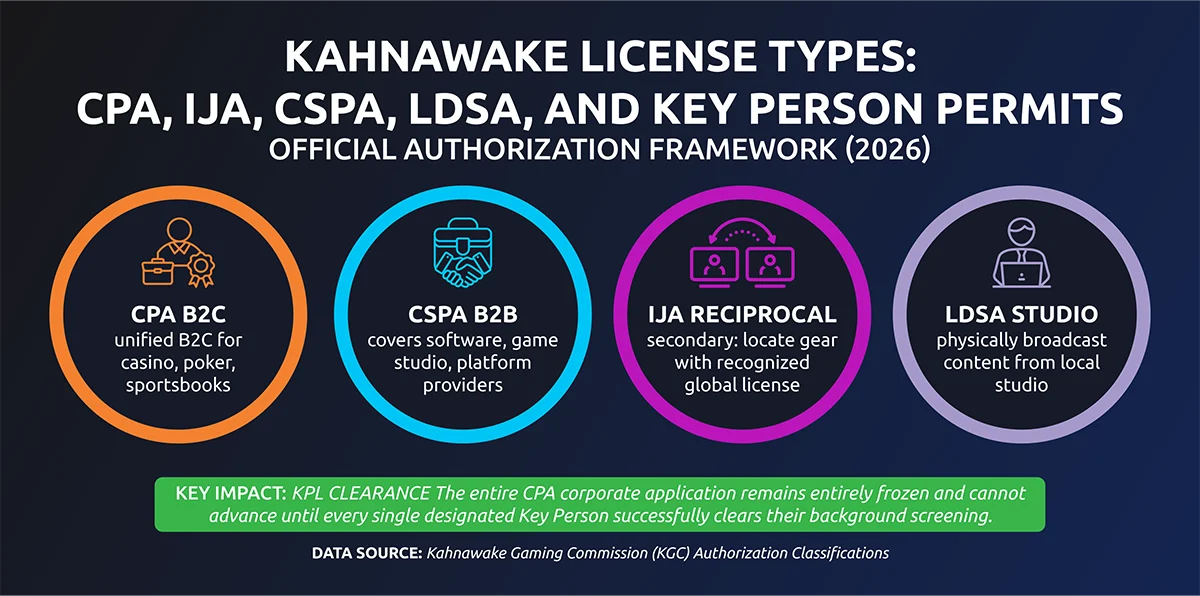
The KGC issues five distinct authorization types. Knowing exactly what you need before you start the application saves weeks of wasted effort.
Client Provider Authorization (CPA)
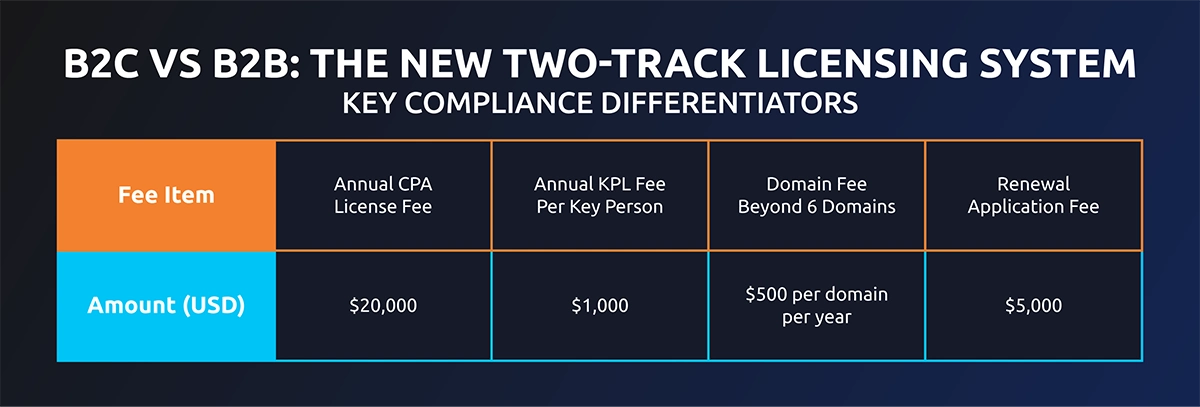
The CPA is the standard B2C authorization for real-money online casinos, poker rooms, and sportsbooks. A single CPA covers all interactive gaming verticals under one unified framework. The application fee runs from USD 35,000 to USD 40,000, which covers due diligence and the first annual fee. The annual renewal is USD 20,000. Domains beyond six cost an additional USD 500 per domain per year since the rule change in April 2025.
Casino Software Provider Authorization (CSPA)
The CSPA covers the B2B side, including software developers, game studios, and platform providers distributing gaming solutions to licensed operators. If you build the tools operators use rather than running a player-facing product, this is your authorization. CSPA holders must host gaming equipment through Mohawk Internet Technologies and meet the same technical and AML standards as CPA holders.
Inter-Jurisdictional Authorization (IJA)
The IJA is a secondary authorization rather than a standalone license. Operators who already hold a valid primary license in a recognized reciprocal jurisdiction use it to locate equipment, staff, or operations within Kahnawake territory. If you are already regulated elsewhere and want to use Kahnawake’s hosting infrastructure or North American presence, the IJA is your mechanism.
Live Dealer Studio Authorization (LDSA)
The LDSA is required for operators or studios that physically host or broadcast live dealer casino content from within the territory. Live dealer operations carry technical requirements beyond a standard CPA, including studio setup standards, broadcasting equipment specs, and dealer compliance protocols. If live dealer content is part of your product, you need this alongside your CPA.
Key Person Permit and Key Person License (KPL)
Every director, executive officer, or major shareholder with meaningful control over the licensed operation must hold an individual Key Person authorization. The KPL application fee is USD 5,000 per person, and the annual renewal is USD 1,000. Checks cover criminal records, financial history, and professional background. The CPA application does not advance until every key person clears. For operators with complex ownership structures, key person clearance is usually the longest part of the entire timeline.
See Real Kahnawake Casinos Already Operating Worldwide
Explore verified operators using the Kahnawake license and learn how successful brands structure their launch.
Kahnawake Gaming License Requirements in 2026
The KGC is not flexible on its documentation requirements. Prepare everything completely before you submit.
Corporate Structure and Beneficial Owners
The applicant must be a properly incorporated entity with its full ownership structure disclosed, including all beneficial owners, directors, and shareholders. The KGC runs background check protocols covering criminal history, source of funds, and professional suitability for every beneficial owner. Any shareholder with meaningful control triggers a full key person review.
Offshore corporate structures are accepted, but every beneficial owner must still be fully documented and verified.
MIT Server Hosting Requirement
All primary gaming infrastructure and player transaction logs must be hosted at Mohawk Internet Technologies (MIT), which is the territory’s licensed data center operator and part of the Continent 8 network. There is no alternative hosting arrangement that satisfies this requirement. Budget MIT hosting as a fixed operational cost from day one, because operators who discover this late consistently get surprised by the additional expense.
Personnel and Key Persons
Every individual with decision-making authority over the gaming operation needs a key person authorization before they can assume the role. Compliance officers must be designated and their qualifications fully documented. The KGC reviews key person fitness on an ongoing basis. Changes to your key person lineup require prompt notification and re-approval rather than a post-hoc update.
Technical Standards and Game Certification
All gaming software requires independent RNG certification from a recognized testing laboratory before submission. The KGC runs a separate control system review, which is billed upon invoice and not included in the application fee. Game provider lists go into the KGC portal and must be updated whenever you integrate a new studio.
Documentation Mandates
To satisfy the regulator, each ultimate beneficial owner (UBO) and key person must provide a notarized government-issued ID alongside proof of address dated within three months. You must also supply a clean criminal background check from your country of residence, comprehensive source of funds documentation such as bank statements or audited financials, and a detailed professional biography detailing your business history. For the corporate entity itself, you must submit the certificate of incorporation, articles of association, corporate and shareholder registers, and a highly specific business plan that the KGC will actually read instead of a generic template.
Application Process and Timeline
The step-by-step path from submission to a full CPA follows a strict chronological structure. During the pre-application phase, which takes two to four weeks, you must assemble every document before submission. Missing documentation at this stage is the most common reason timelines slip by months, so ensure you get RNG certification from an approved testing lab before you file.
Formal submission takes one week to process the full application package alongside the application fee, and the KGC review does not start until the payment clears. Next is the due diligence review, lasting four to eight weeks, where the Commission reviews corporate and personal documentation, runs background checks on all key persons, and assigns a compliance officer to the file. Expect follow-up requests on your source of funds, as this normal back-and-forth is exactly where unprepared operators lose weeks of time.
Once approved, applicants receive a six-month provisional permit for limited operations while final compliance verification runs. This is a preliminary permit and not the full CPA, meaning you must operate with extreme care during this period. After the preliminary period closes with satisfactory compliance, the KGC issues the full Client Provider Authorization, which remains valid for five years subject to annual compliance. This creates a total timeline of 6-8 months from submission to a provisional license and six to eight months to reach a full CPA.
Kahnawake Gaming License Cost Breakdown
Application and First-Year Fees
The USD 40,000 CPA application fee is divided into three distinct buckets. First, USD 15,000 goes to KGC due diligence, which is completely non-refundable. Second, USD 20,000 covers the first annual licensing fee, which is fully refundable if the license is not granted. Third, USD 5,000 covers the Key Person License application for your first key person. Additional key persons cost USD 5,000 each, while the control system review is assessed and billed separately based on complexity, meaning it is not factored into the initial application fee.
Annual Renewal and Key Person Fees
Hidden and Ongoing Costs
The KGC fee schedule is only a fraction of your actual expenditure. First-year total costs realistically run from USD 80,000 to USD 120,000 once you incorporate mandatory MIT or Continent 8 hosting, third-party RNG certification testing lab fees, the variable KGC Control System review invoice, legal and filing costs, ongoing compliance staffing, and bank or PSP merchant account setup fees. Operators who plan solely around the KGC fee and discover the rest post-approval consistently overspend their first-year budget.
Jurisdiction Comparison Matrix
Tax Benefits and Fiscal Structure
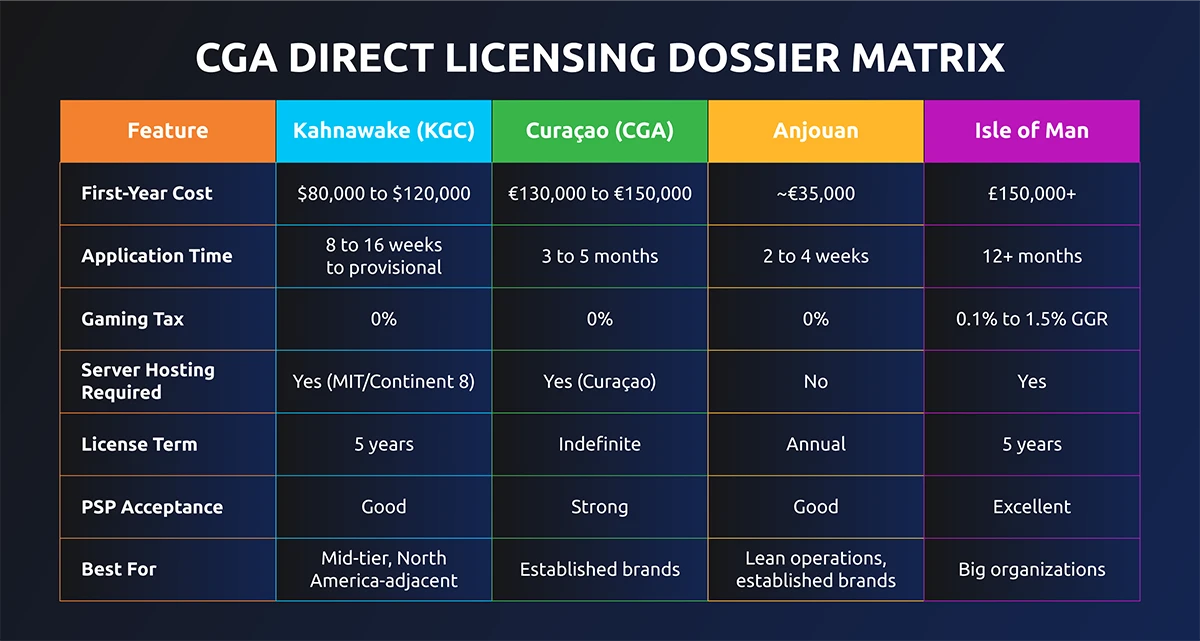
There is no gaming tax on gross gaming revenue, no corporate income tax within the territory, no capital gains tax, and no withholding tax on profit distributions. The 0% Kahnawake gaming tax structure is one of the cleanest in offshore iGaming.
Every dollar of GGR stays in the business. For operators moving away from European frameworks where gaming tax runs 5% to 20% of gross revenue, that difference compounds fast.
Here is what most articles get wrong: the 0% rate applies to operations under the KGC license within the territory. There is no local company in Kahnawake because it is simply not possible to incorporate one there, and the KGC does not require it. What determines your actual tax position is the corporate structure you build around the license.
At LicenseGentlemen, we design setups where there is no corporate income tax, no capital gains tax, and no withholding tax on profit distributions. That means choosing the right jurisdictions and holding structure before you incorporate. Build it wrong and fixing it later is expensive. Book a free consultation and we will get the structure right from the start.
Restricted Jurisdictions and Market Access
The United States market is entirely off the table. Following a landmark 2016 settlement between the KGC and the New Jersey Division of Gaming Enforcement, Kahnawake-licensed operators cannot accept US players under any circumstances. If your primary focus is the US market, then Kahnawake is just the wrong license for you.
Restricted markets are any jurisdictions that are blacklisted by the Financial Action Task Force (FATF) in addition to the US and also jurisdictions where offshore gaming is explicitly prohibited or requires a specific local license. The KGC does not publish a universal restricted countries list. Maintaining your own restricted list, enforcing tight geoblocking and tracking the regulatory status of your target markets are the operator’s responsibility.
To save you the research, download our full Kahnawake restricted countries guide below.
Where the Kahnawake license truly shines is across Latin America, Asia, parts of Europe, Africa, Canada and the Middle East. For operators building a global player base outside the US and strictly regulated EU markets, the KGC framework gives you solid operational ground because a North American jurisdiction association carries a completely different level of weight in banking and PSP conversations compared to Caribbean alternatives.
Player Protection, AML, and Dispute Resolution
The KGC dispute resolution framework is one of the primary reasons this license is commercially useful rather than just technically valid. The Commission employs a full-time Dispute Resolution Officer, allowing players to escalate complaints directly to the KGC. Operators must respond within defined timeframes, and the KGC holds the power to push unresolved disputes to a binding resolution.
That active enforcement record is what banking partners actually look at during due diligence. When a PSP checks your license, they can look up your complaint history, see an active regulator standing behind the authorization, and make a real assessment of your operational credibility, which is something very few offshore jurisdictions offer.
AML requirements mirror strict Canadian federal standards, demanding full KYC on all players, enhanced due diligence for high-value transactions, suspicious transaction reporting, and ongoing monitoring. The MLRO function must be fully staffed, and responsible gaming tools like self-exclusion, deposit limits, session time controls, and reality checks must be built into the platform and completely functional before the KGC authorizes your brand.
Banking and Payment Solutions for Kahnawake Operators
Many European payment service providers accept a KGC license for onboarding, making high-risk merchant accounts highly achievable for licensed operators. The 26-year track record and active regulatory oversight make the due diligence conversation significantly shorter than it would be with a newer or less active regulator.
However, there is an honest limit, as some markets require a local license before PSPs will process transactions for players there. A KGC authorization does not substitute for a UKGC or MGA license when serving players in those regulated markets, so you must know your target markets and the specific PSP requirements for each before you apply.
If you are unsure which providers will onboard a KGC license entity in your target markets, LicenseGentlemen can map out for you before you spend $4000 on the application. Book a free consultation today.
Crypto operations fit cleanly inside the existing CPA framework, and cryptocurrency gambling is explicitly covered without needing a separate license category. Fiat-to-crypto gateway compliance falls within the standard CPA terms, and full KYC and AML apply to crypto transactions exactly the same as fiat. One practical step most operators skip is starting banking and PSP conversations before applying, since knowing which providers will onboard a KGC-licensed entity in your target markets before spending USD 40,000 on the application is basic due diligence that LicenseGentlemen can map out for you.
Real Operator Case Studies
JackpotCity Casino

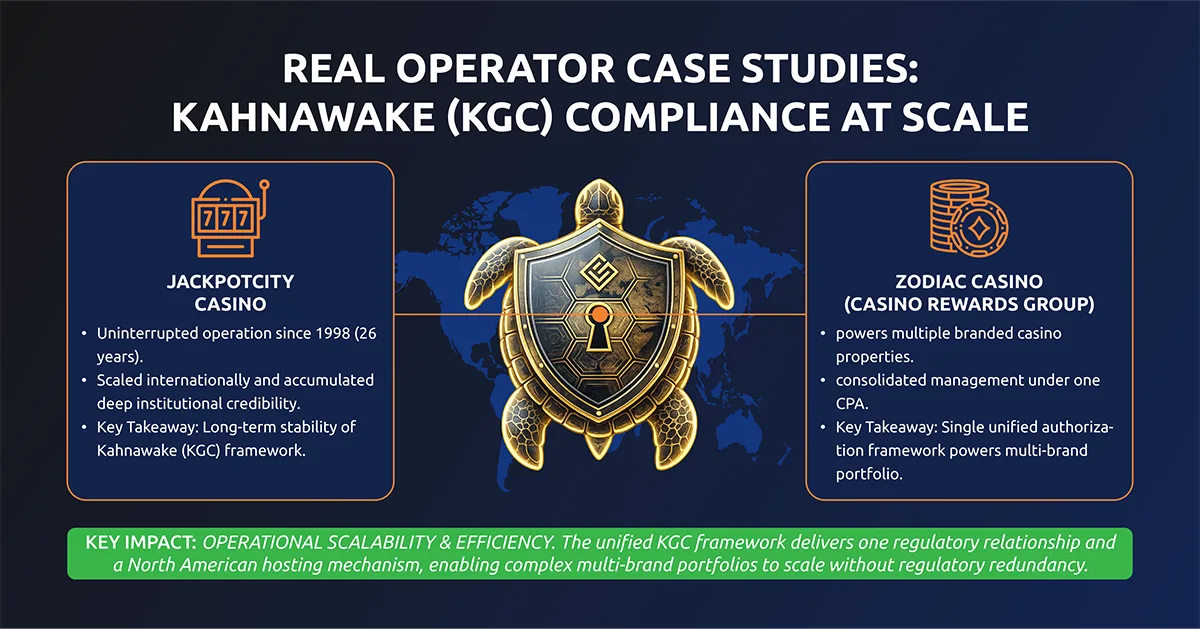
JackpotCity has operated under a KGC license since 1998, representing twenty-six years without a single license revocation. That is the most straightforward argument for the long-term stability of this framework. Over that time, the platform expanded product verticals, scaled internationally, and built the kind of institutional credibility that only accumulates through sustained, uninterrupted operation, making JackpotCity the ultimate reference point for a KGC license at scale.
Zodiac Casino

Zodiac Casino is part of the Casino Rewards Group and demonstrates how a single Kahnawake authorization scales across a complex multi-brand operation. Multiple branded casino properties, each serving distinct player segments, run under the exact same CPA compliance umbrella. This delivers one regulatory relationship and one license framework powering multiple revenue streams, which is the exact operational model the KGC makes possible for operators planning to build a large portfolio.
Ongoing License Maintenance
Holding a KGC license requires active compliance management rather than just paying an annual fee and hoping for the best. Operators must submit annual compliance reports, updated RNG certifications, and full financial statements. The KGC runs periodic technical audits and can initiate unscheduled reviews based on complaint patterns or anomaly flags.
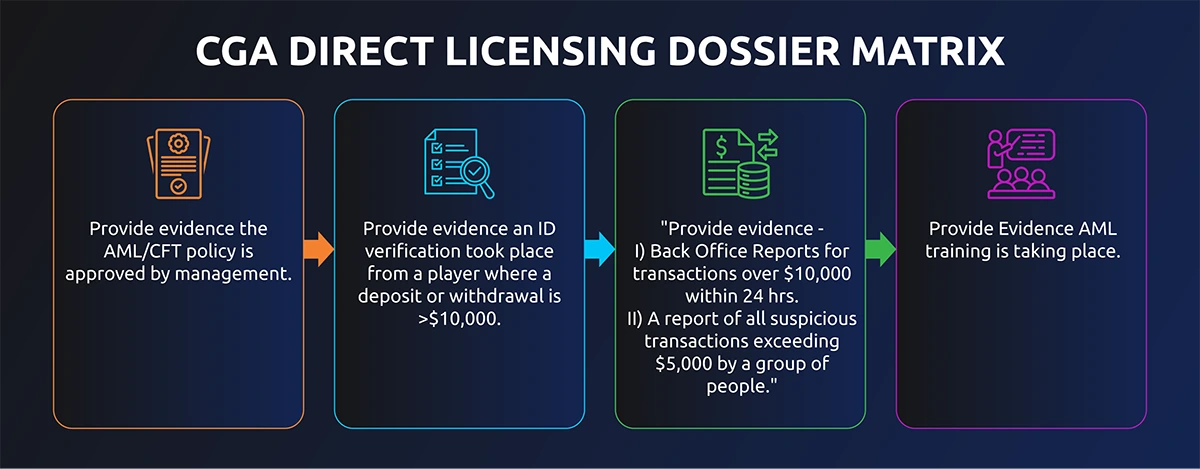
Furthermore, any change to directors, major shareholders, or compliance officers must be reported promptly, and new key persons need individual authorization before assuming their roles, since missing this is a direct compliance violation. Adding a new studio requires updating the approved provider list in the KGC portal before integration, because operating with an unapproved provider is a breach of CPA terms. You must also document penetration testing results for your gaming platform and submit them as part of ongoing compliance obligations while ensuring all licensed domains are registered with the KGC, keeping in mind that domains beyond six cost USD 500 per year each and adding them without notification is strictly prohibited.
Is the Kahnawake License Right for You
The KGC framework fits a highly specific operator profile. It fits perfectly if you have validated your concept and can budget for a mid-tier framework, require a North American-adjacent license that opens banking and PSP conversations, and target international markets outside the US or strictly regulated EU zones. It is ideal if you want a single authorization covering every vertical and want to own the license outright.
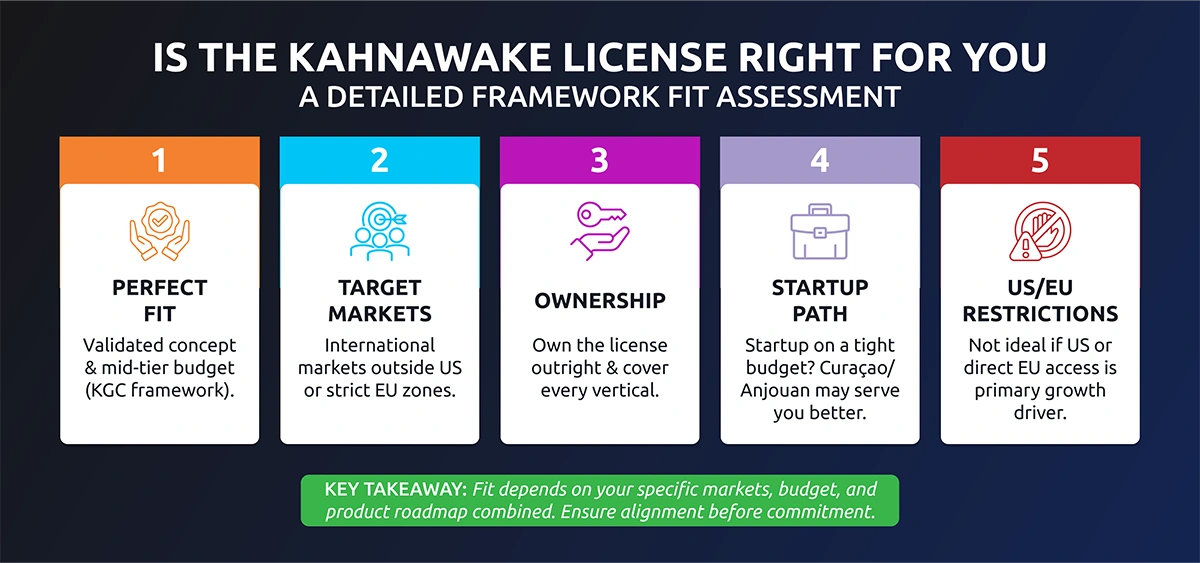
Conversely, it does not fit if the US is your primary market, if you need direct EU-regulated access without local fallback options, or if you are a startup on a tight budget where Anjouan serves you better right now. Whether Kahnawake fits your situation depends on your markets, budget, and product roadmap combined.
LicenseGentlemen has issued over 500 licenses across Curaçao, Anjouan, Kahnawake, and other jurisdictions, meaning we know which operators thrive under a KGC framework and which are better served by a different path, so book a free consultation before you commit to an application.
Conclusion
The Kahnawake gaming license is 26 years old and still standing. That matters immensely in an industry where regulators appear and disappear and where enforcement quality is rarely what the marketing claims it to be. The KGC has a functioning dispute resolution framework, consistent technical standards, and a track record that banking partners actually verify.
It is not the cheapest option, nor is it the most prestigious. In 2026, it represents a highly reliable mid-tier framework that gives operators real market access, genuine oversight, and a direct licensing relationship they own outright.
LicenseGentlemen has been navigating these frameworks since day one, with over 500 licenses issued across Curaçao, Anjouan, Kahnawake, and other global jurisdictions. We know exactly which operators the KGC framework fits and which are better served elsewhere. If you want to protect your investment and secure your launch timeline, book a free consultation with our compliance experts today to get your application right the first time.
FAQ
The CPA application fee runs from USD 35,000 to USD 40,000, covering KGC due diligence (which is non-refundable) and the first annual licensing fee (refundable if not granted). Annual renewal is USD 20,000. Key person licensing adds USD 5,000 per person at application and USD 1,000 annually. Once you add mandatory MIT server hosting, RNG certification, legal costs, and operational setup, your realistic first-year total runs from USD 80,000 to USD 120,000.