


Sportsbook Bonus Strategy for Operators in 2026: Types, Design, and Compliance
Methodology & Updates, 2026. This article was updated in 2026 the betting limits, bonus abuse thresholds, and NGR figures given below reflect data up to August 2026 and take into account the betting reforms introduced by the UK Gambling Commission in January 2026. The benchmarks in this article are based on interviews and discussions with sportsbook operators, bonus managers, acquisition specialists and other active iGaming professionals working across multiple markets. They are practical operating ranges rather than universal industry averages. Actual economics vary significantly by GEO, license, product mix, player profile, payment costs and acquisition channel.
What makes a bonus scheme for betting operators work in 2026? It is not the amount stated in the headline on a homepage – that is precisely the first mistake most new operators make. A sportsbook bonus strategy for 2026, on which operators can build a genuine business, treats the bonus as a financial instrument with an estimated cost, rather than as a marketing tool set once and then forgotten.
Three things determine whether that instrument pays off: the sportsbook bonus types operator teams choose to deploy, the wagering terms that quietly turn a headline offer into a real dollar liability, and the compliance rules that, as of this year, dictate what you’re even allowed to run.
This guide explores the options for sports betting bonus design, distinguishing between promotions that drive conversions from those that only appear generous on paper, as well as sportsbook promo strategy shifts forced by new UK regulation, and the rollover math almost nobody outside a finance team sits down to calculate.
LicenseGentlemen has spent over five years guiding operators through gaming licensing, with a track record of almost 100% success on applications, and bonus architecture is one of the most common gaps we see in a new operator’s launch plan. Schedule a free call if you want your bonus program reviewed against your license terms before you go live.
Why Bonuses Define Sportsbook Acquisition and Retention in 2026
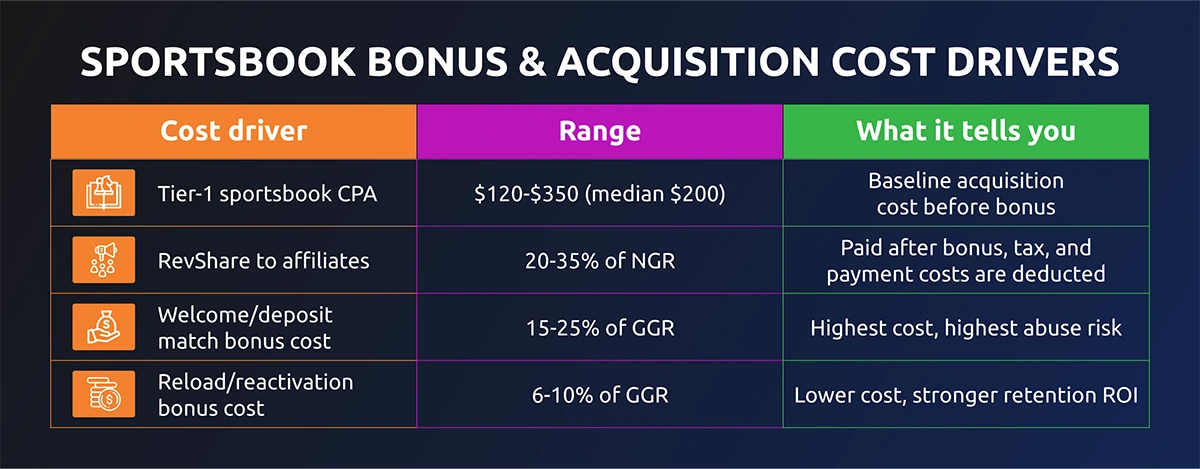
Before you design a single offer, ask whether your bonus is earning back what it costs. Bonus spend now determines whether your acquisition math works at all. Tier-1 sportsbook CPA runs $120 to $350 per first-time depositor in 2026, with a $200 median, and most of that cost sits inside the welcome bonus you pay out on day one. The real significance of bookmaker bonuses lies in the fact that a bonus is not something separate from the cost of customer acquisition. In fact, it is that very cost, only paid to the player rather than to the advertising network.
The right lens for measuring a bonus program is net acquisition cost against lifetime value, not the bonus figure against raw signups. A $200 welcome offer that converts a player who deposits once and vanishes is a $200 write-off, full stop. The same $200 offer against a player who goes on to generate $600 in NGR over six months is a channel worth scaling. The landing-page number alone tells you nothing about which of those two players you’re buying.
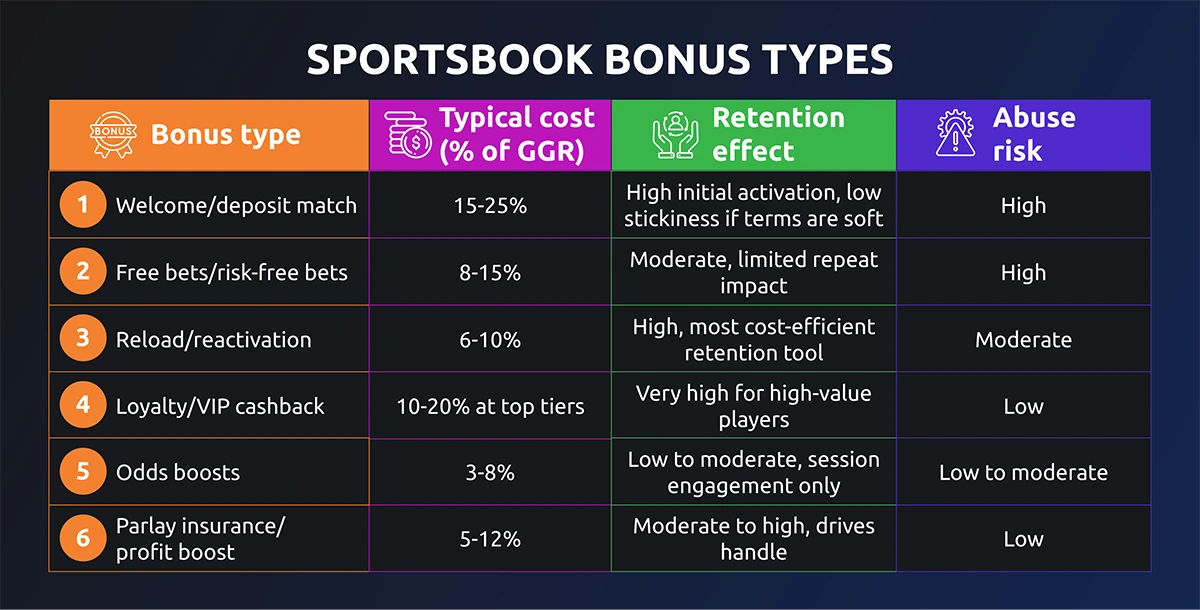
Sports betting bonus ROI should be tracked by bonus type, not blended into one company-wide figure. Reload and reactivation bonuses run 6% to 10% of GGR and tend to produce the strongest retention lift to dollar. Welcome offers and free bets run 8% to 25% of GGR and carry the highest abuse exposure of any category. Fold both into a single “bonus spend” line, and you lose the ability to see which promotions are paying for themselves and which ones are quietly draining margin.
The Full Range of Sportsbook Bonus Types Operators Deploy
Sportsbook bonus types 2026 fall into seven working categories, and each one carries a different cost profile, retention effect, and abuse risk. Treat all seven as interchangeable slots on a monthly promo calendar, and you’ll overspend on the ones that don’t earn their keep. The sports betting bonus categories below, from the sportsbook welcome bonus through VIP cashback, reflect what’s running this year, not a theoretical list carried over from 2022.
Welcome Bonuses (Bet & Get, Deposit Match, First-Bet Refund)
To simplify, in the highly competitive online sports betting market, a sportsbook welcome bonus can be explained in one line: it’s the first offer a new depositor sees, structured as a bet-and-get, a deposit match, or a first-bet refund.
When you look at the best sportsbooks’ welcome bonus offers in 2026, most lean toward bet-and-get, because it pays out a fixed, guaranteed amount regardless of whether the qualifying bet wins, sidestepping the wagering-requirement complaints that dogged deposit-match offers for years.
A deposit match still doubles a player’s bankroll on paper, but that money sits locked behind a rollover requirement before it’s withdrawable. A first-bet refund lands in between: place a bet, and if it loses, get the stake back as bonus credit.
No Deposit and Free Bets
No deposit bonuses let a player claim bonus credit without funding an account first, a useful trial mechanic, though rarely offered at meaningful size because the abuse exposure is severe when there’s zero financial commitment from the player. Free bets ask for a real-money stake but return only the net winnings, not the stake itself, which keeps the operator’s liability capped and predictable no matter how the bet lands.
Reload and Replenishment Bonuses
Reload bonuses reward existing players for a subsequent deposit, usually at a smaller match percentage than the welcome offer. This is the workhorse of a mature retention program: cheaper than acquisition bonuses, far less attractive to professional bonus hunters, and tied directly to the exact behavior you’re trying to reinforce, a player choosing to come back and fund their account again.
Cashback and No-Sweat Bets
Cashback returns a percentage of a player’s net losses over a defined window, either as cash or bonus credit. No-sweat bets are a single-bet variant, refunding the stake on one qualifying wager if it loses. Both function as a psychological safety net that keeps one bad session from becoming the reason a player never comes back.
Parlay Boosts, Profit Boosts, and Insurance Bets
Parlay boosts increase the payout on multi-leg bets, encouraging exactly the bet type that carries the sportsbook’s highest hold percentage. Profit boosts apply a flat percentage increase to winnings on a single wager. Parlay insurance refunds the stake if a parlay loses by one leg, which keeps players betting the higher-margin product without absorbing full downside risk on every ticket.
In our experience, the logic behind which specific events get an odds boost comes down to margin and traffic quality, not just marketing flair. A sportsbook’s margin is the gap between true odds and the posted price. On a coin flip, true odds sit at 2.0 on both sides, but a 107% margin turns that into roughly 1.85 on each side, the sportsbook equivalent of RTP on a slot machine.
Boosting odds on a handful of major, mainstream fixtures thins that margin on paper, but it’s a deliberate trade: high-profile events draw recreational betting volume rather than sharp, informed money, so the house stays well protected even at a lower margin, and a visibly boosted price on the top events signals value to players comparing odds across competing books. That logic breaks down fast on obscure leagues or lower-tier fixtures, where thin margins can’t absorb the insider and informed betting those markets tend to attract.
Event-Linked and Seasonal Promotions
These are time-boxed offers tied to a specific match, tournament, or season: boosted odds on a Super Bowl prop, a cashback special during March Madness, a parlay insurance push around the World Cup. They spike handle during predictable high-traffic windows and give your CRM team a natural, non-generic reason to message players who’ve gone quiet.
Loyalty and VIP Bonuses
Loyalty and VIP bonuses scale with a player’s tier, funded by points, cashback rates, or dedicated promotions unavailable to the general base. These carry the lowest abuse risk of any bonus category, since eligibility is gated by verified wagering history rather than a signup event, and they consistently deliver the strongest ROI of anything on this list against your highest-value segment.
The 2026 Standard: Why Bet & Get Dominates Welcome Offers
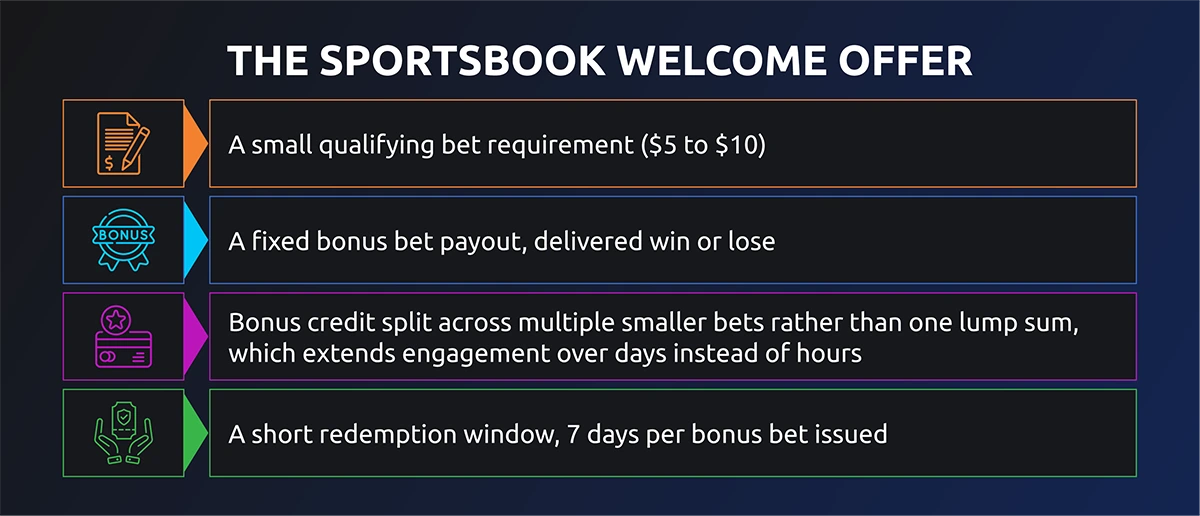
One welcome-offer format has quietly taken over the whole industry this year. The guaranteed welcome offer became the default headline promotion in 2026 because it removes the single biggest source of new-player frustration: a bonus that looks huge on the landing page but pays out nothing if the first bet loses. A bet-and-get structure, wager $5 and receive $150 in bonus bets regardless of outcome, guarantees value up front. That guarantee converts better on paid acquisition traffic where the player has zero existing trust in the brand.
This shift isn’t just a UX preference. Regulatory pressure across UK and EU markets has pushed operators away from deposit-match offers with steep wagering requirements toward simpler, guaranteed structures, and US operators adopted the same model because it tests better on conversion.
Based on our conversations with operators, the deeper reason bet-and-get has overtaken wagering-based welcome offers is math, not just landing-page psychology. A standard casino wagering requirement, often 40x, clears in about 20 minutes of slot spins. Apply that same multiplier logic to sportsbook, where a player might only have one or two matches worth betting on in a given week, and clearing six or seven qualifying bets can take two or three weeks.
That’s long enough to lose the player before the bonus ever pays out. A risk-free bet sidesteps the problem entirely: deposit, place one bet, get it refunded if it loses, no wagering multiplier to grind through. From the player’s side, it reads as a straightforward safety net rather than a hurdle, frictionless without the player ever needing to understand the mechanics behind it.
The sportsbook welcome offer standard now looks like this at most major regulated books:
Rollover Math: What Operators (and Players) Should Actually Model
Here’s a question worth sitting with: if you quoted your own rollover terms to a finance team member with no gaming background, would the number make sense to them? Rollover wagering requirements and sportsbook terms determine how much of a bonus’s headline value the operator pays out, and the math is rarely intuitive from the multiplier alone. A 5x rollover on a $100 bonus means $500 in qualifying wagers before the bonus converts to cash available for withdrawal. Still, the operator’s real liability isn’t the full $100; it’s $100 minus the margin recovered on that $500 of handle.
Let’s walk through the sportsbook math: an operator offers a $100 deposit match at 3x rollover. The player wagers $300 across several bets, loses $180 net, and withdraws the remaining $120. At a 5% hold rate on that $300 of handle, the operator recovers roughly $15 in margin, so net bonus liability is closer to $85, not $100.
Run the identical offer at 6x rollover with a minus-150 odds floor instead, and recovered margin rises to about $30, cutting net liability to $70. Over 10,000 redemptions, that $15 difference per player adds up to $150,000 in protected NGR.
Three levers control the bonus real cash value an operator ends up paying:
- Rollover multiple: industry standard sits between 3x and 8x, calibrated by offer type.
- Odds floor: minimum odds of -200 or higher prevent players from meeting the wagering requirements by betting on near-certain favourites where the casino’s edge is virtually zero.
- Expiry window: The 7- to 14-day period allowed for using the bonus means that the rate of unused welcome bonuses remains steady at between 20 per cent and 35 per cent, which means that a significant proportion of the value of the bonuses awarded is never used at all.
The converted bonus rate, the percentage of issued bonus value that clears rollover and becomes withdrawable, is the single number that tells you whether your terms are calibrated correctly. Track it by bonus type. A converted rate above 80% usually means your rollover is too soft and you’re overpaying. A rate under 40% risks player complaints and regulatory scrutiny for terms that are functionally unmeetable.
Designing Bonuses That Actually Convert
Designing sportsbook bonuses that move real metrics starts with rejecting the idea that a bigger headline number automatically performs better. A $200 bonus with harsh terms often converts worse than a $75 bonus with clean, transparent terms, because players increasingly compare rollover requirements before they compare bonus size.
The bonus conversion rate from claim to first qualifying wager is the metric that reflects offer quality, not the raw signup number sitting on a dashboard.
Data-Driven Personalization
How do you use a sportsbook bonuses guide like this one in practice? Start by matching the offer to what your segmentation data already tells you about a player, rather than running the same promotion at everyone in the database.
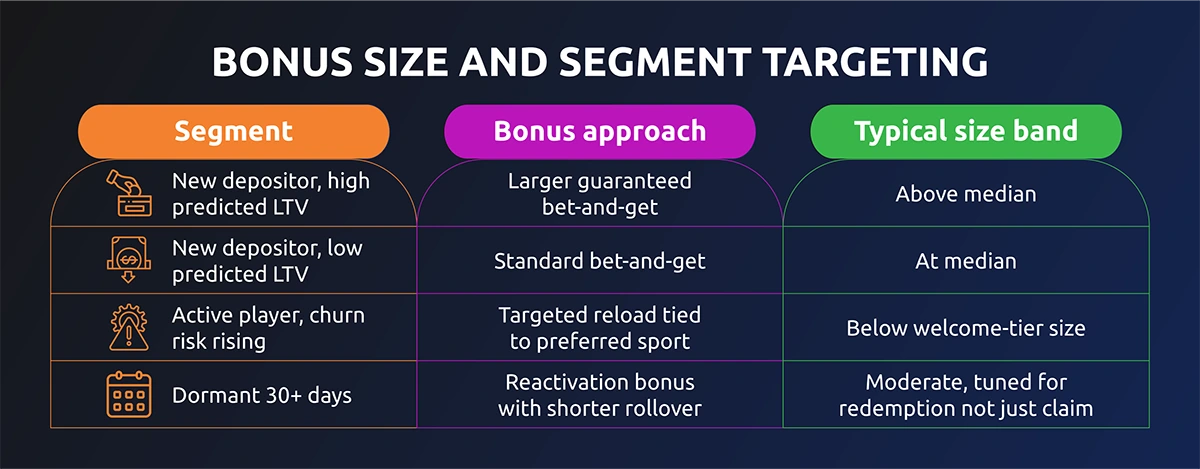
Personalization bonus data analytics pulls from deposit history, sport preference, session frequency, and prior bonus redemption behavior to predict which offer size and structure will move a specific player. A high-frequency NFL bettor and a casual monthly depositor respond to entirely different triggers, and sending both the same generic reload offer wastes budget on one while under-serving the other.
Bonus Size and Segment Targeting
Bonus size optimization means setting offer value against expected LTV per segment, not applying a flat rate across your entire base. Target segments sportsbook bonus programs typically split into three or four tiers:
Time Limits and Urgency
Short redemption windows do double duty: they create urgency that drives faster engagement, and they cap the operator’s open liability on issued bonus credit. A 7-day window on bonus bets tied to a specific event outperforms an open-ended 30-day window on both fronts: faster redemption and fewer forfeiture-driven complaints.
Bonus Codes and Distribution Channels
Bonus codes let an operator track exactly which channel, affiliate, or campaign drove a given claim, and that tracking matters more for fraud detection than for the player experience itself. Distribute codes through affiliates, email, and in-app push separately, then track redemption rate by channel. A channel with an unusually high claim-to-fraud-flag ratio is often the first sign of a compromised affiliate or a bonus-hunting ring working a specific traffic source.
Wagering Requirements: Balancing Fairness and Sustainability
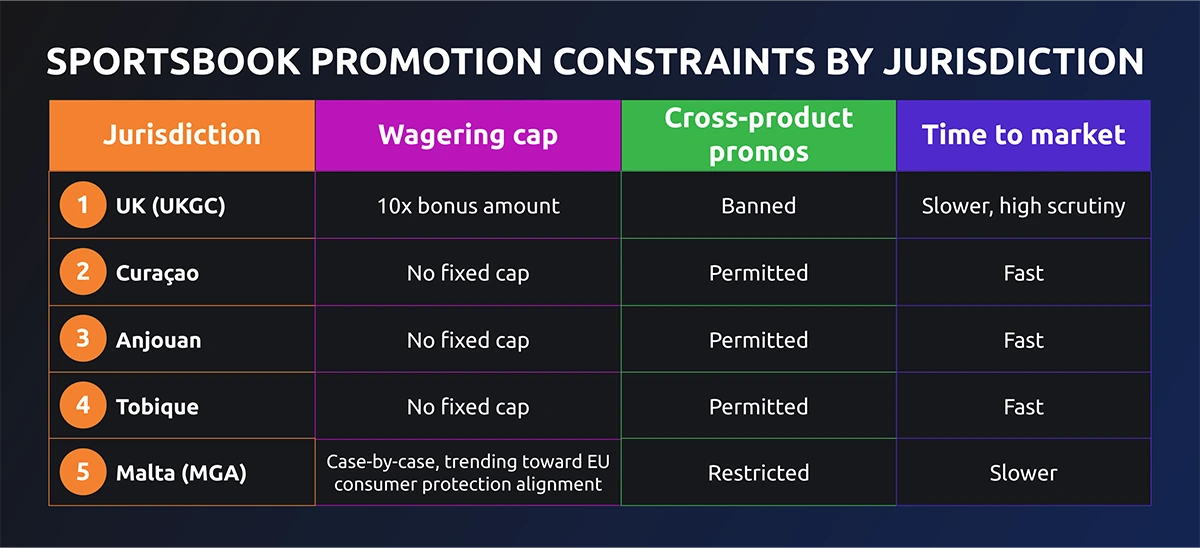
Sportsbook wagering requirements exist to stop a bonus from acting as an instant cash giveaway, and in 2026 the line between fair and functionally-a-trap has moved sharply. The UK Gambling Commission’s rules, effective January 19, 2026, cap bonus wagering at 10x the bonus amount for all UKGC-licensed operators, down from the 35x to 50x multiples that were standard practice for years. The same rule bans mixed-product promotions outright, so an offer can no longer require sports betting activity to unlock a casino reward, or vice versa.
Bonus fairness now means terms a player can calculate before accepting the offer: a stated multiplier, a clear odds floor, and no surprise changes to conditions once a player has already started wagering toward them.
Operators outside UKGC jurisdiction aren’t bound by the 10x cap, but the direction of travel across every major regulator points the same way, and building sustainable bonus terms now avoids a costly retrofit later.
A practical band that holds up across most jurisdictions:
- 3x to 5x rollover for reload and reactivation offers
- 5x to 8x rollover for welcome and deposit-match offers
- Minus-200 odds floor or longer on any bonus with a rollover attached
- 7 to 14 day expiry, matched to the offer type and stated in plain terms, not buried in a linked terms page
Based on our conversations with operators, the practical sweet spot for a sportsbook wagering multiplier is 6x to 7x, well under the UKGC’s 10x ceiling and nowhere near the 40x common in casino. Push past that and retention suffers measurably. The stronger lever isn’t the multiplier at all; it’s requiring parlays of three or more legs to satisfy the requirement rather than single bets. Single bets are the primary vehicle for bonus abuse, while parlays carry a higher margin for the operator even at a lower multiplier like 5x.
Several operators go further and recommend skipping the wagering-bonus format altogether in favor of a risk-free bet as the core welcome and reload mechanic, arguing that casino bonus logic doesn’t transfer cleanly to sportsbook, and that risk-free bets outperform wagering-based offers on engagement, particularly outside CIS markets where live, in-play betting dominates.
Bonus Abuse Prevention in 2026
How big is the abuse problem, really, and is it something a small operator needs to worry about on day one? Sportsbook bonus abuse is now the top fraud concern in the industry: 78% of North American gaming professionals cite it as the single biggest fraud threat facing their business, and it accounts for close to two-thirds of all detected iGaming fraud globally.
Operators without dedicated detection logic report bonus-related losses running 4% to 11% of bonus-funded gross gaming revenue, and some unprotected operators lose up to 15% of total revenue to promotional abuse and related fraud combined. Even a small operator needs this solved before launch, not after the first fraud ring finds you.
Bonus abuse detection in 2026 relies on layering behavioral and technical signals rather than any single check:
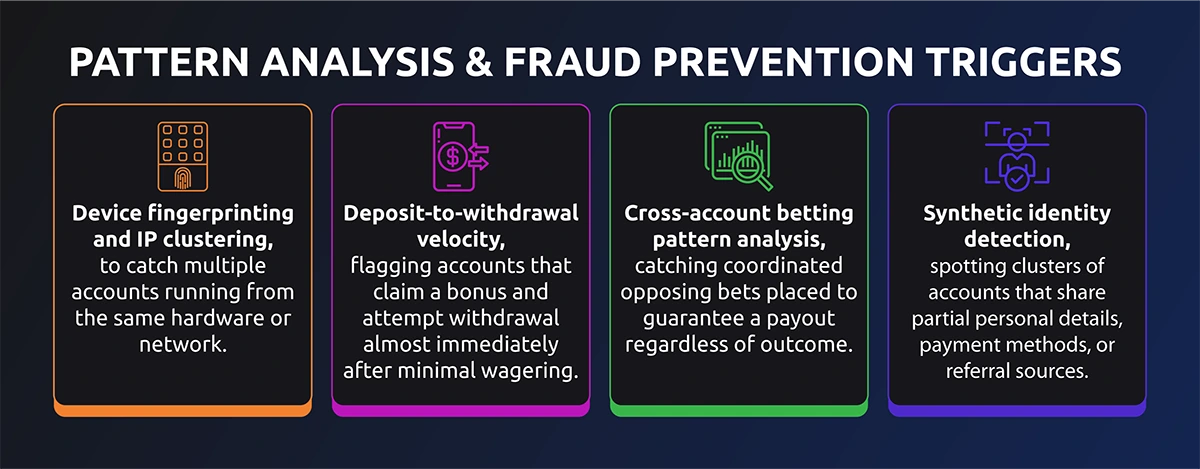
Multi-accounting sportsbook rings have moved well past a single player claiming the same offer twice. Coordinated operations now run dozens or hundreds of accounts across VPNs, emulators, and partially fabricated identities, engineered to resemble a normal stream of new signups rather than a single abuse source. The strongest defence embeds fraud rules directly into bonus issuance logic, velocity checks and fingerprinting run before a bonus is credited, not in a monthly audit after the funds are already gone.
Operators we interviewed break sportsbook-specific abuse into four recurring profiles worth watching for by name:
- Courtsiding, or post-goal betting. A bettor with a faster data feed places a wager in the 3 to 5 second gap between a live event happening and the sportsbook’s own system catching up. Flagging any bet placed within 10 seconds of a score change, especially when it shows up in 3 or more of a player’s last 10 bets, catches this reliably.
- Arbitrage, or “fork,” bettors. These exploit pricing gaps across competing books where the combined odds on both sides of an event add up to under 100%, a mathematically guaranteed profit no matter the outcome. Pulling live odds from a handful of competitors and flagging any bet that creates a fork in real time catches it as it happens. A single fork bet isn’t automatically a red flag, professionals need high betting frequency to cover their costs, so a pattern of 3 or more forks across 10 bets is the real signal, and pre-match forks show up as a high share of single bets concentrated in obscure leagues.
- Value bettors trading on privileged information. Functionally insider trading applied to sports betting: a player places a large bet before the market has adjusted to news like an injury report. Tracking how a coefficient moves in the run-up to kickoff flags the large, early drops that mark informed money moving first, which also separates that group from “steam chasers,” players with no inside information who are simply following a line that’s already dropping.
- Match fixers. Harder to catch player by player, since disposable accounts and fake identities make individual bans largely ineffective. The more effective response is refusing bets on the suspicious fixture itself rather than trying to identify every account behind it.
Regulatory Constraints on Sportsbook Bonuses by Jurisdiction
Running the same bonus program across every market you’re licensed in is getting harder by the year. Sportsbook bonus regulation varies enormously by license, and the gap between what’s legal has widened sharply since January 2026. The UKGC bonus rules now cap wagering at 10x the bonus amount and prohibit any promotion that requires activity across more than one gambling product to unlock, changes that forced a full redesign of promotional systems for every UK-facing operator this year.
Jurisdictions like Curaçao, Anjouan, and Tobique don’t currently mirror the UKGC’s wagering cap, which gives operators licensed there real flexibility to run deposit-match and cross-sell promotions that would be illegal under a UK license.
That flexibility is a genuine competitive advantage for a startup sportsbook still finding its acquisition economics, but it isn’t a reason to ignore where regulation is heading.
Picking the right jurisdiction is exactly the kind of strategic call LicenseGentlemen specializes in, matching a market to your actual business rather than defaulting to whichever license looks familiar: a jurisdiction with lighter bonus restrictions gets you to market faster, while a tighter-regulated license carries more acquiring-bank trust and cleaner long-term compliance. Schedule a free call if you want help weighing which one fits your target markets and runway.
Bonus KPIs Every Sportsbook Operator Must Track
Sportsbook bonus KPIs tell you whether a promotion is working or just looks active on a dashboard. The one that matters most is the bonus cost NGR ratio, bonus spend measured against net gaming revenue rather than GGR. A 20% bonus-to-GGR ratio can translate into a 50% bonus-to-NGR ratio once taxes and payment costs are stripped out, which is why tracking against GGR alone consistently understates true bonus cost.
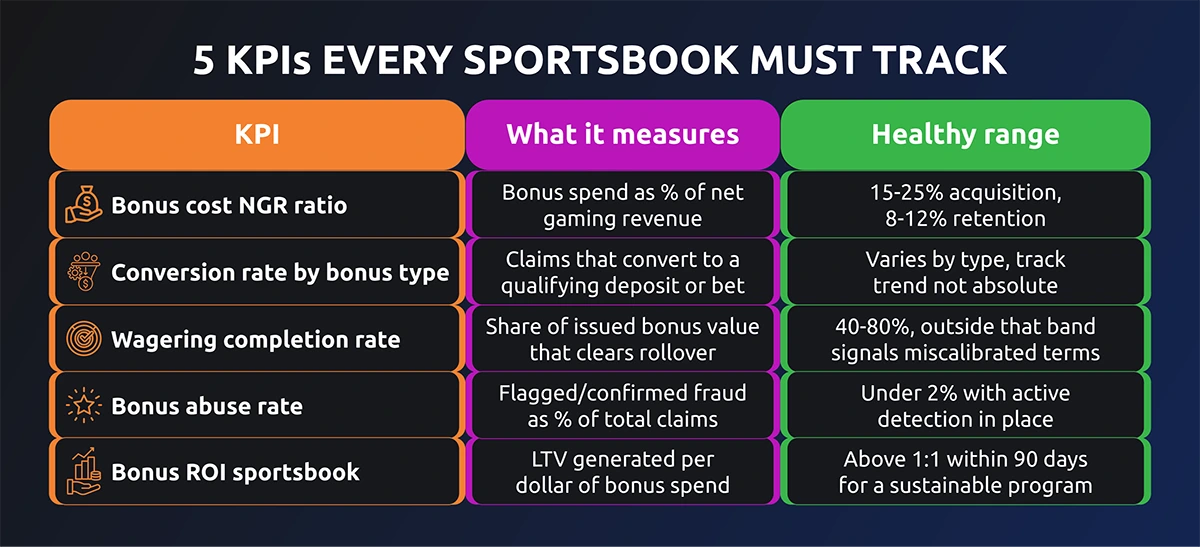
Conversion rate by bonus type should never be tracked as one blended figure. A welcome offer and a reactivation bonus serve entirely different purposes and will always convert differently; comparing them on the same scale hides which one is underperforming.
Wagering completion rate and bonus abuse rate together tell you whether your terms are too soft, too harsh, or being actively exploited. Bonus ROI sportsbook tracking ties all of it back to LTV; run all four KPIs side by side before adjusting any single lever.
Common Mistakes Operators Make With Bonus Design
Some mistakes sink a bonus program. Others just feel risky and rarely matter. Sportsbook bonus mistakes almost always trace back to a handful of repeatable bonus design errors rather than bad luck or an unusually sophisticated fraud ring. The most common ones we see:
- Measuring cost against GGR instead of NGR, which makes an unsustainable bonus program look healthy on paper until the quarterly numbers come in short.
- Offering an overly generous bonus to match a competitor’s main offer, without analysing the actual figures for the transfer of funds, the size of which catches the eye in the screenshot.
- Blanket offers with no segmentation, sending the same reload bonus to a high-value VIP and a dormant low-stakes player, wasting budget on one while under-rewarding the other.
- No fraud rules built into issuance, catching abuse only after payout instead of at the point a bonus is claimed.
- Cross-product bonuses in regulated markets that now ban them, a legacy promo template built before January 2026 that’s simply no longer legal under a UKGC license.
- Ignoring wagering completion rate, running the same rollover terms for years without checking whether they’ve drifted too soft or too harsh for current player behavior.
These bonus profitability issues and bonus retention pitfalls rarely show up all at once; they erode margin quietly, month over month.
LicenseGentlemen’s support doesn’t stop at the license itself. We also help set up the company structure behind it, including banking and payment rails, so operators aren’t rebuilding that scaffolding after a bonus program launches on the wrong foundation. Schedule a free call if your current bonus terms haven’t been reviewed against your license yet.
FAQ
Bet-and-get dominates in 2026: a small qualifying wager (typically $5 to $10) returns a fixed bonus bet payout regardless of whether the qualifying bet wins. It replaced deposit-match offers as the headline promotion because it guarantees upfront value and converts better with new players who have no prior trust in the brand.