
Updated GCB Curaçao License: Key Changes 2026
Here is what no one tells you about the new Curaçao license until it is too late. One day everything is fine. The next, a payment provider won’t onboard them, a bank account is frozen, or an application comes back rejected. By the time that happens, the damage is done.
The GCB Curaçao license changed completely in 2026. The LOK framework replaced the old master license system with a government-controlled regulator, real enforcement powers, and a 38% application rejection rate. What used to take weeks and cost next to nothing now takes months and costs €130,000 to €150,000 in year one.
If you’re planning to apply, renew, or keep operating under a Curaçao gaming license, this is what you need to know before you make a move.
From NOOGH to LOK: A Quick Recap of How We Got Here
To understand what Curaçao requires of you today, you need to understand what it used to let slide. For most of its history, the island ran on a regulation called NOOGH, dating back to 1993 and never designed for the scale that online gaming would eventually reach. A handful of private companies held master licenses and handed out sub-licenses to operators at their own discretion. No standardization. No real oversight. Almost no accountability.
Why the master/sublicense model was scrapped
Four master license holders ran the old Curaçao master license network:
- Antillephone
- Curaçao eGaming
- Gaming Curaçao
- Curaçao Interactive Licensing
Each operated independently, with their own rules and their own standards. An operator could spin up a gambling brand, pay a registration fee, stick a tiny seal on the homepage, and go live. Nobody was looking closely at where the money came from or who ran the business.
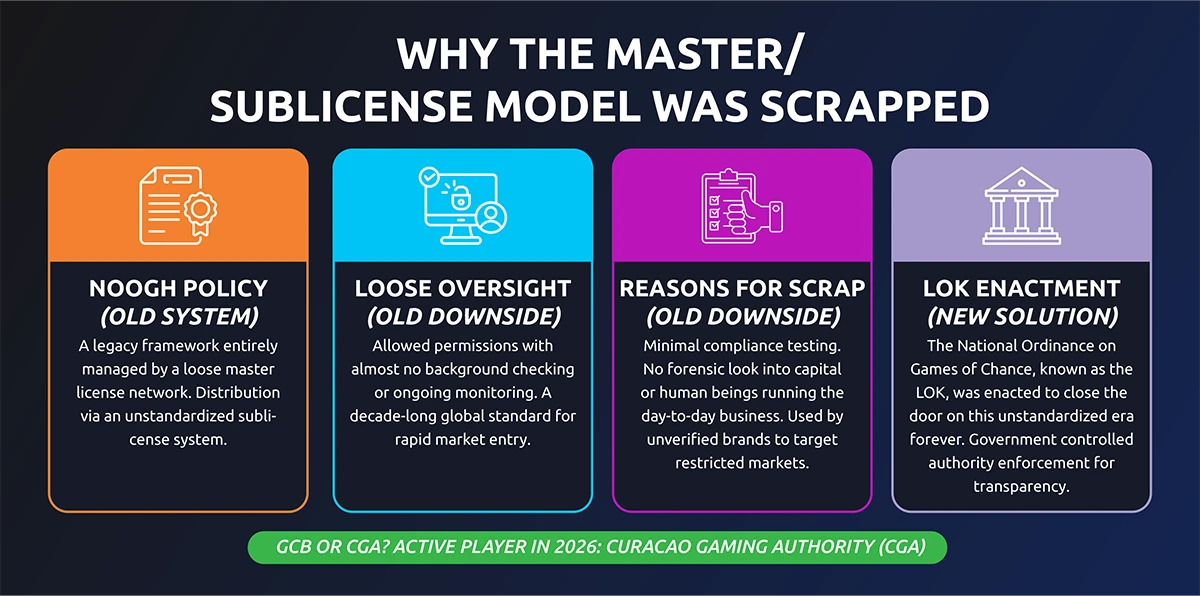
That worked for a long time. Then it didn’t. As online gaming grew into a global industry, the international banking and regulatory community started paying attention to where these licenses came from. The old Curaçao license was being used to target markets operators had no legal business entering. Reform became unavoidable.
The Structural Shift: The National Ordinance on Games of Chance, known by its Dutch acronym LOK, came into force on December 24, 2024. The old sublicense system was abolished overnight. All legacy sublicenses expired in January 2025. The four master license holders no longer exist. Every operator now applies directly to a government authority. The CGA LOK reform didn’t update the old system; it replaced it entirely.
GCB or CGA? The Authority Behind the License in 2026
Many operators are still emailing old contacts, referring to old documents or searching for the GCB Curacao license as if it still exists. It doesn’t. Now it’s the Curaçao Gaming Authority (CGA) that’s the active authority and they are the ones that control everything: license issuance, enforcement, the public register and your ability to stay in business.
What GCB still does vs what CGA owns
The Gaming Control Board (GCB) was a placeholder name until the LOK framework was finalized. After the law was enacted and the new infrastructure was in place, the authority was reorganized and renamed the Curaçao Gaming Authority (CGA). The transition was a quiet one, with no grand announcements or new buildings, the name changing as the institution changed.
Then you apply to the Curacao Gaming Authority, pay fees to the CGA and call the CGA if there is a problem. The GCB has become a historical reference only.
CGA enforcement powers and public register
The CGA maintains a live public register of all valid licensees and has formal enforcement powers, including suspension and revocation. As of early 2026 the register shows more than 330 active licenses. Real-time count, accurate, public, and free.
All legitimate licensed operators will have a CGA seal in the footer. Clicking it routes directly to cert.cga.cw, where the license status is listed as:
- Active
- Withdrawn
- Suspended
- Revoked
The CGA publicly called out fraudulent operators using copied seals as recently as February 2026. That kind of active enforcement didn’t exist under the old system.
What changed in 2026
The actual experience of holding a license this year brings an entirely new set of operating burdens that founders must account for in their business plans. The territory has leveled up its reporting standards to clear its name with international compliance networks. To see how this affects your software supply chain, we need to dive into the current operational divisions.
B2C vs B2B: The new two-track licensing system
Under the old system, one sub-license covered everything. That’s gone. There’s now a hard split between two categories:
- B2C License Curaçao: This is for player-facing operations, including online casinos, sports books, lotteries, and live dealer platforms. If players interact directly with your platform, this is your license.
- Annual fee: €47,450.
- B2B License Curaçao: This covers companies supplying services to operators, such as game studios, platform providers, payment processors, and compliance tech providers. If your customer is an operator rather than a player, this is your track.
- Annual fee: €24,490.
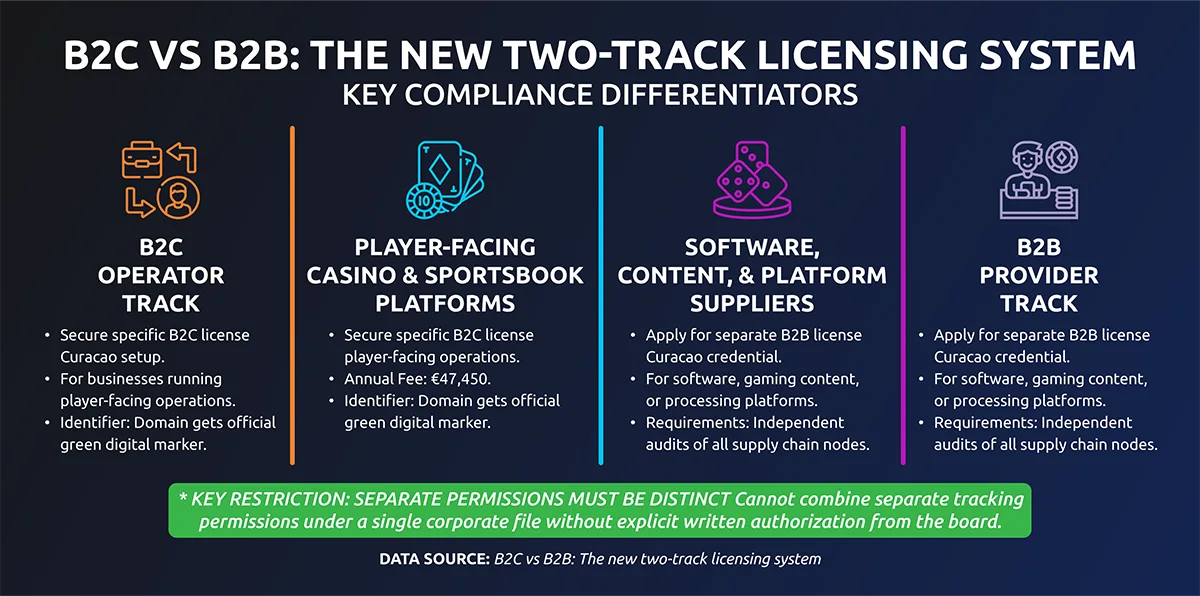
One clarification that a lot of articles get wrong: as of 2026, B2B suppliers are not yet required to hold a separate license to supply B2C licensees. That requirement is on the CGA’s roadmap but hasn’t been formally enforced. Neither license type can be combined without specific written CGA authorization.
Local substance, AML/FATF and technical standards
The iGaming compliance 2026 requirements under the CGA go well beyond what operators dealt with under the old system. These are enforced conditions, not suggestions.
- Local Substance: A Curaçao company and local managing director are required today. The CGA planned to introduce additional staffing requirements but placed them on hold after we and other compliance providers pushed back. Operators were being hit with too many new requirements simultaneously. The CGA listened and postponed the substance requirements to 2027. How many staff, what roles, what salary minimums, and whether employees can be shared across entities. All of this is still being worked out. Until those specs are published, the managing director requirement is what’s in force.
- AML/FATF Compliance: The CGA requires FATF-aligned AML policies, KYC procedures for all players, enhanced due diligence for high-value transactions, a dedicated MLRO, and ongoing transaction monitoring. This applies to fiat and crypto equally. There is no shortcut.
- Technical Standards: A data center physically located in Curaçao is now mandatory. “Serverius” is one provider the CGA has worked with directly and a practical starting point for operators evaluating hosting options. RNG certification from an independent test house is required. All active domains must be registered and verified with the CGA, and the CGA seal must appear on every licensed domain.
- Tax Compliance: New in 2026, the CGA requires a tax declaration from the local tax authority confirming your company is in good standing. All filings must be current, with no outstanding debts. Both the CGA and the tax authority are government bodies and they cross-check each other. Any tax issue with your Curaçao entity means the application won’t clear.
PLANNING TO LAUNCH AN ONLINE CASINO, SPORTSBOOK, OR LOTTERY?
Download the full list of restricted countries under the Curacao license.
The End of the Orange Seal Era
The orange seal represented an operator in transition: application submitted, license pending, business running while the review was ongoing. That safety net is gone.
October 15, 2025: The hard cutoff
The orange seal Curaçao program ended on October 15, 2025. No extensions. No grace periods. Any platform still displaying an orange seal after that date was operating without valid authorization, full stop.
If you’re still on an orange seal or an old sub-license, this isn’t a compliance gray area. You’re running an unlicensed operation. Get in touch with us immediately and we’ll work out the fastest path to resolution.
Green vs blue seal: What each means now
A lot of older articles still describe a green seal for B2C operators and a blue seal for B2B suppliers. That information is outdated. In 2026, the CGA uses a single grey seal. One seal, four possible states: Active, Withdrawn, Suspended, or Revoked.
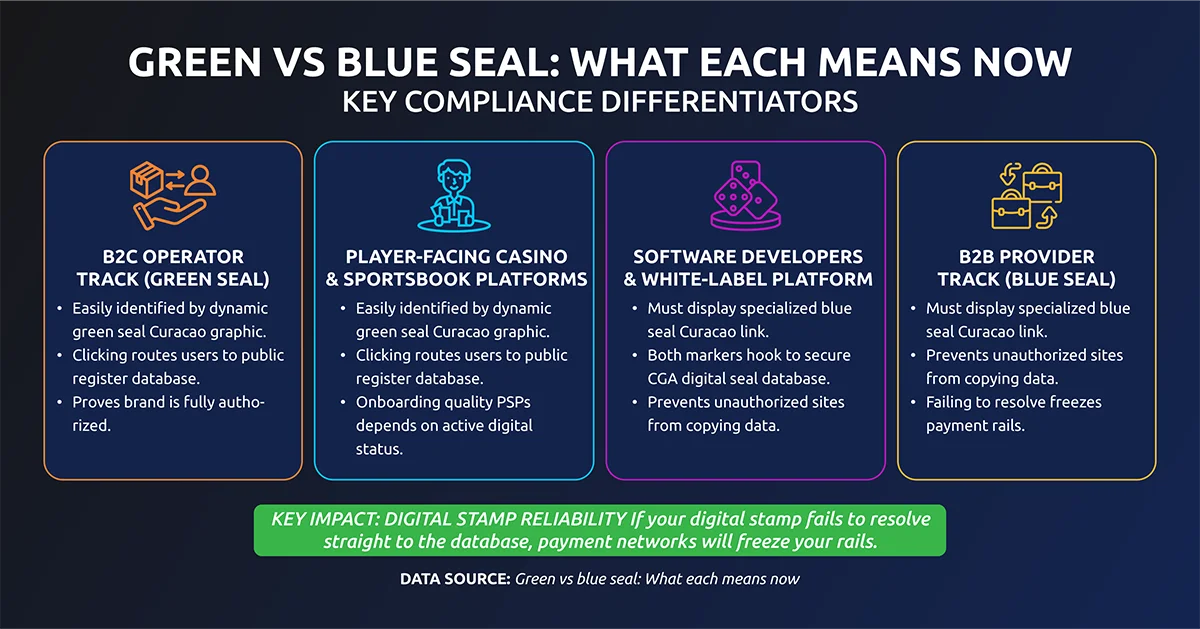
The seal appears in the footer of every licensed operator’s site. Clicking it takes you to cert.cga.cw, where anyone can verify the license status in real time. Check the footer of Stake.com if you want to see what a properly displayed, active CGA seal looks like. If a site can’t produce a valid, clickable seal resolving to an active CGA record, it’s unlicensed.
Direct Licensing Under CGA: What Operators Experience in 2026
The application process today is structured, demanding, and unforgiving of sloppy preparation. Operators who’ve been through it consistently say the same thing: the documentation requirements were harder than expected. Not the fees; the paperwork. To help you prepare your files without stalling your timeline, let us look at the current documentation requirements.
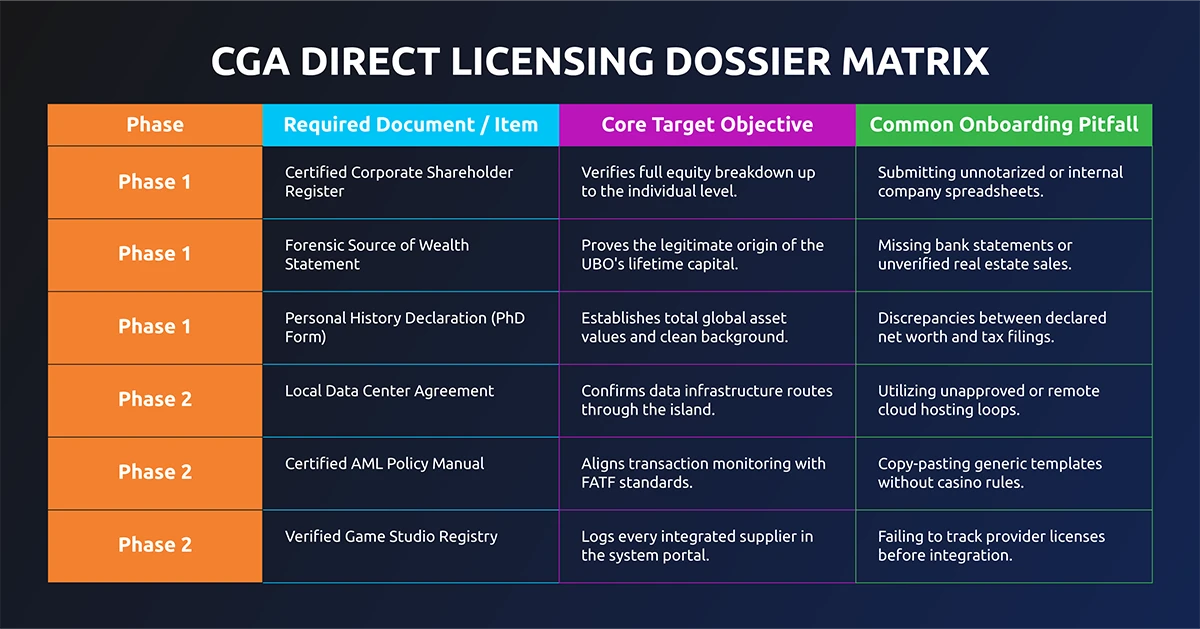
Phase 1 (integrity/UBO) vs Phase 2 (technical audit)
Phase 1 is where most operators run into trouble. It’s the integrity and ownership review. You need three forms: an online gaming application form, a business information form, and a personal history declaration for each UBO. You also need company articles, a notarized shareholder register, a business plan, and proof of source of funds for both the company and the UBO, with declared annual income and net worth.
Phase 1 takes around four weeks, but the CGA almost always comes back asking for more on source of funds and source of wealth. That follow-up exchange is where timelines stretch and unprepared operators stall indefinitely. If a UBO says they have €2 million in capital but can’t produce a clean paper trail showing where it came from, the application freezes. Bank statements with gaps, unexplained transfers, and a business plan that reads like a template; these are the most common reasons applications grind to a halt at Phase 1. Sort the financial documentation before you submit, not after the CGA comes back asking for it.
One thing that catches operators off guard is the CGA charges. A non-refundable application fee of approximately €4,000 before they even look at your submission. This started in 2024. If the application is rejected and the objection fails, that money is gone. Preparation before submission is how you protect that €4,000.
Phase 2 covers policies, game provider lists, RNG certificates, domain verification, and operational readiness checks. AML policies, player complaint procedures, and responsible gaming documentation can be submitted here rather than with the initial application, which gives operators some breathing room. Phase 2 runs about four weeks with clean documentation. The UBO requirement applies to anyone holding 10% or more equity.
CGA Direct Licensing Dossier Matrix
Temporary vs definitive license: Operational impact
Operators who applied during the 2024 transition received provisional licenses that renewed every six months. That cycle is ending as the CGA transitions eligible operators to indefinite licenses that renew annually.
There are ongoing compliance checks, but the intense back and forth of the initial review is over. For new applicants starting fresh in 2026, the realistic timeline from submission to first license is 3 to 5 months assuming documentation is in order from day one.
The 38% Rejection Rate: What CGA Is Actually Enforcing
Nearly 40% of applications are hitting a wall. By April 2026, the CGA had received approximately 140 direct licence applications, approved 87 and rejected or shelved the rest. The process isn’t broken. The CGA is doing exactly what it was built to do: keeping out underfunded, underprepared, and non-compliant operators.
Phase 1 failure triggers: UBO, capital, documentation
Most rejections happen at Phase 1, before auditors reach the technical review. The patterns are consistent:
- A UBO who claims significant capital but can’t trace its origin stalls the application immediately.
- Bank statements with unexplained gaps or transfers are the single most common rejection trigger.
- Documents that expire mid-review create delays. Every piece of ID must be current at submission.
- Complex ownership structures where not everyone holding 10% or more has submitted a full documentation set consistently cause problems.
- Business plans that read more like wishful thinking than funded operations don’t pass.
Rejection isn’t always permanent. The CGA’s denial letter specifies exactly what was missing. Operators can file a formal objection with supporting documentation.
We’ve done this for several clients: put together point-by-point responses to every CGA concern, and in a number of cases the license was granted on the second attempt. Getting it right the first time is faster and cheaper, but the door isn’t sealed shut after a rejection.
AML gaps and anonymous crypto platforms
Crypto casino Curaçao operators face a layer of scrutiny fiat-only platforms don’t deal with. The CGA requires chain analysis tools capable of flagging suspicious wallet activity, full KYC on every player regardless of payment method, wallet ownership disclosures and source-of-funds verification for crypto deposits, and an MLRO who carries personal liability for compliance failures. Anonymous platforms that never collected player identity data under the old system are rejected at Phase 1. There is no path around it.
The MLRO role gets underestimated. This person takes personal responsibility for your platform’s compliance in the eyes of the CGA. Prior experience in gaming or banking compliance is required. They need to be genuinely embedded in your daily operations, not a name on a document reviewed once a year. A professional MLRO costs around €4,000 per month. That’s what the personal liability is worth.
Upcoming Deadlines That Will Shape 2027–2028
The CGA is staggering the rollout, which means the compliance calendar keeps filling up. Miss any of these dates and you’re not dealing with a fine; you’re dealing with a license risk. Three dates to track: October 8, 2026, for the T&C update required of all B2C licensees; 2027 (exact date still to be confirmed) for local substance staffing requirements; and year five of the license for additional local employee obligations, with numbers still pending CGA publication.
October 8, 2026: T&C update deadline
All B2C operators are required to update their player-facing terms by October 8, 2026. This should include account closures, dormant accounts, payouts, refunds and crypto transactions. This is a substantive policy review across several areas of your platform, not a footer text edit. The LOK has no room for negotiation on the Curaçao T&C deadline. If you’re not started yet, you’re already behind.
December 2026 + April 2027 – B2B and staffing cutoffs
Currently, B2B suppliers are not required to have a CGA licence to supply B2C operators, but this is on the regulatory roadmap. As December 2026 nears, stay vigilant with official CGA communications. When enforcement lands, it will require the same two-phase review as B2C. There won’t be a long runway.
The CGA confirmed they’ll revisit local staffing requirements in 2027, but the specs are still unknown. How many people, what roles, what salary minimums, and whether employees can be shared across licensed entities. None of it is published yet. The managing director requirement is in force today, but more requirements are coming. Start mapping your local hiring options in Curaçao now.
What Operators Should Be Doing Right Now
Reactive compliance is how operators end up in emergency mode. Act now, or the deadlines make these decisions for you.
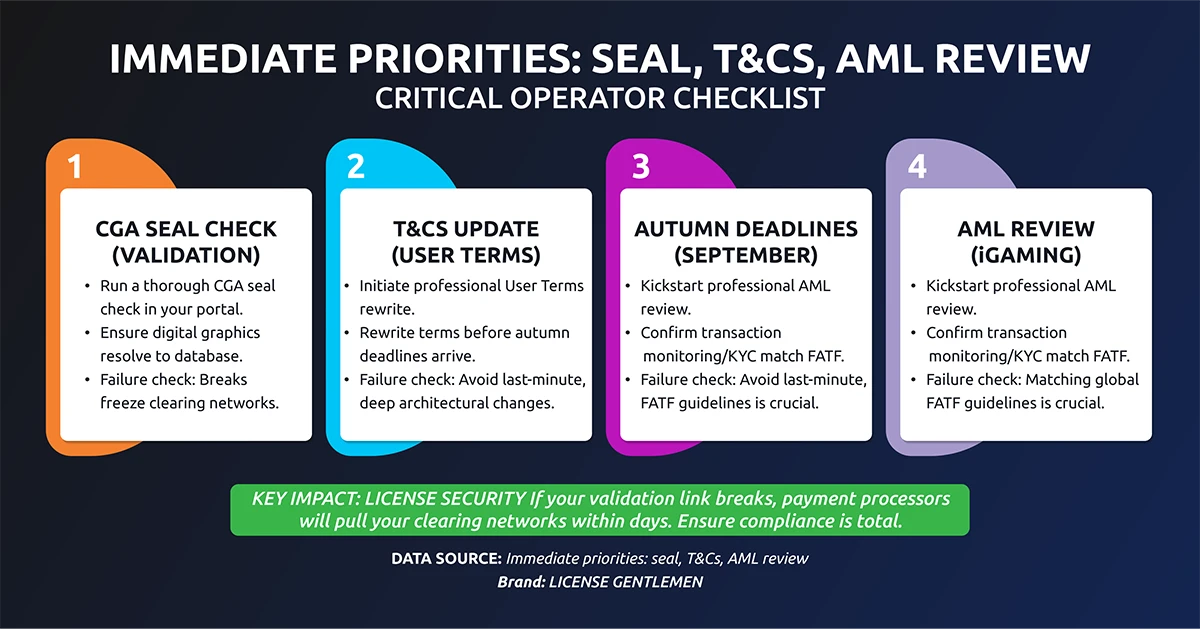
Immediate priorities: seal, T&Cs, AML review
- Check your CGA status: Log into the CGA portal and confirm your grey seal is active and renewal fees are current. The CGA removes operators from the public register after 71 days of non-payment. That’s not a warning letter situation; it’s automatic.
- Start your T&C review now: October 8, 2026, is closer than it feels. Your player-facing terms need to cover account closures, dormant accounts, payout procedures, refunds, and crypto transaction handling. This is not something to delegate to a junior team member or park until September.
- Conduct an AML review: If your AML policy hasn’t been touched since your initial application, it’s out of date and your MLRO is personally liable for what’s missing. Cover your transaction monitoring setup, KYC procedures, due diligence triggers, and whether your MLRO is actually involved in the business or just listed on a form. Not sure whether your setup meets the 2026 standard? LicenseGentlemen runs that review and tells you exactly what needs to change.
Medium-term: local hiring and B2B licensing plan
Plan for 2027 local hiring now. The talent pool in Curaçao is limited. The CGA hasn’t published the substance specifications yet. When they do, operators who haven’t started the search will scramble. The managing director requirement is already live, and additional staffing is coming. Start early.
This, surely, will increase the overall cost of maintaining the Curacao license by a mile.
Assess your B2B exposure. If you supply technology, games, or services to licensed operators, B2B enforcement is on the horizon. It is not active yet, but when it arrives, it goes through the same two-phase review as B2C. Six months of runway disappears fast.
If your structure can’t meet what the CGA requires, now is the time to evaluate alternatives, not after a deadline forces your hand. We’ll help you make that call with facts, not guesswork. Book a free consultation and let’s work through your options.
Conclusion
The Curaçao gaming license isn’t the easy option it used to be. The LOK changed the rules, the CGA is enforcing them, and operators who aren’t managing their compliance obligations are going to find themselves in a very difficult position. Some already have.
The CGA is getting better. The chaos of 2024 is behind us. The portal works. The team knows what they are doing. Well-prepared operators with solid documentation are getting through in reasonable timelines. A CGA license in 2026 carries more commercial weight than a Curaçao sub-license ever did. Banks, PSPs, and players treat it differently.
LicenseGentlemen has been in this since day one. Over 500 licenses have been issued across Curaçao, Anjouan, and other jurisdictions. We’ve lodged objections and won. We’ve helped operators figure out when Curaçao is worth the cost and when a leaner alternative makes more sense.
If you want to know exactly where you stand, whether that’s a new application, a renewal, an AML review, or a jurisdiction comparison, book a free consultation. Let’s figure it out together.
Frequently Asked Questions
The old GCB name belongs purely to the transitional phase of the reform. In 2026, the active Curacao gaming regulator is the CGA. All modern applications, regulatory updates, and corporate renewals route exclusively through the centralized CGA license system rather than a legacy GCB license 2026 pipeline.