
Anjouan B2B License and Recognition Certificate
If you are building a platform, game studio, or aggregation business, the Anjouan B2B license can no longer sit at the bottom of the to-do list. It now affects whether you can supply Anjouan-licensed operators at all, how quickly deals move, and whether your launch keeps its momentum.
A lot of teams only feel the pressure once a commercial deal is already moving. They sign with a supplier, start integration talks, and only later find out that the licensing route on the B2B side is missing. By then, the problem is no longer abstract. It becomes a delay, a cost issue, and sometimes a partner issue.
For some providers, a full license is the right move. For others, a recognition certificate can work well. The important part is knowing the difference before committing to the wrong path.
Before choosing between the two routes, it helps to look at why the market started treating B2B licensing differently in the first place.
What Changed in Anjouan
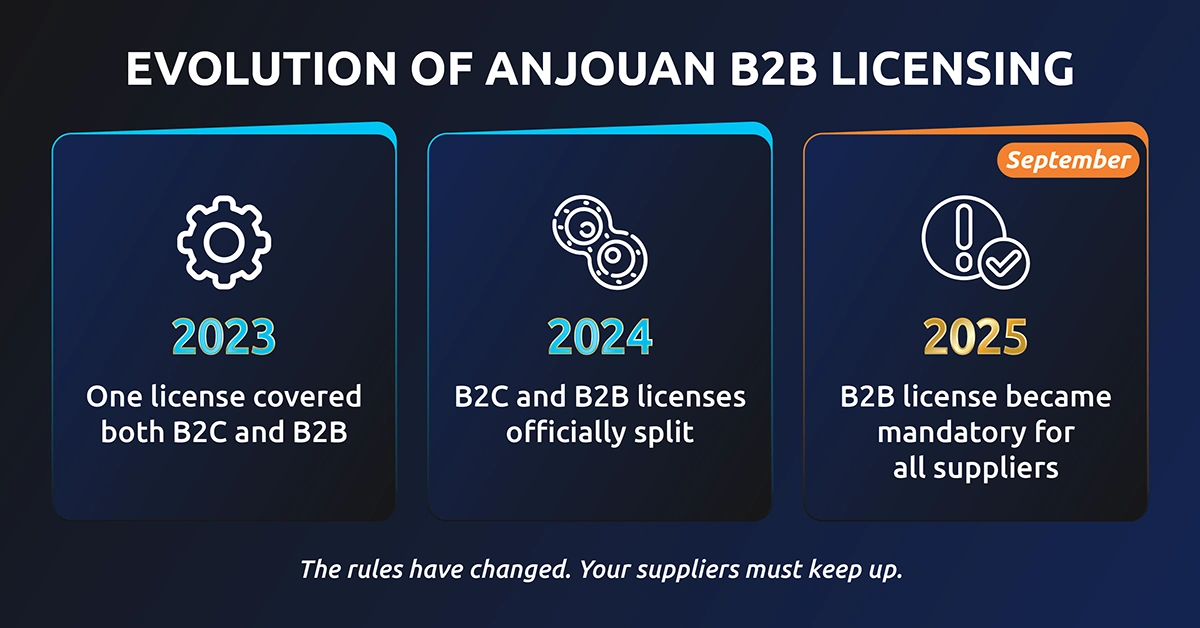
Back in 2023, one Anjouan license could cover both B2C and B2B activity. An operator could run a casino under that license and also cover services like aggregation under the same structure.
In 2024, that changed. B2C and B2B were split into separate categories, so businesses working across both sides had to treat them separately.
The market moved again in 2025. From September 1, 2025, suppliers working with B2C operators had to hold a B2B license. That included providers supplying platforms, aggregation, or games. Before that, very few suppliers had one. After the change, the number rose quickly because providers could no longer rely on the old model.
The stricter approach did not appear out of nowhere. Anjouan moved in this direction because one broad B2C umbrella was no longer enough to control the full supplier chain behind an operator. If copied games, manipulated content, or weakly documented suppliers enter the stack, the risk does not stop with the operator. It reaches aggregators, payment partners, banks, and the wider market around them.
Banks and PSPs add another layer of pressure here. They are audited, and they want to see the full chain properly licensed and documented rather than relying on a vague “the operator has a license” answer. A more structured B2B regime gives them better visibility into who is supplying the platform, the games, and the underlying services.
The commercial impact is easy to picture. A B2C operator may already be moving forward with supplier integrations, only to discover during licensing that the aggregator or platform provider has no B2B license. Then there are only two real options:
- wait for the supplier to start its own licensing process
- replace the supplier
We have a real example that shows how painful that can get. A client signed with an aggregator, paid a EUR 15,000 setup fee, and later learned that the aggregator did not hold the required B2B license. The agreement did not require the supplier to have one, the fee was not returned, and the client had to start over with another partner after losing time and momentum.
The regulator is also much more hands-on than many founders assume. In the source material, the regulator is not sitting quietly in the background. It checks ownership, reviews whether games are legitimate or copied, verifies RNG certification, and can step into disputes when suppliers argue that they do not need a B2B license. That active role is part of the reason the rules became stricter.
The practical takeaway is simple: the B2B layer no longer sits quietly in the background. It now affects whether deals can move at all.
Once that shift is clear, the next question becomes practical: which route makes more sense for the way you plan to enter the market?
Full B2B License vs Recognition Certificate
Here is the clean side-by-side view:
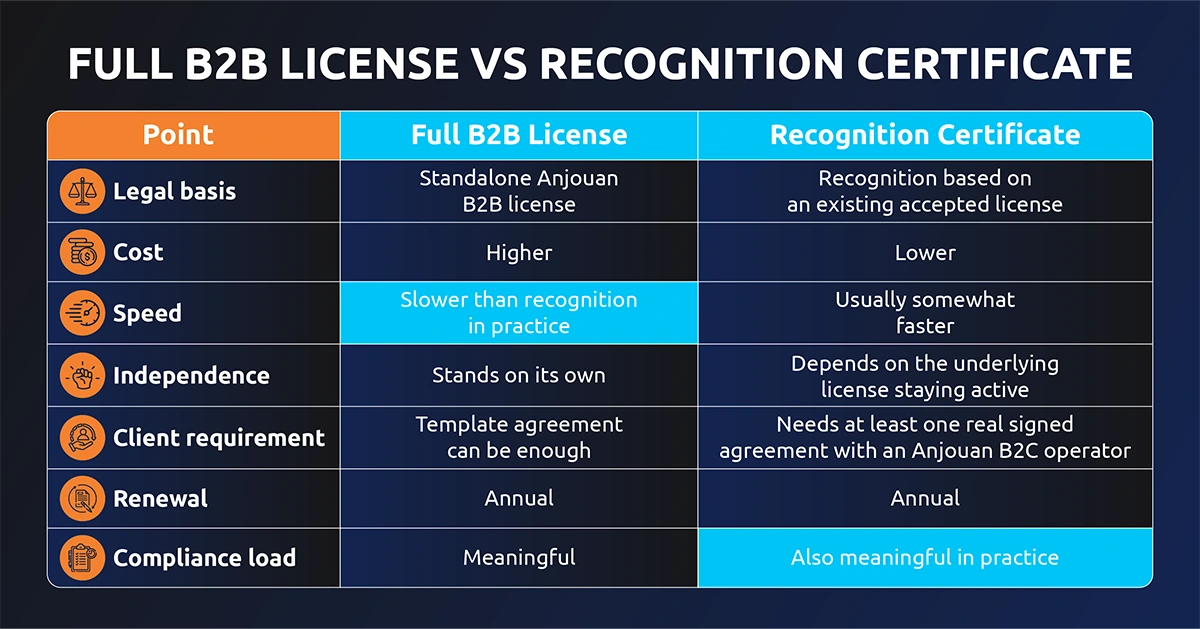
The recognition certificate is often marketed as faster, easier, and cheaper. On price, that can be true. On paperwork, the gap is much smaller than many expect, and in practice the process is not nearly as light as the headline version suggests. Even with an existing license elsewhere, Anjouan still asks for a broad set of current corporate, personal, and operational documents.
That point deserves to be said plainly because many providers approach the recognition route expecting a shortcut and only later realize they are still facing a fairly heavy documentation exercise.
The biggest difference is independence. A full license does not depend on another jurisdiction staying alive in your structure. A recognition certificate does. If the underlying license is not renewed later, the recognition certificate cannot be prolonged either.
Speed matters, but long-term planning matters more.
The comparison gives the headline view. From there, it helps to look more closely at what the recognition certificate actually does.
What Is the B2B License Recognition Certificate
A recognition certificate is not a separate B2B license. It is a document issued by Anjouan on the basis of an active license from another accepted jurisdiction.
The purpose is straightforward. If a B2B provider already holds a respected license elsewhere, it may be possible to use that as the basis for recognition instead of starting from zero. Once the certificate is issued, the provider can supply Anjouan-licensed B2C operators.
That makes the route attractive on paper, but it still needs to be treated as a real licensing process rather than a quick administrative add-on.
Not every jurisdiction works as the foundation. The brief names Malta, Romania, UKGC, Kahnawake, and Isle of Man as workable examples. Curaçao and Tobique are described there as unsuitable bases for recognition.
That makes the “which license do we use?” question more important than it may look. If you already hold several licenses, the best foundation is usually the one you still expect to keep in one, two, or three years. A certificate built on a license you plan to drop later may save time now and create a renewal problem later.
The concept sounds simple enough. The real problem usually starts once the paperwork begins, because the supporting file is still much heavier than many applicants expect.
Documents for the Recognition Certificate
The recognition certificate is usually presented as a simpler route, but the supporting paperwork is still extensive. In practice, you’ll still need to provide a full corporate pack, detailed information on all key parties (UBOs, shareholders, directors), operational and compliance materials, and supporting evidence of your business activity, partnerships, and target markets.
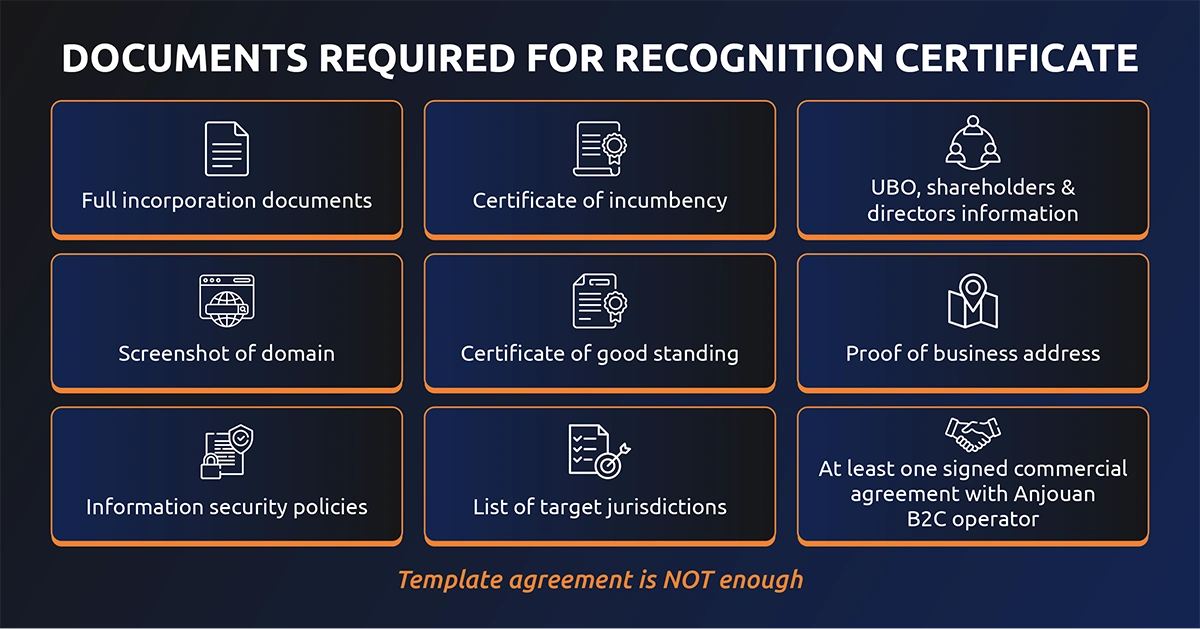
One point deserves extra attention: for the recognition certificate, a template agreement is not enough. You need at least one real signed client agreement with an Anjouan B2C operator. A full B2B license is more flexible there.
The most common causes of delay are practical:
- no signed B2C client agreement
- weak or unfinished information security policies
- outdated documents that need renewal or certification
The preparation stage alone can take anywhere from 10 days to 2 months, depending on how ready the business is and how quickly the document work is handled.
For a live business, that delay can be expensive. Operations may be ready to move, commercial talks may already be underway, and the company can still end up waiting on documents while salaries and other ongoing costs keep running. That is one of the least appreciated parts of the recognition route.
At LicenseGentlemen, we map out the entire process in advance, including realistic timelines and potential bottlenecks, so you understand exactly what to expect before committing. This allows you to plan cash flow and operations properly, rather than reacting to delays mid-process.
Once the recognition route is clear, the standalone license becomes easier to judge on its own terms.
How to Get a Full Anjouan B2B License
A full B2B license starts with structure, not forms.
The first step is understanding the business model. Are you a platform provider, game provider, aggregator, or a hybrid business doing more than one of those things? That affects the corporate setup, the document pack, and the wider licensing strategy.
From there, the process moves into planning:
- future business plans
- cash flow
- target markets
- client profile
- payment routes
- operating structure
That part matters because the setup is not one-size-fits-all. A company serving Southeast Asia may need a different structure from a company focused on Europe. Banking needs, partner expectations, and how money moves through the group all affect the final design. The brief also notes that many B2B providers do not rely on one license only. Some operate with several B2B licenses across different entities and add a recognition certificate where it makes sense.
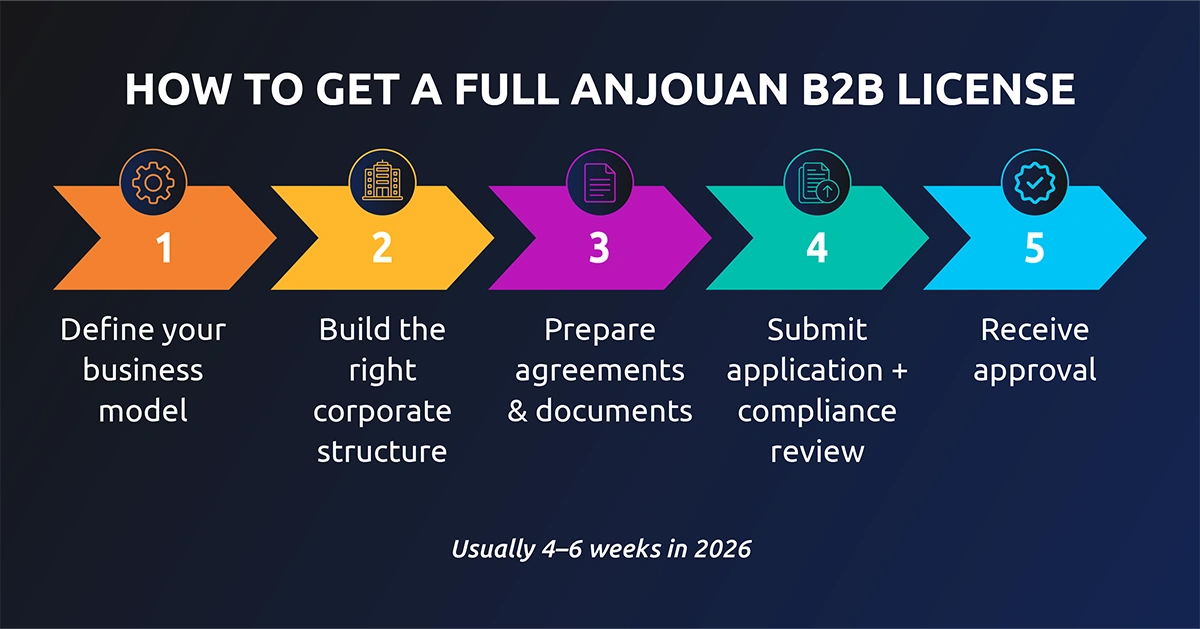
The process itself is straightforward:
- define the business model
- build the right company structure
- prepare agreements and supporting documents
- submit the application
- complete compliance review
- move to approval
The timeline described for a full Anjouan B2B license in 2026 is usually around 4 to 6 weeks, with the reminder that the actual timing depends on structure and readiness. The cost is described as similar to a B2C license, with a rough working range of 30,000 to 45,000 depending on how complex the setup becomes. Those figures are practical estimates, not guarantees.
There is also a practical difference between obtaining the license and keeping the business moving while the file is being prepared. If documents take too long, the cost does not pause. Staff still need to be paid, launch plans still need to be managed, and supplier conversations can lose momentum while the paperwork catches up.
For most suppliers, the licensing path ends there. Game studios have one more layer to account for.
Not Sure Which Markets You Can Enter with an Anjouan License?
Download the free geo-restriction guide — blocked zones, red zones, and grey zones all in one place.
RNG Certificate Requirement
If you are a game provider, the RNG requirement is one of the key parts of the file.
RNG stands for random number generator. In simple terms, it is the system that drives random outcomes in games, and certification is used to confirm that the results are fair and consistent with the declared setup.
According to the brief, RNG certification is:
- required for game providers
- not required for platform providers
- not required for aggregators
The same section names several labs used for this work:
- iTech Labs
- BMM Testlabs
- GLI
The expected timing is about one month. The practical approach described in the brief is to run RNG certification in parallel with the license preparation, so both tracks move together and the regulator can review the full picture at once.
The regulator’s role matters here as well. It is not only checking that a certificate exists. It is also checking game integrity, ownership, and whether the content being supplied is legitimate rather than copied. That review helps explain why the B2B framework became more structured: fair games, verified ownership, and supplier control all sit inside the same compliance picture.
With RNG covered, the next point is scope: who actually falls inside the B2B licensing requirement and who does not.
Which B2B Providers Need This License
The B2B license is meant for suppliers inside the gaming product chain.
The main groups listed in the brief are:
- game developers
- platform providers
- aggregators
- hybrid models that combine those functions
White label providers sit in a different position because they work across both sides. If a business provides platform and aggregation services while also hosting operators under its own structure, it may need both a B2B and a B2C license, and possibly additional permission for the white-label activity itself.
The brief also clears up a common misunderstanding: payment providers do not need an Anjouan B2B license just because they work with gaming businesses. They need their own financial permissions, not a gaming-supplier license.
There is one more detail for game studios. During Q1 and Q2 of 2026, a game provider distributing only through aggregators may not need its own B2B license yet. The expectation described in the brief is that, by the end of 2026, game providers will need a B2B license regardless of whether they distribute directly to casinos or only through aggregators.
Getting approved is only part of the picture. Keeping the business in good standing matters just as much.
Ongoing Obligations After Approval
Once Anjouan license is in place, the ongoing burden is described as relatively light compared with heavier audit-driven jurisdictions.
The operating rhythm is simple:
- obtain the license
- provide the required documents
- operate
- renew annually
Renewal repeats the documentation cycle and brings the business back through the same basic review logic.
That does not mean maintenance is effortless. There is a real difference between obtaining the license and keeping business operations moving without interruption. Delays in document refresh, notarial work, or renewals can quickly become operational problems when live client relationships depend on current licensing status.
Speed still matters after approval. Slow paperwork is not just an admin problem. It can block commercial activity, delay integrations, and leave the business carrying salaries and other ongoing costs while waiting for documents to catch up.
All of that affects suppliers directly, but the operator side feels the impact just as quickly.
What This Means for B2C Operators
For B2C operators, this is not somebody else’s licensing problem.
If you want to work with an aggregator, platform provider, or game supplier, you need to know whether that supplier is properly licensed or already in process where that is acceptable. Waiting until after the commercial agreement is signed can create the worst kind of delay: the one that comes with sunk cost and no clean way forward.
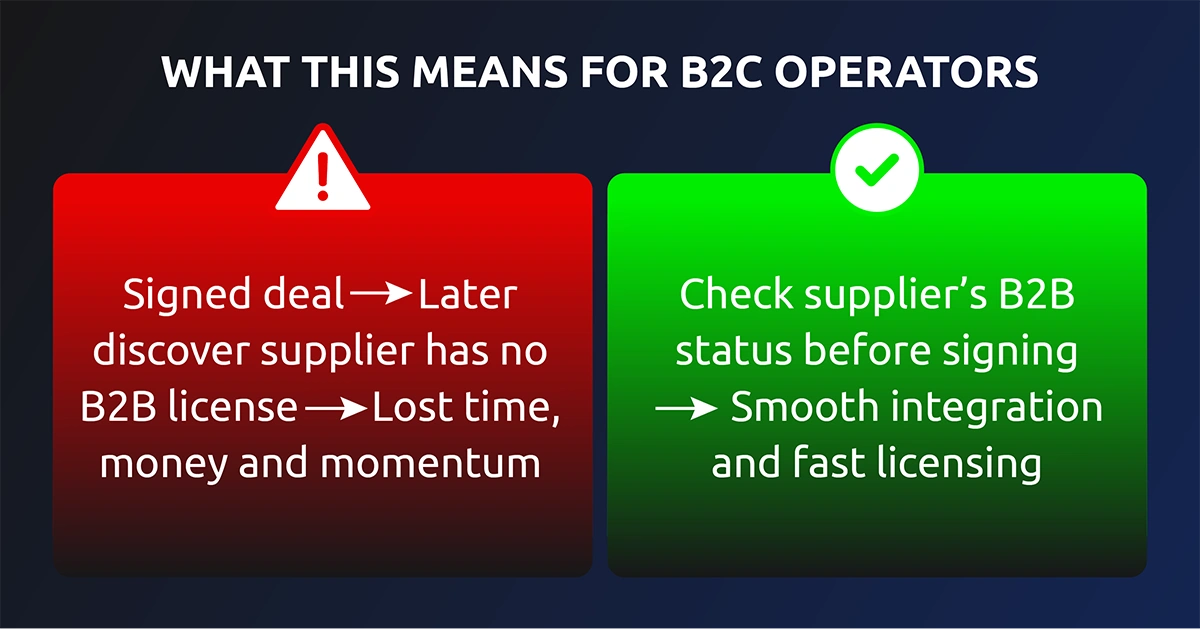
The consequences in the brief are direct. If the supplier is not licensed, the operator may not be able to onboard them, may not get licensed at all, or may risk suspension later.
There is a wider control point behind that. A properly licensed B2B layer gives operators, regulators, banks, and PSPs a clearer view of the full supply chain. That matters when they need confidence that the games are legitimate, the suppliers are documented, and the whole setup is not carrying avoidable risk into the business.
The market effect is broader than that. A more structured B2B layer improves trust, provider access, and stability across the chain. From the operator’s side, the lesson is simple: supplier due diligence now starts much earlier than many teams still assume.
That covers the main commercial and licensing points. A few practical questions still tend to come up at this stage.
Ready to Start the Right Licensing Route?
If you are planning to supply Anjouan-licensed operators, the earlier you choose the right path, the easier it is to avoid delays, contract issues, and expensive changes later on.
License Gentleman can help you assess whether a full B2B license or a recognition certificate fits your model, prepare the required documents, and move the process forward with a structure that works for your business.
Contact LicenseGentlemen to get your B2B license or recognition certificate issued quickly and without unnecessary delays.
Frequently Asked Questions
Yes. The brief describes the regulator as confirming that all B2B suppliers to B2C operators, including aggregators, need the B2B license.