
Transaction Monitoring for Crypto Casinos – From Red Flags to Regulatory Reporting
In the early days of the internet, online gaming felt like the Wild West. It was a boom where regulations did not exist and criminals often exploited the lack of oversight to move funds without a trace. If you were around back then, you know it was a time of shoot first and ask questions later.
Today, things look very different. For a modern founder, launching a crypto casino is no longer just about choosing a license and writing code. It is about building a Transaction Monitoring Backbone. This is the set of tools and human processes that keep you from hitting a regulatory wall. It is the navigation system that satisfies the high integrity demands of global regulators and banks.
Crypto gaming is not just another payment method. While jurisdictions like Anjouan or Tobique might treat crypto like traditional money, the technical and regulatory risk is entirely different. In a regulated environment, you must prove you can track the Provenance, which is the documented history and origin of the funds.
If you want your business to be bankable and maintain relationships with top payment providers like Nuvei or Paysafe, you must prove that your technical setup can handle the scrutiny of an audit.
In this article, we break down the key parts of a regulated compliance stack. We will cover topics from where your funds are held to the human processes that keep your license in good standing.
Where the Money Lives and Why Every Cent Is Watched
At the heart of every crypto casino is the way the money is stored and moved. How you organize these digital accounts determines how much trust regulators like the Malta Gaming Authority or the Isle of Man Gambling Supervision Commission will place in your operation.
Many founders get caught up in the technical names for these accounts. In reality, they can be distinguished easily:
- Hot Wallet This is a digital wallet connected to the internet. Think of this as a cash register used for moving money quickly for daily player deposits and payouts.
- Cold Wallet This is a digital vault kept offline and away from the internet. Think of this as a high-security safe used to protect funds for the long term.
In a regulated crypto casino, you typically use a mix of both. However, the choice is not just about speed or technical locks. The problem arises not from how the vault is built, but from what you put inside it. It does not matter whether you use a register that is online or a vault that is offline.
You are in trouble the moment you receive funds from a high-risk source. If you accept money from a criminal, your business is compromised the second that transaction touches your system. It does not matter how secure your safe is if the currency came from malicious sources.
How Tier-1 Regulators Force Transparency in Crypto Casino Operations
I remember one of the first crypto projects in the Isle of Man, a Bitcoin only sportsbook called Maverick Games. Because traditional bank accounts did not exist for crypto back then, the project team had to get creative to satisfy the regulator. The operators ended up with actual physical safes on Athol Street.
They used a split signature setup, which is a security method where a transaction cannot be approved unless multiple authorized directors sign off on it at the same time. One director had half the code, the CEO had the other, and the regulator held a viewing key. This allowed the government to look into the vault at any time to see the money was there without having the power to move it. This is the level of transparency Tier-1 regulators expect.
Keeping Player Money Safe Through Segregation
One of the most critical requirements for an Isle of Man crypto gaming license or a Malta crypto gaming license is fund segregation. You cannot simply keep all your crypto in one big pot.
- Operational Wallets: These wallets handle regular business costs, including things like marketing, payroll, and rent. This is also where you manage the small transaction fees paid to a network or service to process a digital payment. To keep these accounts running smoothly, you need a proper compliance stack, which is the complete set of software and staff used to watch every transaction and follow the law. A big part of this setup includes using software like chainalysis to monitor transactions for money laundering and illegal funds. Any red flags from the software go to a Money Laundering Reporting Officer, or MLRO. This person is the senior individual in charge of making sure the company follows all anti-money laundering laws. Without this human oversight and the right tools, even a crypto friendly license can become impossible to manage.
- Player Funds Wallets: These are used only to hold your customer deposits and must stay completely separate from your business money. Regulators in jurisdictions like the Isle of Man and Malta require these funds to be ring-fenced, which is a legal structure that ensures player money remains safe even if the business fails.
The Isle of Man Gambling Supervision Commission is particularly strict about this and requires you to maintain between 100 and 110 percent of all player deposits at all times. This ensures that even if the company goes bankrupt, every player can still be paid out in full.
While places like Tobique and Anjouan offer a faster route to market, showing this same level of transparency is what makes your casino trusted by the banks and payment providers you need to stay live.
How Transaction Monitoring Works in a Crypto Casino
Behind every crypto casino sits a monitoring system that tracks how funds move through the platform. Its purpose isn’t just to record deposits and withdrawals. The real goal is to identify patterns that might signal risk.
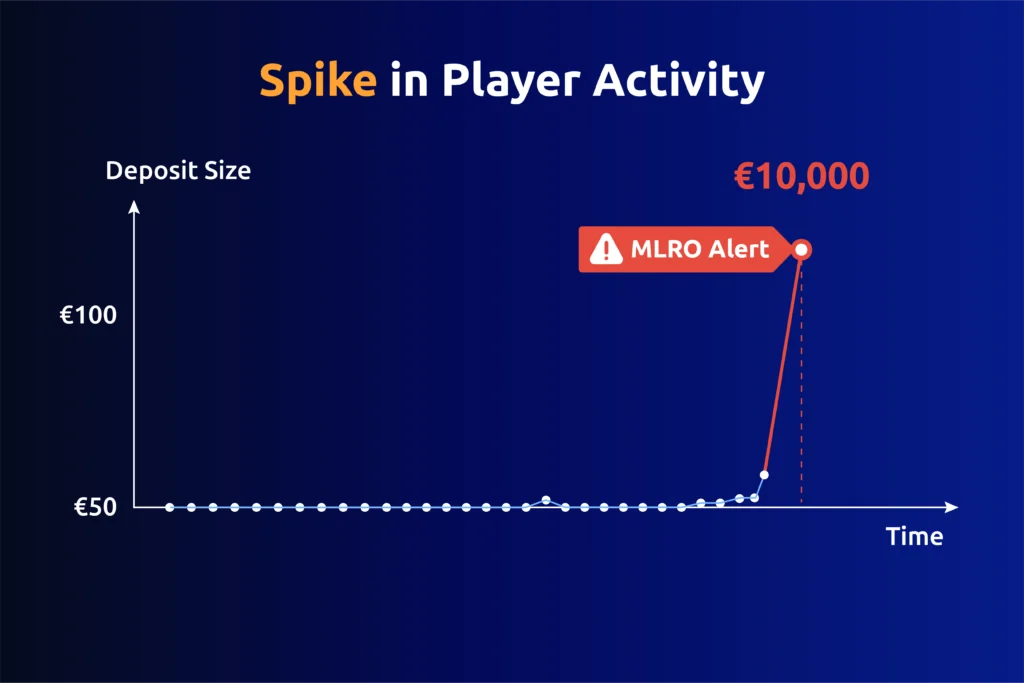
Modern monitoring tools analyze transactions in real time. They look for unusual behaviour: sudden spikes in deposits, wallets linked to high-risk services, or transaction histories that appear intentionally obscured. When something unusual appears, the system generates an alert.
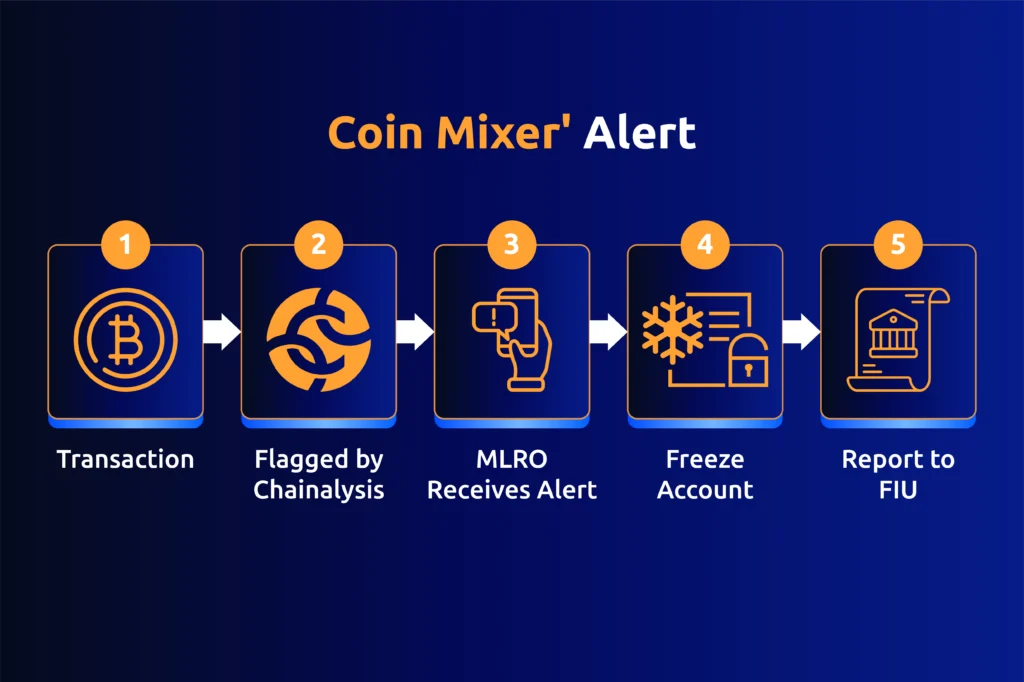
At that point the process moves from automation to human judgment. The alert is escalated to the Money Laundering Reporting Officer (MLRO), who reviews the transaction history, the player profile, and the available blockchain data. From there the operator decides whether the activity can be explained or whether it needs to be escalated further.
When this infrastructure works properly, it creates a clear chain of oversight from the first transaction to regulatory reporting. The following case illustrates how a typical crypto red flag moves through this workflow.
The Closed-Loop Rule
Regulators are very careful about one particular risk: a casino accidentally operating like a crypto exchange. The moment a platform allows players to deposit one asset and withdraw another, it stops being just a gambling product and starts looking like a financial service.
For example, if a player deposits Bitcoin but withdraws USDT, the operator is effectively performing a currency conversion. In many jurisdictions, including the Isle of Man, that activity falls under a completely different regulatory framework such as the Designated Business Act, which governs exchange-type services.
The Meaning of a Closed Loop
To avoid this problem, most regulated crypto casinos operate under what is known as a closed-loop payout system. The principle is straightforward: the asset that enters the platform must be the same asset that leaves it. If a player deposits Bitcoin, the withdrawal must also be in Bitcoin.
This rule also helps prevent the use of coin-mixing services, where criminals move value between different currencies to obscure the origin of funds. By forcing deposits and withdrawals to match, regulators preserve a clean transaction trail that can be monitored and audited.
In practice, this transaction trail is constantly monitored by blockchain analytics systems used by regulated operators. When a wallet connected to a coin-mixing service appears in the transaction history, the monitoring system generates an alert for the compliance team.
The moment an operator allows players to swap assets inside the platform, the regulatory picture changes dramatically. In the Isle of Man, for example, the business could end up reporting to two authorities at once: the Gambling Supervision Commission for the gaming operation and the Financial Services Authority for exchange activity.
For most startups, operating under two regulators at once is simply not practical. The closed-loop rule exists precisely to keep the casino inside the boundaries of a gambling license rather than pushing it into the far stricter world of financial services regulation.
This is not a theoretical risk. In practice, monitoring systems regularly flag transactions connected to coin-mixing services.
Case Example: A Coin Mixer Alert
Scenario: [CASE PROVIDED BY CLIENT] An operator’s Chainalysis iGaming tool flagged a withdrawal request because the player’s deposit had originated from a known “tumbler” or a service used to scramble crypto history.
The Alert: The system generated a “High Risk” alert for the MLRO.
The Action: The operator asked the player to explain the source of the funds. The player claimed it was “privacy-focused” trading, but could not provide a transaction hash, the digital receipt for a crypto move, to prove a legal origin.
The Outcome: The operator followed their suspicious activity workflow MLRO and terminated the account, keeping the funds frozen while filing a report with the local Financial Intelligence Unit (FIU).
The Digital Detective Tools That Track the Unseen
Chain analytics for btc casino management is the technology that turns anonymous crypto addresses into clear data points that a regulator or a bank can understand. Without these tools, you are essentially flying blind in a storm.
What These Digital Detectives Look For
Modern tools like Chainalysis iGaming or CipherTrace look for specific red flags:
- Links to Illicit Markets: They flag if a deposit comes from a known darknet criminal marketplace.
- Tumbling Services: They spot if crypto has passed through mixing tools used to hide the origin.
- Sanctioned Wallets: They identify addresses linked to nations or individuals on global do not trade lists.
Connecting Technology to Human Review
Technology can flag unusual activity, but people make the final decision. For example, if a player suddenly deposits €10,000 euro after months of placing €50 bets, the system will generate an alert. That alert is then reviewed manually by the Money Laundering Reporting Officer.
The MLRO is the human filter who decides if a transaction is legitimate or if it needs to be reported to the government. They often use complementary tools like Zion, which is used for screening high risk individuals, and ComplyRadar, which monitors behavioral spikes and unusual transaction patterns. Technical alerts are the first step, but they are just noise until a human steps in to interpret them.
The “Coin Mixer” Alert
Scenario: [CASE PROVIDED BY CLIENT] An operator’s Chainalysis iGaming tool flagged a withdrawal request because the player’s deposit had originated from a known “tumbler” or a service used to scramble crypto history.
The Alert: The system generated a “High Risk” alert for the MLRO.
The Action: The operator requested the player explain the source of the funds. The player claimed it was “privacy-focused” trading, but could not provide a transaction hash, the digital receipt for a crypto move, to prove a legal origin.
The Outcome: The operator followed their suspicious activity workflow MLRO and terminated the account, keeping the funds frozen while filing a report to the local Financial Intelligence Unit (FIU).
The Moment a Player Becomes a Compliance Case
In the world of regulated gambling, Knowing Your Customer (KYC) is a staged process. You do not necessarily need every document on the first day, but certain events make the paperwork mandatory.
The €2,000 Verification Trigger
In many jurisdictions like Malta or Tobique, €2,000 is the magic number. This is the casino KYC threshold €2,000 that triggers formal verification. Verification is typically required by one of three events:
- Total Deposits: Once a player has deposited €2,000 in total.
- First Withdrawal: Often, the very first time a player asks for their money back, you must verify their identity to ensure you are not paying out to a criminal.
- The Calendar: In some jurisdictions, checks are triggered 30 days after the first deposit even if the money limit has not been reached.
Beyond KYC: Source of Wealth
When player activity hits a total between €10,000 and €25,000 the regulator requires a deeper review of the overall financial profile of the person.
At that point, operators must conduct source of wealth checks.
- Source of Funds: This is an explanation of where the money for one specific deposit came from.
- Source of Wealth: This is a deep dive into how the player earned their total net worth over time.
The Response Plan for Suspicious Activity
When your technology flags a problem, your team must follow a specific game plan. This is called a Standard Operating Procedure (SOP). This is not just for safety. It is to ensure you have a “paper trail” to show the regulator during an official audit.
Checklist: The Suspicious Activity SOP
If your system flags a player, follow these 8 steps immediately:
- Identify the Spike: Your system flags a sudden jump in deposit velocity or a high risk crypto coin.
- Notify the MLRO: The team member who sees the flag informs the Money Laundering Reporting Officer immediately.
- Freeze the Account: Block the ability of the player to move any money out of the casino.
- Enact Silent Monitoring: Allow the player to log in so they do not realize they are being investigated.
- Review Behavioral History: The MLRO looks at the past behavior of the player and the history of the crypto coins.
- The “Request for Info”: Ask the player to explain the activity or provide more documents, like an updated bank statement.
- Escalate to FIU: If the risk is real and the explanation is weak, the MLRO files an official report to the local Financial Intelligence Unit.
- Final Decision: Either clear the player to keep playing under “enhanced monitoring” or end the relationship and keep the record for the next audit.
Staying Live After You Launch
Launching is just the beginning. The hard part is staying live and compliant. Regulators expect you to be a living partner in compliance.
The Ongoing Workload
- Weekly and Monthly Grinds: If you have a Malta crypto gaming license, you must submit reports on player balances and complaints every single week.
- The Quarterly Upload: In Tobique crypto gaming license setups, you are required to provide encrypted player data, balances, and complaint logs every three months.
- The Renewal Audit: Launching is just the beginning. The hard part is staying live and compliant. Regulators expect you to be a living partner in compliance.
These checks might feel like routine housework, but they are the only thing standing between a healthy business and a regulatory nightmare. If you do not stay on top of the paperwork, it can create problems with your license.
The true test comes during the renewal audit when the authority performs Dip Sampling. This is a process where a regulator randomly selects a small number of files to verify that all correct steps were followed. We saw exactly how fast a business can stall when an operator assumes their files are in order, only to have a random check expose a massive hole in the evidence.
The “Dip Sample” Disaster
Scenario: An operator was undergoing a license renewal audit. The regulator picked 15 files to review.
The Problem: In 4 of those files, the SoW questionnaire was present, but the supporting evidence such as payslips or bank statements was missing. The staff had assumed the questionnaire was enough.
The Consequence: The license of the operator was placed on probationary status. This required them to hire a third party auditor at their own expense to review the entire database.
The Lesson: In compliance, if it is not documented, it did not happen.
The Cross-Contamination Problem
As the business grows, you might hold multiple licenses, such as an MGA license for Europe, a Kahnawake license for North American reach, and an Anjouan crypto casino license for international markets. The biggest mistake is Cross Contamination. This is when you use the same team or the same database for everything.
Regulators increasingly demand that you keep your back office instances separate for each license. This ensures that if a player blocks themselves from a brand under a Tobique gaming license, they are not accidentally allowed to keep playing on an international brand. Furthermore, you should understand the difference in standards between regions. While UKGC AML KYC rules do not currently support crypto, they set the benchmark for the type of documentation and player protection that the Isle of Man gaming license now requires.
Keeping your back office data siloed protects your business as much as it satisfies the law. It prevents a situation where a regulator or a former employee has access to your sensitive contracts from other jurisdictions. This level of data protection is a key part of a professional monitoring infrastructure.
Why Back-Office Separation Matters
Regulators increasingly demand that you keep your back office instances separate for each license. This ensures that if a player blocks themselves from a European brand due to a gambling problem, they are not accidentally allowed to keep playing on an international brand.
Furthermore, you want to avoid commercial overreach. In the Isle of Man, we often warn operators about having a junior inspector see all contracts across multiple jurisdictions. If that inspector leaves to work for a competitor, your sensitive business data could go with them. Keeping your back office data siloed protects your business as much as it satisfies the law.
The Core Compliance Stack
- Segregated Wallets: Operational money versus player money.
- Multi Signature Vault: No single employee can move vault funds.
- Chain Analytics: Integrated tool such as Chainalysis iGaming or CipherTrace.
- SOP Documentation: A written suspicious activity workflow MLRO guide.
- Geo Blocking: Automated blocks for restricted regions.
Checking off every item on this list means you are well on your way to building a bankable operation. However, even with a solid minimum viable compliance stack, questions often remain. Many founders find that the rules for digital assets can feel like a maze when they are just starting out.
Common Questions About Crypto Casino Basics
Not always. Most regulators allow standard play until a specific event happens, such as the player asking for a withdrawal or reaching a casino KYC threshold €2,000. However, a bitcoin casino must always collect basic details like a name and email during registration to start the risk assessment process.