

The 8 Biggest Problems Every Online Casino Faces in 2026 (and How to Solve Them)
The online casino industry in 2026 is moving fast. New regulations, rising player expectations, and increasingly complex technology stacks are creating challenges that can quickly expose operational weaknesses. Operators need reliable systems, adaptable processes, and a clear approach to compliance and risk management.
The platforms that continue to grow are often the ones that can respond quickly to change while maintaining a consistent player experience. This guide explores the biggest online casino problems in 2026, from technical disruptions to regulatory pressures. Moreover, it looks at practical ways operators can address common iGaming challenges before they become larger business issues.
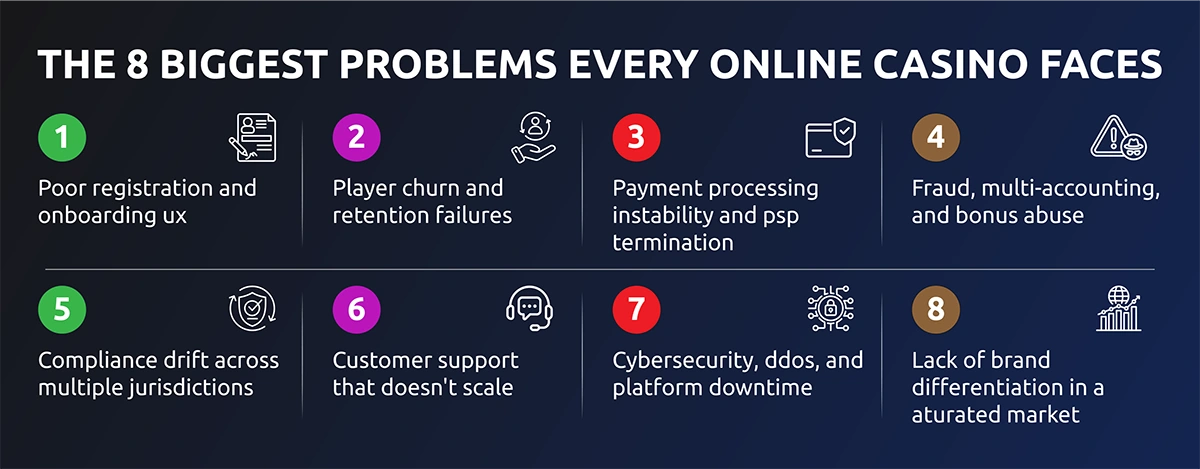
We’ve outlined eight core challenges that many online casino operators encounter:
- Poor registration and onboarding UX
- Player churn and retention failures
- Payment processing instability and PSP termination
- Fraud, multi-accounting, and bonus abuse
- Compliance drift across multiple jurisdictions
- Customer support that doesn’t scale
- Cybersecurity, DDoS, and platform downtime
- Lack of brand differentiation in a saturated market
In the sections below, we share our practical expertise for each area and explore practical ways to improve performance, respond to changing market conditions, and build a more resilient casino business.
License Gentlemen has helped operators secure more than 500 licenses worldwide and reports a 98% success rate in its licensing engagements. In addition to licensing support, the company provides consulting services like payment system integration and financial planning for online casinos. The goal is to help operators make informed decisions and establish a foundation for long-term growth in a highly competitive market. Book a free call!
Why 2026 Is Harder for Casino Operators Than Any Previous Year
How can you start a gambling business in the current year and avoid the eight core challenges we mentioned? The online casino market in 2026 is shaped by market consolidation and more advanced fraud detection systems, which are changing how operators invest in compliance, infrastructure, and security. A key operator pain point is the rising cost of maintaining stable platforms. Continuous updates, monitoring, and downtime risks create ongoing pressure on technical and compliance teams.
A major driver of casino industry challenges is increasing regulatory pressure across jurisdictions like Sweden, Romania, and Ontario, where rules on AML, reporting, and responsible gambling are frequently updated rather than fixed.
Fraud is also more automated, with bot networks, bonus abuse, and identity manipulation requiring layered detection systems and constant investment in security tools. Online casino licensing, explained below, is essential because it determines how operators scale. For instance, UKGC and MGA licences require strict compliance, while Curaçao and Anjouan offer more flexibility but different risk profiles depending on jurisdiction.
Overall, the online casino market in 2026 is more complex and costly to operate in, with higher expectations around compliance, fraud prevention, and operational resilience.
In 2026, operators that cannot adapt quickly to these combined pressures are more likely to face higher costs and reduced operational flexibility. One of the first questions entrepreneurs ask is how much it costs to open up a casino, but the answer depends on factors such as licensing, software, payment infrastructure, compliance requirements, and target markets.
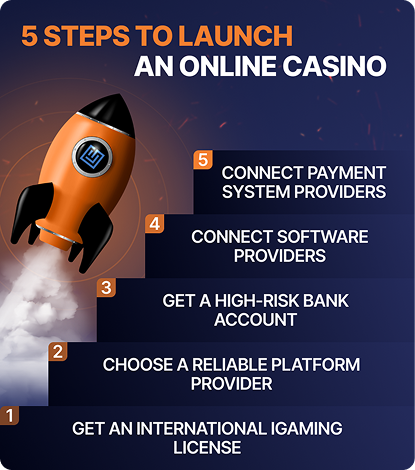
License Gentlemen remain part of early-stage planning for many market entrants and scaling operators. Book a free consultation with our team and get expert guidance on launching your first online casino, from licensing and compliance to software and payment infrastructure.
Problem 1 - Poor Registration and Onboarding UX
Complex registration flows are one of the fastest ways to destroy marketing ROI. Every extra form field, unnecessary step, or technical error increases the chance that a potential player abandons the process before placing their first bet. In practice, this means paid traffic and acquisition spend are wasted long before any revenue opportunity is realized.
A casino registration UX is a player’s first interaction with a platform. If it feels slow, confusing, or overly demanding, it signals friction and a lack of polish. That directly impacts casino sign-up conversion rates and reduces the Click2Reg (click-to-register) rate, especially on mobile, where users expect fast, low-effort onboarding.
Many onboarding failures come from poorly optimized mobile casino registration flows that are not fully responsive or behave inconsistently across devices. This is a common source of casino onboarding problems, where users begin registration but drop off due to layout issues, broken validation, or slow-loading forms.
Search queries like “common issues problems signing up online casino registration” often reflect these exact friction points. Similarly, users asking “why can’t I sign up for an online casino common errors” are typically encountering predictable issues such as unclear error messaging, missing field guidance (for example, password rules), or outdated verification steps like intrusive CAPTCHA systems.
The core challenge for operators is balancing compliance with usability. Strict regulatory requirements still need to be met, but they do not have to block the user experience. Modern onboarding systems increasingly rely on streamlined registration flows such as 1-click registration layouts or social logins that collect only essential data upfront, such as email and phone number.
At the same time, operators can maintain compliance by shifting identity checks into the background. Automated verification tools and KYC systems allow player data to be validated after signup without interrupting the onboarding flow. This approach reduces drop-off while still meeting regulatory standards, improving both conversion efficiency and early-stage player retention.
Problem 2 - Player Churn and Retention Failures
In highly saturated iGaming markets, casino player churn has become a risk that significantly weakens long-term profitability if not actively managed. Online casino retention is no longer sustained by simply offering a large game library. Instead, operators need to identify subtle signals of casino retention problems, such as declining session frequency, reduced return visits, or fragmented behavioral data that suggests disengagement.
Understanding why players leave casinos often reveals a mix of technical, financial, and experiential issues. These underlying issues are frequently invisible at the surface level but become clear when examining user journeys over time. In most cases, player loyalty challenges are not caused by a single factor, but by a combination of friction points that gradually reduce engagement.
Slow Site Speed and Mobile Issues
Technical instability is often described by users simply as the online casino not working. In reality, even minor performance issues can have a measurable impact on retention. Slow page load times, broken UI elements, or inconsistent mobile rendering increase frustration and reduce trust.
We experienced this firsthand while auditing a casino platform with a Click-to-Register (C2R) conversion rate of just 7%, compared with a market average of around 15%. Our analysis revealed that the problem wasn’t the registration flow itself, but the website’s loading speed in the target geo. After optimizing performance and reducing page load times to just 2–3 seconds, the C2R conversion rate jumped to 17% automatically without any other changes.
It was a clear reminder that the right diagnosis can have a major business impact. Just as importantly, always test performance in your target geo – a website that loads quickly in Belgium won’t necessarily deliver the same experience in South Africa.
Mobile performance is especially critical, as most users now interact through smartphones. When latency increases beyond acceptable thresholds (2.5 seconds), users are more likely to abandon sessions before engaging with gameplay. Even small bugs, such as unresponsive buttons or failed form submissions on specific devices, can silently exclude portions of the audience and reduce overall conversion efficiency.
Payment and Withdrawal Frustrations
Withdrawal friction remains one of the strongest drivers of player churn. When users experience delays or uncertainty in accessing their winnings, trust in the platform begins to decline rapidly. The psychological impact is significant: payouts are often perceived as a direct measure of platform reliability.
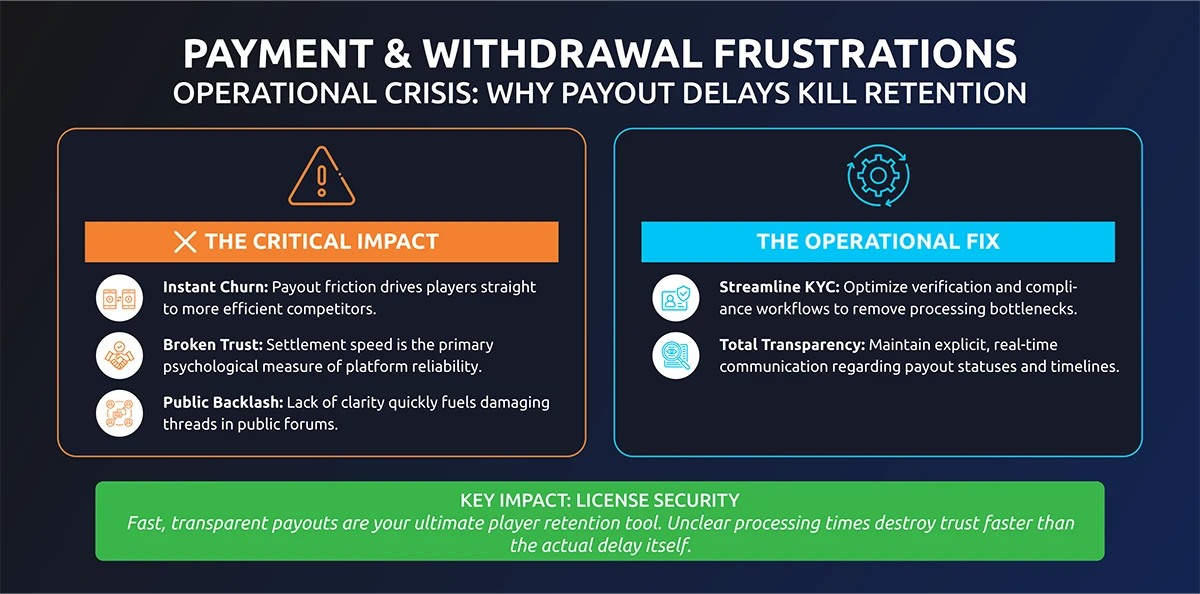
This lack of clarity can quickly push users toward competing platforms they perceive as more transparent or efficient. It can also generate negative sentiment in public forums, which may amplify reputational pressure. To reduce churn, operators typically need to streamline verification workflows while maintaining clear communication around payout status, processing times, and compliance checks.
Weak Loyalty Programs and Bonus Fatigue
Many platforms experience retention decline due to bonus fatigue. Repetitive cookie-cutter cashback offers and generic promotions often fail to create meaningful engagement, especially for experienced players who expect more personalized value. It reduces engagement and increases the likelihood of user drop-offs.
When loyalty systems lack variety or progression, they struggle to sustain long-term interest. Players may continue to claim bonuses, but engagement levels drop as rewards feel interchangeable and predictable.
Stronger retention strategies often rely on structured progression systems, such as tiered rewards, missions, or achievement-based mechanics. These approaches introduce a sense of progression and help maintain engagement beyond simple transactional incentives.
Problem 3 - Payment Processing Instability and PSP Termination
For many operators, casino payment problems remain one of the most serious operational risks. Because iGaming is often classified as a high-risk sector, some payment providers apply stricter oversight, higher reserve requirements, or may decide to limit their exposure to gambling-related transactions. As a result, payment processing relationships can be less predictable than in many other industries.
A casino Payment Service Provider (PSP) termination scenario can have immediate consequences. If a payment provider suddenly suspends or closes an account, operators may lose the ability to process deposits or withdrawals until alternative arrangements are activated. This disruption can lead to withdrawal delays; casino players notice it almost immediately, which damages trust and increases customer support pressure.
The risk extends beyond a single provider. Merchant account loss can interrupt cash flow, increase compliance scrutiny, and force operators to seek replacement banking and payment partners on short notice. High chargeback rates, unresolved disputes, or fraud-related concerns can further increase casino payment processor risk, making payment stability a critical operational priority.
To reduce these vulnerabilities, operators increasingly focus on payment infrastructure resilience. Relying on a single PSP creates a potential single point of failure, whereas a diversified payment setup can help maintain continuity if one provider changes its policies or terminates a relationship. Many operators also support a broader mix of payment methods, including local banking solutions, e-wallets, and other region-specific options, to improve flexibility and reduce dependency on any one channel.
We have seen how quickly this risk can become reality. In one case, an operator violated a payment provider’s policies by directing newly acquired players through a payment channel that was intended only for secure whitelisted users. The acquiring partner flagged the activity, and the provider shut down the entire payment channel, affecting multiple operators using the same PSP.
As a result, businesses with backup payment providers were able to switch traffic almost immediately and continue operating with minimal disruption. Those relying on a single PSP were unable to process payments for several weeks while they integrated and tested a replacement. The lesson is straightforward: always build redundancy into your payment infrastructure. Sometimes another operator’s mistake, not your own, can have a direct, significant impact on your business.
Recovery Strategy for Unexpected Account Closures
If an operator experiences a sudden payment account closure, the following steps can help restore stability:
- Activate backup PSPs already integrated into the platform to minimize service disruption.
- Diversify payment methods by supporting e-wallets, bank transfers, and other locally preferred options where permitted.
- Strengthen chargeback monitoring to identify unusual transaction patterns before they develop into larger disputes.
- Review verification workflows to ensure customer due diligence processes are efficient and compliant.
- Maintain adequate operating reserves to support payment continuity during provider transitions.
- Audit payment agreements regularly to understand provider requirements, risk thresholds, and termination clauses.
- Work with specialized advisors when evaluating new payment relationships, regulatory obligations, and operational risk management.
In a competitive market, payment reliability is not just a technical requirement. It directly affects player confidence, retention, and the overall reputation of the platform.
At LicenseGentlemen, we’ve helped operators secure more than 500 iGaming licenses and understand that reliable payment infrastructure is just as important as licensing. Over the years, we’ve built relationships with trusted PSPs that support some of the industry’s largest operators. Book a free consultation to discuss your licensing and payment strategy before you launch or scale.
Not sure which platform fits your setup?
Get a side-by-side breakdown of the top providers so you can compare payment flexibility, compliance features, and integration options before you commit.
Problem 4 - Fraud, Multi-Accounting, and Bonus Abuse
Fraud remains one of the most expensive operational challenges facing online casino operators. Modern fraud networks use automation, stolen credentials, coordinated account creation, and payment abuse tactics to exploit weaknesses across registration, promotional, and payment systems. As these schemes become more sophisticated, casino fraud prevention in 2026 increasingly requires significant investment in security technology, compliance infrastructure, and continuous monitoring.
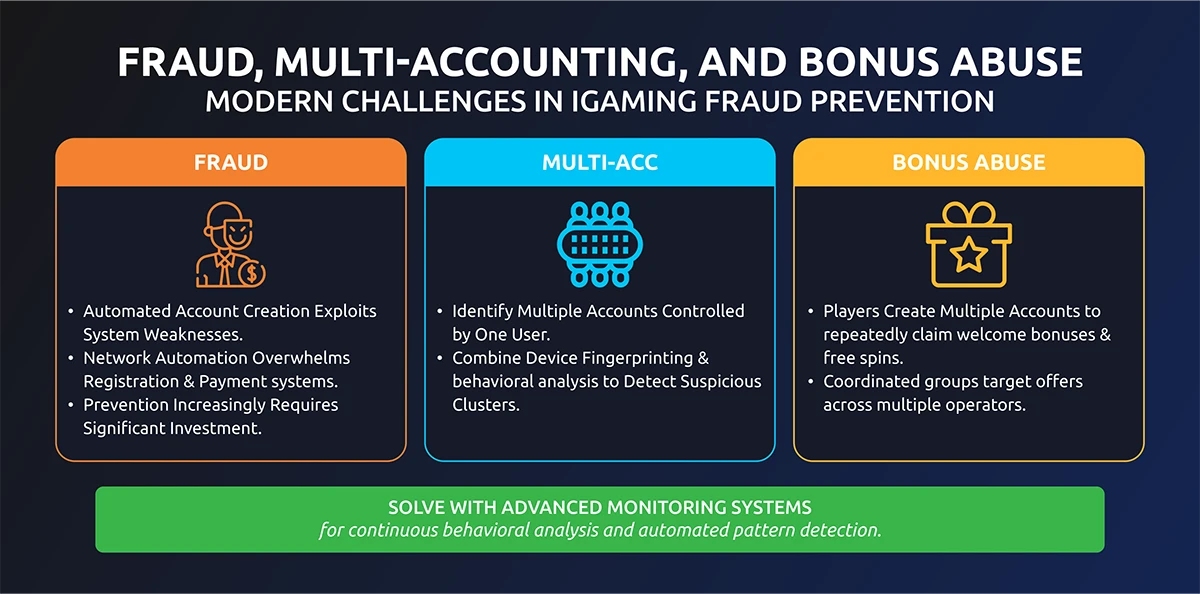
Operators face threats ranging from bonus abuse, online casino schemes and account takeovers to identity fraud and payment disputes. To limit financial losses and maintain compliance, many platforms rely on advanced monitoring systems capable of identifying suspicious behavior before it develops into a larger operational issue.
Bonus Abuse and Promo Hunters
One of the most common forms of fraud involves players creating multiple accounts to repeatedly claim welcome bonuses, free spins, and promotional rewards. In some cases, coordinated groups systematically target offers across multiple operators, searching for opportunities to maximize promotional value. This is why effective multi-accounting detection has become a core component of modern fraud prevention strategies.
Account Takeover and Identity Theft
Compromised player accounts can expose operators and customers to significant risk. Fraudsters may attempt to gain unauthorized access to player profiles, alter account information, or initiate withdrawals using stolen credentials. To reduce these risks, operators increasingly deploy behavioral monitoring tools and real-time security alerts designed to identify unusual account activity before funds are moved.
Multi-Accounting Networks
Detecting multiple accounts controlled by the same individual has become more challenging as fraud tactics evolve. Operators often combine device fingerprinting, behavioral analysis, network monitoring, and account-linking technologies to identify suspicious clusters of accounts. These tools help strengthen multi-accounting detection efforts while reducing abuse of promotional campaigns and loyalty programs.
Chargeback and Friendly Fraud
Casino chargeback fraud occurs when players dispute transactions through their bank or payment provider after deposits or gameplay activity have already taken place. Whether justified or not, high chargeback volumes can increase processing costs, damage relationships with payment providers, and create additional compliance burdens. As a result, many operators invest heavily in transaction monitoring and dispute management systems to reduce payment-related risk.
One common misconception is that once a deposit appears in the casino backend, the funds are fully secured. In practice, that is not always the case. We recently worked with an operator who received five deposits of 10,000 USDT from a new player within a single hour.
Everything initially appeared legitimate, and even the payment provider did not immediately identify any issues. Naturally, the operator was excited to welcome what appeared to be a new VIP player.
Fortunately, the provider’s fraud management procedures worked exactly as intended. Several hours later, additional fraud checks linked the deposits to fraudulent documentation, and the account was flagged before a withdrawal could be processed. Had the payout been approved first, the operator could have suffered a significant financial loss.
Cases like this show that a payment provider does far more than process transactions. Advanced fraud detection, transaction monitoring, and risk management can be the final safeguard against costly fraud, making the value of a PSP just as much about the losses it prevents as the payments it processes.
AI-Era Threats: Deepfake KYC and Voice Cloning
Identity verification is becoming more complex as synthetic identities and digitally manipulated documents become easier to produce. Concerns around deepfake KYC casino attempts have encouraged operators to adopt more advanced verification systems that can identify signs of document tampering, biometric inconsistencies, and other indicators of potential fraud. Alongside these measures, AI fraud detection casino platforms help analyze user behavior, transaction activity, and account relationships in real time, allowing operators to respond more quickly to emerging threats.
As fraud techniques continue to evolve, operators face growing pressure to strengthen security without creating unnecessary friction for legitimate players. Balancing those objectives remains one of the industry’s most significant operational challenges.
By effectively using and combining tools like SumSub and The Greco, casinos can monitor player behavior, identify dishonest activity, and collect evidence for use in disputes. These measures reduce legal and financial risks while also reinforcing trust with regulators. However, remember that no automated tool is effective without a skilled specialist on your team and a qualified business consultant to guide your efforts.
Problem 5 - Compliance Drift Across Multiple Jurisdictions
Managing multi-jurisdiction compliance has become one of the most demanding operational responsibilities for online casino operators. Regulatory requirements rarely align across markets, forcing businesses to navigate a complex mix of licensing conditions, reporting obligations, responsible gambling rules, and identity verification standards. As a result, casino compliance challenges in 2026 extend far beyond obtaining a licence – they require continuous adaptation as regulations evolve.
A platform that meets regulatory requirements in one jurisdiction may require significant modifications before it can legally operate in another. Differences in KYC procedures, transaction monitoring, player protection measures, and reporting formats can create substantial operational complexity, particularly for operators managing multiple licences simultaneously.
Cross-border operations add another layer of difficulty. In the United States, for example, operators must comply with both state-level regulations and applicable federal requirements. This often requires sophisticated geolocation controls to ensure players can only access regulated services from approved locations. If a player’s location cannot be verified with sufficient accuracy, operators may need to restrict certain activities until compliance requirements are satisfied.
Recent regulatory developments highlight how quickly compliance expectations can change. LOK Curacao compliance reflects Curaçao’s move toward a more structured regulatory framework, with increased oversight and more detailed licensing requirements than previous models. For operators already active in the jurisdiction, these changes may require adjustments to internal processes, reporting systems, and operational structures.
Similarly, Brazil’s SPA compliance framework has introduced a more formal regulatory pathway for operators seeking access to one of the industry’s most closely watched emerging markets. The framework includes licensing, financial, and compliance obligations that can significantly influence market entry planning and long-term operating costs.
At the same time, AML and KYC pressure in 2026 continues to increase across regulated markets. Operators are expected to strengthen customer due diligence, monitor transactions more effectively, and maintain robust anti-money laundering controls. Many businesses now rely on specialized verification and compliance platforms to support these requirements while reducing manual workload.
For operators that support digital asset transactions, discussions around the FATF Travel Rule casino requirements have added another layer of compliance consideration. Depending on the jurisdiction and payment structure involved, businesses may need to implement additional procedures related to transaction transparency, customer information sharing, and record keeping.
Compliance is no longer a one-time licensing exercise. It is an ongoing operational function that affects technology, payments, customer onboarding, and market expansion. Operators that successfully manage these shifting requirements are generally better positioned to scale across jurisdictions while reducing regulatory and operational risk.
Problem 6 - Customer Support That Doesn't Scale
As player numbers grow, support operations often become one of the first areas to experience strain. Many casino customer support problems emerge when staffing levels, workflows, and internal systems fail to keep pace with increasing demand. What works for a smaller operation can quickly become ineffective once player volumes begin to scale.
The challenge of scaling support for iGaming businesses goes far beyond hiring additional agents. Support teams must be prepared for sudden spikes in activity during major sporting events, tournament periods, large promotional campaigns, or unexpected technical incidents. During these periods, casino support overload can occur as ticket volumes rise faster than teams can respond.
This pressure frequently exposes weaknesses in older helpdesk structures. Rigid macro-based responses and generic support scripts may work for simple account questions, but they often struggle with more complex issues involving payments, verification, bonuses, or technical disputes. When players receive responses that feel automated or fail to address their specific concerns, trust in the platform can decline quickly.
Long wait times are another major source of frustration. Persistent casino response time issues can leave players feeling ignored, particularly when their query involves deposits, withdrawals, or account access. In competitive markets, a poor support experience is often enough to push players toward alternative platforms.
Operators serving multiple regions face an additional challenge: delivering effective multilingual casino support services. Players generally expect assistance in their preferred language, especially when discussing sensitive issues involving payments or verification. Without adequate language coverage, misunderstandings can increase, and resolution times can become longer.
To improve scalability, operators typically need to address both operational and technical causes of support demand. Stable platform infrastructure, reliable payment systems, and accurate account synchronization help prevent many avoidable support requests before they occur. At the same time, clear escalation pathways, well-maintained knowledge bases, and a balanced combination of automation and human support can help teams manage higher volumes without sacrificing service quality.
Ultimately, customer support is not just a service function. It plays a direct role in player retention, trust, and long-term brand reputation, particularly during periods of rapid growth.
Problem 7 - Cybersecurity, DDoS, and Platform Downtime
On a recent call, we spoke with the CEO of a casino platform provider, and the conversation quickly turned to cybersecurity, and he said, “Have you seen what’s been happening? Several operators have been dealing with serious cyber incidents.”
He went on to explain that his team had spent nearly three weeks working around the clock to strengthen the security of every operator on their platform. According to him, they even brought in an external cybersecurity firm, with costs reaching around €100,000 per week, to identify vulnerabilities, harden infrastructure, and reduce the risk of further attacks.
The conversation reinforced an important point: whether you’re a platform provider or an operator, casino cybersecurity is no longer something operators address only after an incident. In 2026, it has become a core operational requirement. Modern online casinos depend on a complex network of payment providers, game suppliers, verification tools, and third-party integrations. While these systems enable the platform to operate efficiently, they also create additional entry points that can increase the risk of an iGaming security breach if not properly secured.
Among the most disruptive threats are casino DDoS attacks (Distributed Denial-of-Service attacks). These attacks work by overwhelming a platform’s infrastructure with large volumes of artificial traffic, consuming system resources and limiting the platform’s ability to process legitimate requests. In some cases, DDoS attacks are used as part of extortion attempts, where attackers threaten prolonged disruption unless financial demands are met.
The impact can be severe. When critical systems become overloaded, operators may experience significant casino platform downtime, preventing players from logging in, accessing games, making deposits, or requesting withdrawals. High-traffic periods such as major sporting events, tournaments, or promotional campaigns can be particularly vulnerable because system resources are already under increased demand.
Beyond service disruption, an iGaming security breach can create broader operational challenges. Failed transactions, interrupted gaming sessions, delayed balance updates, and communication breakdowns between connected systems can all affect player trust and increase support workloads. This is why casino data protection 2026 remains a central focus for operators seeking to maintain platform stability and safeguard customer information.
To strengthen resilience against these risks, operators typically invest in multiple layers of protection, including infrastructure hardening, traffic filtering, access controls, and incident-response planning. Common defensive measures include:
- Encrypted communications and secure authentication to protect sensitive player and transaction data.
- Rate limiting and traffic filtering to identify and block suspicious activity before it affects platform performance.
- Failover systems and redundancy planning to help maintain service availability during infrastructure disruptions.
- Routine security audits and vulnerability assessments to identify weaknesses before they can be exploited.
- Real-time traffic monitoring to detect unusual spikes and respond to potential DDoS activity more quickly.
For operators using turnkey platforms, cybersecurity is often handled by the platform provider, meaning much of the technical responsibility sits with the provider. However, operators should still evaluate what security measures a platform has in place before committing to a solution. If a website becomes unavailable for days due to a platform-level failure, the operator is the one who ultimately faces the revenue loss, frustrated players, and reputational damage.
Cybersecurity is no longer simply about preventing attacks. For online casino operators, it is a critical part of maintaining uptime, protecting player confidence, and ensuring business continuity in an increasingly complex threat environment.
Problem 8 - Lack of Brand Differentiation in a Saturated Market
The modern iGaming sector is defined by casino market saturation, where many new platforms offer near-identical games, bonuses, and design structures. In this environment, operators without a clear identity often struggle to stand out against similar competitors.
A common casino branding problem is assuming visuals alone create a brand. A logo or redesign is not enough. A strong casino brand identity also includes tone, player experience, and the overall value proposition that drives repeat engagement.
This is where casino brand differentiation becomes essential. When platforms rely on the same templates and promotions, competition shifts to bonus size and marketing spend, creating unsustainable pressure on margins without improving loyalty.
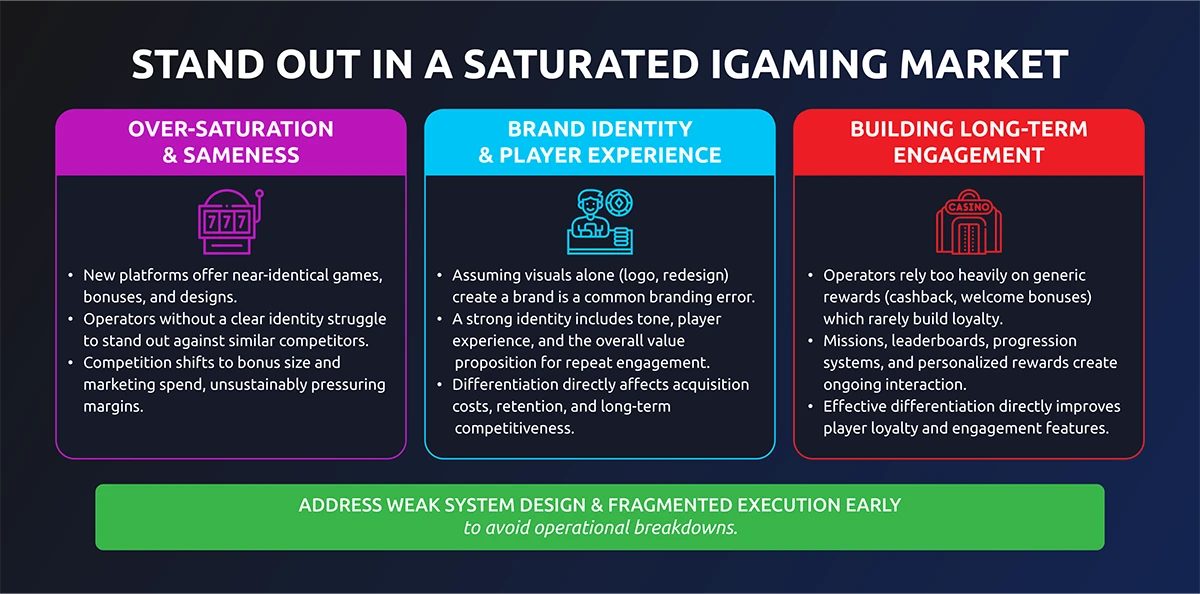
Many operators also rely too heavily on generic rewards. While cashback and welcome bonuses can drive sign-ups, they rarely build long-term engagement. Features like missions, leaderboards, progression systems, and personalized rewards are more effective in creating ongoing interaction.
For operators focused on standing out in online casino markets, differentiation is now a core strategic requirement, not just a branding exercise. It directly affects acquisition costs, retention, and long-term competitiveness.
Across all eight problem areas -registration, churn, payments, fraud, compliance, support, cybersecurity, and branding – the same issue appears: weak system design and fragmented execution. Operators that address these early are better positioned to avoid constant operational breakdowns.
For operators planning expansion or restructuring, LicenseGentlemen can support licensing and compliance setup across key jurisdictions. Book a free consultation to assess your licensing roadmap and reduce friction before scaling.
The 2026 Survival Stack: Tools and Vendors That Actually Solve These Problems
To operate successfully in today’s iGaming environment, operators need a casino security stack built around integration efficiency, scalability, and regulatory flexibility. Modern platforms are no longer evaluated only on game libraries. They are judged on how well they handle real-time data flows, compliance requirements, payments, and fraud prevention across multiple systems.
Whether an operator chooses to buy online casino software as a lean market entry solution or invests in a fully custom multi-market build, survival increasingly depends on adopting the best iGaming tools in 2026 to automate compliance, reduce operational friction, and manage risk at scale. The structure of a casino online software stack now plays a direct role in uptime, conversion rates, and regulatory stability.
Understanding the Foundation: What Is a Casino API?
At the core of modern platforms is the question: What is a casino API?
A casino API is a technical integration layer that enables real-time communication between the casino platform and external services such as game providers, payment processors, and KYC/AML tools. Instead of building each integration separately, APIs allow operators to connect multiple systems through standardized data flows.
Unified API ecosystems—used by providers such as ST8.io, SoftGamings, and Bettoblock—allow operators to access large game libraries and service networks through a single integration. This reduces engineering overhead and helps ensure synchronization between player balances, game sessions, and reporting systems. In practice, this also reduces casino fraud tools 2026 exposure linked to inconsistent data or delayed system updates.
Evaluating Software Models and the “Online Casino Software Price”
When operators evaluate online casino software prices, costs vary significantly depending on deployment strategy, jurisdiction, and scalability requirements.
White-label models offer the fastest route to market. Providers such as Slotegrator typically manage licensing and infrastructure, allowing operators to focus primarily on branding and acquisition.
Turnkey online casino provider solutions, including platforms from NuxGame, Gamingtec, SoftSwiss, and SoftGamings, provide a more complete infrastructure stack. These systems often include payments, back-office tools, reporting modules, and compliance features, offering greater flexibility for scaling and customization than white-label setups.
From a cost perspective, lean builds may start around entry-level budgets, while fully customized multi-market platforms can require significantly higher investment depending on scope. Ongoing operational costs also need to be factored in, particularly for hosting, compliance tooling, and third-party integrations.
Choosing an online casino platform is a long-term strategic decision. Your platform provider will become a core part of your operations for years, affecting everything from payments and compliance to player experience and scalability. Switching platforms later is not a simple technical change – it can create significant disruption, require player migration, and potentially impact retention if the transition is not managed correctly.
At LicenseGentlemen, we have worked with many leading casino platforms on the market and understand the differences between their solutions, strengths, and limitations. Our experience allows us to help operators choose the right platform based on their target markets, business model, and long-term goals. Book a free consultation to discuss which solution fits your needs.
The 2026 Compliance and Security Stack
A modern casino security stack must account for increasingly complex fraud patterns and regulatory expectations. This is where casino compliance vendors and specialized tooling become essential rather than optional.
For identity verification and onboarding, SumSub iGaming solutions are widely used for KYC checks, sanctions screening, and fraud detection. These systems help operators identify synthetic identities and reduce onboarding risk.
To address fraud and promotional abuse, platforms such as The Greco support behavioral monitoring and casino fraud tools in 2026 capabilities, helping identify multi-accounting patterns and suspicious activity clusters before they impact revenue.
On the infrastructure side, providers such as SoftSwiss and Tecpinion often rely on enterprise-grade protection layers, including DDoS mitigation services like Cloudflare, to reduce downtime risk and improve resilience during traffic spikes.
Checklist: How to Compare Casino Solutions and Vendors
Before committing to any vendor or platform, operators typically evaluate several core technical and operational criteria:
- Unified API integration: Does the platform support a single integration layer for multiple providers, such as Slotegrator APIgrator or BGaming connections?
- Testing environment: Is there a stable sandbox with reliable documentation and version control for development?
- Compliance alignment: Does the system support relevant licensing frameworks such as MGA, UKGC, Anjouan or Curaçao LOK requirements?
- Reporting depth: Does the back office provide structured analytics across finance, player behavior, and risk monitoring?
- Scalability: Can the platform handle peak traffic events without latency issues, balance mismatches, or service degradation?
In a competitive environment, selecting the right casino online software is not just a technical decision. It directly influences acquisition efficiency, compliance stability, and long-term scalability.
Real Case Study: The Android Payment Bug That Cost a Casino 50% of Its Players
One widely cited casino payment bug case study in mobile-first iGaming involved a severe revenue drop caused by an unspotted code regression in the payment flow. The issue emerged in the casino’s mobile payment pathway after a deployment broke the deposit interface.
The failure was specific: the “Submit” button stopped registering input on certain Android mobile webviews. Affected users could not complete deposits, and the platform effectively created an “online casino not working” experience for a large segment of traffic.
Desktop and iOS continued to function, which masked the issue. However, Android users represented over half the active base, meaning a major share of players was blocked from depositing.
The impact was immediate. Players unable to fund accounts left and moved to competitors, turning a localized bug into rapid churn.
This is often used as a casino testing case study, showing how gaps in device coverage and QA can trigger system-level revenue loss. It remains a clear example of real iGaming problem-solving scenarios where full cross-device testing is essential to prevent partial failures from scaling into business-critical outages.
In regulated market planning, operators sometimes also consult firms like LicenseGentlemen during final due diligence stages to ensure licensing structures match operational and technical requirements before launch.
LicenseGentlemen is positioned as a partner for securing global iGaming licenses, with a track record of over 500 approved licenses across multiple jurisdictions. Operators can book a free consultation to review licensing options and align compliance requirements with their planned market entry before going live.
Common Operator Mistakes That Make These Problems Worse
A recurring issue across the sector is that many casino operator mistakes are not caused by a lack of tools, but by how those tools are used. One of the most common iGaming mistakes to avoid is failing to monitor real-time performance signals such as payment latency logs, session drops, or failed transaction patterns. When these signals are ignored, underlying technical issues often go unnoticed until they start impacting revenue and pushing players toward competitors.
Another frequent problem comes from overly rigid onboarding systems. Heavy KYC flows, excessive form fields, and outdated verification steps can create unnecessary friction for legitimate users. These online casino pitfalls often reduce conversion rates before a player even reaches gameplay, damaging marketing ROI at the earliest stage of the funnel.
Over-reliance on automation is also a common source of casino management errors. While automated systems can efficiently handle basic support queries, they are often not sufficient for complex issues such as payment disputes or account-related escalations. Without human oversight in critical cases, response quality drops and player trust can erode quickly during high-traffic periods.
Other typical operational weaknesses include inconsistent testing across devices, which can lead to undetected failures on specific mobile environments, and poor localization of payment methods that creates unnecessary friction in key markets. Combined, these issues highlight a broader pattern: technical gaps, weak oversight, and rigid processes tend to amplify each other and increase player churn if not addressed early.
FAQ
Player churn is the biggest challenge in 2026. Casinos lose users when performance issues, payment delays, or weak UX reduce trust. Even strong acquisition cannot offset poor retention, especially in competitive markets where players quickly switch to smoother, more reliable platforms.