
Anjouan White Label Gambling License: All You Need to Know
An Anjouan white label gambling license is a setup where an operator launches under another company’s licensing structure instead of holding its own license. In practice, that usually means using a ready-made platform that may already include the website, games, backend tools, and parts of the wider operating setup.
Within the Comoros gambling license framework, Anjouan supports both direct licenses and white label structures. For that reason, it comes up often in early-stage planning, especially for founders looking for a lighter route to market than building the full legal and technical stack from scratch.
That faster route can be appealing, but it also changes the control structure in a major way. A white label setup may shorten the path to launch, yet it also shifts control over payments, platform operations, and parts of compliance into the hands of the provider rather than the operator.
What Is an Anjouan White Label Gambling License?
In an Anjouan white label license setup, the platform provider holds the license and the operator runs under that structure. The operator is not getting its own license in this model.
What the operator gets instead is access to a framework that is already in place. That may include the casino site, games, backend tools, payment connections, and parts of the risk and compliance setup.
Because of this, white label gets presented as the easier route. A lot of the infrastructure already exists. The founder does not need to build every layer before launch.
Still, that convenience comes with a tradeoff. The casino is being built inside another company’s structure. That means some of the decisions that matter later may not belong to the operator.
KYC is the process of checking a player’s identity. Responsible gaming means the controls used to protect players. CRM is the system used to manage player accounts, communication, and retention.
How the Anjouan White Label Structure Works
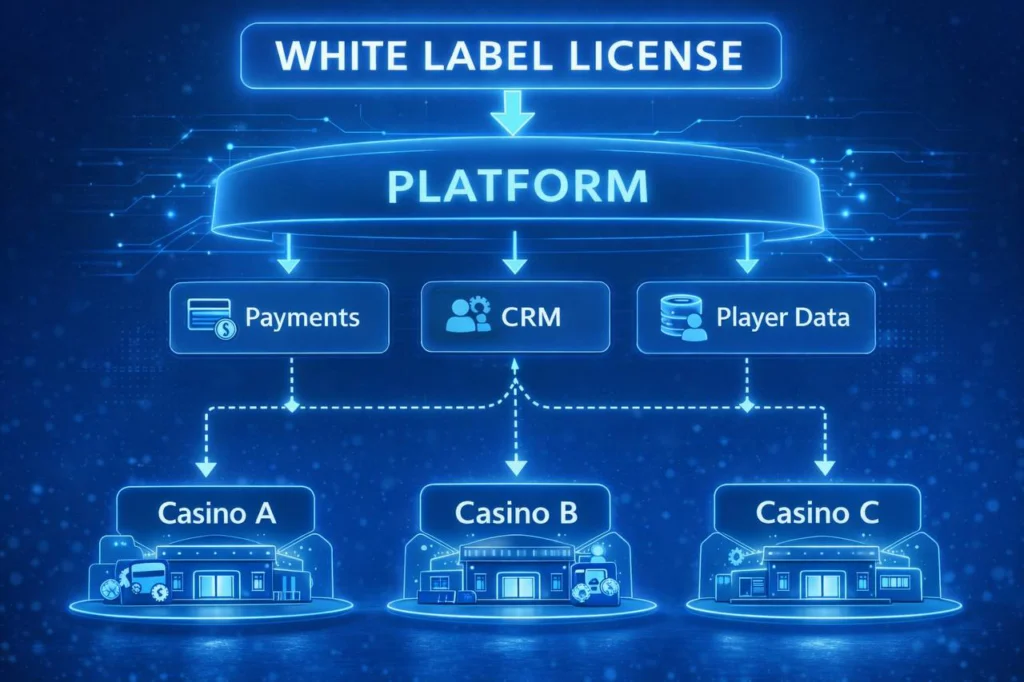
The structure works through the platform’s licensing umbrella:
The platform holds the permissions needed to offer white label services, then places the operator’s domain under its B2C licensing setup. That is what allows the operator to go live without holding the license directly.
From the operator’s side, that can look attractive. A founder may get a ready-made site, games, backend tools, and access to a broader operating stack without sourcing each provider separately.
The commercial logic behind white label is simple. It’s less setup work at the beginning and fewer moving parts at entry.
But a ready-made platform does not mean a frictionless launch. The operator still goes through onboarding, compliance checks, legal preparation, and payment setup. The difference is that these happen inside the platform’s structure, not under the operator’s own license.
Who Actually Holds the Anjouan License in a White Label Model
The platform is the license holder, which shapes the rest of the relationship.
Once the platform carries the licensing risk, it also wants control over the areas that could create trouble for that license. That usually includes payment flow, player balances, and much of the operating framework.
Here is how control usually looks in a white label setup:
|
Asset or function |
Who usually controls it |
|---|---|
|
Brand |
The operator should own the brand |
|
Domain |
The platform, because the domain sits under its license |
|
CRM |
Usually the platform |
|
Player data |
Usually the platform, though some providers may allow more flexibility |
|
Player accounts |
The platform |
|
Wallets and balances |
The platform |
This matters because it affects migration options, payment decisions, player management, and long-term leverage. The brand may be yours, but much of the operational core usually is not.
Operating Model Comparison: White Label vs Own License
The easiest way to see the tradeoff is to compare the two models directly.
|
Area |
White Label |
Own License |
|---|---|---|
|
License holder |
Platform holds the license |
Operator holds the license |
|
Control over payments |
Platform controls payment flow and cash movement |
Operator controls payment setup directly |
|
Control over PSP relationships |
Limited for the operator |
Operator signs and negotiates directly with PSPs |
|
Compliance responsibility |
Split in practice, while the platform protects the license and the operator still bears risk for its own actions |
Operator owns the compliance structure and provider relationships |
|
Operational flexibility |
Limited, packaged, slower to change |
Higher, because the operator controls tools, providers, and workflows |
White label may feel easier at the beginning, but ease at entry is not the same as control during operations. Once deposits, withdrawals, fraud issues, and player complaints start showing up, control becomes much more important.
Instead of comparing jurisdictions, the more relevant comparison here is between two operating models available under the Anjouan framework.
|
Model |
Crypto openness |
Compliance friction |
Bankability / PSP readiness |
|---|---|---|---|
|
Anjouan white label license |
Not clearly defined at operator level because the structure is controlled through the platform |
Lower at entry on paper, but still shaped by onboarding, compliance, and legal setup |
Depends heavily on the platform’s risk controls, player screening, legal structure, and PSP relationships |
|
Own Anjouan license / turnkey |
Not clearly defined here as a white label-style packaged offer |
Higher direct responsibility for the operator because the operator controls the structure itself |
Stronger direct PSP position because the operator signs and manages those relationships itself |
Payment Providers Under an Anjouan White Label License
Now let’s talk about the part that usually causes the biggest frustration: payments.
Under a white label setup, the platform controls the PSP relationships. A PSP is a payment service provider, the company that handles deposits and withdrawals.
Payment performance depends heavily on the target market. A method that works in one region may perform badly in another. Approval rates can drop. Withdrawals can become slower. A provider can stop performing the way the operator needs.
If the operator holds its own license, it usually has more room to negotiate directly, replace providers, or restructure the setup. Under white label, the operator depends on the platform to decide whether the issue gets priority and whether any change will be made at all.
The result is slower reactions and less flexibility. In a business where conversion matters, that can become expensive very quickly.
There is also the margin issue. Operators under white label usually cannot negotiate directly with PSPs. That often means higher payment costs than a business operating under its own licensing structure.
Payment providers evaluate not only the license itself but the overall compliance posture of the operating structure, including player screening, risk controls, and legal accountability.
The bigger issue goes beyond the license itself. PSPs do not judge a casino only by whether it is licensed. They also look at the quality of the wider structure around it. They care about player screening, risk controls, legal terms, complaint handling, and whether the operating setup looks stable enough to protect the payment channel.
Consequently, PSP acceptance tends to follow compliance posture and jurisdiction integrity. In a white label model, those foundations usually sit with the platform. If the platform is weak, slow, or too rigid, the operator still suffers the commercial damage.
Case callout: payment provider limitations under white label
[CASE PROVIDED BY CLIENT]
Many operators go in believing they can rely on the platform’s payment setup because that is how the offer is often presented. Sales teams may say the platform already has the right payment providers for the target markets. Once operations begin, the reality can look very different. Operators may find that the strongest PSPs for their market are not integrated at all, or that they need a payment gateway and payment cascading to improve conversion. That creates more work, and in practice that work often falls back on the operator. Asking a white-label platform to add the right PSPs or fix payment issues can take months, and in some cases it may not happen at all.
Rolling reserve risks
A rolling reserve is money held back to cover financial exposure.
This exists because the platform may need to step in if a player wins a large amount and the operator does not or cannot pay. To protect itself and the license, the platform holds reserve.
As operator volume grows, reserve requirements can grow too. If the platform decides the reserve is no longer enough for the level of risk involved, it can raise the requirement or stop the operation.
Typical Launch Timeline for an Anjouan White Label Casino
White label is often sold as the faster route to launch.
You can see why. The site may already exist in template form. The games may already be integrated. The licensing structure is already in place at platform level.
The reality is less tidy.
The operator still needs onboarding, identity checks, legal preparation, payment readiness, and platform-side coordination. So no, white label does not mean skipping the hard parts. It means going through them inside someone else’s structure.
Launch timelines can then stretch further than founders expect.
Common Operational Limitations of White Label Casinos
The weaknesses of the structure become harder to ignore at this stage.
The first limitation is dependency. The operator is using another company’s system, license, and payment relationships. Major issues often turn into coordination issues before they turn into solutions.
The second limitation is payment flexibility. If a market needs a new PSP, better routing, or a different payout structure, the operator may not be able to move fast enough.
The third limitation is compliance infrastructure. Some setups leave parts of KYC, reporting, or responsible gaming with the operator. Others pull more of those functions under platform control. Either way, the operator does not have the same level of freedom as a business that holds its own license.
The fourth limitation is the product stack itself. Online casino white label systems are packaged. Operators work with what is already built. Some providers may offer access to CRM or data, but that does not always mean full freedom to create custom workflows or reporting views.
Then there is response time. Payment delays, poor approval rates, fraud flags, and backend friction all need fast action. A white label platform is managing multiple clients at once, so the operator rarely gets the speed of response it would have inside its own structure.
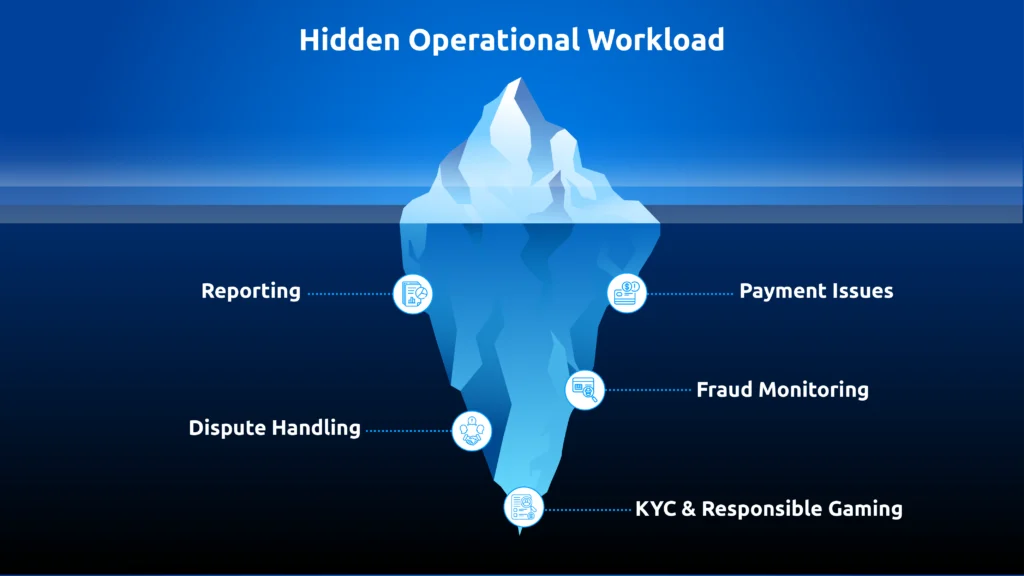
Hidden Operational Workload
White label can look light from the outside. The workload does not disappear. It just changes shape. Even under a white label structure, the operator still carries day-to-day operational responsibilities.
These can include:
- reporting cadence to the platform
- payment issue coordination
- fraud monitoring
- dispute handling
- KYC and responsible gaming support
Many founders underestimate this part. An Anjouan white label casino may reduce the amount of infrastructure the operator has to build, but it does not remove the operating burden needed to keep the business stable.
Case callout: rolling reserve pressure after growth
[CASE PROVIDED BY CLIENT]
I met an entrepreneur several months ago who was running a white-label online casino. When I asked about his experience, he told me they were about to shut down operations because they had already lost €400,000.
Naturally, I asked what went wrong.
He explained that the platform provider who sold them the white-label solution made everything look simple and inexpensive. But once they entered the market, the reality was very different. New fees kept appearing from different departments, costs they had never been warned about. What initially seemed like an affordable solution quickly turned into a system where they were being milked from every direction.
On top of that, they had no control over their data. They were spending money on traffic acquisition but had no real ownership of the players they were bringing in. Without access to player data, they could not leverage it, build long-term value, or even retain those players independently. Rolling reserve fees skyrocketed from €25,000 to €80,000 in a matter of two weeks.
In the end, they were funding growth for someone else’s platform rather than building their own business.
Eventually, they decided to stop and start again from scratch, but with a different approach.
When the Anjouan White Label Model Makes Sense
So when does white label actually make sense?
It can make sense, but in a narrower set of cases than many founders assume.
The strongest fit is a business closely tied to offline cash collection. In that kind of setup, agents collect money in cash and then top up player accounts through the system. That reduces dependence on external payment providers and changes the pressure around PSP access and payment flexibility.
If the business is built around scalable online traffic, affiliate growth, performance marketing, and fast commercial optimization, the weaknesses of white label become harder to ignore. Limited control over payments, reserves, risk handling, and data can slow growth and weaken margins.
Checklist: when white label may make sense
White label may fit if most of these points sound like your business:
- your business is tied closely to offline cash collection
- you do not need direct control over PSP relationships
- you can work within a platform’s existing payment stack
- you accept that key assets like wallets and player accounts will sit with the platform
- you are prioritizing entry speed over long-term control
- you can operate inside a packaged product and compliance structure
- you are not relying on fast custom changes to payments, CRM, or backend tools
If that does not sound like your model, white label is usually much harder to justify as a long-term solution.
A 5-point decision framework for founders and investors
Before shortlisting a jurisdiction or launch model, these five questions help cut through the sales pitch:
|
Criterion |
What to check |
|---|---|
|
Payment control |
Can you choose, replace, and negotiate PSPs when conversion drops? |
|
Data and CRM control |
Will you have enough control over player data and player management tools to scale or migrate later? |
|
Compliance execution |
Who handles KYC, reporting, and responsible gaming, and who takes the hit if something fails? |
|
Reserve and risk tolerance |
Can the business absorb rolling reserve requirements and sudden platform intervention? |
|
Growth model |
Are you building around offline cash collection or around scalable online traffic? |
Cost Structure of an Anjouan White Label Setup
Many first-time buyers read the deal too narrowly at the start.
The entry price may look lighter. That is one reason white label gets attention so quickly. A direct-license or turnkey route can look heavier upfront, while the white label path feels easier to step into.
But the wider cost structure tells a more complete story.
In practice, the cost stack can include platform fees, commissions or revenue share, higher payment processing costs, rolling reserve requirements, account management, accounting support, risk management support, and compliance-related overhead.
So yes, the first number may look easier. That does not mean the structure is more efficient once the business is moving.
Why Some Operators Eventually Move from White Label to Their Own License
At the beginning, many operators are trying to solve one problem: how to get to market.
Once the casino is live, the priorities start changing. Payment routing matters more, along with direct PSP access, data ownership, faster issue resolution, and stronger control over compliance and risk.
At that point, the own-license route starts making more sense.
A business that holds its own license is in a stronger position when negotiating with PSPs, choosing tools, shaping its compliance structure, and managing risk directly. That does not make the path easier. It makes it more controllable.
Final Verdict
An Anjouan white label gambling license can work, but it works best in a narrow model where the business is closely tied to offline cash collection and does not depend heavily on direct PSP control or fast backend change.
That is the dividing line.
If the goal is a controlled entry point inside a limited setup, white label may be enough. If the goal is long-term scale, stronger margins, direct PSP relationships, and more operational ownership, then moving toward your own license usually becomes the better path.
F.A.Q. (Frequently Asked Questions)
It is a setup where an operator runs an online casino under a platform’s license instead of holding its own license. The platform provides the legal structure and usually part of the wider operating stack.